
An engineering customisation request rarely lands as a purely mechanical brief. Change the housing, the lens stack, the radio module, the battery cell, the firmware feature set, or the on-device claims, and you have changed the product configuration. A changed configuration is the trigger for a changed compliance file. That is the plain fact at the centre of this article, and it is the reason the certification impact of an engineering customisation is decided at the requirements gate rather than discovered at the end of the programme.
Most of the confusion in this area comes from a category error. Buyers tend to think of "certification" as a badge that a factory either has or does not have, attached to the brand rather than to the article. In a genuine OEM/ODM programme the compliance file is not a badge. It is a set of documents, each of which names a specific model string, and each of which exists because somebody decided that a configuration was going to ship. If you change the configuration after the file is closed, you have not added a small task to the schedule. You have invalidated part of the evidence chain that was built around a particular article.
Our catalogue currently covers 28 models, and that catalogue is deliberately kept as a configuration reference rather than a certification reference. Certification status per model is not published here, and the absence is meaningful rather than an oversight. Until a buyer freezes a requirement, fixes a market, and defines a model string, the honest answer to "does this SKU hold CE, FCC, RoHS, RED or EN 18031?" is that nobody can say. The question does not have an answer yet, because the thing being asked about has not been specified.
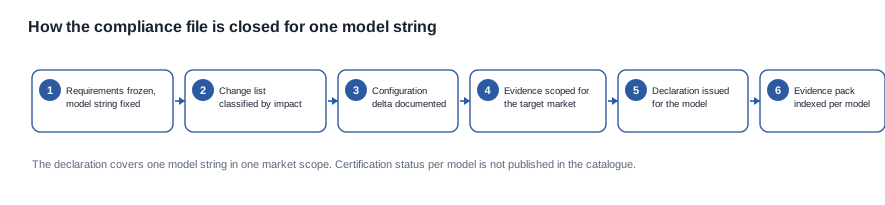
The framework that makes this manageable is the development gate sequence used across our programmes: requirements frozen, feasibility reviewed, engineering and tooling, samples built and verified, compliance file closed, and a pilot run before mass production. A stage is finished when it produces a document, not when a date arrives. The compliance file is one of those documents. It exists because a gate closed, and it exists for one model string. That single design choice is what makes the certification impact of a customisation predictable instead of alarming.
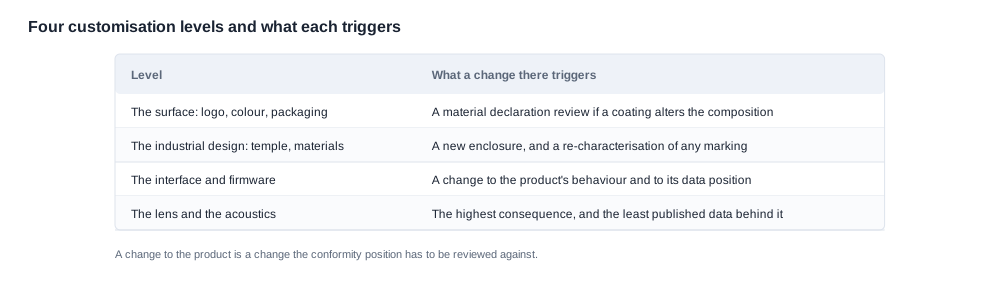
Engineering customization: which changes touch the compliance file
The useful way to think about this is to separate changes that alter the model string from changes that alter the product configuration, and to notice that both can ripple into the declaration.
A model string is the identifier that will appear on the declaration of conformity, on the product label, on the packaging artwork, on the purchase order, and on the shipping paperwork. It is the key that links the physical article in the carton to the documents in the file. The moment a customisation changes the identity of the article — a new shell colour with a different commercial positioning, a different logo treatment, a different model code because the brand wants to run the product as a separate line, a region-specific variant — the model string changes, and with it the string that must appear on the declaration.
A configuration change is subtler and more common. The visible industrial design can look identical while the electrical or firmware content changes. Swapping a battery cell for a different capacity or a different cell chemistry changes the charge profile and the thermal envelope. Swapping the radio path changes the frequency behaviour. Enabling a camera function that the standard article does not carry changes the optical stack and the data handling characteristics. Adding a sensor, changing the microphone array count, changing the display panel supplier, or altering the firmware behaviour all sit in the same category: the article looks the same on the shelf but is not the same product underneath.
We will be direct about the practical consequence. If a change can plausibly alter the electromagnetic behaviour, the optical path, the power characteristics, the radio functionality, or the safety-relevant behaviour of the article, then the compliance file has to be examined for that change. The supplier's engineering team will tell you which specific reports are affected, but only after the configuration delta is documented. Buyers who arrive expecting a same-day answer to a certification question usually arrive without a written requirement, and a written requirement is the only thing that makes the question answerable.
The practical way to work this is to classify every requested change into one of three buckets before the requirement document is signed. The first bucket is the identity bucket, containing anything that changes how the article is named, labelled, listed or ordered. The second bucket is the technical bucket, containing anything that changes what the article electrically, optically, radiatively or thermally does. The third bucket is the commercial bucket, containing packaging, artwork, insert cards, regional labelling content and the permitted claim set.
Identity changes and technical changes both feed the declaration. Commercial changes feed the label and the artwork, which the declaration and the file normally reference. A request in the third bucket can therefore still force a conversation with the engineering team, which surprises buyers who assumed packaging was a purely creative line.
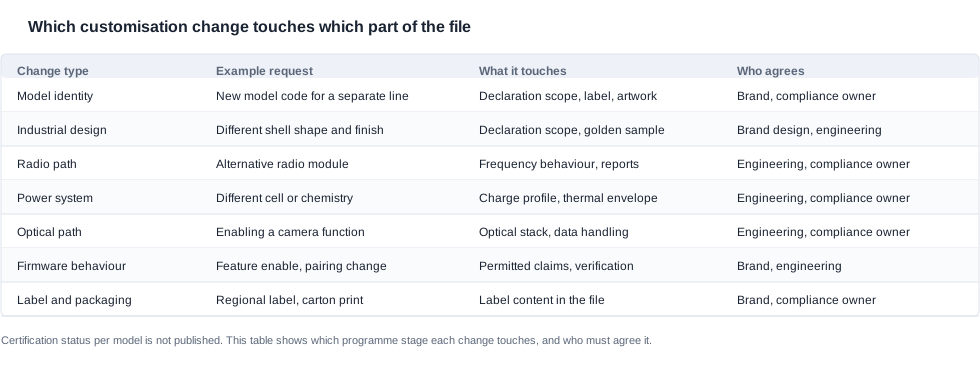
Here is how the classification typically plays out in practice:
| Change type | Example request | What it touches | Who must agree |
|---|---|---|---|
| Model identity | New model code for a separate product line | Declaration scope, label, artwork, paperwork | Brand, compliance owner, supplier |
| Industrial design | Different shell shape and surface finish | Declaration scope if it alters the article, golden sample | Brand design, supplier engineering |
| Radio path | Alternative Bluetooth or radio module | Frequency behaviour, reports behind the file | Supplier engineering, compliance owner |
| Power system | Different cell capacity or chemistry | Charge profile, thermal envelope, reports | Supplier engineering, compliance owner |
| Optical path | Enabling a camera function | Optical stack, data handling, reports | Supplier engineering, compliance owner |
| Firmware behaviour | Feature enable, pairing change, UI logic | Permitted claim set, golden sample verification | Brand, supplier engineering |
| Label and packaging | Regional label layout, insert card, carton print | Label content referenced by the file | Brand, supplier compliance owner |
The table is not a legal instrument, but it is the working agenda for a requirements conversation. Notice that the last row is the one most often underestimated. Packaging and artwork are frequently treated as a design deliverable that happens at the end, but the label is the point at which a model string, a permitted claim and a market-specific requirement all become physical. Once cartons are printed, a mistake in any of the three is a reprint, not an edit.

What a declaration has to cover
A declaration of conformity is a specific instrument, and it is narrower than most buyers assume. It covers an identified article, against named standards, in a named market, at a stated date. Three things must line up for it to be useful to you.
First, the declaration must name the exact model string that will ship. This is the point where family-level declarations break down. A supplier may hold a declaration that covers a family, a series, or a product group, and that document can be perfectly valid for the products inside its declared scope. The moment you commission a custom variant, your SKU sits outside that scope. The family declaration remains true for the standard articles and says nothing at all about yours. This is not a loophole and it is not the supplier withholding something; it is the intended behaviour of the instrument. A declaration that covers a product family rather than a model is not a declaration for your SKU.
There is a second-order problem here that buyers rarely anticipate. A family declaration covering a standard article does not transfer to a custom article even when the custom article is technically near-identical, because the declaration is written against a specific assessed configuration including the model designation on the sample. The safe assumption is that a custom SKU needs its own document, and the useful question is not whether that can be avoided but how quickly the file can be scoped and closed.
Second, the declaration is a summary that sits on top of a body of evidence. The reports behind it — the underlying test records for the specific configuration that was submitted — are what actually carry the technical weight. When a buyer asks for "the certificate", what is wanted is the declaration plus the reports it rests upon, plus the scope statement that shows which variant the reports were performed on. A declaration without its supporting reports tells you that somebody signed something, not what was tested.
Third, the declaration is market-scoped. The requirements that apply are not a single global set. A product placed on the European market, on the North American market, or on other markets is assessed against the requirements that apply in each of those places, and the applicable requirements are part of the file. A declaration that is correct for one market does not transfer automatically to another.
The claim set is the fourth element and it is the one most often lost. If your customisation adds a function, the marketing material must be allowed to say so, and if your customisation removes a function, the marketing material must not still claim it. A claim added late in the programme is a compliance problem, not a copy problem. Copy can be rewritten in an afternoon. A claim that the technical file does not support means either the hardware must change or the claim must be withdrawn, and both of those cost schedule. This is exactly why the requirement gate has to fix, in writing, which claims the product is allowed to make — because at that point the supplier can still design the product to support them, and after that point the only way to support a new claim is to reopen work.
We will put it plainly: the permitted claim set belongs in the frozen requirement, in the same document as the target market, the models in scope, the configuration, the packaging and the delivery documentation. It is not a marketing annex and it is not a decision that can be deferred to whoever writes the landing page. A requirement document that names markets, configuration and packaging but leaves the claims open is a requirement document that will reopen the compliance file later, because the file is built to support claims, not to anticipate them.
There is a related discipline about the claim set: what is permitted is not the same as what is proven. A claim can be commercially attractive and still be outside what the file supports. The supplier can tell you which claims the engineering can substantiate for a given configuration, and that conversation is far more useful when the requirement document already names the claims you would like to make.

Where certification status actually sits
It is tempting to treat certification as a fixed attribute of a factory, something you inherit by choosing the right partner. That framing produces two wrong conclusions: it makes buyers over-trust a supplier that has a strong general file, and it makes buyers assume that a supplier without a prominent file is disqualified.
Neither holds. Certification status is a property of a specific article, in a specific configuration, for a specific market, at a specific point in time. It lives in the compliance file, not in the relationship.
The catalogue is a good illustration of why this is stated plainly rather than argued. Across the 28 models, the catalogue records configuration details in a granular way — 8 audio models, 3 sport models, 11 camera models, 3 kids models and 3 models without a model number. Bluetooth version is published for 14 models and left unstated for the 11 camera models together with A05, A06 and the bone conduction line. A remote control shutter is documented only on D17 and ZH12. An IP54 rating appears on V06 and S7 only. Those are the kinds of facts a catalogue can hold, because they describe the product. CE, FCC, RoHS, RED and EN 18031 appear zero times in the catalogue body. The certificate export page is an image page showing 10 patent certificates — 8 design patents and 2 utility models — with no per-model certification rows.
So what does "not published" mean here? It means the supplier's product documentation is scoped to configuration and application, and the compliance file for any specific model is assembled as part of a project rather than displayed as a standing attribute. It is the correct behaviour for a manufacturer whose customisations differ per programme: a static certification table would become false the moment the first custom article shipped. Buyers should read the absence as a signal that the file is project-scoped, and should therefore request it as a project deliverable, with a named model string, instead of asking for it as a catalog item.
We will also make explicit what is not being claimed in this article. Nothing here asserts that any particular model holds any particular approval. The catalogue does not publish certification status per model, the certificate export page contains patents rather than per-model approvals, and this article therefore describes document structure, buyer obligations and review method only. If a reader needs the status of a specific SKU, the route is a project-specific file request against a named model string, not a catalogue lookup.
That framing also settles the question of what the supplier is actually obliged to give you and when. The declaration and its supporting reports are the output of the compliance gate — the stage in which the compliance file is closed. Before that gate, the honest state is that the file is being prepared against a frozen requirement. After that gate, the file covers a named model, with a defined scope, and can be handed over as part of the evidence pack.
The evidence pack is the durable form of this. For each model string a programme produces, keep an index of the declaration, the underlying reports, the scope statement, the approved label and artwork, the golden sample verification record and the approved claim set. Keep it indexed by model string, because that is the key everything else uses. When a channel partner asks six months later for the paperwork behind a unit they bought, a programme with a maintained pack answers in a day, and a programme without one spends a week reconstructing what was decided.
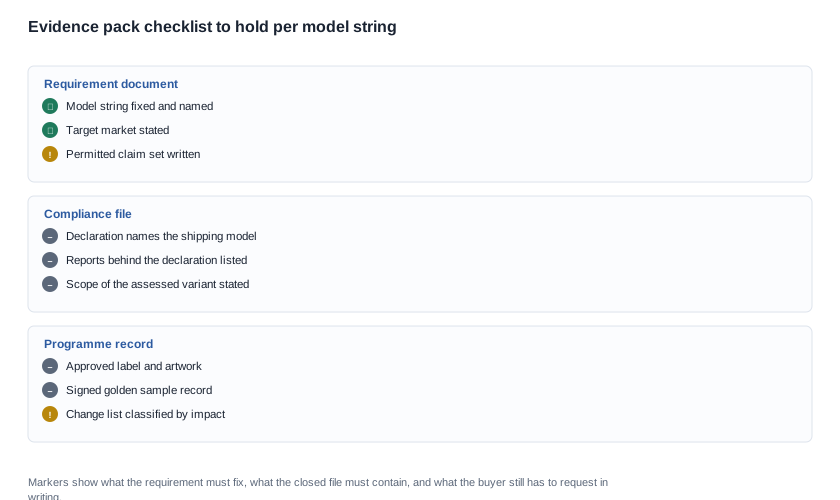

Questions to ask about certification evidence
The practical value of this article is a set of questions that produce specific, checkable answers. Ask them at the requirements gate, in writing, and attach the answers to the requirement document. Every one of them converts a later surprise into an early clarification.
- What exact model string will appear on the declaration of conformity for our SKU? A name, a number, or a code pattern agreed with us, not a family name. If the answer is a family, push until you get the string.
- Which market does this file cover, and which requirements apply in that market? Confirm the market list you expect to ship into and ask for the file to state the applicable requirements.
- Which reports sit behind the declaration, and were they performed on our configuration? Ask for the report list and the configuration they cover, not only the summary document.
- Does our customisation change any technical content of the submitted configuration? Give the supplier the change list and ask them to state, per item, whether the file is affected. This is the highest-value question in the set.
- Which claims is the product permitted to make, and are they recorded in the frozen requirement? Get the permitted claim set written into the requirement document before anyone writes packaging copy.
- When is the compliance file closed, and what do we receive at that point? Agree the exact deliverable set and the timing relative to the pilot order.
- What happens to the file if the configuration changes after closure? Establish the re-open procedure and who triggers it.
- Can we hold a per-model evidence pack in our own files? Ask for the declaration, the reports, the label artwork approval record and the golden sample record, indexed by model string.
We will keep one practical rule in mind throughout: the model string is the spine of the compliance file. Everything else — the reports, the label content, the packaging artwork, the purchase order line, the shipping paperwork — hangs off it. A programme where the model string is still being negotiated while the artwork is already in print is a programme with a compliance problem waiting for it.
Three negotiation habits make this work in practice. First, ask for the change list as a written table, with one row per requested change and one column for the compliance impact, and require the supplier to fill that column in writing. A verbal assurance that a change is "not a big deal for compliance" is worth nothing at a later review; a written column is worth a lot. Second, tie the model string to the purchase order and the artwork approval in the same document, so that there is exactly one version of the name in circulation. Third, treat the evidence pack as a deliverable with an owner, not as something the supplier will send when asked. Documents without an owner are the ones that turn up late.
Buyers in the channel position should add one more question of their own: does the supplier already hold a file for the nearest standard article, and how much of it can be reused for the custom SKU? The answer is generally "some of it", and knowing the boundary up front is what allows a buyer to plan the compliance work rather than discover it.
For the wider picture of what an engineering customisation can cover, and how it maps onto a development sequence, the pillar page on engineering customization is the natural place to continue. If you want the option set before you talk to a supplier, read the overview of customization options. If you want to know what documentation should exist at each stage, the piece on development process documentation sets out the expected records. And for the practical menu of what can be changed on a smart glasses platform, see what can be customized.


