

Most customisation programmes do not fail because the factory cannot build what was asked. They fail because what was asked was never written down, and every party remembered it differently. The gap is not technical. It is that a requirements gate is treated as a milestone rather than as a document, so the programme leaves it with a verbal agreement that nobody can point to.
This checklist exists to close that gap. It is a line-by-line list of what a brand-side buyer should have decided before the requirements gate closes, written for procurement managers and engineering leads who intend to run a customisation programme rather than place a stock order. Every line is framed so that the answer is a written statement attached to the requirement document, not a decision carried in someone's head.
The framework behind the checklist is the same one used across the OEM and ODM programme models: requirements frozen, feasibility reviewed, engineering and tooling, samples built and verified, compliance file closed, pilot run before mass production. The checklist covers the first gate in detail, because the second gate is only meaningful when the first one produced something specific. A stage is finished when it produces a document, not when a date arrives.
If you want the wider commercial context before you start filling in the form, read the customisation options overview at /blog/customization-options-overview and the standard OEM tooling requirements at /blog/standard-oem-tooling-requirements. For the detailed item-level checklist that sits at the foundation of this document, see /blog/smart-glasses-oem-requirements-checklist. The programme overview sits at /oem-odm/customization and the framework reference at /oem-odm/engineering-customization.
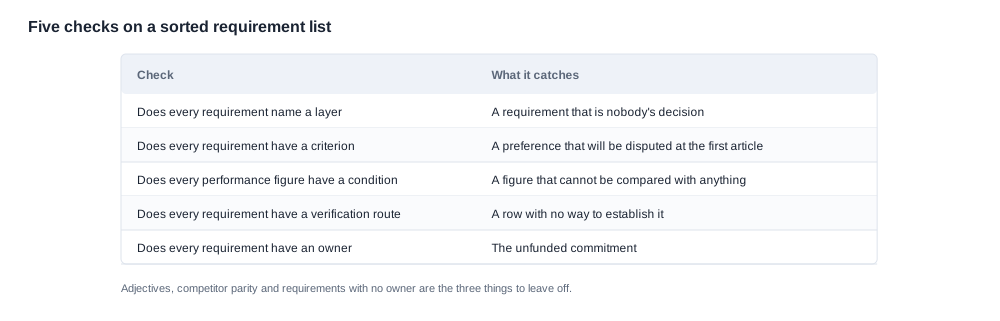
Engineering customization checklist before the gate closes
Work through the list in order. The order is not cosmetic: each group depends on the previous one being settled, and the last group is the one that most often gets skipped.
- Target market and destination documentation. Name every country where the product will be sold, and for each one state which documentation the destination requires, who holds that documentation, and whether it is held by the brand, the factory or a third-party laboratory. Also state the language of the mandatory labelling and the language of the optional packaging copy.
- Model scope and configuration. List the exact model identifiers in the programme, and for each one the configuration: the colour, the memory and radio configuration, the bundled accessories, the packaging variant, and the software baseline. State whether the programme covers one model or a family, because a document covering a family is not a document covering your SKU.
- Packaging and what ships in the box. Define the box, the insert, the printed artwork source, the accessory count, the language set on the box, the barcode and serial format, and what is present in the box that is not present in the factory unit. Say explicitly whether the charging cable, the case, the temple tips or the pouch are included.
- Branding and marking rules. State where the brand mark appears on the product and on the packaging, the rules for laser marking on the device, the minimum size of any printed text on the housing, and which markings must not be altered. If the brand supplies artwork, state the file format and who signs off on it.
- Bluetooth device name. State the exact device name the product presents during pairing, and confirm that this string and the model identifier on the declaration of conformity are related in a way that the documentation can express. Explain why this matters: the declaration of conformity covers an exact model string, and a marketing name that does not map cleanly onto that string creates a traceability problem at every gate after this one.
- Firmware and application behaviour. List every behaviour change in the release, separate configuration changes from engineering work, and state what is explicitly out of scope for this generation. Attach the interface document, the copy deck and the screen list as named revisions.
- Allowed claims. State which product claims are permitted and which are not. Claims that touch radio, safety, water resistance, battery endurance or regional compliance must be traceable to evidence that the compliance file can carry for the shipping model string.
- Verification plan. Define what will be checked, on what hardware, in what environment, by whom, and how the result is recorded. Name the people or the party who may sign off.
- Golden sample definition. State what the golden sample is: the configuration, the firmware build identifier, the packaging, the accessories and the marking it carries, and how it is identified and stored.
- Tooling ownership and cost on project stop. State who owns the tooling, who pays for it, what happens to the tooling cost if the programme is cancelled after tooling is committed, and what the brand receives at that point.
- Sample quantities. State how many samples are needed and why: engineering samples, verification samples, the golden sample, spares, and the number required for the pilot run inspection.
- Inspection criteria and the pilot run. Define the acceptance criteria applied to pilot run units inspected against the golden sample, and state who performs the inspection and where.
- Document set retained at every gate. Attach the document list that must exist at each of the six gates, and agree where each document is stored and who may change it.
- Commercial frame. Record the quotation basis, the MOQ, the lead time, the incoterms, the packaging and spares plan, the warranty position, and the pilot order structure as the points to be negotiated. Treat these as items to be asked and settled in the agreement, not as numbers carried over from a previous programme.
- Publication boundary. State which figures are not published by the supplier and must be requested directly, and which product facts the brand is permitted to repeat in its own marketing.
That last line matters more than it looks. A supplier may deliberately keep certain figures unpublished — capacity, stage durations, cost, certification status per model — while publishing everything else in detail. That is a legitimate editorial position, and it is not a reason to stop asking. It is a reason to ask the right question and get the answer as a document attached to the programme. We will flag which items on this checklist are typically unpublished so you can go into the first supplier conversation already knowing where the gaps are.

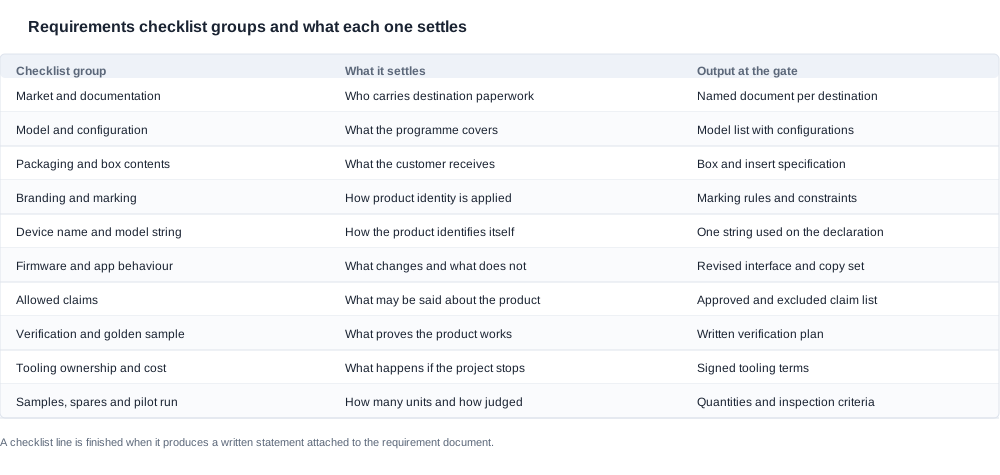
What each line of the checklist has to settle
A checklist is only useful if each line has a defined output. Here is what each group above is actually settling, and what a weak answer looks like compared to a strong one.
Market and documentation. The decision to settle is whether the brand or the factory carries the burden of destination-specific paperwork, and what evidence will exist at the compliance gate for each destination. A weak answer says the product "will be sold in Europe". A strong answer names each destination, the documentation that must exist for it, and the party that holds it. This is also where certification evidence enters the programme: not as a claim to be made, but as a document to be produced, matched to the model string that ships.
Model and configuration scope. The decision is what the programme is about. A weak answer says "the same as our current product with some changes". A strong answer lists model identifiers with their configurations, and states the software baseline. This protects the buyer later: an undisclosed configuration change between the sample and the pilot run is a common source of dispute.
Packaging and box contents. The decision is what the customer actually receives. A weak answer attaches a photograph. A strong answer describes the insert structure, the accessory count, the languages on the box, and the serial format. Packaging also carries regulatory marking obligations, so it cannot be closed later than the rest of the document set.
Branding and marking. The decision is how the identity of the product is applied and what the factory is permitted to change. Marking rules are physical: laser marking on a housing leaves no room for a large logo, and this is where an unrealistic brand expectation surfaces. It is much cheaper to discover that trade-off before the tooling is committed than after.
Device name and model string. The decision is how the product identifies itself to a customer and how that identity connects to the paperwork. This is a small line on the form and a large one in the compliance file. A declaration of conformity covering a product family is not a declaration for your SKU, so the exact string that ships has to be the string the document names, and the pairing name has to be consistent with it.
Firmware and application behaviour. The decision is what changes and what does not. A weak answer is a feature list. A strong answer separates configuration from engineering work, attaches the interface and copy documents under revision numbers, and lists the exclusions. Exclusions are what keep the release stable.
Allowed claims. The decision is what the product may be said to do. This line is deliberately restrictive. A claim that cannot be traced to evidence covering the shipping model string should not be printed, and the requirement document is where that prohibition gets set in writing rather than discovered at artwork approval.
Verification and the golden sample. The decision is what proves the product works, and what the reference unit is. The golden sample is the physical reference that all later units are compared against, and it must be identified by configuration, firmware build and marking. Without a signed golden sample, inspection at the pilot run becomes opinion, and the pilot run becomes a dispute instead of a gate.
Tooling ownership and cost. The decision is what happens to the hardest-to-reverse asset in the programme. Tooling is the least reversible step, so the agreement about tooling cost if the project stops must be signed before the tooling is committed. A buyer who reaches that point without the clause in place negotiates it without leverage.
Samples, spares and the pilot run. The decision is how many units are needed for each purpose and how many are kept. Engineering samples, verification samples, the golden sample, spares and pilot run units have different counts and different acceptance rules, and they should be requested as separate lines.
Document retention. The decision is where the programme's memory lives. At every gate a document is produced, and if it is not filed in one agreed place it will be lost, and the next stage will start from a conversation again. This is the least glamorous line on the checklist and the one that most reliably prevents a stalled programme.
Commercial frame. The decision is what the agreement covers commercially. Quotation, MOQ, lead time, incoterms, packaging quantities, spares, warranty and the pilot order are all items to settle in the purchase order rather than to assume from a previous relationship. We will keep the numbers out of a public checklist and put them into the negotiation, where they belong.

Where a customisation programme usually stalls
The stalls are rarely in the workshop. They are in the handover between stages, and they repeat because the cause is structural rather than personal. Knowing the six common ones lets you spot them early, because each has a visible symptom long before it becomes a delay.
The requirements gate closes by conversation. Symptom: the buyer and the factory both believe a requirement was agreed, but neither can produce a document. The fix is not more discussion; it is refusing to open the next stage until a written requirement document exists with target market, models in scope, configuration, packaging, delivery documentation and allowed claims in it. A stage ends when it produces a document.
Scope grows after the golden sample is signed. Symptom: new requests arrive after the sample is approved, and each one is small. The fix is the exclusions list on the checklist. If a behaviour was excluded in writing, a later request is a change to the programme with a cost attached, not an item that was always meant to be there.
Buyer-owned inputs arrive late. Symptom: firmware work is ready but there is no backend, no test account, no final copy, so the build cannot be verified. Credentials, accounts, endpoint documentation, server-side behaviour and the store distribution arrangement are inputs the buyer supplies. We will say plainly that a schedule built on factory-side work alone is a schedule that ignores half the critical path.
Tooling is committed without a stop clause. Symptom: the programme is cancelled after tooling is complete and the conversation about tooling cost becomes adversarial. Tooling is the least reversible step in the programme, which is exactly why the ownership and cost-on-stop terms belong in writing before the tooling is committed, not after.
The device name and the model string drift apart. Symptom: the product is presented to customers under one name while the declaration of conformity names another, and nobody can produce the mapping. This surfaces at the compliance gate, which is the worst place to discover it, because the gate is closing and the packaging artwork is already at the printer.
The pilot run is a formality. Symptom: pilot units are produced and then inspected informally, so the gate passes or fails on impressions. A pilot run belongs on production tooling at production volume, inspected against the golden sample against written criteria, with a recorded result. If the acceptance criteria were never written, the pilot run cannot fail, which means it proves nothing.
A seventh pattern is worth naming because it is common in catalogues rather than in programmes. A product range may publish some specifications clearly and leave others absent, and a brand that treats every missing figure as a problem to fix will argue about things that were never meant to be published. Take our own catalogue as the illustration: across 28 models spanning audio, sport, camera, kids and unnumbered variants, the Bluetooth version is published for 14 of them and is simply absent for the 11 camera models and for the A05, A06 and bone-conduction entries. A water-resistance figure appears on only two models. A remote-control shutter appears on only two. That is a publication boundary, not an inconsistency, and the correct response is to ask the supplier for the missing figure for the specific model you are buying rather than to assume the missing models are different products.
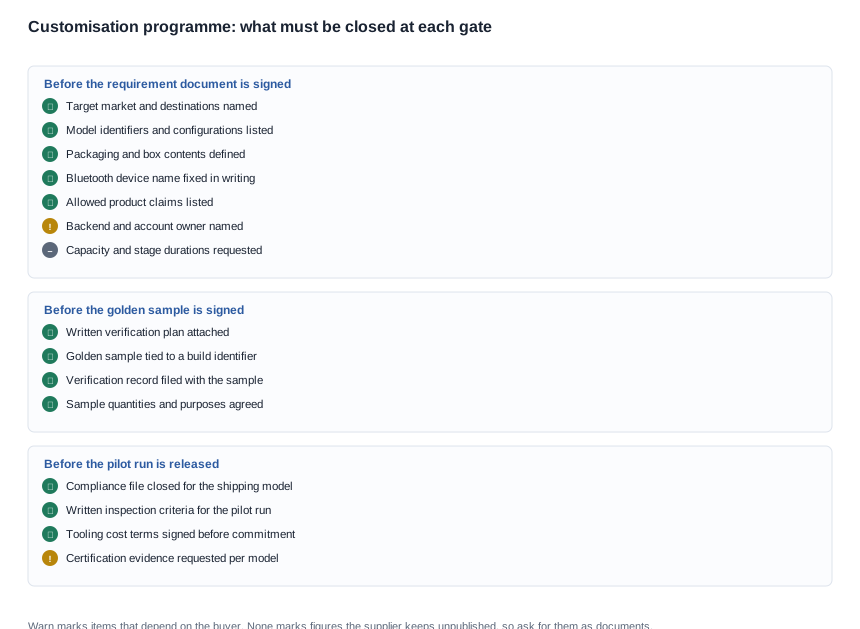
The same logic applies to compliance information. Our catalogue body does not carry certification status per model, so a brand should not read anything into the absence of a mark on a page. The correct move is to request certification evidence for the exact model string that will ship, and to treat a document covering a product family as insufficient for your SKU. Asking for that evidence is a normal part of the programme, not a favour, and we will treat it that way when the request reaches us.

Questions to ask about a customisation programme
Use these as the supplier-facing version of the checklist, and treat them as the what to ask the supplier list rather than as an interview. The answers should arrive as documents attached to the programme, and any item answered in prose should be converted into a written line before the requirement document is signed.
- Can you show us a requirement document from a comparable customisation programme, and what does it contain?
- What must the buyer decide and supply before the requirement document can be frozen?
- Which parts of our request are configuration changes, and which require new firmware engineering?
- How do you confirm that a firmware build matches the frozen requirement rather than a verbal instruction?
- What exactly does the golden sample for our programme consist of, and how is it identified and stored?
- What is the document set you expect at each of the six gates, and where is each one filed?
- Which figures do you publish for your products, and which are not published? Please give the answer as a list so we know in advance what we will have to ask for.
- What is your position on tooling ownership, tooling cost if the programme stops, and what we receive if it stops after tooling is committed?
- What does a pilot run consist of in your process — tooling, volume, inspection method — and what criteria does the inspection use?
- How many samples of each type do you recommend, and what is the sample cost and the payment terms for them?
- What are the packaging options, and which of the box contents are standard, optional or unavailable?
- How do you handle branding and laser marking on the housing, and what are the practical constraints?
- What certification evidence can you provide for the exact model string that will ship, and for which destination markets?
- What is the warranty position on the product, and what is the mechanism for handling a field failure that originates in the buyer's own application or backend?
- What are the commercial terms — quotation basis, MOQ, lead time, incoterms, spares, pilot order — and which of them can still be negotiated at the point the requirement document is signed?
The sequence of the programme matters as much as the checklist itself. A customisation programme runs through the same six gates every time: requirements frozen, feasibility reviewed, engineering and tooling, samples built and verified, compliance file closed, pilot run before mass production. The checklist above populates the first gate properly, and a properly populated first gate is what makes the second gate a real answer about what the request costs in engineering and tooling rather than a vague yes.

The commercial questions at the end of that list deserve one comment. Prices, MOQ, lead time, sample fees and warranty terms are not published by us and we do not publish them here, and the same is true of stage durations and capacity. That is a deliberate boundary, not an obstacle. The programme is negotiated, the negotiation happens with the requirement document open in front of both sides, and the numbers that come out of it are the ones that matter. For background on how programme shapes differ, the lead-time impact of a customisation option is covered at /blog/customization-options-lead-time-impact.
Two closing points for the buyer. First, treat the checklist as a negotiating instrument rather than a form. A buyer with a completed checklist can negotiate on terms, because the scope is fixed and the commercial terms are the only open variable. A buyer without one negotiates on everything at once, which is the slowest and most expensive way to do it. Second, file the answers. A programme whose six gates each produced a document is a programme that survives staff changes, supplier changes and calendar pressure. That is the entire point of the framework.


