

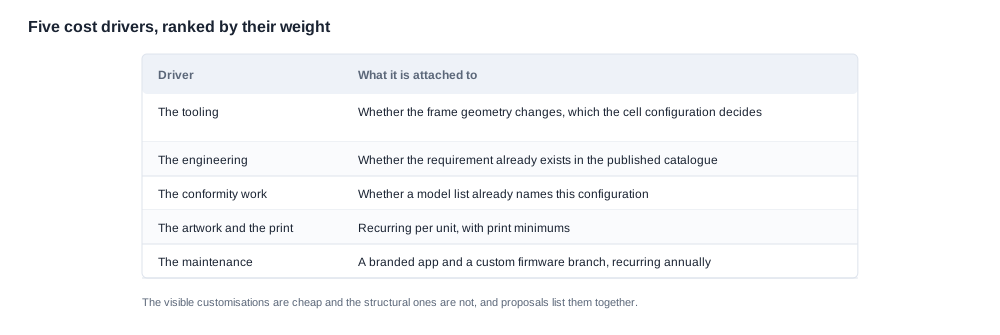
Costing an engineering customisation is hard for one reason: the number a buyer wants is the number a supplier cannot honestly quote yet. At the point where the enquiry is written, nobody knows the model string, the market, the configuration, the permitted claims, or the volume. Every figure would be invented. That is not an excuse to be vague. It is a reason to price the programme by its cost lines rather than by its total, and to know which line to push on when a quotation arrives.
This article therefore contains no prices, no percentages, no durations and no volumes, because none of those are published for our programmes and inventing them would be worse than useless. Instead it gives you the method: the lines that actually create cost in a smart glasses OEM/ODM customisation, the distinction between a one-off and a platform change, and the specific questions that turn an opaque quotation into a comparable one.
The working sequence is the same one used across our development gates: requirements frozen, feasibility reviewed, engineering and tooling, samples built and verified, compliance file closed, and a pilot run before mass production. Each gate produces a document. The engineering and tooling gate produces a written answer on what the customisation costs in engineering and tooling; the pilot gate produces a production run on production tooling at production volume. Those documents are where cost lines become visible and comparable, which is why the order of the gates matters as much as their content.
There is a second reason to price by line rather than by total, and it is about leverage rather than accuracy. A total is a number you accept or reject. A structure is something you can work with, because each line has a different negotiability profile, a different reversibility, and a different set of questions that can change it. Tooling is expensive and hard to unwind. Engineering is expensive and responsive to scope. Packaging is comparatively light and easy to reissue. A buyer who only sees the total cannot tell which of these it is actually looking at, and cannot direct its negotiating effort where it will pay.
Engineering customization: the cost lines a programme creates
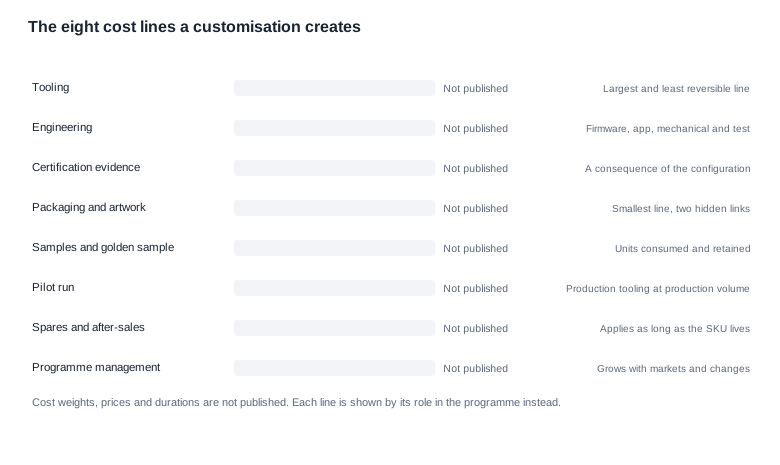
A customisation programme creates cost in eight recognisable lines. They are listed here in the order in which they are usually committed, which is roughly the order of reversibility: the least reversible decision comes first.
- Tooling. Injection moulds, soft tooling, assembly jigs, test fixtures and the calibration equipment that holds the article to specification. Tooling is the largest and least reversible line, because once a mould is cut against a specific geometry, that geometry is what your product is for the life of the programme. Tooling cost, ownership and residual value must be agreed in writing before the tooling gate closes.
- Engineering time. Firmware, companion app, pairing behaviour, control logic, any on-device processing, and the test work that supports it. This is the line most often underestimated because it is described as "configuration" when it is really development. Ask for it in engineering hours by discipline, not as a lump.
- Certification evidence. The cost of testing and documenting the configuration you actually shipped. This is a consequence of the configuration decision, not an independent item, and it scales with how far your variant departs from an already-assessed baseline.
- Packaging and artwork. Carton print, insert cards, label content, regional variants, and the revision cost of a change after print approval. Artwork that references the model string carries a compliance dependency as well as a print dependency.
- Samples and golden samples. The physical units consumed while the configuration is proven: pre-production units, verification units, the golden sample that the production run is inspected against, and the extra units consumed by destructive or repeated testing.
- Pilot run. The production run on production tooling at production volume, inspected against the golden sample. The pilot is where yield, rework and assembly problems surface, and it is a real cost line rather than a formality.
- Spares and after-sales. A customised SKU cannot usually be serviced from the standard article's spare pool. Repair, replacement and warranty handling all become SKU-specific.
- Programme management. The coordination, document control, travel, sampling logistics and version control that sit around the above. Smaller than tooling, but real, and it grows with the number of markets and the number of changes.
We will state the central asymmetry clearly, because it drives every negotiation: tooling is the largest cost and the least reversible one, and engineering is usually the line with the most room to trade off against scope. A buyer who negotiates only the total is negotiating the wrong thing. A buyer who negotiates the structure — which lines are included, what is excluded, what happens if scope moves — negotiates the programme.
Tooling deserves its own paragraph because it is the line where most programme disputes originate. Three properties make it different from everything else. It is committed early, because the engineering and tooling gate is where it happens. It is specific, because a mould encodes a specific geometry and a specific set of dimensions; it cannot be adapted to a different product without becoming a different mould. And it is stranded if the programme stops, because a tool for a cancelled programme has no buyer and no alternative use. Those three properties are why the ownership question must be settled in writing before the gate closes rather than at the end, when there is nothing left to negotiate with.
The question to put in writing is specific: what happens to the tooling cost if the project stops. Does the tooling remain with the supplier against a future programme, or is it transferred to the buyer, and on what terms? Is any part of the tooling cost amortised into the unit price and therefore recoverable at volume? Is the mould covered by a maintenance obligation that survives the programme? A buyer who has not asked this question has not finished scoping tooling, regardless of what the quotation says.
Engineering is the second line, and it is where scope discipline pays for itself. The reason engineering is mis-estimated is that a request which sounds like configuration is often development. Turning a camera function on for a product whose base article does not carry one is not a switch; it is optics, firmware, control logic, test coverage and compliance evidence. Changing a pairing behaviour so it works with a specific phone application is not a menu setting; it is a firmware feature with its own verification record. The way to make this visible is to have the supplier break engineering down by discipline, and to have each discipline's estimate tied to a named requirement rather than to the programme as a whole.
The certification evidence line is best understood as a consequence rather than an item. The evidence cost of a customisation is determined by how far the configuration departs from something already assessed, and by how many markets it must cover. A change that leaves the technical behaviour intact is cheap in this line. A change that alters the radio path, the optical path or the power system is not. This is also the line where late changes hurt most, because testing and documentation cannot be compressed into a conversation.
Packaging and artwork are usually the smallest line, and they carry two hidden dependencies. The first is the model string: if the label, the carton and the purchase order do not agree on the name of the article, the whole set has to be reissued. The second is the permitted claim set: the artwork states what the product does, and the claims must match what the compliance file supports for that configuration. Both dependencies are reasons to freeze packaging content early, and both are invisible in a quotation that treats artwork as a print run.
Samples and the golden sample are a physical cost that is easy to underestimate because the units are consumed silently. Verification work takes units. Retesting takes units. The golden sample itself must be retained, signed and protected, because the production run is inspected against it and a lost golden sample means a programme that cannot be objectively judged. Retained units also become the first spares, which is why the sample line and the spares line should be discussed together rather than separately.
The pilot run is where the programme's assumptions meet production reality. It runs on production tooling at production volume and is inspected against the golden sample, which means it exposes yield, rework and assembly problems that no sample stage will reveal. Buyers who treat the pilot as a formality are the buyers who discover their true unit cost at the mass production order instead.
Spares and after-sales are the cost line with the longest tail, because it applies for as long as the SKU is in the field. A customised SKU generally cannot be assembled from the standard article's spare pool, because the custom configuration is exactly what differs. Repair, replacement and warranty handling therefore become SKU-specific, and the cost of holding spares, of training a service partner, and of handling a warranty claim on a bespoke article all belong to the programme rather than to a later budget line.

One-off customisation against a platform change
Not every customisation is the same kind of spend, and the two kinds behave completely differently over time.
A one-off customisation is a change scoped to a single programme: a specific brand, a specific market, a specific model string, a specific configuration. Its cost is repeated every time the customisation is repeated. If you run the same request with three different channel partners, you pay for it three times, because the tooling is specific, the engineering is specific, the evidence is specific, and the packaging is specific. There is no amortisation, because there is no shared base.
A platform change is a change made on the standard platform so that every future order inherits it: a new shell material, a revised audio path, an added sensor, a firmware framework change. Its cost is paid once and then spread across every programme that uses the platform. The economics are completely different, and so is the negotiation.
We will put the distinction to work. Before you negotiate anything, establish whether your request is a one-off or a platform candidate. A request is a platform candidate when it will be repeated across your own range, when it removes a recurring engineering task, when it reduces assembly or test complexity for every unit, or when it is a capability you will need on the next programme anyway. A request is a one-off when it serves a single market, a single customer, or a single short sales window.
The catalogue is a reasonable illustration of why this distinction is worth making deliberately rather than by accident. The range spans 28 models across several distinct application types — 8 audio models, 3 sport models, 11 camera models, 3 kids models and 3 models without a model number — and it is deliberately heterogeneous rather than a single product with colour options. Configuration detail is recorded at model level: Bluetooth version is published for 14 models and left unstated for the 11 camera models together with A05, A06 and the bone conduction line; a remote control shutter is documented only on D17 and ZH12; an IP54 rating appears on V06 and S7 only.
Read as a cost structure rather than as a product list, that heterogeneity says something important. A request that touches several of these models at once is not one-off work, it is platform work, because the underlying engineering and the underlying evidence are shared. A request that touches exactly one of them, for one market, for one channel partner, is one-off work even if it looks identical in form. The economics are identical; only the repeatability differs. Which is exactly why the one-off and platform distinction has to be made explicitly, in writing, before the quotation is structured — because the supplier cannot price a one-off and a platform change the same way, and a buyer who has not decided which one they are asking for has not actually defined the request.
The consequences run through every line. Tooling for a one-off is single-use and typically has no residual value beyond that programme, so the ownership question is at its sharpest. Engineering for a one-off is per-programme; engineering for a platform change is amortised across the platform's future volume. Certification evidence for a one-off is a file you build and hold; for a platform change the evidence can support every downstream model that inherits the configuration. Packaging for a one-off is a bespoke artwork run; for a platform change it can converge on a shared structure.
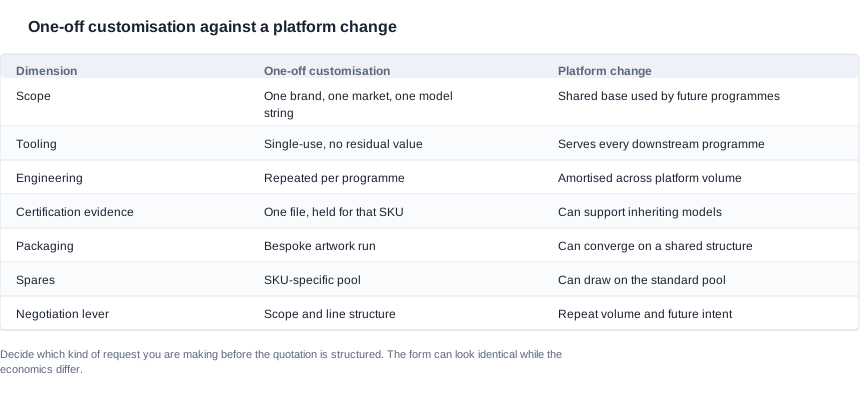
| Dimension | One-off customisation | Platform change |
|---|---|---|
| Scope | One brand, one market, one model string | Shared base used by future programmes |
| Tooling | Single-use, no residual value | Serves every downstream programme |
| Engineering | Repeated per programme | Amortised across platform volume |
| Certification evidence | One file, held for that SKU | Can support inheriting models |
| Packaging | Bespoke artwork run | Can converge on a shared structure |
| Spares | SKU-specific pool | Can draw on the standard pool |
| Negotiation lever | Scope and line structure | Repeat volume and future intent |
The mistake to avoid is treating a platform change as a one-off because the first order was small. That habit produces a business where every programme pays engineering for the same underlying work, and where the buyer never accumulates any leverage. The alternative is to propose platform candidates explicitly, with the amortisation logic stated, and let the supplier quote the programme line and the platform line separately.
There is a caution on the other side. A platform change made for a single programme's benefit gets paid for by every future programme that inherits it, including programmes you never wanted it for. It also delays the first delivery, because platform work generally requires more validation before it can carry other people's SKUs. Buyers with a genuinely short commercial window should say so and accept the one-off cost, rather than pushing a platform change they will not amortise. We will not pretend there is a universally correct answer here, because there is not; there is only a question that has to be answered and written down.
How to ask for a quotation you can compare
A single total figure is not comparable across suppliers. Two quotations with the same total can represent completely different structures — one including tooling ownership and the other excluding it, one including certification evidence and the other assuming it, one including pilot tooling and the other amortising it. Comparing the totals tells you nothing.
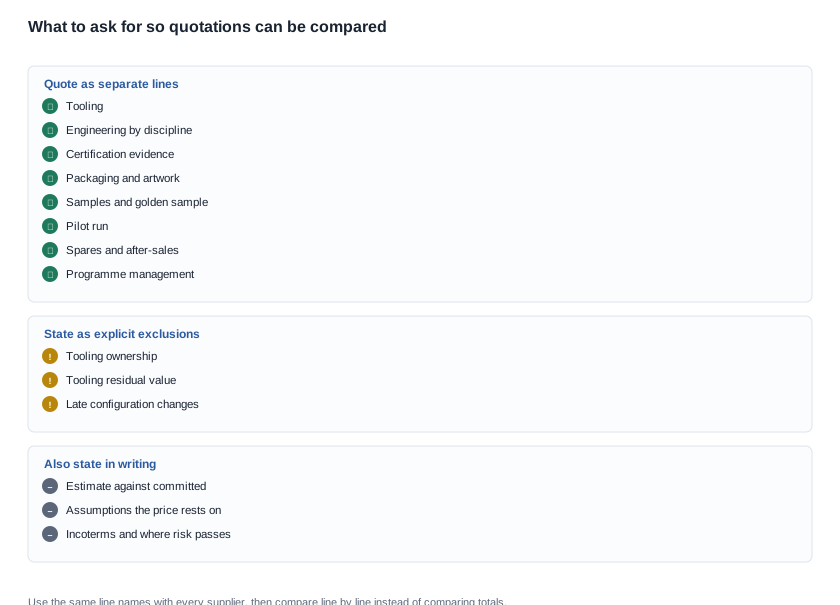
What is comparable is a quotation broken into lines, with the same line names in every quotation you collect, and with the same exclusions stated in each. We will recommend asking for the eight lines in the order above, plus three explicit exclusions.
The three exclusions matter more than most buyers expect. The first is tooling ownership: is the tooling included in the price, or is it invoiced separately and held by the supplier? The second is tooling residual value: if the programme stops after the pilot, what happens to the tooling, and is any part of the cost recoverable? The third is the cost of a configuration change after the tooling gate closes, because that is the one that decides whether a late request is a conversation or a crisis.
Here is the line structure we would ask for, with the question that makes each line legible. Use the same table against every supplier, because the value comes entirely from the consistency of the labels.
| Line | What it should contain | What to ask the supplier |
|---|---|---|
| Tooling | Moulds, fixtures, test and calibration equipment | Is it included or invoiced separately, and who owns it |
| Engineering | Firmware, app, mechanical, test, by discipline | Which discipline owns which requirement, and how many hours |
| Certification evidence | Testing and documentation for the shipped configuration | What is already covered and what must be built for our SKU |
| Packaging and artwork | Carton, insert, label, regional variants | Which parts are fixed and which are changeable after approval |
| Samples and golden sample | Units consumed, retained and signed | How many are consumed, retained, and kept as spares |
| Pilot | Production run on production tooling, inspected | What is included and what happens on failure |
| Spares and after-sales | Custom-SKU service and warranty handling | What can be served from the standard pool |
| Programme management | Coordination, documents, logistics, travel | Who owns the programme and what cadence is included |
Beyond the line structure, three quotation conventions make the comparison usable. Ask for the quotation to state which figures are estimates pending the feasibility answer and which are committed. Ask for it to state which cost lines are excluded and what would bring them into scope. Ask for it to state the assumptions it depends on — target volume, market, configuration, and the permitted claim set — so that a later change of assumption is visibly a change of assumption and not a mystery.
We will also recommend negotiating the commercial terms as explicitly written lines rather than as goodwill. The incoterms used, the point at which risk passes, the payment structure, the MOQ applied per line, and the warranty position on a customised SKU are all items that belong in the quotation, because each one changes the effective cost of the programme without appearing in the engineering scope at all. A quotation that leaves them out is not a cheaper programme; it is an incompletely described one.
One more comparison convention is worth adding to the pack: ask each supplier to quote the same programme at two volume scenarios, labelled as assumptions rather than as commitments. This does not require published volume figures to be meaningful; it requires the supplier to state which lines are volume-sensitive and which are not. Tooling is largely fixed and engineering is largely fixed, while certification evidence, spares and programme management behave differently at different volumes. A quote that shows that shape tells you something a single number never will.
The final convention is the least common and the most valuable: ask what the supplier would change about the programme to reduce its cost without reducing what it does. This is a scope question, not a discount request, and it usually surfaces genuine trade-offs — a simplified artwork, a reused platform feature, a deferred claim, a reduced variant set — that a buyer would never have thought to offer.
Questions to ask about programme cost
These questions are designed to be answered in writing, and to be answerable before the programme is committed. Each of them replaces a number you would otherwise have to guess.
- Can you quote this programme broken into tooling, engineering, certification evidence, packaging, samples, pilot, spares and programme management? Ask for the same line names across every supplier you approach.
- Which lines are estimates pending the feasibility answer, and which are committed? A quotation that does not distinguish them is hiding the risk.
- What is excluded, and what would bring each excluded item into scope? Ask specifically about tooling ownership, tooling residual value and late configuration changes.
- How is the engineering effort broken down by discipline? Firmware, app, test and mechanical should be visible as separate lines.
- How many units are consumed at each sample stage, and how many are retained? Ask what is consumed, what is retained as the golden sample, and what is retained for spares.
- What does the pilot run cost, and what does it include? Confirm that it runs on production tooling at production volume and is inspected against the golden sample.
- How is a customised SKU handled for spares, repair and warranty? Ask what can be served from the standard pool and what must be made specifically for your SKU.
- What are the MOQ and lead time assumptions behind the quotation? Ask for the assumptions and the conditions under which they change, rather than a single figure.
- What is the incoterms basis, and where does risk pass? Ask for it as a line, not as an assumption in a footnote.
- Is this request a one-off or could it be a platform change, and what would the platform option cost separately? Ask both. The comparison is often the most valuable negotiation lever you have.
Three habits make these questions productive rather than decorative. Ask them against a written requirement, because a quotation priced against a written requirement is the only kind you can hold the supplier to. Ask them before the feasibility answer, because the feasibility review is where the boundary is set and it is far cheaper to change the requirement than to change the tooling. And ask them of every supplier in the same words, because the answer you do not get is itself information.
We will close with the honest constraint. We do not publish programme prices, tooling cost figures, sample fees, MOQ, lead times, capacity, or stage durations, and any figure you are quoted here is specific to a frozen requirement, a named configuration and a stated market. The method above is how to make those figures meaningful when you receive them — by demanding the line structure, the exclusions and the assumptions, and by holding the supplier to the requirement they priced against.
For the wider customisation picture, the pillar page on engineering customization sets out where an engineering customisation sits in the engagement. If you want the option set before costing anything, the overview of customization options is the right starting point. If you want the stage sequence and the documents each stage should produce, the piece on development process quality gates covers it. And if you want to understand what a standard platform already gives you before you customise, see the standard OEM tooling requirements.


