

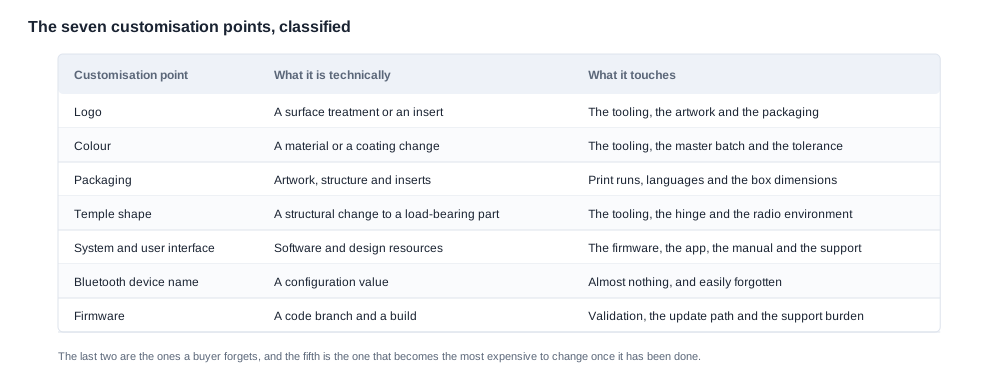
There is a standard way to sell customisation in this category, and it is a list. Bluetooth device name, logo, packaging, colour, firmware, interface, temple shape. A buyer sends the list back with the items they want ticked, and expects a price and a date in return. The list is not a bad vocabulary, but it hides the most commercially important fact about customisation work, which is that two items on the same list can differ by an order of magnitude in cost, effort and risk.
The reason for that spread is physical, not commercial. A Bluetooth device name is a value in a settings table that a person reads in the first thirty seconds of using the product. A temple shape is a change to a load-bearing part of a product that contains a radio and an antenna. Both arrive in the same inbox, both get described in the same confident tone, and both end up on the same quotation. Separating them honestly is the whole job.
Consider a request that is completely ordinary on paper: a brand wants its logo on the temple, its name in the Bluetooth list, its colour on the frame, its artwork on the box and its own setup screens on the device. Read as a list, that is five small items and one reasonable price. Read as engineering, it is one configuration change, one production change, one tooling or batch question, one print programme with inserts for each market, and one software branch with a version scheme. The five items are only cheap if they are treated as five independent things, and they cannot be, because they all end up in the same golden sample and the same manual.
This article follows a request through the factory, from the first file to a released build, and sets out the classification, the inputs, the verification and the baseline update. It also sets out what a buyer should ask a supplier to put in writing, because most of the commercial rows that decide whether a programme works — minimum order quantity, tooling cost, NRE, lead time, warranty, support terms — are not published anywhere and have to be asked for, then recorded in the quotation and the purchase order.
Engineering customization: from a request to a released build
A customisation request enters as prose and has to leave as a released build with a known state. The sequence below is the one we work to, and the order is not arbitrary: each stage produces the input the next stage needs, and skipping one is what produces the dispute three months later.
The classification. Before anything is costed, the request is sorted into one of three kinds of work. A configuration change alters a setting or a name and is verified by inspection. A production change alters a material, a surface, an insert or an assembly step and is verified by inspection against a physical reference. An engineering change alters behaviour, structure or the software that drives the product and is verified by a test plan. The three have different lead times, different cost structures and very different effects on the certification file and the support material.
The input file. Every customisation starts as an input from the buyer: artwork, a logo vector, a colour reference, a device name, a behavioural specification, a manual draft. The quality of that input decides the number of iterations, and most customisation disputes turn out to be disagreements about a file that was never specified in the first place. A logo that arrives as a low-resolution screenshot cannot be judged for tolerance, and a colour that arrives as a hex value on a screen cannot be matched to a moulded surface.
The change record. This is the document that keeps the scope from expanding quietly. It states what changed, which baseline it changed from, what it touches as a consequence, and which documents, tests, labels or listings are affected as a result. In practice, the change record is a one-page table, and it is the single most useful thing a buyer can ask for during due diligence, because it reveals whether the supplier is managing scope or simply accepting whatever arrives.
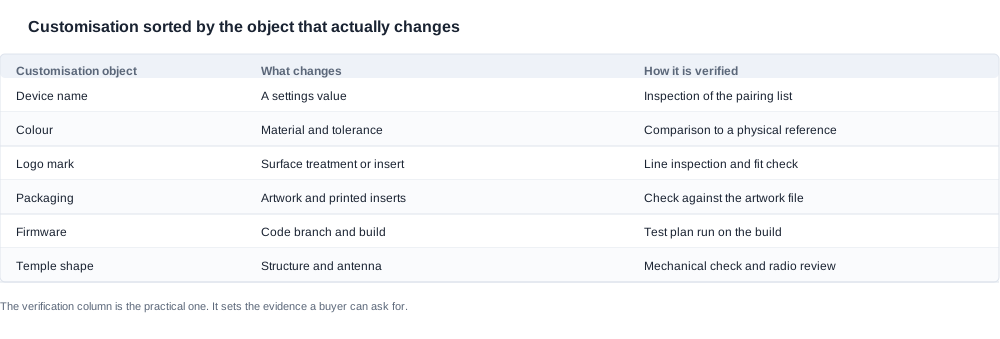
The verification. Configuration and production changes are verified by looking at a unit: does the name read correctly on the pairing list, does the colour match the physical reference, is the insert in the box. Engineering changes are verified by a test, because what changed is behaviour and behaviour needs evidence rather than an opinion. A firmware or interface change also requires a version, a changelog and a decision about how units already in the field will be handled.
The baseline update. The released build becomes the reference against which everything else is judged. The golden sample, the specification, the artwork file, the manual and the training material for distributors are all updated together. Skipping this step is how a product ends up with a specification that describes a version that no longer exists, and how a distributor ends up selling something the buyer's support page does not mention.
The six stages below are the working sequence. Note what is not in it: there is no stage called "price". Cost is an output of classification, not an input to it.
Iteration count is worth isolating, because it is the item that most often moves a final cost. Iteration is caused by input quality, not by the supplier being slow. A logo delivered as vector artwork with a stated minimum size produces a review and an approval. The same logo delivered as a photograph of a printed page produces a conversation about resolution, about whether the mark can be reproduced at all in the space available, and about what happens to the shape of it. A colour delivered as a physical moulded sample produces a tolerance discussion at the first inspection. The same colour delivered as a screen value produces a match that is technically acceptable and commercially disappointing.
The practical consequence is that the input list should name file formats, not intentions. "Send us your logo" is an intention; "send a vector file, with the mark on an artboard rather than a photograph of a page, and state the minimum print size you intend to use" is an input. The second version shortens the programme on every request, including the ones that turn out to be straightforward.
There is a second habit that saves time: sending one consolidated request rather than five separate ones. Each separate message invites a separate classification, a separate cost line and a separate lead-time answer, and the parts are only comparable once they sit on the same baseline. One request, with a table of items against the base model, produces one classification and one coherent answer.
- Classification of the request into configuration, production or engineering change.
- Input collection of the files and references the work depends on.
- Change record describing the change, its baseline and its consequences.
- Verification plan defining the evidence that closes the change.
- Build and inspection against the plan.
- Baseline update across the sample, the documentation and the support material.


Engineering customization sorted by the object it touches
Buyers usually list customisation by marketing category, because that is how the request arrives. Sorting by the object that actually changes gives a more useful picture, because the object determines the tooling, the verification and the paperwork. The categories below are the ones that come up repeatedly in brand and channel work.
Naming and identity. The Bluetooth device name, the product name in the interface, the model string that appears in a system list, the brand in the companion application. This is the cheapest and most forgotten group. It costs almost nothing and it is the difference between a product that feels branded and one that feels like stock. It is also the group where a buyer can get an expensive result by supplying a bad string, so the name should be agreed in writing, character by character, including what happens when two variants are in the field at once.
Surface and colour. Colour is a material or coating change and it carries a master batch, a tolerance and a colour standard. A colour that already exists on a stock option is close to free. A new colour is a tool or a dye batch with its own minimum, and it changes the tolerance structure, because a coloured surface shows variation that an unpainted one does not. The practical question is whether the buyer can hold a physical reference: a screen colour and a moulded plastic are different objects, and a supplier working from a screenshot will be guessing.
Branding marks. A logo is either a surface treatment or a physical insert, and which one it is changes everything downstream. A treatment adds a step to the line, a file, a tolerance and an inspection point. An insert is a part with its own tooling, its own fit and its own failure mode, and it becomes a line item in the bill of materials. Ask which method is used, because a buyer who assumes a treatment and receives an insert has a different cost and a different schedule.
Packaging and inserts. Packaging is artwork, structure and inserts, and the word that hides the work is inserts. A manual in several languages, a warranty card in each, a quick start guide and a regulatory insert for each market turn a box into a print programme with its own lead time and its own minimum. Artwork alone is a small job. Artwork with inserts is not, and each additional market adds another insert rather than another copy of the same one.
Software behaviour. Firmware and interface work is a code branch, a build, a validation cycle and a version scheme. It is also the change that most often introduces a mismatch between the product and its own paperwork, because the manual, the listing screenshots and the training material for distributors all describe an older build. Any change to radio behaviour, connectivity, pairing or the handling of personal data also has to be assessed against the radio-equipment cybersecurity requirements that sit behind CE marking, including the EN 18031 harmonised standards for secure communication, encryption, secure storage, user consent and the handling of identified vulnerabilities. That is an assessment to schedule, not an item to skip.
Structure. Temple shape, hinge geometry and frame proportion are changes to load-bearing parts. They move the tooling, the tolerance stack and the antenna environment, and because the frame is part of the radio environment they need a radio assessment before they are quoted. This is the request most likely to be treated casually by a buyer and most expensive to accommodate by a factory, because it reopens a product that was otherwise considered finished.
One category sits outside the list and needs its own attention: the multi-SKU programme. A buyer who wants three colours across two models with one shared box design has not asked for six customisations, they have asked for a variant family, and the cost sits in the number of distinct tooling and print combinations rather than in the depth of any one of them. The honest way to price that is a matrix: models across the top, customisation elements down the side, and every intersection marked as standard, as a one-off, or as shared. A buyer who builds that matrix before the first quotation gets a shortlist they can actually compare, and a supplier who cannot fill it in is telling them something important about how the programme would run.
Engineering customization cost signals a buyer can read before quoting
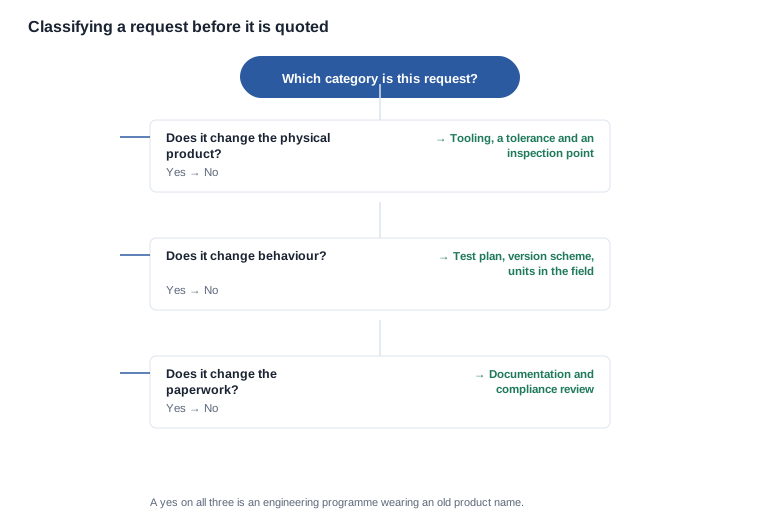
A buyer cannot see the internal estimate, but they can see the signals that produce it. These six questions, asked before any number is discussed, tell a buyer which category a request falls into and therefore whether the number that comes back is a settings change or a new product wearing an old name.
- Does the request change the physical product? If it does, there is tooling, a tolerance question and a physical inspection point. If it does not, there is not.
- Does it change behaviour? If it does, there is a test plan, a version number, a changelog and a decision about units already in the field.
- Does it change what a customer sees? If it does, there are artwork, listing, packaging and distributor training consequences on top of the engineering.
- Does it change the documents that describe the product? If it does, there is a compliance and documentation consequence, and this is the group most often forgotten because nothing physical has moved.
- Does it change the radio environment or the data handling? If it does, it needs an assessment against the applicable radio and cybersecurity requirements before it can be scheduled.
- How many separate inputs does it need from us, and in what format? If the answer is a list of named file types, the request is scoped. If the answer is "whatever you have", the request will grow.
A request that answers no to all six is routine. A request that answers yes to all six should be scheduled as an engineering programme, priced like one, and given its own baseline, even if it is called a variant. The trade-off is real and it is worth naming: a smaller scope with a clear baseline ships predictably, while a wide scope with a loose baseline generates change requests, and change requests are where the cost of a customisation programme usually leaks.

Engineering customization and the model portfolio it starts from
Customisation is not a starting point; it is applied to a product that already exists, and choosing that product is the first negotiation a buyer has with any supplier. CYNRIN publishes a range of 28 named models: eight in the audio range (K02 and YK12, D12 and LC-105-2, D11 and LC-105-1, and K01 and G07), three in the sport range (YKC02, D17, ZH12), eleven camera models (KY06 and V03 Pro, MT6 and L2 Utral, L1 Pro and CY05, S7 and CY03, V06 and V03, and MT5), three kids models (A05, A06, A07), plus AR glasses, electrochromic and bone conduction lines that we list by capability rather than by model string.
What is published at model level is specific and uneven, and a buyer should read the pattern rather than assume completeness. Bluetooth version is published for 14 of the 28 named models and is not published for the eleven camera models, A05, A06 and the bone conduction line. Charging method is magnetic for 17 models and Type-C for 7, and is not published for L1 Pro and CY03, and MT6 and CY05. Charge time is published as two hours or less for 26 models, which is a ceiling rather than a measurement, and only D17 and ZH12 publish a figure of about one hour. An IP rating appears on only two rows in the entire catalogue: V06 and S7 publish IP54. A weight appears on only one row: MT6 at 158 grams for the glasses alone, excluding its 1200 mAh foldable case. Camera resolution is 8 MP on eight models and 13 MP on three (L1 Pro and L2 Utral, and S7). Camera batteries run from 220 to 290 mAh with a rated runtime of about five to eight hours and no published test condition.
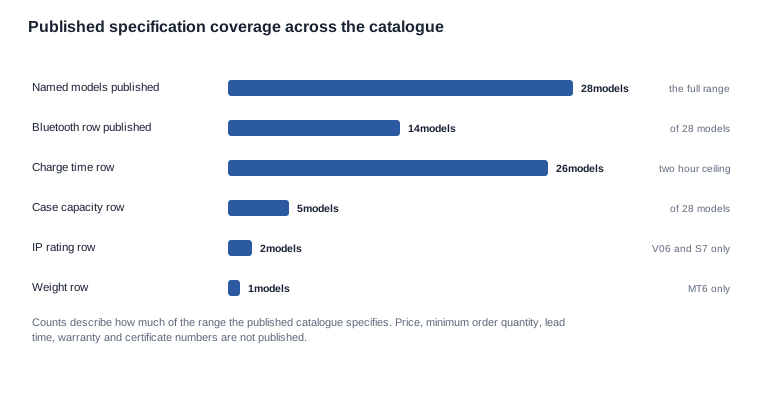
Two things follow from that pattern, and they matter more than the individual rows. First, a buyer choosing a base model on the strength of a specification that is not published should ask for it in writing rather than assume the answer. Second, and more usefully, a shortlist built on published rows is a shortlist you can defend: the audio range gives you charging method and charge time for most models, the camera range gives you battery and resolution, and the two IP54 rows give a defensible answer for outdoor use.
The classification of the range also matters for customisation. YKC02 is a sport model with two 70 mAh batteries, not an audio product, and V06 and S7 are named for sport use while belonging to the eleven camera models. A buyer who builds a shortlist by reading marketing names rather than the range tables will make the wrong base-model decision, and a wrong base-model decision is the most expensive kind of mistake in a customisation programme because every later change inherits it.
We publish no customisation catalogue, no tooling list, no firmware version policy, no obsolescence commitment and no support service-level row. That is deliberate and it is also the reason this article exists: those things are decided per programme, and the way to get them right is to know what to ask for.

Engineering customization when one request arrives with eleven items
A worked example makes the classification concrete. A channel partner wants to sell an audio-range model under their own brand into three markets. Their brief contains eleven lines. Classified, they look like this.
- Bluetooth device name — configuration change. One settings value, one line in the inspection sheet, no tooling.
- Brand mark on the temple — production change. The method matters: a surface treatment and a moulded insert are different work with different costs and different failure modes.
- A specific frame colour — production change with a material minimum. A physical reference is required before a tolerance can be written.
- Retail box artwork — production change. Artwork preparation and print, with its own minimum.
- A warranty card — production change, and a commercial decision. We publish no warranty terms, so the buyer sets the period and the card must match the agreement rather than a template.
- A manual in three languages — documentation change with three separate proofs.
- A regulatory insert for each market — one insert per market, not one insert in three languages.
- Setup screens with the brand — engineering change. A code branch, a build, a version number and a changelog.
- A printed quick start card — production change, small but it has a minimum like everything else in print.
- A serial number format — configuration change, but it links to the warranty claim process and the shipping paperwork.
- A distributor price list — not a factory item at all, and worth saying so, because it is the line most often left in a technical brief by mistake.
Eleven lines have become two configuration changes, five production changes, one engineering change, one documentation change, one non-item and one commercial decision. That classification is the useful output, because it tells the buyer which lines to negotiate hard on, which to leave standard, and which three need a decision from their own side before a price can be quoted.
The trade-off a buyer makes here is between speed and distinctiveness. Leaving the temple mark standard and the box artwork standard ships sooner and costs less; a brand that is invisible in the hand and on the shelf gets a different result in the market. Neither answer is right in general, and the classification is what makes the choice explicit rather than accidental.
Engineering customization evidence a quotation should carry
The most useful negotiation tool in a customisation discussion is not a lower price. It is a request that the quotation show its work. A buyer who asks for the following gets a comparable document from any supplier, which makes a shortlist possible.
- A classification line per item. One sentence per request item saying whether it is a configuration change, a production change or an engineering change, and what it touches.
- The input list. The exact files, formats and references required from the buyer, so that iteration count is bounded by the request rather than by the supplier.
- The verification plan. How each item will be confirmed, and against what standard: a physical colour reference, a test plan, an inspection sheet, a firmware build number.
- The baseline list. Which documents and artefacts will be updated when the change is released, including artwork, manual, packaging artwork and the golden sample.
- The exclusions. What is explicitly not included, because most disputes are about the boundary rather than the centre.
- The commercial rows that are not published. Minimum order quantity, unit price, tooling cost, NRE, sample fee, lead time, warranty terms, payment terms and support terms, each either filled in or explicitly marked as not yet determined, with a date by which it will be.
The last point is the one buyers skip and then regret. A quotation that leaves those rows blank is not wrong, but it is unusable for a negotiation, because there is nothing to negotiate against. A quotation that marks them as open, with a date and a named owner, is a working document.
The second point is about comparing two suppliers rather than one. Two quotations for the same request are only comparable if they use the same classification, the same input list and the same verification plan, because a cheaper quotation that assumes fewer inputs is not cheaper, it is differently scoped. During due diligence, the efficient question is not "who is cheaper" but "what does each quotation assume". Once the assumptions are lined up, the negotiation is about the rows that were actually quoted.
We will do three things with a specific request. We will classify each item against the objects above. We will tell you what inputs we need and in what format, which is usually the item that decides how many rounds the job takes. And we will mark clearly which commercial rows are not published and therefore open, so that the first quotation is a baseline for negotiation rather than a starting guess.
Related reading
- The points and what they cost when they change — system changes
- The stage where the baseline is set — the requirements phase
- The checks a change has to pass — quality gates
- The document set a shipped product has to match — certification checklist
Send us your customisation list and we will classify each item, tell you what it touches and what inputs we need from you.


