

Most customisation projects do not fail because nobody reviewed them. They fail because the review was treated as a meeting rather than as a gate, and a meeting can only produce opinions. A gate produces a decision, and a decision has an owner, a date, a defined output and a defined exit condition. The difference sounds procedural and is not: a meeting that ends with "we will look into it" has added a week of elapsed time and nothing else, while a gate that ends with "the request is feasible as specified, with these three constraints" has converted an open question into a quotable scope.
The reason the distinction matters commercially is that a customisation request is unusual in how early its cost is determined. By the time a buyer has a price and a lead time in writing, the structure of the request has already been decided, in a meeting, by people who were not thinking about the structure. The review process exists to make that decision deliberate, and it exists because the first decisions in a customisation programme are the ones that are hardest to reverse.
What follows is the five-stage review we work to, the question each stage answers, the output the buyer should leave with, and the failure mode that a review programme without gates produces. We also cover the record a completed review produces, because the difference between a review that happened and a review that can be evidenced is the difference between a process and a habit.

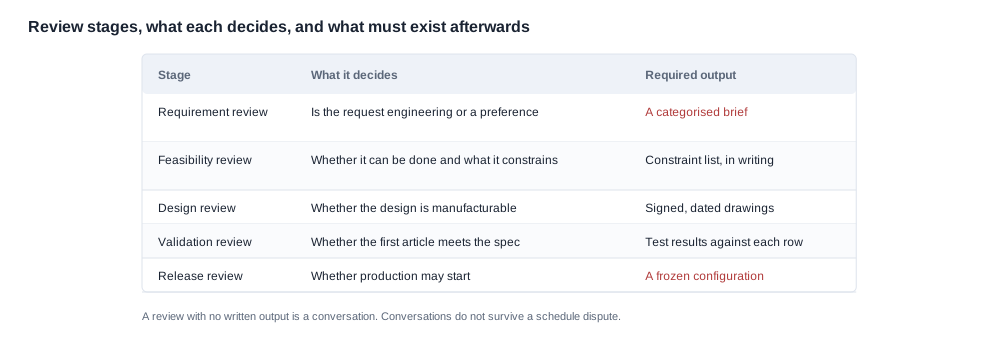
Engineering customization review process: stage one is the requirement review
The requirement review exists to answer one question: is this request specific enough to be priced by anyone, including the factory? It sounds pedantic and it is the highest-value gate in the process, because everything downstream — feasibility, cost, schedule, samples — inherits the ambiguity of whatever passes this stage.
A complete requirement set contains five things, and a buyer should be able to hand over all five at once.
- The base model. Which product the customisation is applied to, identified by model string rather than by description. CYNRIN publishes 28 named models across the audio range (K01 and LC-105-1, D11 and LC-105-2, K02 and D12, and YK12 and G07), the sport range (YKC02, D17, ZH12), the camera range (MT5 and V06, KY06 and L2 Utral, L1 Pro and V03, CY05 and MT6, CY03 and V03 Pro, and S7) and the kids range (A05, A06, A07), plus AR glasses, electrochromic and bone conduction lines listed by capability rather than model string. Naming the model precisely matters more than it looks, because two models with similar names sit in different ranges and carry different specifications.
- The customised elements. Each one listed separately, each with the level of detail needed to price it. A logo is not a logo; it is a placement, a size, a file format and a method, and the method is either a surface treatment or a physical insert.
- The target markets. Because markets determine the packaging inserts, the languages, the labelling and the regulatory assessment scope, and because one insert per market is not the same work as one insert in several languages.
- The quantities and the plan. Which quantity is the first order, which is the annual plan, and whether a repeat order is expected on the same configuration. This is what lets a supplier say whether tooling is amortisable, and it is not published.
- The decision rights. Who on the buyer's side can approve a change of requirement, and who signs the purchase order. If the request has to pass through three people and only one of them can say yes, the review will stall at the first disagreement.
Two things are worth saying about what a requirement review is not. It is not a negotiation, because the buyer has nothing to negotiate yet: there is no quotation and no position to defend. And it is not a demonstration, because a demonstration shows a standard unit and the request is about a unit that does not exist.
A useful discipline is to end the stage with a written requirement set that both sides have read, rather than with minutes. Minutes describe a conversation; a requirement set can be priced, and a pricing exercise will find the remaining ambiguity faster than any discussion will.
Buyers who have not run this stage before tend to prepare it as a presentation, and that is the most common preparation error. A review is not a pitch and the supplier is not an audience to be persuaded of the value of the request; it is an assessment, and the buyer's job is to make the request legible. The most productive preparation is unglamorous: a one-page description of the intended customer and the intended use, a table of the customised elements with the level of detail available for each, the markets with their languages, and a list of the questions the buyer wants answered before committing. That last list is the single most useful document in the pack, because it converts a general request into a set of specific answers, and it is also how a buyer discovers which of their own assumptions were never agreed internally.

Engineering customization and the feasibility stage that follows it
Feasibility answers a different question from the requirement stage. The requirement stage asks whether the request is described well enough to price. Feasibility asks whether it can be built, and what it touches when it is built. A request can be perfectly specified and still not feasible in the form it was written, and the useful output of this stage is not a yes or a no but a set of options with their consequences.
The assessment typically runs through the following lines, and for each one it produces a position rather than an opinion.
The mechanical and tolerance question. Can the requested form, colour or mark be produced within the tolerance the buyer needs, and does it need new tooling? A temple shape or a hinge change is a different category from a surface colour, because it moves the tolerance stack and it affects the structure that carries the radio.
The radio and the certification position. We publish no per-model certification row, and the catalogue body itself does not carry CE, FCC, RoHS or RED entries per model; the export-certification page is a picture page showing ten patent certificates, eight design patents and two utility models, which is not the same thing as a regulatory test record. So the feasibility stage has to state which assessments the change requires, rather than assuming the existing approvals carry over. A change to the radio environment or to the handling of personal data also needs to be assessed against the radio-equipment cybersecurity requirements behind CE marking, described through the EN 18031 harmonised standards, covering secure communication, encryption, secure storage, user consent and the handling of identified vulnerabilities. That assessment has a cost and a duration and belongs on the schedule at this stage, not later.
The feature and specification question. The catalogue has no capacitive-touch row, no AI-feature row, no translation row, no microphone row and no codec row, for any model. If the requirement includes one of those, feasibility has to establish what is technically available, what the buyer will receive and what evidence will show it works. The same applies to the published specifications that are uneven by design: charging method is magnetic on 17 models and Type-C on 7 and is not published for CY03 and CY05, and MT6 and L1 Pro; an ingress rating appears only on V06 and S7 at IP54; a weight appears only on MT6 at 158 grams for the glasses alone, excluding its foldable case; charging case capacity is published for five models, two more have a case without a published capacity, and three have no case row while V03 Pro explicitly ships without one.
The programme question. Whether the request can be built on the existing line, whether it needs a dedicated run, and what that does to the schedule and to the minimum order quantity. None of those rows is published.
The output is a feasibility statement: what can be done as written, what must change, what each change costs in effort and schedule, and what evidence will be needed to prove it. A buyer who receives a feasibility statement with three options and their trade-offs can negotiate. A buyer who receives a flat refusal or a flat yes can only guess.
The feasibility stage rewards a specific kind of question. "Can you do this?" invites a yes or a no and produces very little. "Can you do this on the base model as it is built today, and if not, what is the smallest change that achieves it, and what does that change touch?" produces an answer that a programme can be planned around, because it identifies the minimum viable change rather than the maximum possible one. Buyers who work this way consistently get faster feasibility statements, and they get them in a form that can be quoted, because the assessment has already been expressed as an option with a consequence attached rather than as a judgement.

Engineering customization and the three reviews after feasibility
Feasibility produces a scope that can be costed. The next three stages turn that scope into a commitment, and each has a different character.
The programme and commercial review. This is where the request meets the commercial structure: quantities, tooling, non-recurring engineering work, the cost of the customisation amortised over the plan, and the rows that will not appear in a catalogue. Unit price, minimum order quantity, lead time, sample cost, warranty terms, payment terms, shipping terms including FOB and DDP, and production capacity are all not published by us, and a programme review exists to turn each of them into either a number or an open item with a date and an owner. The value of the stage is the open-item list, because that list is what stops a programme from being launched with assumptions in it.
The validation review. This is where samples meet a written specification. The buyer approves a golden sample against a document that states what the unit should do, and the validation review records what was tested, on which build, with what result. This is also the stage where the buyer's own product team has to decide what it will accept, because the specification is written by the buyer's side and the factory tests against it. The stage works when the specification is specific enough to fail; a specification written as a list of feature names cannot fail anything.
The approval and baseline review. The last stage freezes the configuration, names the version of each artefact, assigns an owner to each element of the deliverable and releases the baseline. This is the moment where the programme stops being a discussion and becomes a commitment, and it is the stage most often skipped in time pressure, which is exactly why it should be the stage that is protected.
The three stages are sequential in principle and overlapping in practice, and the overlap is the point. Validation often produces small changes, and a small change that arrives after the baseline is released has to be handled as a change request. Handling it that way is not bureaucratic; it is the mechanism that keeps the baseline meaningful.
Sample handling at the validation stage is worth a short note, because the sample is where the buyer's expectations and the factory's build meet. A sample that was produced as a demonstration unit and a sample that was produced against the written specification are not the same object, and only the second one can close the stage. It also helps to agree in advance what a sample is for. A sample used to approve appearance and a sample used to approve behaviour are different approvals, and a buyer who expects one unit to settle both will either accept a function it has not tested or reject an appearance it has already approved. The catalogue's own unevenness makes this concrete: a camera model's rated runtime of about five to eight hours carries no published test condition, so a sample that runs for seven hours under the buyer's conditions confirms nothing unless the condition is written down first.
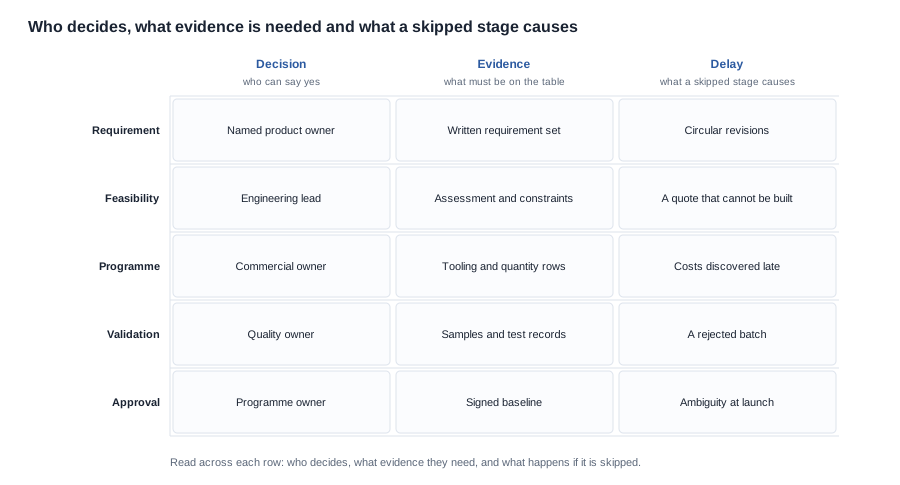

Engineering customization and the failure mode a review programme avoids
The characteristic failure of a review process is not a bad decision. It is a review that decides nothing and consumes a month.
The pattern is consistent. A request arrives with a partially specified requirement. The review is convened because something has to be reviewed. The meeting identifies six open questions, none of which is assigned. The minutes record the six questions. A fortnight later the same six questions are raised in a different meeting, with two new ones added because the first six are still open. Nothing is decided, but everybody involved believes the request is progressing, because it is being reviewed regularly.
Three things separate that from a working process, and each is cheap to put in place.
A gate has an exit condition. Not a topic and an outcome, but a condition: the request is specific enough to price, the assessment shows no unmitigated blocker, the open items are either closed or accepted, and the baseline has a named owner for each element. If the condition is not met, the gate has done its job by sending the request back.
A gate has a decision owner. One person can approve, and that person is named before the meeting. The alternative is a review that collects opinions and transfers the decision to a later meeting, which is how the six open questions multiply.
A gate produces an artefact. A requirement set, a feasibility statement, a quotation with the open rows marked, a validation record, a versioned baseline. Artefacts survive staff changes, they can be handed to a factory that has not met the team, and they are the evidence that a review happened.
There is a second failure mode, quieter than the first: reviewing too late. A request that reaches its first review after the buyer has committed to a launch date, a channel commitment or a price to its own customer has already lost the option to say no, and the review becomes a formality that confirms the plan. This is why the requirement review should be the earliest formal step and should be able to end with a decision not to proceed. A programme that stops early costs a few weeks. A programme that continues past the point where it should stop costs the launch.
A third failure mode is structural rather than procedural: a review that is used as a negotiating position. If a buyer brings a requirement to a review in order to discover what it will cost, and the factory discovers the same thing about the buyer's intent, the review stops being an assessment and becomes a duel. Both sides then withhold information, and the output is a negotiation over positions rather than a scope that can be built. The remedy is not goodwill, it is sequencing. Give the assessment what it needs, take the quotation as it comes, and negotiate on the rows that were actually priced.
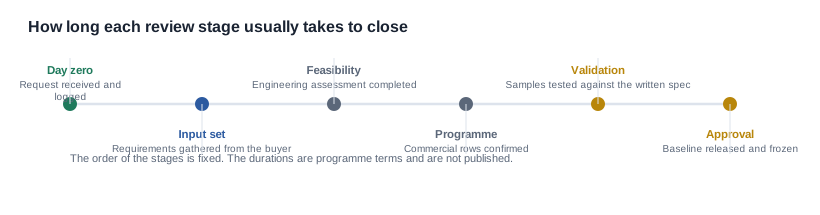
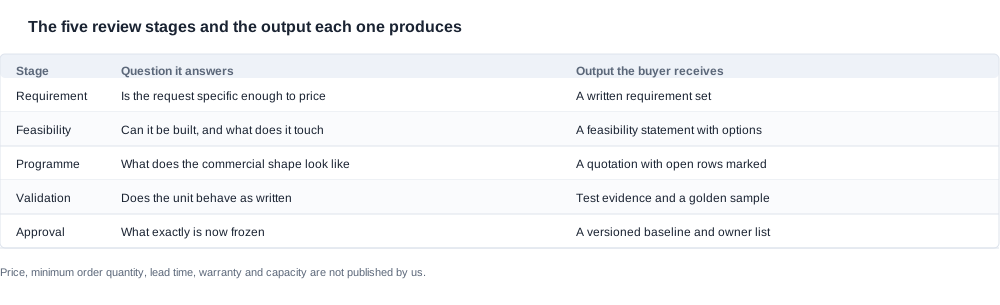
Engineering customization and the record a completed review produces
When the review process is working, a completed programme leaves behind a small number of documents, and a buyer can point to them when the next customisation request arrives. The record is worth having for its own sake and as a template for the next programme, because the second customisation in a brand's history is usually faster than the first for exactly one reason: the requirement format is now known.
The requirement set, versioned, listing the base model, the customised elements, the markets, the quantities and the named decision owners.
The feasibility statement, listing what is possible as written, the options where it is not, the assessments required, and the constraints each option carries.
The quotation with open rows marked, so that the negotiation has something to negotiate against and the assumptions are visible on the page rather than in someone's head. We do not publish price, minimum order quantity, lead time, sample fee, warranty, tooling cost, non-recurring engineering cost or production capacity, so a quotation that leaves those rows blank cannot be compared and a quotation that marks them as open with a date can be.
The validation record, naming the golden sample by version, the build identifier, the specification it was tested against and the result.
The baseline, listing every artefact with a version and an owner, and stating what a change after this point costs and how it is raised.
During due diligence, these five documents are also the fastest way to see how a supplier actually works. A supplier who can show a redacted requirement set and a change record has a process. A supplier who says the requirement is in the buyer's inbox has a conversation. That distinction matters more than any reference a buyer can be given, because a reference describes a past relationship while a process describes a capability.
The same five documents make the second programme cheaper than the first. A buyer that keeps its requirement format, its feasibility questions and its baseline template from one customisation to the next removes the part of the work that is pure repetition, and the part of the negotiation that is spent on finding out how the supplier presents things. That is the real return on running the review properly: the second customisation of a given product line should be a conversation about the product rather than a conversation about the process.
We would rather a buyer runs the review with us than receives a price without one. Send the request and the base model, and we will walk the five stages with you: what we need in order to price it, what the assessment will and will not cover, which rows we can fill in the quotation and which are still open, and what the baseline will contain when the programme is released.
Related reading
- The customisation request the review is run against — engineering customization
- The stage where the requirement and the baseline are set — the development process


