

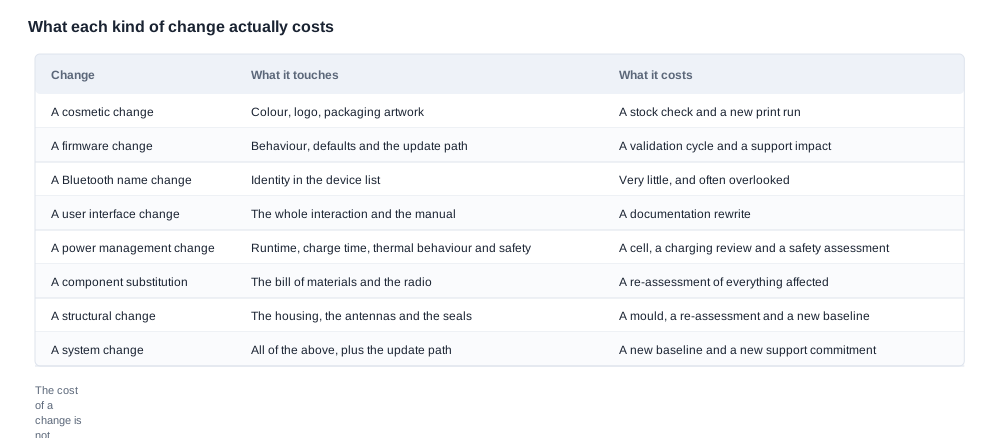
A system change is a change to what the product does rather than to what it looks like. A new colour is a production change; a new language in the setup flow is a system change. A logo on the temple is a production change; a different pairing behaviour on first connection is a system change. The distinction matters because a system change does not stay inside the engineering team. It reaches the documentation, the packaging artwork, the listing images, the training material for distributors, the support scripts, the certification file, the accessory behaviour and the units already in the field, and it reaches all of them at once.
Most of the surprise in a customised programme comes from that reach. The change itself is usually small enough to describe in a sentence, and the sentence lands in an inbox where nobody has listed the dependencies. Two or three weeks later a team member asks whether the manual still shows the old screen, and the answer is that it does, because nobody thought of the manual when the change was requested.
This article takes a system change and maps it: the layers it touches, the cost curve that timing produces, the questions to ask about any behaviour change, the dependencies that usually get left off the list, and the record that closes the change properly.
It is worth saying why the map matters commercially rather than technically. A buyer who has never run a customised programme thinks of the product as a single object that a factory makes, so a request to change the product's behaviour is a request to change one thing. Everyone who touches the product afterwards thinks of it as a set of artefacts that a set of people maintain, so the same request is a change to eight things, each with its own owner and its own lead time. The gap between those two pictures is where programme time goes, and it is much easier to close it in the first programme than to explain it in the third.
Engineering customization system changes: what a system change really touches
The first step is to stop thinking of the product as one object and start thinking of it as layers, because a behaviour change lands on several of them and each layer has its own owner, its own release discipline and its own failure mode.
The firmware build. Every system change begins as a branch and ends as a build with an identifier. The work is not the code; it is the branch, the validation, the version number and the changelog. Our catalogue publishes no firmware version policy, so the scheme has to be agreed as part of the change rather than inherited from an assumption, and the question of how many builds of a given product are supported at once has to be answered at the same time.
The interface and the setup flow. The screens a customer sees, the wording on them, the order of the first-run steps, the default state, the language options. This layer carries an unusual cost, because it is photographed. Every listing image, every screenshot in the manual and every slide in the distributor training pack is a copy of this layer, and each copy has a revision date and an owner. We publish no translation row, no capacitive-touch row, no AI-feature row, no microphone row and no codec row for any model, which means a change to any of those features has no published baseline to compare against and has to be specified in writing by the buyer before engineering can estimate it.
The radio and the pairing behaviour. Bluetooth naming, pairing flow, connection behaviour, and anything that changes the radio environment. The certification position has to be re-examined here rather than assumed, because a radio change is exactly the kind of change that invalidates an existing assessment. That includes the radio-equipment cybersecurity requirements behind CE marking, described through the EN 18031 harmonised standards for secure communication, encryption, secure storage, user consent and the handling of identified vulnerabilities. We publish no per-model certification row, so the assessment scope is agreed as part of the change.
The power behaviour. Charge curves, charging case interaction, sleep and wake, and the behaviour of the status the customer sees. This layer is where the published specifications are most exposed, because a charge-time figure and a runtime figure are claims that a behaviour change can invalidate. Charge time is published as two hours or less for 26 models, which is a ceiling, and only D17 and ZH12 publish a figure of about one hour. Camera batteries run from 220 to 290 mAh with a rated runtime of about five to eight hours and no published test condition. Charging method is magnetic on 17 models and Type-C on 7, and is not published at all for MT6 and CY05, and L1 Pro and CY03. A change to charge behaviour therefore forces a decision about which of those published rows survive, and the answer is often that a row has to be withdrawn or re-qualified.
The accessory behaviour. Where the product has a charging case, the case has its own behaviour: how the product detects it, what state it reports, how it charges. The catalogue is explicit about how varied this is. Capacity is published for five models — CY05 and CY03, and L1 Pro — each at 1400 mAh, L2 Utral at either 900 or 1400 mAh, and MT6 as a 1200 mAh foldable case. KY06 and MT5 have a case with no published capacity. S7 and V03 Pro, and V06 and V03 have no case row at all. A behaviour change that touches pairing or charge state has to be tested against each accessory configuration the brand actually sells, which is a smaller set than the model list but not the same as one.
The printed and published material. The manual, the quick start card, the regulatory inserts, the packaging artwork, the listing images, the training material. This layer is usually owned by the buyer and it is the layer that goes stale first, because it is produced on a different timescale from the product.

Engineering customization and the cost curve that timing dominates
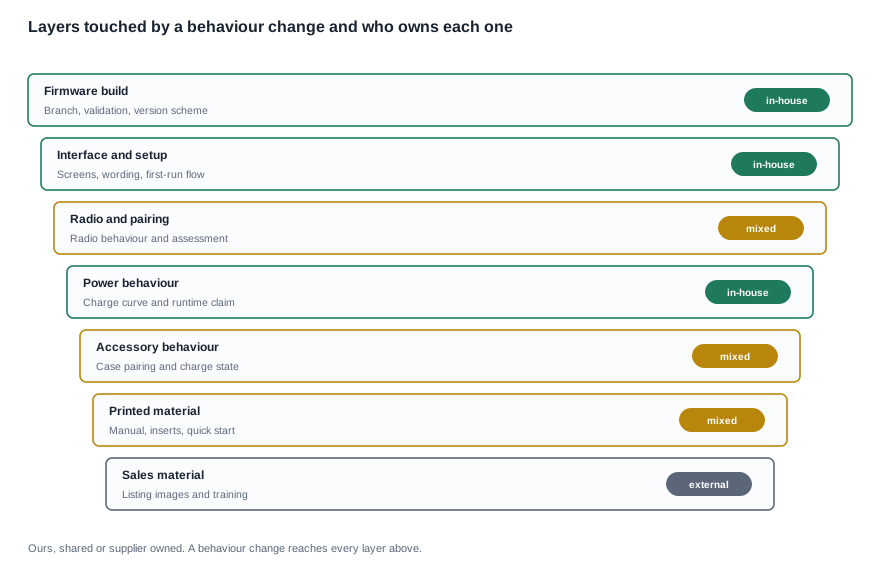
The cost of a system change is not a function of the size of the change. It is a function of the size of the change multiplied by how much of the programme has already been closed. A change requested before the baseline is released costs the engineering work and a validation cycle. The same change requested after the baseline is released costs the engineering work, a new validation cycle, a new version, a reissued manual, re-shot listing images, a re-trained distributor network, and a decision about the units already in the field.
That last item is the one that turns an inconvenient change into an expensive one. A field population is created by every release, and it does not disappear. Once two builds are live, every support question has to establish which build the customer is holding before anyone can answer it. A change that adds a third build multiplies a problem that was already there.
Three practical rules follow, and they are worth writing into the change process rather than discovering them.
The cost of a behaviour change rises sharply after the first production run. Before production, the build is one build and the documentation describes one product. After it, the documentation describes one product and the field contains another. The second one is not a bigger engineering job, but it is a bigger management job, and management jobs are where the time goes.
Changes to the radio and the power behaviour are more expensive than their size suggests. They reopen an assessment, and an assessment has a duration that cannot be compressed by enthusiasm.
Changes to the interface layer are cheap to make and expensive to distribute. The engineering is usually a day; the re-issue of a manual in three languages, the re-shooting of listing images and the re-training of a channel partner are not.
A buyer who wants to negotiate well on a customisation programme should therefore negotiate for a defined change window rather than for a fixed scope. A fixed scope invites requests to be made late, because the request appears to be free. A change window, with a stated consequence for requests made outside it, prices the timing correctly and moves the discussion to where it belongs.
The criteria for a change window are worth setting before the programme starts, because they are much harder to set once the first late request has been granted. Three questions define one: which changes are always allowed with no window at all, for example a defect correction or a regulatory requirement; which changes are allowed inside the window at no charge, for example wording corrections in a translation; and which changes are allowed outside the window and at what cost. Buyers who agree those three categories in advance find that the late-request conversation mostly disappears, because the answer was given before the request was made. Buyers who do not agree them find the same conversation happening four or five times, each time with a different request and a different sense of unfairness.
The same logic applies to the supplier's side of the window. A factory that agrees to unlimited changes inside a window will spend the window re-verifying instead of producing, and the buyer will pay for it in a later date without knowing why. A bounded window with a stated number of included changes is a better commercial arrangement for both parties, and it is the arrangement we would propose.

Engineering customization and the questions to ask about any behaviour change
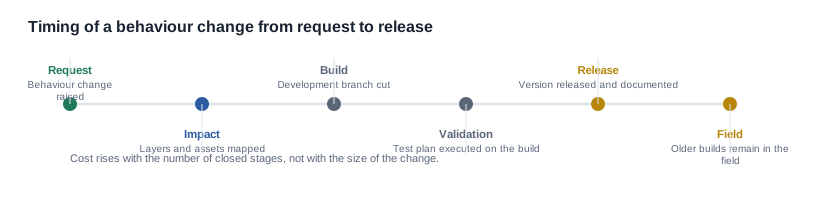
Before a behaviour change is estimated, five questions will tell a buyer almost everything they need to know about its cost and its consequences. They are worth asking because each one has a different answer depending on the change, and each one exposes a dependency that is otherwise invisible.
- Which published specifications does this change affect? A change to charging behaviour touches the charge-time and runtime rows. A change to the interface touches the listing images and the manual. A change to the radio touches the certification position. The published rows are the cheapest possible dependency list, because they are the claims the product makes to the market, and a change that invalidates one of them is not a private engineering matter.
- What has to be re-issued, and to whom? The manual, the quick start card, the packaging artwork, the listing images, the training material, the support scripts. Each re-issue has a lead time and an owner, and the owner is often the buyer.
- Does it change anything for the units already in the field? If yes, the change is not just a new build; it is a migration question, and it needs an answer about who updates which units and what happens to those that are not updated.
- What has to be re-tested, and can that testing be repeated? Some behaviour can be re-verified with a sample and a checklist. Some behaviour has to be re-assessed as a whole. The distinction is the difference between a week and a month, and it is not visible from the request.
- Who approves the release, and against what written expectation? A behaviour change without a written expectation is a change without an acceptance criterion, and the release will be judged against the reviewer's memory of the request rather than against a document.
The third question is where most of the attention should go, and it is where most buyers are least prepared. A field population is a fact of life in this category, not an edge case. Buyers sometimes assume that because the change is small, it can be applied silently to units in the field. It can, and the result is a mixed population with no documentation, which is the specific condition that makes technical support expensive for the rest of the product's life.
There is a version of this that applies before the first shipment rather than after, and it is worth separating out because it is cheaper. If the buyer expects a behaviour to change twice in the product's life, then the programme should be designed with a versioning scheme, a documented field position and a channel for updates from the start, rather than retrofitting them at the first change request. The design cost is a rule that every build carries an identifier and a changelog, and that every release states what it does to units already in the field. That rule costs nothing until it is needed and then saves an entire release cycle, and it is the difference between a product with a support plan and a product with a support history.
For a buyer assessing a supplier during due diligence, the quickest way to see whether this discipline exists is to ask which builds of a recent product are currently supported, and what happens to a unit running an older one. A supplier that can answer both questions has a versioning practice. A supplier that answers in terms of the latest firmware has the file but not the process, and the difference will appear the first time a customer calls with an older unit.

Engineering customization and the dependencies nobody lists
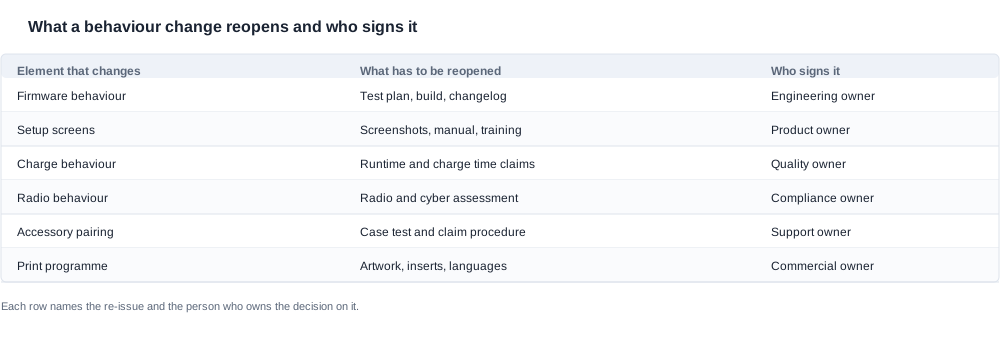
Every factory has a standard change list, and the standard change list covers the changes the factory has made before. The dependencies that get missed are the ones that are specific to a brand programme, and they fall into four groups.
Brand-specific language. The brand name appears in the device list, on the setup screens, on the packaging, on the insert, in the manual and possibly in the serial format. A behaviour change that introduces a new screen introduces a new place where the brand name has to appear, and the places where the name appears are usually maintained in several places at once. The checklist that prevents this is short: search for the product name and for the old behaviour in every asset, and compare the results with the change record.
Accessory combinations. A brand that sells a model with a published case capacity, a model with a case of an unpublished capacity and a model with no case row at all has three accessory behaviours to consider for any change that touches charging, pairing or status indication. The V03 Pro, whose case position the catalogue does not publish, is the clearest example of a configuration where a behaviour written for the rest of the range cannot simply be assumed to apply.
Market and language variants. A change to the interface has to be assessed per language, and a change to the packaging artwork per market. The cost is proportional to the number of variants, and the number of variants is rarely the number the buyer thinks of, because a market may need its own insert even when it shares a language with another market.
Channel and distributor material. Distributors sell from their own listings and their own training. A behaviour change that is released to the factory and to the brand but not to the channel produces a gap that shows up as returns and as support calls from customers who were told something that is no longer true. This is the dependency with the longest tail, because the material sits with third parties.
The last of the four is the one that most often decides whether a change is worth making at all. A behaviour change that the channel will never hear about is a change that will be discovered by a customer. A buyer who is choosing between two candidate changes should ask which one the channel can actually be told about, and which one the channel will simply absorb. The trade-off is straightforward: a change with no channel communication is only viable when the behaviour is invisible to the end customer, and that is a narrower condition than it first appears.
The practical method for catching all four is to write the change down as a set of nouns — screens, names, documents, accessories, markets, channel material — and then to ask each noun where it appears. The method is unglamorous and it is the reason some programmes are surprised by a manual that still shows the old behaviour three weeks after the change shipped.

Engineering customization and the record that closes a system change
A system change is closed when four things are true, and the record is what proves them.
The behaviour is written down. A specification of what the product now does, in the words that will be used in the manual and in the support scripts, approved by a named person.
The version is identified. The build identifier, the release number, the date, and the list of units and configurations it applies to. Without a build identifier, a behaviour change cannot be traced, and a claim about behaviour cannot be assessed.
The affected assets are listed. Every document, image and asset that changed with the release, with its version and its owner, and a statement of the assets that were reviewed and found not to need changing. The second half matters, because it is what stops the same question being asked again in the next release.
The field position is decided. What happens to units already in the field: updated, supported as they are, replaced, or supported only for warranty. That is a decision with a cost attached, and it is much cheaper to make once, in writing, than to leave open until a customer asks.
We publish no firmware version policy, no obsolescence commitment and no support service-level row, so all four of these are agreed per programme rather than inherited. That is not a weakness in the offer; it is the reason a system change has to be handled as a documented event rather than as a small request. Send us the behaviour change and the base model, and we will map the layers it touches, mark the published specifications it affects, and set out what the release and the field decision would involve.
Related reading
- Where a customisation request belongs in the range — engineering customization
- The stage where the baseline is set — the requirements phase
- The document set a shipped product has to match — certification checklist


