

Every customisation programme has a schedule, and every schedule in this category is quoted as a number of weeks that nobody can reproduce. The reason is simple: we do not publish lead times, programme dates or production capacity, because all three depend on the model, the depth of the customisation, the tooling state and the current load on the line. So the honest answer to "how long will it take" is a method rather than a figure, and this article is that method: the stages, what each stage actually waits for, which changes compress the schedule and which lengthen it, and how to hold a date when the programme moves.
The most useful thing to understand about a customisation timeline is that most of it is waiting. The engineering work in a programme is usually the shortest part of it. The longer parts are the waits for an approval, for artwork to be proofed, for a printed insert to be produced, for a regulatory assessment to be booked, and for the buyer to answer a question that was never asked clearly enough to answer quickly. A buyer who understands that the programme is a chain of waits will manage the schedule very differently from one who assumes the factory is simply slow.
It helps to separate two dates that buyers routinely run together. The programme date is the one the factory is working to, and it is the sum of the stages and the gates described below. The commercial date is the one the buyer has promised to its own market, and it is the programme date plus the buyer-side commitments that follow it: the channel listing, the retailer launch, the marketing that was booked against a date. The gap between the two is where a launch goes wrong, and the gap is usually owned by the buyer's side rather than the factory's. A programme that is on time for a shipment that misses a retail launch is on time and still a failure.
There is a second reason to plan against stages rather than against a single number. A number cannot be renegotiated; a stage can. If a buyer knows that the date is dominated by a printed packaging programme, the conversation is about artwork and print slots. If the buyer does not know that, the conversation is about whether the factory can go faster, which is the one question no factory can answer usefully.
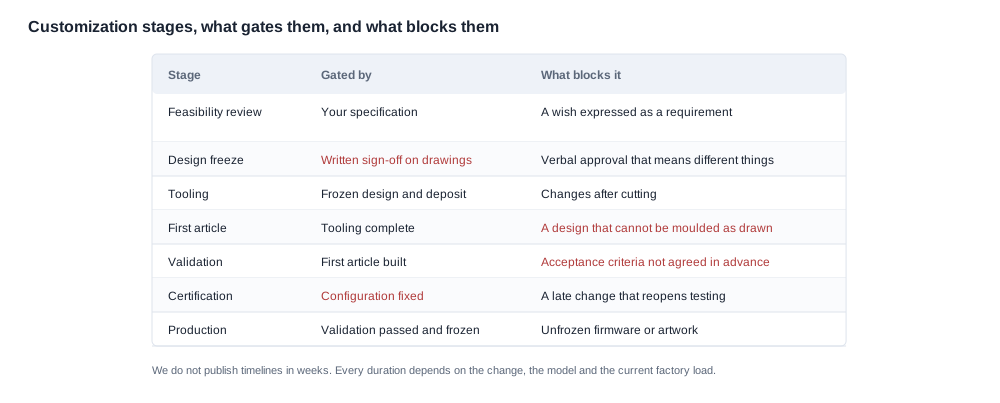
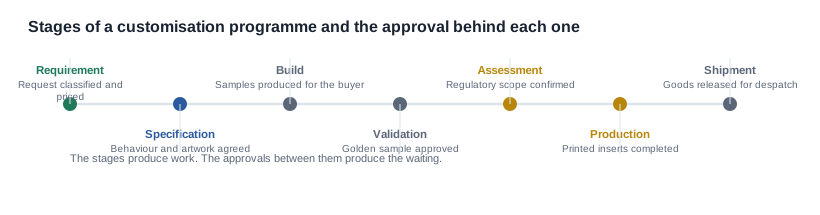
Engineering customization timeline: the stages and their real gates
The stages of a customised programme are broadly consistent across suppliers, and so are the gates between them. The gate matters more than the stage, because the stage produces work while the gate produces delay, and the gate is where a buyer usually has more influence than they realise.
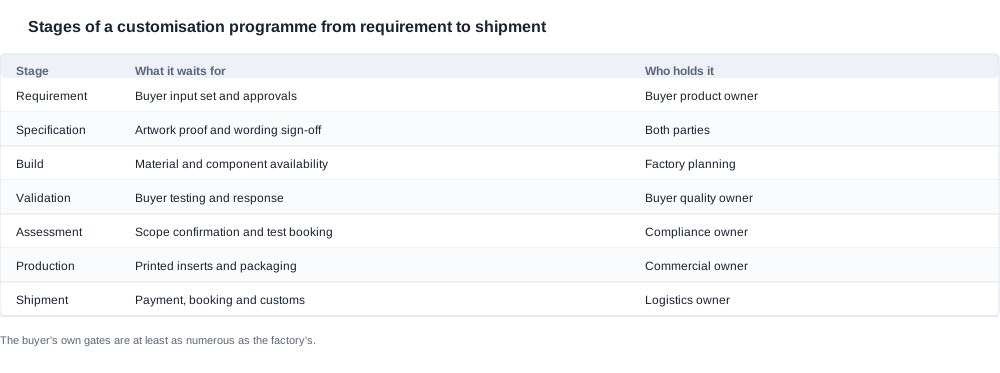
The requirement stage. The request is classified, the inputs are collected and the requirement set is written. What it waits for: the buyer's input set and a decision on who approves the requirement. Who holds it: the buyer's product owner, because the requirement cannot be closed without the buyer agreeing what is required.
The specification stage. Behaviour, artwork, packaging, inserts and the market list are written and agreed. What it waits for: artwork proofs, wording approvals and the decision on which languages and which markets. Who holds it: both parties, because the artwork usually comes from the buyer and the print programme from the factory.
The build stage. Materials are prepared, components are allocated, tooling is confirmed or cut, and samples are produced. What it waits for: material and component availability, and the first build slot. Who holds it: factory planning, but a buyer who has not settled the configuration cannot be given a slot, because a configuration change after the slot is booked restarts the wait.
The validation stage. The samples are tested against the written specification and the golden sample is approved. What it waits for: the buyer's testing, and the buyer's response. Who holds it: the buyer's quality owner, and this is very often the longest single wait in the whole programme, because it is the stage where the buyer's own organisation has to find time.
The assessment stage. Whatever regulatory scope the change requires is confirmed and any necessary testing is booked and completed. What it waits for: scope confirmation, test booking and test execution. Who holds it: the compliance owner, and we publish no per-model certification row, so this scope is established per programme rather than inherited from a catalogue. It is worth flagging for buyers that our export-certification page is a picture page showing ten patent certificates, eight design patents and two utility models; that is a different kind of evidence from a regulatory test record and should not be read as one.
The production and packaging stage. The production run happens, the printed programme runs, and the packing and carton quantities are produced. What it waits for: printed inserts and packaging availability, which has its own lead time and its own minimum, and which is routinely underestimated because it is the last thing to be ordered and the first thing to be late.
The shipment stage. Booking, payment terms, freight terms including FOB and DDP, customs and delivery. What it waits for: payment and documentation. Who holds it: logistics, on both sides.
Two observations about this list. The first is that the buyer's own gates are at least as numerous as the factory's, which means the buyer is usually at least half of the critical path. The second is that the gates are cheap to accelerate and expensive to ignore, because a gate that is rushed produces a decision that has to be revisited, and revisiting a decision costs more than the gate did.

Engineering customization and the three change categories that set a schedule
Not all customisation takes the same time, and the reason is that the change categories have different dependencies. This is the single most useful planning tool a buyer has, because it lets a date be estimated per request item rather than per programme.
Configuration changes — a device name, a startup string, a serial format — are usually the fastest, because they need no new material, no new tooling and no new artwork. Their gate is the build identifier and the verification of the value on a sample. Their real risk is not time but field population: a name applied in March does not retroactively change the units shipped in January.
Production changes — a colour, a surface treatment, a printed programme, a packaging structure — sit in the middle. Their duration is dominated by external lead times rather than by factory work: a new colour needs a batch or a tool with a minimum, and a print programme needs artwork, proofs and print capacity. Their gates are the artwork approval and the first-article inspection.
Engineering changes — firmware, setup flow, pairing, structure, battery, case — are the slowest, because they carry the longest dependency chain. A behaviour change needs a build, a validation cycle, a documentation re-issue and a decision about the units already in the field, and if it touches the radio or the handling of personal data it also needs an assessment whose duration is not ours to compress. A structural change adds a tooling step and a radio assessment on top of that.
The practical consequence is that a programme's schedule is really a stack of per-item schedules, and the longest item in the stack usually determines the date. Buyers who send a request with one deep engineering change and several shallow configuration changes should expect the date to follow the deep one, and they should be careful not to read the fast items as evidence that the programme is moving quickly.
The test for which category a request falls into is deliberately simple: ask whether the change alters what the product does, or only what it is. A change that alters behaviour, structure or a specification carries validation and possibly an assessment. A change that alters only appearance, wording on paper or a value in a settings table does not. The trap is the mixed request, where a single sentence contains both, and where the whole request is then scheduled as the deeper category even though most of it is shallow. Splitting the request is worth doing, because it lets the shallow items release early and it stops the programme from waiting on the deep one. The trade-off is administrative overhead, and it is worth paying for a request that contains more than one category.
A second consequence is about the specification itself. The catalogue's published rows are uneven in a way that is directly relevant to how long a validation stage takes. Charging method is magnetic on 17 models and Type-C on 7, and is not published for CY03 and MT6, and CY05 and L1 Pro. An ingress rating appears only on V06 and S7 at IP54. A weight appears only on MT6, at 158 grams for the glasses alone and excluding its foldable case. Charging case capacity is published for five models, two more have a case with no published capacity, and three have no case row at all, with V03 Pro explicitly shipping without one. Charge time is published as two hours or less for 26 models, which is a ceiling rather than a measurement. Each of those gaps is a validation task that has to be written down rather than assumed, and each one is a day of testing that would otherwise have been assumed to be zero.

Engineering customization and the mechanism that actually holds a schedule
A schedule holds because of a mechanism, and most programmes do not have one. The mechanism has four parts, and it is worth naming them precisely because they are cheap to set up and expensive to retrofit.
An agreed start event. The clock starts from a defined event, not from the first email. For most programmes the right start event is the point at which the last required buyer input has been received in the agreed format, because that is the point at which the factory can actually begin. A schedule that starts at the enquiry date will slip by exactly the time the buyer takes to gather inputs, and it will look like the factory's fault.
A named approver per gate. Each gate has one person who can close it, and that person's response time is part of the plan. When several people must agree, the gate does not close faster; it closes at the speed of the slowest one, and the buyer cannot change that by asking more politely.
A published position. A short, regular statement of where the programme stands against the plan, which stage is open, what it is waiting for and what the recovery action is if the stage slips. It is a very short document, and it is the single most effective mechanism we have seen for preventing the slow drift that turns into a missed date. A programme with a published position and a recovery plan misses dates occasionally. A programme without one misses them and cannot explain why.
A recovery plan per stage. For each stage, the action that will be taken if it slips, decided in advance. Stage-specific recovery is ordinary work: if the artwork is late, the print slot is protected by ordering against a placeholder; if validation is late, the next build is scheduled with a contingency unit; if the assessment is late, the shipment decision is escalated rather than deferred. The recovery plan is what stops a slip from becoming a cascade, and it works because the actions are prepared while the schedule is still healthy.
One caution about compressing a timeline. The fastest way to shorten a programme is to start the parts that can be started, and the parts that can be started are the ones with no dependency on the open gate. That is real compression and it is free. The second fastest way is to reduce the number of variants and markets in the first release, which is a trade-off against the commercial ambition of the programme and should be made explicitly. The third is to accept a longer validation stage and a shorter assessment stage, where the trade is acceptable only if the change touches nothing in the radio or the data handling. The way that does not work is skipping a gate, because a skipped gate does not remove the work; it moves it into the shipment stage, where it is more expensive and less visible.


Engineering customization and the question of what a lead time covers
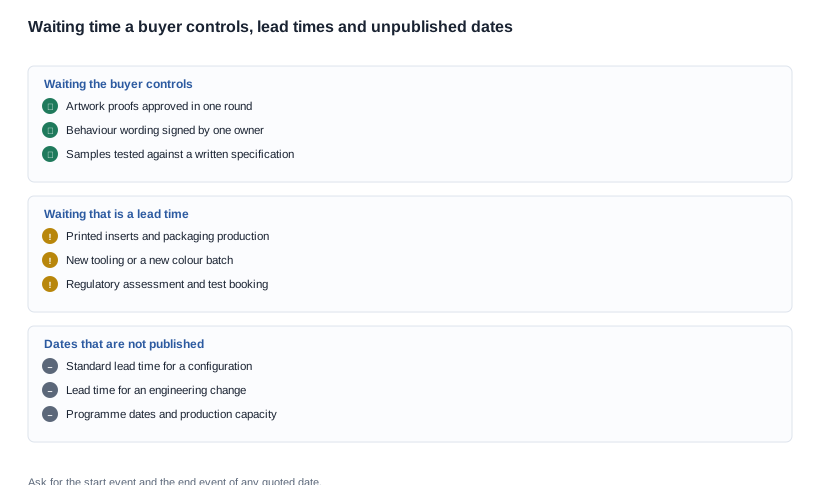
Because we publish no lead times, the most important question a buyer can ask about a date is what it covers. A number without a start and an end is not a date, and the two missing halves are where the disagreements come from.
A quotation's lead time should name the start event, which is usually the approval of the artwork and the receipt of the final inputs, and the end event, which is usually the goods being ready for shipment rather than the goods arriving. Between those two points there are at least five items that are frequently assumed to be inside a lead time and are usually not: the buyer's own approval time, the artwork proofing round, the print programme for inserts and packaging, the regulatory assessment where one is required, and the payment and documentation steps before booking. A date that excludes all five is not dishonest; it is just a different date from the one the buyer is imagining, and the negotiation is much easier once the two are on the same page.
The second half of the question is what happens when the date is missed. A programme with a published position and a recovery plan will usually say so before the buyer asks, and that is worth a great deal in a relationship. A programme without one will say nothing until the shipment does not arrive, and the buyer will spend the time reconstructing the position from emails.
There is also a commercial question that belongs in the same conversation. The trade-off between quantity, price and date is real in this category and it is worth naming explicitly rather than discovering late. A larger order is usually better for price and worse for cash; a shorter programme is usually better for the launch date and worse for the unit economics; a deeper customisation is usually better for differentiation and worse for both the date and the cost per unit. Buyers who want one of the three to move usually have to let one of the others give, and a negotiation that states which one is moving is much more efficient than one that asks for everything at once.
Engineering customization and how to compress a timeline without losing control
Compression is not the same as speed. Speed is doing the same work faster, which in a factory is usually limited by how the line is scheduled. Compression is removing waiting, and waiting is where the recoverable time is.
Four moves account for most of it.
- Supply the inputs in the agreed format, on the agreed date. The single largest controllable delay in a customisation programme is the buyer assembling artwork, wording and specifications after the factory has asked. A buyer who keeps a template for each input type — artwork, colour reference, name list, behavioural wording — removes most of that delay without changing anything else.
- Close gates with one approver. Every gate with two approvers is a gate with a queue. Naming a single approver and a deputy, in writing, at the start of the programme, removes most of it.
- Decide the variant set at the start. Every additional colour, language or market adds a print and artwork dependency and, in many cases, a separate validation pass. Fixing the first release's variant set, and accepting that the second release adds more, is the cleanest way to protect a date.
- Ask for the status before asking for the date. A published position tells a buyer where the recoverable time actually is. It is a better use of a weekly call than a general request for progress.
The last of these is worth expanding, because it changes the character of the relationship. Buyers who treat a factory as a black box end up asking for acceleration, which is expensive and often impossible. Buyers who treat the factory as a system with visible stages and visible waits end up making the decisions that actually shorten the programme, which are decisions about their own inputs and their own approvals.
There is also a scheduling decision that belongs in the first week rather than the last: whether the first shipment is the only shipment or the first of several. A programme built around a single large run can concentrate its effort, and it also concentrates its risk, because a problem found after that run affects everything at once. A programme built around a staged release — a small first run to prove the configuration, a second run once the field reaction is known — compresses the time to certainty, and certainty is usually what a launch date actually needs. The trade-off is a less favourable price on the first run and more administrative work, and for most first-time brands the second run is the cheaper option.
We are happy to be part of that system. Send us the request and the target date and the constraints behind the date, and we will say which stage dominates it, which parts of the date are ours to hold, which parts are waiting on your side, and what we would need in order to compress it. We will also say plainly where a date cannot be met, because a date that is honest at the start is worth more than one that is optimistic and then defended.
Related reading
- What a customisation request covers and how it is classified — engineering customization
- The stage where the baseline is set — the development process
- How a new product line is built out from a platform — ODM development


