

A trading company is not a bad thing to buy from, and pretending otherwise makes the conversation worse. A trading company buys from factories, aggregates volume, handles the export documentation and can be faster and cheaper for a small order than a factory that would rather sell direct. The problem is not the business model; it is the ambiguity. A supplier that presents as a factory and is actually a trading company will give you the factory's answers to the wrong questions, and a buyer who has not tested which one they are dealing with will find out at the worst moment.
The test below works because the two answer in different kinds, not in better and worse ways. That distinction is the whole design: there is no question here that a good intermediary would fail, and none that a careful factory would find difficult.
The failure mode this guards against is specific and common. It is not that a supplier lies about being a factory; it is that a supplier gives a true statement which, in the context of a different commercial model, means something else. "We work with several partner factories" is true. So is "we keep records". Neither is dishonest, and both are unanswerable as commercial terms until you know who holds the process.
There is a fourth kind of failure this test also catches, and it is the one buyers most regret: a supplier who is a factory but does not behave like one. Its production is real, its people are employed, and its quotation is still prepared by a sales office with no authority over the schedule. Such a supplier will answer most of the eight questions well and will fail on the two that matter commercially — the capacity question and the change-control question — because both require an authority it does not have internally. Classifying it correctly is not enough; the agreement has to be written to the part of the organisation that actually controls the process.
The test is also worth running more than once, because suppliers change. A company that was a factory when you first ordered may have sub-contracted an operation since; a company that was an intermediary may have acquired a line. Asking the eight questions again at the start of a second programme costs an afternoon and occasionally changes the commercial model of the relationship entirely.
Factory vs trading company: the eight questions and what each one separates
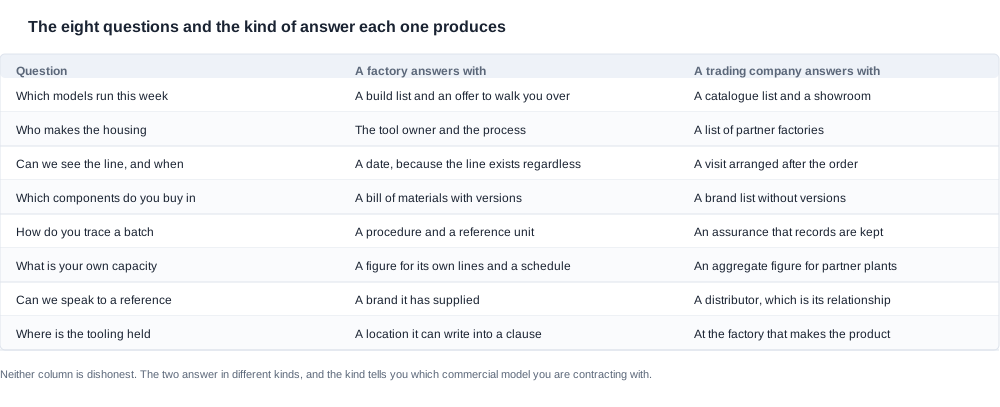
Which models are running this week? A factory answers with a list and offers to walk you to the line. A trading company answers with a list and shows you a showroom, because the list it has is the list it sells, not the list it builds. The follow-up that settles it is to ask which of them you could walk past on the floor.
Who makes the housing? A factory owns or controls the moulding and will tell you the name of the tool owner. A trading company will say it works with several factories, which is an honest answer and a different business.
Can we see the line, and when? A factory can usually accommodate a visit with a few days notice, because the line is there whether or not you are watching. A trading company will offer a visit after the order is placed, when it is arranging a factory visit for you, which is a reasonable service and a different answer.
Which components do you buy in? A factory answers with a bill of materials, usually with versions, because it has to control the change. A trading company answers with a brand list, which tells you the brand of the chip and nothing about the version.
How do you trace a batch? A factory has a procedure, a reference unit and a record, because traceability is a regulatory requirement it has to meet. A trading company answers that it keeps records, which may be entirely true of its own paperwork and tells you nothing about the goods.
What is your own production capacity? A factory gives a figure and a schedule for its own lines. A trading company gives an answer about the capacity of the factories it uses, which is a much larger number and a much softer one.
Can we speak to a reference customer? A factory will name a brand it has supplied and will make the introduction. A trading company will offer a reference, usually a distributor rather than a brand, because that is the relationship it has.
Where is the tooling held? A factory knows where its tools are and can put it in a contract clause. A trading company will say the tool is at the factory that makes the product, which is a perfectly normal arrangement and the one that determines what happens to the product if that relationship ends.
Two of the eight carry more weight than the other six, and it is worth knowing which. Question five, batch traceability, is the strongest test in the set, because traceability is an obligation that falls on the party placing the product on a market and is therefore something a factory has had to build whether it wanted to or not. Question eight, tooling location, is the strongest commercially, because the answer determines who you actually depend on for your second order.

Why the two answer in different kinds rather than different qualities
The two answer in different kinds rather than in different qualities. A factory gives a specific, verifiable, sometimes inconvenient answer: a name, a location, a procedure, a date. A trading company gives a general, aggregate, usually well-meant answer: several factories, records, a visit later, a reference.
Neither set of answers is dishonest, and a good trading company is a good partner for a good buyer. What the test establishes is which commercial model you are in, and that matters for three things. The price, because a factory quotes the factory's cost and a trading company quotes a margin on it. The lead time, because a factory controls it and a trading company has to negotiate it. And the risk, because with a factory you own the relationship with the party making the goods, and with a trading company you own the relationship with the party who arranged them.
There is a consequence here that is easy to miss. The three differences are not renegotiable after the fact. A price agreed with a party whose cost you cannot see cannot be reopened on the basis of information you did not have at quotation time. A lead time given by a party who does not control the schedule carries a dependency that does not appear anywhere in the document. And a relationship with an arranger rather than a maker cannot be converted into a relationship with a maker later, because the maker has no obligation to you at that point.
This is why the classification is worth doing before the purchase order rather than during the returns process. By the time a defect rate is being discussed, the commercial model has already determined who bears the freight, who takes the rework and who has to be persuaded.
A third consequence is less obvious. The two models produce different technical files, not merely different contracts. A factory holds the process knowledge that a technical file describes — the component versions, the build records, the tooling references — and can supply it. A trading company holds the commercial documentation and must obtain the process knowledge from a partner, which means the file depends on a third party's willingness to co-operate with a party it is not contracting with.
What the test does not settle, and how to settle it
Even a perfectly classified supplier leaves three things unresolved, and a buyer who assumes otherwise is carrying open risk into a purchase order.
Capacity and lead time. Neither is settled by the classification; it is settled by the supplier's own position. Our documentation publishes no lead times, no production capacity figures and no minimum order quantities, and our own source material records the minimum order quantity figures as unresolved. These are confirmed per enquiry because they depend on configuration, quantity, documentation scope and the current schedule — and a number quoted without that context is not one you can plan against.
Certificate coverage. The classification tells you who holds the process; it does not tell you who holds the evidence. Our documentation claims CE, FCC and RoHS at company level and publishes no certificate number, issuing body or validity period for any model, so the question of what exists for a given model code has to be asked separately and answered separately.
Sub-supplier visibility. A factory may sub-contract a specific operation, and an intermediary sub-contracts the whole. In both cases the audit rights differ from the build rights, and the question worth asking is which sub-suppliers you are entitled to audit as a matter of contract rather than as a matter of goodwill.
The practical method for settling all three is to convert them from general questions into specific ones. Instead of "what is your capacity", ask what capacity you can commit for our configuration and quantity, by when, and what happens to the commitment if it slips. Instead of "are you certified", ask which documents you can produce for this exact model code today, which are in progress, and which we would have to obtain ourselves. The specific version produces a schedule; the general version produces a claim.

What to do once you know which one you are dealing with
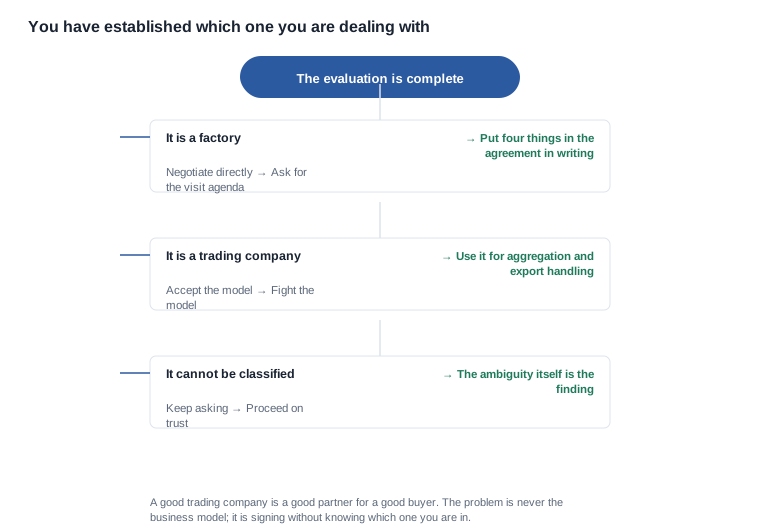
If it is a factory. You can negotiate the bill of materials, the compliance scope, the change control and the tooling ownership directly, and you should put all four in the agreement. The advantage is real and it is the reason to pay a factory.
If it is a trading company. Accept the model and use it. Ask which factory will make your order, ask for the factory's own compliance position rather than the trading company's, and make sure the agreement with the trading company binds them to deliver goods from a named factory with a named compliance scope. The advantage here is speed, aggregation and export handling, and a buyer who fights that model is paying for the cost of it.
If you cannot tell. Then you have the real risk, and the answer is to keep asking until you can. A supplier that cannot be classified after a second conversation is telling you something, and it is not about factories.
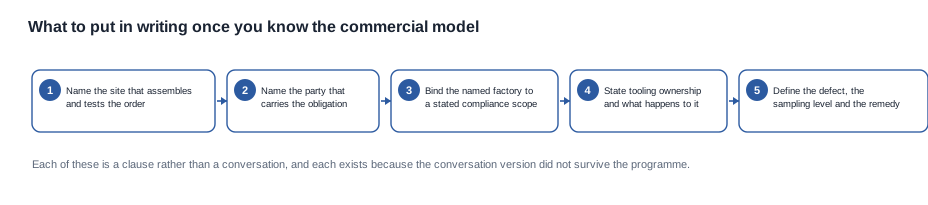
The clause that matters most in each case is different. For a factory, it is the change control clause, because direct access makes changes easy and an undefined change process turns that accessibility into schedule risk. For an intermediary, it is the binding clause naming the production site and its compliance scope, because everything else depends on the arranger being unable to substitute the factory without your agreement.
That second clause is worth reading carefully rather than accepting as boilerplate. The questions to ask about it are whether the named factory can be substituted with notice, whether the compliance scope travels with the goods if it changes, and what happens to the technical file if the factory changes. None of those questions is adversarial and all three are frequently unanswered.
The substitution question deserves particular attention, because it is the point at which an intermediary arrangement quietly becomes a different commercial model. If the production site can be changed at the supplier's discretion, then the supplier is not a party who has introduced you to a factory; it is a party who buys from factories. That may still be a good arrangement, but it should then be priced and contracted as one — with a specification that holds regardless of who builds it, and a compliance scope that travels with the specification rather than with the factory.
There is a parallel clause worth adding for factory relationships, and it is the mirror image: a requirement that the production site not be transferred without agreement. For a factory this is a normal protection rather than an unusual one, because the buyer has usually invested in the process knowledge at that site. It is worth asking for explicitly because the absence of the clause does not mean the factory would refuse it.
A final point on sequencing. All of this belongs before the purchase order rather than after the first shipment, but not before the quotation — the answers are frequently what make a quotation meaningful. A price quoted without a model in the answer tells you little; the same price quoted against a stated capacity and a stated evidence position tells you whether it will hold.

A due diligence checklist before you commit
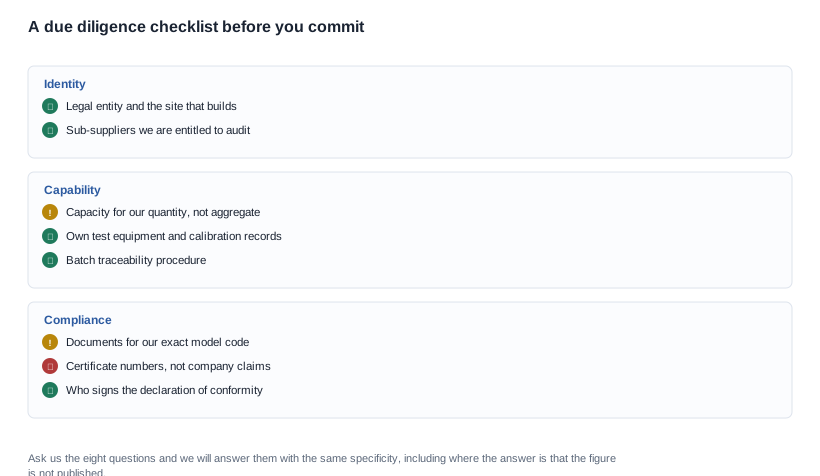
The checklist below is deliberately short. It is the set of items that, if unresolved, make the commercial model unworkable rather than merely uncomfortable.
- Identity. The legal entity you are contracting with, and the site that will assemble and test the order. Both, not either.
- Audit rights. Which sub-suppliers you are entitled to audit, and whether that right is contractual or at the supplier's discretion.
- Capability for your quantity. Not an aggregate figure, and not a figure for their partner network — a figure for your configuration.
- Evidence for your model code. Certificate numbers rather than company-level claims, and a statement of which documents you must obtain yourself.
- Tooling. Ownership, and what happens to it if the project ends.
- Remedy. A defect definition, an inspection scope and a stated remedy, in that order.
The fourth item is the one most likely to be answered in a way that sounds complete and is not. A company-level statement that the organisation holds certain approvals is a true answer to a different question from the one you need. The distinction is not pedantic: a model-level certificate and a company-level claim impose completely different obligations on the party building the file, and only one of them tells you whether the obligation is yours.
The sixth item is the one most often left to the end, and it is the one that matters most when something goes wrong. A remedy agreed at quotation stage is agreed in the abstract; a remedy agreed after a failed batch is agreed under pressure by whichever party has less room to move.
The checklist works best as a document rather than a conversation. Send it, ask for a written answer against each line, and treat a line that comes back unanswered as an unresolved risk with a name attached to it rather than as a gap that will be closed later. Suppliers answer a written checklist far more completely than they answer the same questions in a call, because the call permits the answer to be deferred to a follow-up that never arrives.
One item deserves a note about what a good answer looks like. For the evidence line, a good answer names documents rather than regimes: a specific certificate number, a test report naming your model code, and a statement of which items are not yet held. For the capacity line, a good answer gives a figure for your configuration and quantity together with the conditions attached to it. Answers of the "we are fully compliant" kind are not wrong, but they describe a category rather than a position, and a category cannot be checked.
Being clear about our own position and our published gaps
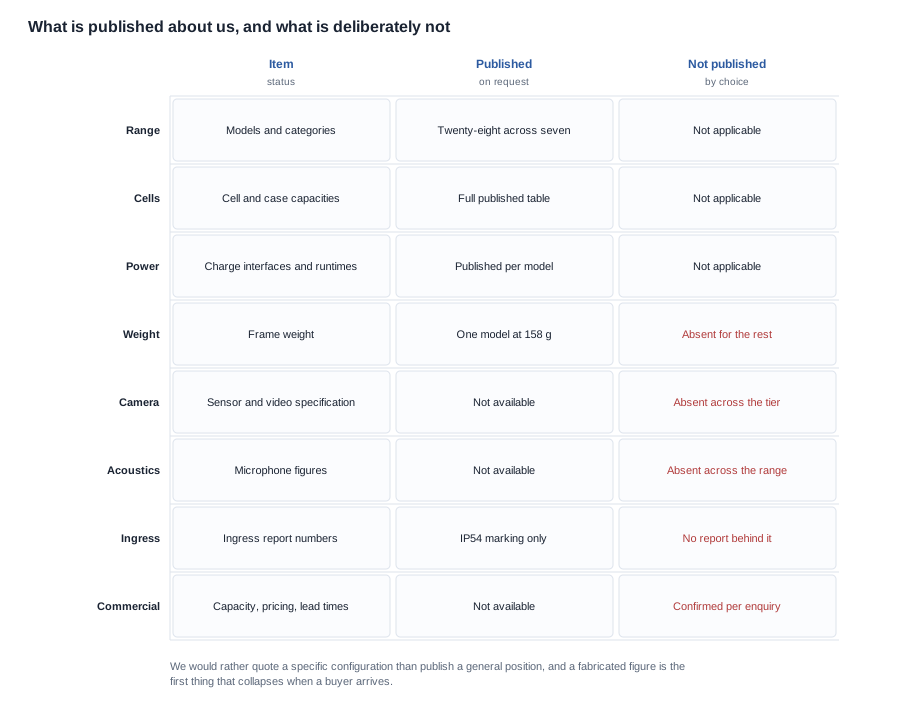
We will say plainly that we are a manufacturing business, and that the honest way to present that is to say what we make, which models are in production and which tooling we hold, rather than to ask a buyer to take our word for it. We publish the product data: twenty-eight models across seven categories, the rated runtimes, the charging interfaces, the battery capacities, the colour options, the charge times, the structural features, the camera tiers and the case capacities and the seven customisation points.
We do not publish our production capacity, our lead times, our minimum order quantities, our unit prices or our tooling costs, and they remain open internally, which is another way of saying the same thing: we would rather quote a specific configuration than publish a general position.
That applies to the framework weight as much as to the commercial figures. The frame weight is published for one model in the range — 158 g for the MT6 — and is not published for the rest. The sensor model, field of view, video specification, frame rate, stabilisation and storage behaviour are not published for the camera tier. The microphone specification is not published for any model. The lens performance figures are not published for the light-responsive entry. The seal material and the ingress test report numbers are not published. We would rather state a gap than fill it with a typical value, because a value we cannot substantiate becomes an obligation the moment it is printed on a document somebody relies on.
What we will do is arrange a factory visit for a serious evaluation, with an agenda rather than a tour, and let you ask the eight questions above on the floor. The engagement a factory offers is set out under standard OEM end to end, what a factory visit is actually for is covered in visiting and collecting a sample, the documentation that distinguishes the two models is in certification checklist, and the samples and how to judge them are in sample evaluation.
One closing observation about repeating the test. The eight questions are worth running again at the start of a second programme even when the first one went well, because suppliers change their commercial model over time and a factory that has sub-contracted an operation since your last order will answer the tooling question differently. The questions cost an afternoon and the answer materially changes what a purchase order has to contain.
The eight questions also work as a written questionnaire, and sending them in writing rather than asking them in a call produces measurably better answers. The reason is the same in every case: a written question is answered in the same terms it was asked, whereas a spoken question invites a spoken answer that can be completed later by somebody with less context. Suppliers answer written questionnaires well because they are used to producing documents; what they do less well is volunteering information nobody has asked for.
Related reading
- The engagement a factory offers — standard OEM end to end
- What a factory visit is actually for — visiting and collecting a sample
- The documentation that distinguishes them — certification checklist
- The samples and how to judge them — sample evaluation
Ask us the eight questions and we will answer them with the same specificity.


