
The certification pathway is the part of an ODM development programme with the longest lead time and the least visibility, and it is the part that most often decides the launch date without anybody deciding it. The reason is simple: a formal test result is valid for the configuration that was tested, and everything that changes the product after the test invalidates it. A programme that keeps changing the product after formal testing is not a programme that has a certification problem — it is a programme that has decided to do the work twice.

What follows is about the sequence, what has to be frozen at each stage, and what it costs to get it wrong. The cost is not primarily money; it is that retesting a battery product with a formal assessment is a schedule event, and schedule events are very difficult to recover from once a launch date has been announced.
ODM development: the pathway has the longest lead time and the least visibility
The reason the pathway is invisible is structural rather than organisational. Every other part of a programme produces something visible — a unit, a tool, an approved colour, a first article. The certification pathway produces documents, and documents do not appear until the stage that produces them has finished. A programme can be visibly and demonstrably on track for six weeks while its formal assessment is queued behind three other jobs in a laboratory that has not been told the programme exists.
That gap between visible progress and invisible progress is where bad decisions get made. Buyers who watch the product conclude the programme is nearly finished; the evidence that it is not arrives later as a date. The countermeasure is not better project management in general; it is simply establishing where the pathway stands, early and specifically.
Three things establish it. Where the design freeze sits, because everything before it is provisional and everything after it is evidence. Which markets are in the plan, because the pathway multiplies with them. And the current state of each document for the exact model code, because a company-level claim and a model-level document are different positions with very different consequences.
The third of those is the question to ask first, because it converts a general question about process into a specific question about somebody's actual position. "What is your certification process?" invites a description. "Which documents can you produce for this exact model code today, which are in progress, and which would we have to obtain ourselves" produces a schedule.

The stages, and what each one actually produces
Pre-compliance testing is the internal stage where the obvious failures are found on an early build. It is not a regulatory step and it produces no document anyone outside the company will accept. Its value is entirely in the early signal, because each failure found here costs a fraction of what the same failure costs after formal testing.
Design freeze is the point at which the product stops moving. The design, the tooling, the bill of materials, the firmware build and the packaging are all fixed. This is the single most consequential decision in a programme and it is usually made for the wrong reason — usually because somebody wanted to see a working unit rather than because the evidence supported it.
Formal testing is the assessment for a named market, performed on a sample that represents the product. What comes out of it is a report, and the report describes a specific configuration.
The report and the certificate are the evidence the market requires. Their value is entirely dependent on matching the product you ship.
The technical file is not a test result. It is the assembly of the evidence, the specifications, the risk assessment, the instructions and the traceability, and it describes the product as configured.
The declaration of conformity is the legal statement by the manufacturer that the product meets the applicable legislation. It is a statement about a configuration, and it has to be true about the goods that actually ship.
Marking and labelling is the physical evidence on the product: the markings, the model code, the identification of the responsible party where one is required, the warnings and the instructions.
Ongoing production is where the obligation continues. The production configuration has to stay inside what was tested, and somebody has to be watching that it does not.
The stage that buyers most often underestimate is the technical file, and the reason is that it is the only stage whose cost is not proportional to the hardware. The first seven stages are mostly engineering and test time. The technical file is a documentation exercise whose size depends on how many blanks the programme has to close, and in a category where several published rows are blank, that is where the real cost sits.
It is worth setting out what a technical file contains, because the list explains most of the surprises. The specifications of the product as built. The risk assessment that says what could go wrong and what was done about it. The test reports that support the claims. The instructions and warnings that will accompany the product. The traceability record that connects a shipped unit to its build. And, where the market requires it, the declaration of conformity signed by the party carrying the obligation.
The two items in that list most often missing are the risk assessment and the traceability record, and they are missing for the same reason: neither is visible until somebody asks for it, and neither is produced by the test laboratory. A risk assessment is a design activity that is frequently skipped because nothing has gone wrong yet. A traceability record is a manufacturing discipline that is frequently skipped because the units have not been mixed with anyone else's yet. Both become expensive exactly when they are finally needed.
There is also a distinction worth holding on to between the file and the certificate, because buyers routinely use the two words interchangeably. The certificate is a single document issued by a third party against a defined configuration. The file is the whole body of evidence, most of which the supplier holds and some of which the brand holds. A programme with a certificate and no file can face a market-access problem; a programme with a file and no certificate may simply not yet have been assessed. Neither substitutes for the other.
What has to be frozen, and what happens when it is not
The freeze is the point where the cost curve turns, so it is worth being precise about what is actually frozen and what the alternative looks like.
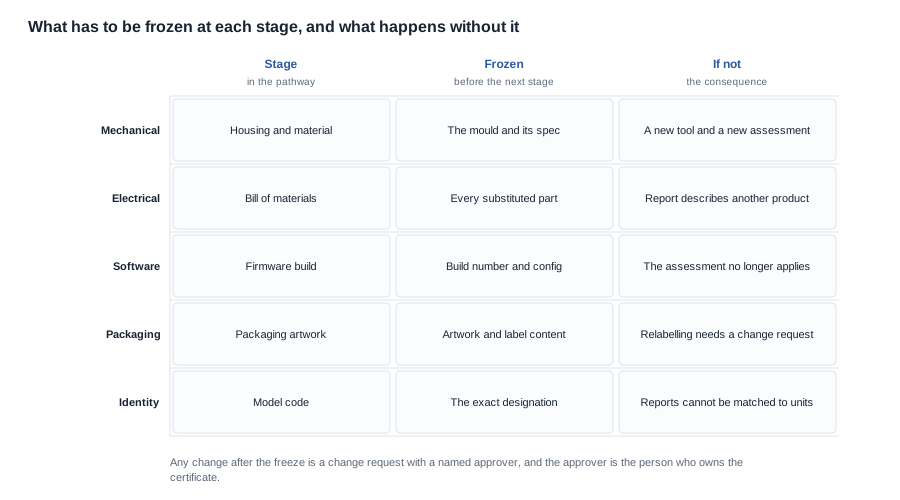
What is frozen: the housing and its material, the bill of materials including every substituted component, the firmware build and its configuration, the packaging and its artwork, the model code, and the label content.
What happens if you do not freeze it: the formal test is performed on a sample, and then a component is substituted for availability, or the firmware is updated for a bug, or the packaging artwork changes for a distributor. Each of those is individually defensible and collectively they mean the test result no longer describes the product. The response is to re-test, and a re-test on a battery product with a formal assessment is a schedule event, not a formality.
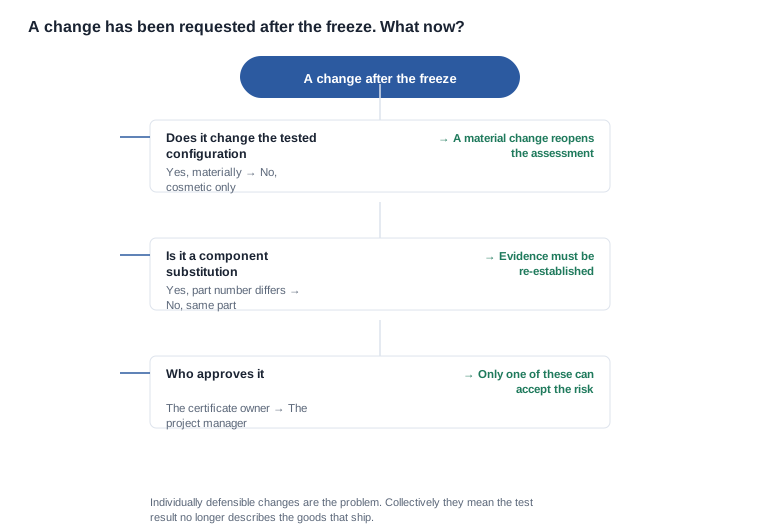
The rule that works is unglamorous: any change after the freeze is a change request with a named approver, and the approver is the person who owns the certificate. Not the project manager, not the commercial contact, and not the person who will be most inconvenienced by the delay. The reason the approver has to own the certificate is that the approver is the only person who can weigh a convenience against a legal exposure.
There is a practical complication that makes this harder than it sounds, and it is worth naming because it is where well-run programmes fail. Once a programme has shipped, the people who approved changes during development are frequently no longer involved, and the certificate has moved to whoever holds it now. A change process that names an individual rather than a role stops working the first time somebody leaves. A change process that names the role and records who currently holds it survives.
The other complication is firmware, because firmware is the change that most often looks harmless. A bug fix is easy to justify on its own merits and easy to apply without considering that it may alter the behaviour an assessment was performed against. The question to ask about any firmware change is whether it alters radio behaviour, power management, stored data handling or the pairing process — and if the answer is not known, the answer is that it should be treated as material until someone establishes otherwise.
The packaging artwork case is the mirror image, and it is worth stating because it surprises people who assume artwork is exempt. Artwork is not assessed, but it carries the label content, the warnings, the model code and the responsible party identification — all of which are market-specific and all of which the file has to describe accurately. A distributor-specific artwork change that alters the warnings or the model designation is therefore a change to the evidence, even though nobody has touched a line of firmware.
The third category is component substitution, which is the most common and the least visible. A part that is replaced because the original is on allocation looks like a supply chain decision and behaves like an engineering one. The bill of materials is part of what was assessed, so a substitution changes the evidence — but only if somebody records it, and a substitution recorded nowhere is indistinguishable from one that never happened until the file is audited.
That is why the freeze list above specifies "including every substituted component" rather than simply the bill of materials. The phrasing is doing real work: it makes substitutions a deliberate part of the frozen configuration rather than a background event, which is the only way to keep the evidence matching the goods.

Markets multiply the documents rather than the engineering
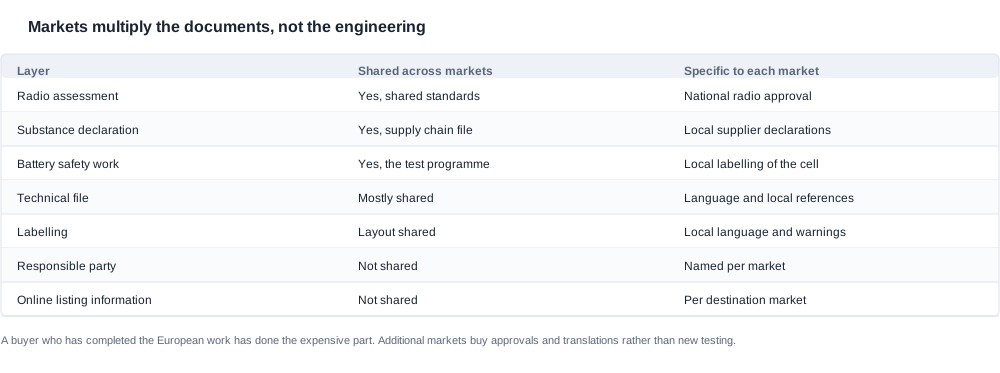
The pathway above is for one market. A product sold into several markets runs several of them, and the multiplication is not linear because the core evidence is shared.
The radio assessment, the substance declaration and the battery safety work are common to the European Union, the United Kingdom and most other markets, because the underlying standards are shared even where the marking is not. What is not shared is the market-specific layer: the national radio approvals, the local responsible party, the local language documentation, the label requirements, the market-specific plugins and the packaging insert set.
The practical consequence is that the number of markets multiplies the documents and the packaging, not the engineering. A buyer who has done the European work has done the expensive part, and a buyer who is launching into a fragmented set of markets is buying local approvals and translations rather than new testing.
That distinction changes the order in which markets should be added to a programme. Adding a market that shares the core evidence costs a label set and a translation. Adding a market that does not share it costs a technical file. Buyers who add markets in the wrong order — starting with the least similar market — pay for evidence that a different first market would have covered.
Two dates matter in the European layer and both are now in force. The General Product Safety Regulation has applied since 13 December 2024, and it is a separate obligation from CE marking rather than a part of it. The cybersecurity requirements of the Radio Equipment Directive became a mandatory part of CE marking on 1 August 2025, described by the EN 18031 series of harmonised standards, covering secure communication, encryption, secure storage, user consent and a process for handling identified vulnerabilities. A programme whose firmware was frozen before that date needs a specific answer to what it does about those requirements.
The six questions to ask a supplier about their pathway
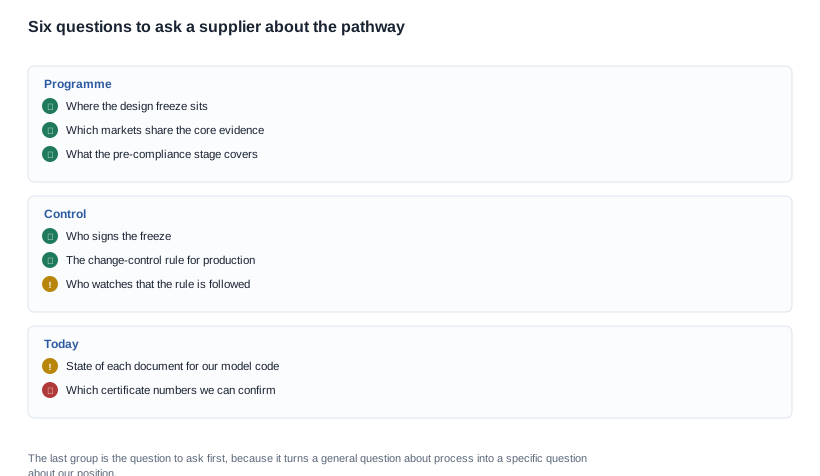
- Where in the programme does the design freeze happen, and what is included in it? A supplier who names a phase and a list has a process. A supplier who names a phase and no list has a milestone.
- Which markets are in the plan, and which of them share the core evidence? The second half of this question determines whether adding a market is a labelling cost or a testing cost.
- What is the pre-compliance stage, and how long does it take? This is the stage that catches cheap failures, and a supplier who runs a thorough one will say so rather than minimising it.
- Who signs the freeze, and what happens to a change requested afterwards? The answer should name a role rather than an individual, for the reason described above.
- What is the change-control rule for production, and who watches it? The second half is the part that is usually missing, because somebody has to be accountable for the ongoing obligation rather than merely for the process.
- What is the current state of each document for our exact model code? Produced, in progress, or not held.
The sixth is the question a buyer should ask first, because it turns a general question about process into a specific question about our position. It also has a property the other five lack: it cannot be answered well by anybody who does not hold the documents, which means a good answer is itself evidence about capability.
There is a seventh question worth adding when the programme has an unusual element — a camera, a radio feature, a battery configuration that differs from the platform default. Ask which parts of the assessment are specific to that element and which are inherited from the platform. The answer determines how much of the pathway is genuinely new work and how much is a re-issue, and it is the difference between budgeting for a development and budgeting for a document.
There is an eighth question, and it is the one most often left until the programme has already gone wrong: what happens to the pathway if the destination market changes? Products get re-pointed. A channel that was planned for one country becomes two, or a distributor requests a market the technical file was never written for. A supplier who can describe that scenario in advance has a process for extending a file; a supplier who has not will treat it as a new programme, which is defensible but expensive, and the buyer who did not ask will not have known which of the two was on offer.
The questions are worth sending in writing rather than asking in a call, for the same reason the sample protocol is worth sending in writing: the answers become a record that both parties can be held to, and they can be compared against the programme as it actually runs rather than against what anybody remembers agreeing.
Being direct about where our own position stands
We will say plainly that the certification pathway is the part of the programme most likely to determine the launch date, and that a buyer is entitled to see where it stands before an order is placed. Our documentation claims CE, FCC and RoHS at company level, and we do not publish the model-level certificate numbers, the test report numbers, the design freeze point, the assessment lead times or the change-control rule, because the company has not confirmed them. The minimum order quantities, the production capacity and the lead times remain open internally as well.
We will also be direct about a consequence of that position. Where a programme needs model-level evidence for a specific destination market, part of that file has to be assembled outside our documentation, and a buyer who assumes the file is complete when it arrives is planning against an assumption we cannot support. It is better to know that in week one than to discover it at release.
What we will do is take a specific model and a specific set of destination markets, and tell you which documents we can currently produce for that combination, which are in progress, and what has to be closed before the first shipment. That answer is narrower than a description of our process, and it is the only version that is worth planning against.
The reason we prefer that format is worth explaining, because it is the same reason this article is organised around documents rather than around stages. A programme is not delayed by the absence of a process; it is delayed by the absence of an answer. A supplier with an excellent certification process and no current position on a given model code has told you nothing you can put in a schedule, and a supplier with a modest process and a clear position has told you exactly what your critical path contains.
The document set itself is set out in certification checklist, the stage where the baseline is established is in the requirements phase, and the changes that move a product after the freeze are covered in system changes.
One closing point about the launch date. In most of the programmes where this pathway decides the date, the decision is made by implication rather than by argument: the launch is announced, the evidence is assembled afterwards, and the programme then spends the remaining time discovering which parts of the announcement the evidence will not support. Announcing a date only once the pathway position is known costs nothing and is the single cheapest control in this article.
That control is entirely within the buyer's gift, which is worth saying because the rest of the pathway is largely outside it. A buyer controls when the announcement is made, which documents they will accept as sufficient at that point, and whether the evidence is assembled before or after the commercial commitment. Suppliers control the assessment, and their processes are as good or as bad as they are. Where the two meet is the announcement, and a buyer who has established the pathway position before that date has already won most of what is available.
It is worth noting what the pathway does not contain. It does not contain a marketing claim, and it does not contain a listing. Both are outside the file, and both are constrained by it — a claim that the evidence does not support is a commercial exposure regardless of how the hardware was assessed. Programmes that keep the pathway and the claims work separate tend to discover the interaction late, and programmes that run them together discover it early.
Related reading
- The document set itself — certification checklist
- The stage where the baseline is set — the requirements phase
- The checks a programme applies — quality gates
- The changes that move a product after the freeze — system changes
Send us the models and the destination markets, and we will say which documents we can produce today and which have to be closed before the first shipment.


