

Maturity is the word that carries the most meaning and the least evidence in this category. Every platform programme is described as mature, and the description means whatever the writer had in mind: sometimes a production line, sometimes a catalogue page, sometimes a supplier who has been building the same model for years. A buyer who cannot turn the word into a test has no way to compare two suppliers, no way to spot a platform that is only mature on paper, and no way to know which parts of the maturity will be tested by the first order and which by the third.
This article sets out the six dimensions we use to assess maturity, how we score our own range against them, and the question list that reaches the same answer in a supplier conversation. The point of a framework is not the score. It is that a framework tells you which of your questions are being answered with a document and which are being answered with a habit, because those two kinds of answer behave very differently when the order changes.
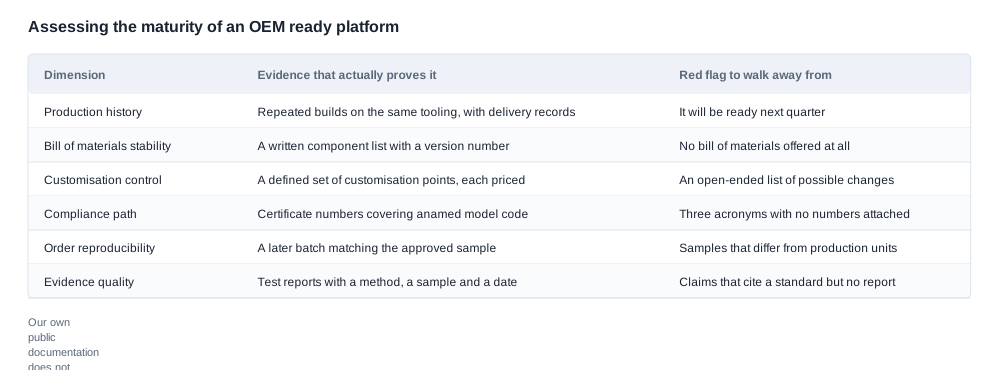
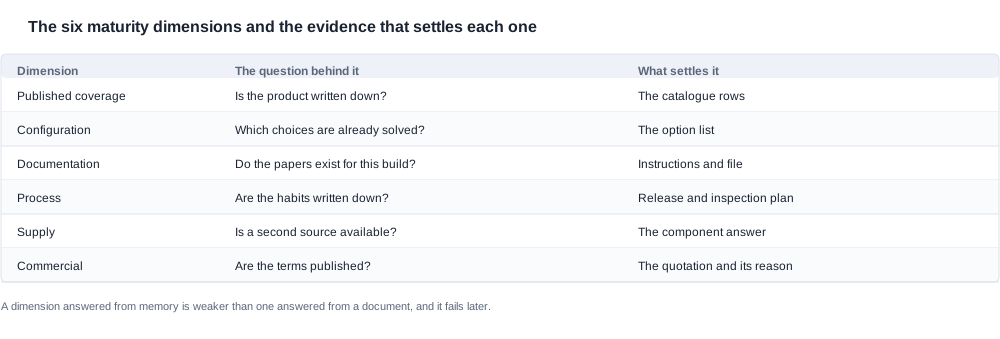
OEM ready maturity: the six dimensions and how each one is evidenced
Maturity is a property of a specific programme, not of a factory or a brand, and each of the six dimensions below can be tested by asking a question that has a documentary answer.
Dimension one is published coverage. It asks how much of the product the supplier has already written down: the models, the configurations, the specifications, the options, the limits. A platform that publishes its rows can be evaluated by a buyer alone, before any conversation; a platform that publishes nothing can only be evaluated by trusting the supplier, which is the opposite of a platform's purpose. The test is simple: can you read the specification of the thing you intend to buy, and does it say what you need it to say?
Dimension two is configuration coverage. It asks how many of the commercial choices are already solved as published configurations, and how much a change between them costs. This is the dimension that decides whether a programme can be run as a range. A platform with one configuration and a long option list is a platform with one configuration; a platform with several configurations that share a case, a cable, a carton and a firmware build is a platform that a multi-market brand can actually operate.
Dimension three is documentation maturity. It asks whether the documents that describe the product exist for the specific configuration, and whether they exist in the form the destination market needs. Instructions, packaging artwork, the conformity file, the test evidence, the support material, the labelling, the language set. This is where a platform most often turns out to be less mature than its catalogue suggests, because the catalogue describes the product while the documents describe the shipment.
Dimension four is process maturity. It asks whether the ways of working are written down: how a release is authorised, how a change is approved, how a first article is inspected, how tooling is maintained, how a non-conformance is handled, how a correction is closed out. A factory with good habits and no written process will produce the same result twice, until the day a person is on leave, and a buyer has no way to find that out before the order.
Dimension five is supply maturity. It asks how the components behind the published rows are sourced, whether a second source exists for the ones that matter, and what happens to the programme when one of them changes. A cell, a charging case, a chipset, a display or an acoustic component can each be a single-sourced part with a lead time of months, and a platform that publishes its rows but not its supply structure is asking the buyer to take that risk without seeing it.
Dimension six is commercial maturity. It asks whether the commercial terms are published, negotiated or concealed. Prices, minimum order quantities, lead times, warranty terms, sample fees and stage durations are the terms that decide whether a programme is affordable, and a supplier that treats all of them as enquiry-based has usually done so because they vary and cannot be stated.

How the framework scores our own range, honestly
Applying a framework to your own catalogue is uncomfortable, and it is the only way to know whether the framework is any use. Ours scores as follows.
On published coverage, our range is strong and deliberately so. The catalogue covers 28 models across the audio, sport, camera, children's and AR-adjacent groupings, and it publishes the rows a buyer needs to choose between them: charging case capacities at 900 mAh, 1200 mAh and 1400 mAh; charging interface by model, with seven models on Type-C and the remainder on magnetic charging; cell capacities for the camera models in the 220 to 290 mAh band; rated runtimes of roughly five to eight hours for the camera models; ingress rating where a model publishes one, which is two models in the range; and the single published frame weight, which is 158 g for the MT6 without its folding case.
On configuration coverage, our range is strong in the same way: the configurations and options are set out on the OEM ready products page, and the standard OEM position page sets out what we hold as a baseline. The honest limit is that a configuration is a published combination, not a bespoke one, and a buyer who wants something outside the set is starting a project rather than placing an order.
On documentation maturity, our position is that the documentation for a specific configuration and a specific destination market is assembled and confirmed per enquiry, because that is how conformity work actually runs: a document is tied to a model, a configuration and a market, and none of those three is fixed in a catalogue. We do not publish a per-model certification row for any model in the range, because the position is not published to us at the model level, and we will not print a conformity claim that our own record does not support. The certification checklist page is where the wider set of market access papers is described.
On process maturity, the working methods are described in the way a factory describes them: release and inspection planning, the tooling and fixture position, the correction cycle, and the sample route. The samples page covers how a sample programme is run, and what a sample does and does not settle.
On supply maturity, we publish the cell and case positions rather than the supplier structure behind them, and we say so. Where a component is single-sourced, a buyer who needs that visibility should ask for it in writing, because the answer changes the launch plan.
On commercial maturity, we are the weakest of the six, and we will not dress it up. Minimum order quantities, unit prices, production lead times, sample fees, warranty terms and stage durations are not published on this site; they are confirmed per enquiry, because each depends on configuration, quantity, tooling and the current schedule. A buyer who needs a published number will not find one here, and the honest reason is that a number we published would be wrong within a month.
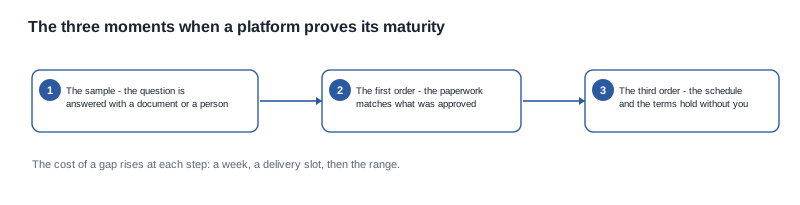
The three moments that expose maturity
Framework scores are easy to produce and hard to trust, because they are produced at the point of maximum good behaviour, which is before anything has gone wrong. The useful test is not the score but the three moments where maturity shows itself, and every one of them arrives in a different part of the programme.
The first moment is the sample. A mature platform answers a sample question with a document; an immature one answers it with a person. If your supplier cannot say which document answers the question you are asking, that is a maturity finding, not a service failure. The reason matters because a platform with published documentation can answer the question twice — once for you and once for the next buyer — while a platform that answers from memory can only answer once.
The second moment is the first order, at the point where something is different from the sample. The sample usually comes from the configuration you asked for. The first order is where the packing list, the artwork revision, the case variant and the accessory set have to match the documentation you approved. This is where documentation maturity is tested, and it is tested by the buyer's own paperwork: a mismatch between the approved artwork and the delivered carton is discovered by your own channel team, at your own cost.
The third moment is the third order. A platform that is mature at the sample and at the first order can still fail on the second, because the second order is the first one where the supplier is working from a schedule rather than from your files, and the first one where a component has moved. The third order is where supply maturity shows, and it is also where the commercial terms get tested, because a platform that has changed a price or a lead time without telling you has told you what its process maturity is worth.
The three moments are also where the cost of an immature platform is paid. A platform that is weak at the sample costs you a week. A platform that is weak at the first order costs you a delivery slot and a channel correction. A platform that is weak at the third order costs you the trust that the rest of the range was built on, and that is the one no supplier can invoice for.

What to ask a supplier, and in what order
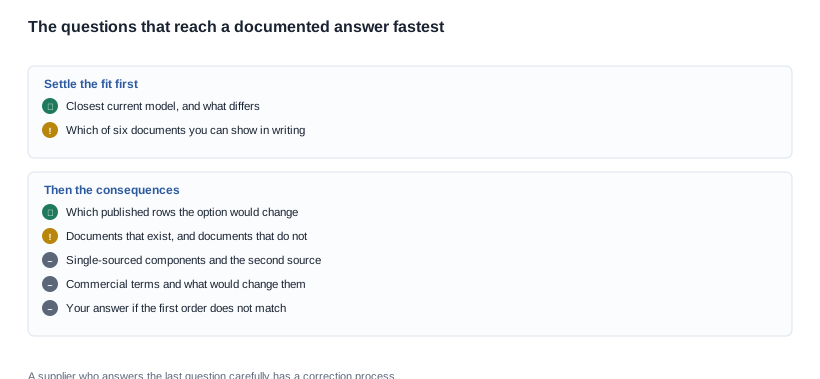
The questions below are ordered so that the expensive ones come first, because the answers arrive in the opposite order to the questions and a buyer who starts with the easy ones has already committed.
- Which of your current models is closest to the configuration we want, and what exactly differs? This is the fastest maturity test there is, because the answer is either a specific model with a specific list of differences, or a general statement about capability. A general statement tells you the supplier has not done the work yet.
- Which of these six can you show us in writing today: the model specification, the configuration list, the option list, the inspection plan, the sample route, and the correction process? Ask for the list rather than for a document. The list is the answer, and a supplier who cannot produce all six is telling you where the programme will slow down.
- Which published rows would change if we took the option we are asking about? This asks the supplier to do the work in front of you. A mature supplier can list the affected rows in a few minutes; an immature one has to go and find out, and the length of that pause is the answer.
- Which documents exist for our specific configuration and our specific destination market, and which do not? Ask for the absences as well as the existences. A supplier that lists only what exists is giving you a catalogue, and the absences are the part that costs time later.
- Which components in this configuration are single-sourced, and what is the qualification route for a second source? This is the question that decides whether a launch date is real, and it is the one most often not asked at all.
- What are the commercial terms for this configuration at our volume, and what would make them change? Ask for the reason as well as the figure. A term with a stated condition is a term you can plan around; a term without one is a term that will move, and the direction is not yours to choose.
- What is your answer if the first order does not match the approved paperwork? The purpose of this question is not the answer but the reaction. A supplier who answers it carefully has a correction process, and one who answers it vaguely does not.
The scoring that follows from these answers is not a number out of ten. It is a short list of the dimensions where the answer was a document, the dimensions where it was a habit, and the one dimension where you still have no answer. That last one is the one to resolve before the deposit, and it is usually the one that decides the programme.

What maturity looks like from the buyer's side
Maturity is an operational property, and the most reliable way to see it is to imagine the ordinary Tuesday of a buyer running several programmes on the same platform, six months after launch, when the launch team has moved on and the routine has taken over.
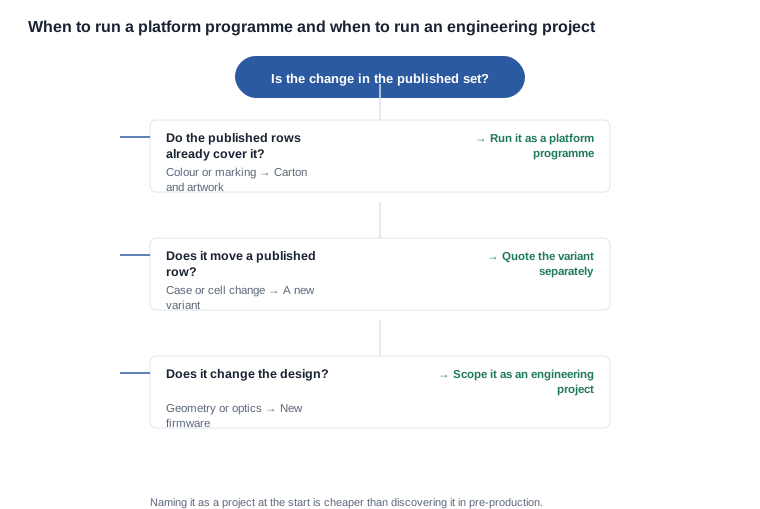
On a mature platform, that Tuesday has a shape. A colour or a market is added by asking for a configuration, and the answer is a date and a per-unit cost, because the change is an artwork and packing exercise that the platform already knows how to do. A second order is placed by repeating a configuration, and the answer is a lead time, because the rows that describe it have not changed. A question about a specification is answered by reading a document, because the document exists for the configuration being shipped rather than for the product in general. A component becomes hard to get, and the first conversation about it is with the supplier's own answer rather than with a discovery that two programmes were quietly dependent on the same part.
On an immature platform, the same Tuesday has a different shape, and the differences are small enough to be mistaken for ordinary business. The colour question takes two weeks, because the change turns out to touch a published row. The second order's lead time is quoted in a range so wide that the launch date has to be set twice. The specification question is answered by a person who explains it well but cannot point at the document, and the explanation will have to be repeated for the next person. The component problem surfaces on the second programme rather than the first, and it is discovered by a customer rather than by a purchase order.
The distinction matters commercially because the immature version is not cheaper; it is cheaper only on the first order. The extra time, the repeated explanation, the re-quoted launch date and the dependency nobody documented are all paid for by somebody, and on a platform programme that somebody is usually the buyer. A framework that measures maturity is therefore not an academic exercise for a procurement team: it is a way of pricing the ordinary week.
There is a second-order effect that only shows up over a range. A platform that is mature on one programme becomes cheaper on the next one, because the documentation, the artwork templates, the inspection plan and the conformity file are shared and already paid for. A platform that is immature does not get cheaper, because every programme repeats the discovery work. This is the mechanism behind the range economics that buyers describe when they say a platform pays for itself, and it is why the second and third programme in a range are a better test of a platform than the first.
Where this leaves the decision
A platform programme is worth doing when the buyer's next twelve months can be planned against a set of published rows, and it is worth doing quickly when the changes are configuration changes and the documentation is per configuration rather than per project. It is worth doing slowly when the programme is an engineering programme, and the discipline there is to name it as one at the start rather than to discover it in the pre-production stage.
We assess maturity on those six dimensions because they are the ones a buyer can test, and we apply the same six to our own range, which is why this article also contains the six answers we would rather not have to publish. A range that publishes its configurations, its charging rows, its case capacities, its cell capacities, its ingress position and its weight, and does not publish its prices, its lead times or its conformity claims, is a range whose maturity you can judge from the outside.
That is the standard we would want a supplier to apply to us, and it is the standard we apply when we assess a platform for a customer. Where a dimension is not published, we will say so and say what we would need in order to answer it. Where the answer exists for your specific configuration and your specific market, we will give you the document rather than a description of it. And where the honest answer is that the dimension is weak, we will say that too rather than let a buyer find it at the third order, which is the point at which finding it costs the most.
Related reading
- The platform itself — OEM ready products
- The baseline we hold — standard OEM position
- The market access papers — certification checklist
- How a sample programme runs — samples
Tell us the configuration, the destination market and the volume, and we will tell you which of the six dimensions we can evidence for your programme today, which we cannot, and what would close the gap.


