
A buyer who arrives at an OEM ready range with one question — which model should I sell? — usually gets an unhelpful answer, because the published data cannot carry it. What the published data can carry is a shorter and more useful sequence of questions. Which category fits the channel and the use case. Which entries inside that category are genuinely different products rather than variants of one product. And which comparisons between them are real, and which are only apparent.
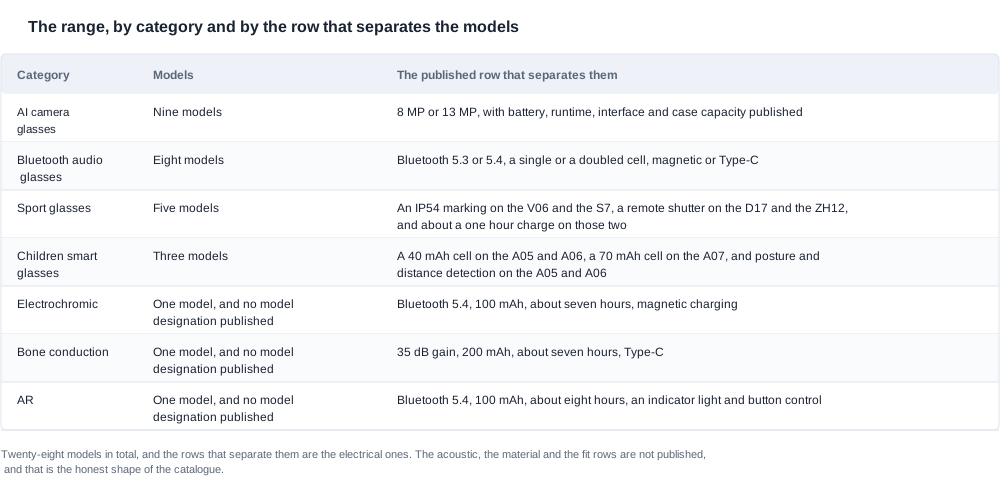
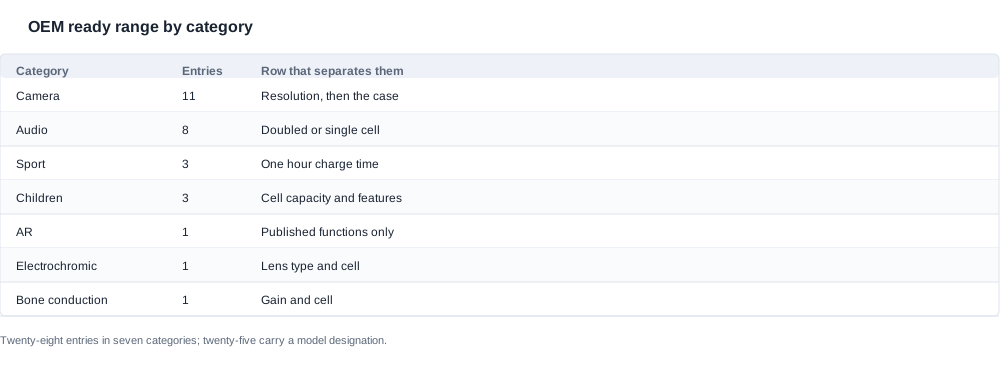
The catalogue holds twenty-eight entries across seven categories, of which twenty-five carry a model designation and three are published without one. Every entry separates from its neighbours on published rows, and this article walks the range group by group, names the row that does the separating, and marks plainly the rows that simply are not there. That shape is not a deficiency in the catalogue. It is the shape of what a catalogue can honestly hold, and a buyer who understands it will spend their sample budget in the right place.
The article is organised so that it can be read in one sitting or used as a reference in a meeting. The first section is the range itself, category by category, with the separating row stated for each. The second is a table of the published rows against the entries they cover, together with the fields that are missing across the board. The third is a shortlisting method you can run in a single working session. The fourth is the question set to send a supplier before you spend anything on samples. The fifth covers the commercial rows that are deliberately not published and what to do about each one. If you only read one section, read the third and the fifth.
OEM ready platforms: the seven categories and how to use the range
AI camera glasses — eleven entries. The MT5 and the L2 Utral, the MT6 and the L1 Pro, the V03 and the KY06, the CY03 and the CY05, the V03 Pro and the V06, and the S7. This is the largest group in the catalogue and the one with the most published rows, which makes it the easiest to navigate and the easiest to get wrong at the same time, because eleven products that all photograph and record look interchangeable until you read the rows.
The dividing row is resolution. Eight of the eleven publish 8 MP; three publish 13 MP, and those three are the L1 Pro and the S7, and the L2 Utral. That single field changes the module, the power draw and the price, and it is the first split to apply. The second row is the charging case: the CY05 and the L1 Pro, and the CY03 publish a 1400 mAh case, the L2 Utral publishes two case capacities at 900 mAh and 1400 mAh, and the MT6 publishes a 1200 mAh foldable case. The KY06 and the MT5 publish the existence of a case without publishing its capacity. The V06 and the S7, and the V03 carry no case row at all, and the V03 Pro is explicit that it has no case.
The third row is charging method, and here the catalogue is candid about its own limits: it is published for seven entries across the whole range and explicitly absent for four camera models, the CY05, the L1 Pro and the CY03, and the MT6. If your shortlist is heavy on camera glasses, this is the field most likely to be blank on a spec sheet you are handed.
The fourth row is the cell. Camera batteries across the range run from 220 mAh to 290 mAh and the rated runtime runs from about five hours to about eight, with no test condition published for any of them. The fifth row is colour and lens configuration. The V03 Pro is the only camera model with photochromic lenses, and it publishes three colour options; the V06 publishes four colours and, together with the S7, carries the only IP54 marking anywhere in the catalogue.
Bluetooth audio glasses — eight entries. The D12 and the D11, the K01 and the LC-105-1, the G07 and the YK12, and the K02 and the LC-105-2. The dividing row is the cell configuration, and it tells you the product architecture before any feature list does. Six of the eight publish a doubled cell, which is the structural signal that they are two-earbud products: the K01 and the K02 at a doubled 90 mAh, the LC-105 pair, and the G07 and the YK12 at a doubled 55 mAh. The D11 and the D12 publish a single 100 mAh cell, which places them in the frame-form category — the electronics live in the temple rather than in an earbud.
Bluetooth version is published for every audio entry, which is a structural difference from the camera group where it is published for none of the eleven. The D11 is the only entry in the entire range that publishes surround audio. The G07 publishes ultra-thin and detachable temple options.
Sport glasses — three entries. The YKC02, the D17 and the ZH12. The D17 and the ZH12 are the only entries in the whole catalogue that publish an approximately one-hour charge; every other entry that publishes a charge time publishes two hours or less, which is the ceiling rather than a typical figure. The YKC02 is a sport model with two 70 mAh cells and a rated runtime of about eight hours.
A naming trap sits here. The V06 and the S7 are named for sport and are frequently assumed to be sport products, but both are camera models and both sit in the camera group. If you build a range page for the sport segment from the names alone, you will mis-assign two of your strongest camera entries.
Children smart glasses — three entries. The A05, the A06 and the A07. The A05 and the A06 publish a lens-type electronic atomiser, a 40 mAh cell, magnetic charging, a rated runtime of about twenty hours, and posture and distance detection. The A07 publishes Bluetooth 5.4, a 70 mAh cell, the same charge time and the same runtime with magnetic charging. Bluetooth version is not published for the A05 or the A06.
AR glasses, electrochromic glasses and bone conduction glasses — three entries without model designations. The AR entry publishes Bluetooth 5.4, a 100 mAh cell, magnetic charging, a rated runtime of about eight hours, and an indicator light with button control. The electrochromic entry publishes Bluetooth 5.4, a 100 mAh cell, magnetic charging, a rated runtime of about seven hours and an electrochromic lens. The bone conduction entry publishes 35 dB of amplification gain, Type-C charging, a rated runtime of about seven hours and a 200 mAh cell. None of the three carries a model string, so none of them can be quoted as a specific part number, and none of the three has a disclosed customisation set.

OEM ready platforms: the rows that separate models, and the rows that do not
Every row that distinguishes one OEM ready entry from another is either an electrical specification or a named feature. That is a useful finding, because electrical rows can be compared on paper and feature names can be checked in a sample.
| Row | Published for | What it tells a buyer |
|---|---|---|
| Camera resolution | 11 camera entries | 8 MP (8 entries) or 13 MP (3 entries) |
| Bluetooth version | 14 of 28 entries | Absent for all camera, A05, A06, bone conduction |
| Charging method | 24 of 28 entries | Magnetic (17) or Type-C (7); absent for 4 camera entries |
| Charge time | 26 of 28 entries | Two hours or less; only D17 and ZH12 publish about one hour |
| Case capacity | 5 entries | 900, 1200 or 1400 mAh; 2 entries publish a case without capacity |
| Rated runtime | 11 camera entries | About 5 to 8 hours; no test condition published |
| IP marking | 2 entries | IP54 on V06 and S7 only |
| Weight | 1 entry | 158 g on the MT6 glasses only, excluding its case |
| Colour | 2 camera entries | V03 Pro (3 options), V06 (4 options) |
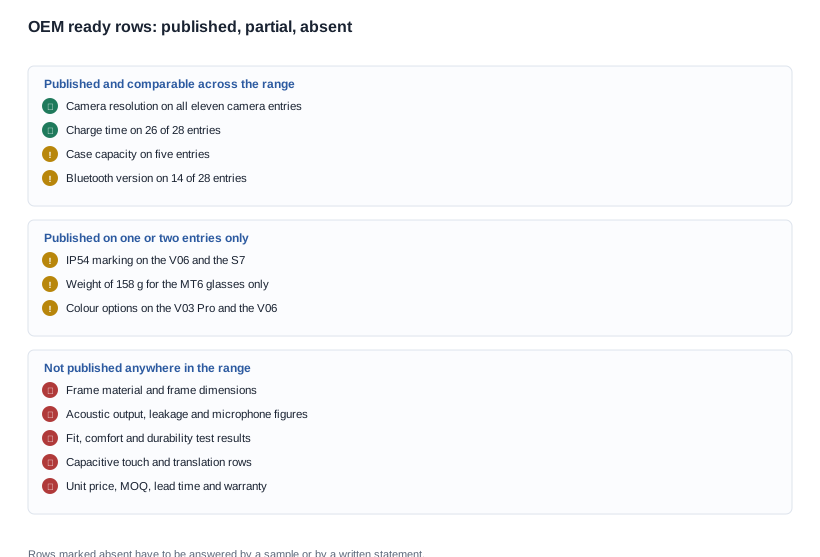
The rows that would settle the questions a buyer is actually weighing are absent across the board. There is no frame material published for any entry, no frame dimension, no weight figure except on the MT6, no acoustic measurement, no output level, no leakage figure, no frequency response, no microphone specification, no fit measurement and no durability test result. The catalogue carries no capacitive-touch row and no translation row anywhere, which means a buyer cannot compare on either of those grounds from published material — the words have to be checked on the product.
Two published figures carry an explicit scope limit that matters for a quotation. The MT6 weight of 158 g covers the glasses only and explicitly excludes the 1200 mAh foldable case, so the shipping weight of that entry is not 158 g and should not be entered into a freight calculation as if it were. The camera runtimes of about five to eight hours have no published test condition, so the figure describes a configuration rather than a laboratory result, and it should never be carried into your own retail copy as a tested number.
OEM ready platforms: a shortlisting method that ends in a sample
The method below is deliberately unglamorous. It exists because the alternative — comparing spec sheets line by line across eleven camera entries — produces a table nobody can act on and a shortlist nobody can defend.
- Fix the use case in one sentence, because the category follows from it. Recording and streaming for a camera brand, open-ear audio for a lifestyle brand, a child-focused atomiser feature for a family brand, and a sport camera for a cycle and run channel are four different problems with four different answers.
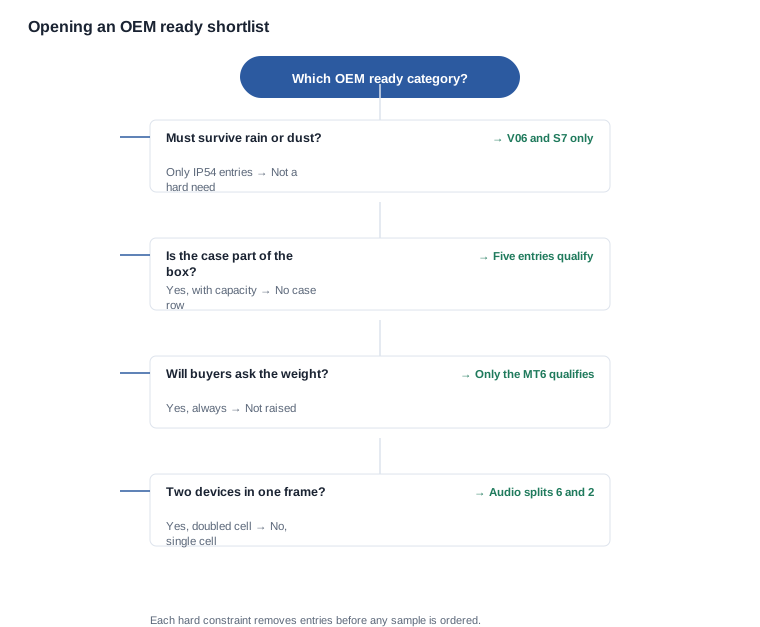
- Choose the category, then discard the categories that fail on one hard constraint. If the product must survive rain, only the V06 and the S7 carry a published IP54 marking, and that alone narrows a camera shortlist from eleven to two. If the product must ship with a case of a known capacity, that is five entries, not eleven.
- Split the remaining entries on the one row that carries the most risk for your channel. For a camera brand selling on image quality, resolution is the split. For an e-commerce seller whose customer support load depends on the box, the case row is the split. For a distributor selling to enterprise buyers, Bluetooth version and charging method are the split, because they determine what your customer can connect it to.
- Reject the entries whose published fields your own customer will ask about and cannot answer. This is the step that most shortlists skip, and it is the one that produces the expensive surprise later. If your buyers will ask about weight and the catalogue publishes it for one entry, the other ten are not competitive for that buyer.
- Put two or three survivors into the sample stage, in the exact configuration you intend to sell, including the case, the accessory list and the packaging. A different configuration is a different product with a different sample and a different cost.
- Write down the pass criteria before the samples arrive, in measurable terms, because criteria written afterwards tend to become arguments. The decision criteria belong to you; the supplier's job is to answer them in writing, not to discover them.
Two trade-offs deserve to be named before you start. The first is between breadth and depth: sampling one entry per category covers the range but proves nothing about the entry you will actually launch, while sampling three camera entries gives real comparative data and leaves the other categories untested. The second is between time and cost: adding a second sample of the same configuration from the same supplier tells you almost nothing, while adding a second configuration tells you whether the change is worth making. If your volume is small and your schedule is tight, depth on one configuration beats breadth across five.
The third trade-off is the one most buyers do not price at all — an OEM ready entry with published specifications is still a platform, not a product. Between the catalogue row and your customer sits your brand, your packaging, your documentation and your after-sales promise, and the sample is the only place where that stack is visible as a whole. Which model to sample is a commercial conversation, and it is one we are willing to have on the record.
A worked example makes the sequence concrete. Take an online audio brand selling through a marketplace, where the customer will ask three questions before buying: how long does it run, does it fit over a prescription frame, and what is in the box. Start with the audio group of eight. The doubled-cell entries are the two-earbud architecture, and the D11 and the D12 are frame-form, so the doubled-cell group of six is the relevant subset. The charge time is published across the whole group, so runtime is comparable on paper — although the test condition is not published, so the number belongs to a configuration and not to a laboratory. The D11 is the only entry in the range publishing surround audio, which makes it the one to test if surround sound is the claim in the listing title. Fit over a prescription frame is not published for any entry, which means it cannot be resolved by comparing rows; it has to be resolved by holding the sample. What is in the box is a packaging and accessory question rather than a product question, and it is settled on the quotation. One group of six becomes two candidates, one feature claim to verify, and one physical question that only a sample can answer. That is the whole method, and it costs one email.
The same exercise for a camera brand ends differently, which is the point. The camera group publishes resolution, case capacity, charge method for seven of eleven, colour for two and IP marking for two, so the paper filter is far more powerful. The residual questions are the same everywhere: what does it weigh, how does it fit, how does the image actually look, and what does the battery do under the buyer’s own use pattern.


OEM ready platforms: the questions to send before the shortlist
Sending a structured question set before you ask for samples is ordinary due diligence and it is the cheapest step in the whole sequence. It costs an email and it can save a sample round.
- Which catalogue row covers this specific configuration, including the case, the cable, the packaging and the colour, rather than the base model?
- Is every figure in the catalogue for this exact configuration, or for the entry as a family, which may bundle variants that behave differently?
- What is the current lead time for this configuration, and is that a production lead time or a sample lead time? Neither is published on this site, so it has to come from the quotation.
- What is the minimum order quantity for this configuration, and does it apply per colour, per configuration or per order? The volume mechanics are covered in smart glasses MOQ.
- Which certifications will the shipped configuration carry, and will you supply the test reports? The catalogue publishes no per-model certification row, so this must be answered in writing for the specific configuration.
- What is the warranty on the shipped goods, in months and in what form, and who carries the freight for a replacement?
- What is the acceptable tolerance for the physical dimensions and the weight, and how is it measured?
- Is the entry you are quoting the same tooling as the entry you show in a sample, or a different production line?
That last question catches more mismatches than the other seven combined. A sample and a production run can differ in the firmware build, the accessory list, the packaging and the supplier of a sub-assembly, none of which is visible in a photograph of the specification row. It is also the reason we ask buyers to specify configuration so precisely when they request a sample.
Which questions matter most depends on who is buying. A distributor who will resell to a retail chain cares about the packaging, the carton quantity, the label position and the lead time more than the acoustic detail, because their margin depends on the shelf and their reputation depends on the delivery. A brand launching on a marketplace cares about the claim set, the accessory list and the support burden, because the first review cycle will test exactly those things. An operator buying for a uniform needs the certification scope, the warranty terms and the batch consistency, because their risk is regulatory and their problem is not the first unit but the four thousandth. Writing the question set in that order — the question your own business model punishes you for getting wrong, first — produces a much better quotation than a generic specification request, because it forces the supplier to quote against your real risk rather than against a template.
OEM ready platforms: the open commercial rows, and how we handle them
There is a set of fields that a procurement reader expects to find on a platform page and that the catalogue does not carry, for one reason: they change with the order. Unit price, minimum order quantity, lead time, sample fee, warranty duration, payment terms, shipping cost, carton and pallet counts, production capacity and tooling cost are all functions of configuration, volume and the state of a specific programme. Publishing them as fixed numbers would be publishing a number that cannot be honoured, which is worse than publishing nothing.
Certification sits in a slightly different position, and it is worth being precise about it. The catalogue's export certification page is a picture page: it shows ten patent certificates, eight of them design patents and two of them utility models. It carries no per-model certification row, no certificate number against a specific entry and no published UN38.3 test summary. The patent images are evidence of design work, not evidence of market conformity for a given product. When a buyer needs to know whether a configuration can ship into a market, that question is answered with a document attached to a quotation, not with a badge on a catalogue page.
So the honest summary of this range is this: seven categories, twenty-eight entries, twenty-five model designations, a published electrical row for most entries, a published feature row for a minority, and a published row for almost none of the things that a wearer actually notices. That is enough to narrow twenty-eight products to two or three. It is not enough to skip a sample, and no catalogue is.
"Not published" is also a process instruction rather than a refusal, and it is worth being precise about how it works in practice. It means the figure is a property of your order rather than of the product, so it moves with configuration, quantity and the state of the programme — and therefore it belongs in a quotation, where it can be attached to a specific configuration and a specific volume and honoured. A buyer asking for the unit price of an unspecified entry is asking a question with no answer. A buyer asking for the unit price of a specified configuration at a stated quantity is asking the right question, and it deserves a written reply with a validity date, so that the negotiation has a fixed point on both sides of the table.
The same logic applies to certification and to warranty, and it is where due diligence pays for itself most clearly. A supplier that cannot state the certification scope of a specific configuration in writing is telling you something important, whatever it says on a website. A supplier that will — naming the standard, the model family the report was issued against, the issuing laboratory and the date — has given you something you can file and re-check at the next audit. The question list to work through is in procurement certification checklist.
What we will do is take your use case, your channel, your markets and your volume, map them onto the range, and tell you which combination covers you, which gaps would need a development, and which of the open rows we can close for you this month. The assessment method behind that is set out on the OEM ready products page, the customisation points that sit on top of these entries are in standard OEM customisation options, the model choice is settled on a quote request, and the regional differences that follow from it are covered in selecting by market.
Related reading
- The platform assessment method — how we assess maturity
- The customisation layer on any entry — standard OEM customisation options
- Which entries to sample — request a quote
- Regional differences that follow — selecting by market
Send the use case, the channel, the markets and the volume, and we will map them onto the range and flag the gaps that a catalogue cannot close.


