

A sample programme fails in one of two directions. Either it is too narrow — three units of one model, a comfortable feeling, and no answer to the question that was actually on the table — or it is too loose, a wide scatter of units with no script, so that the review becomes a room full of opinions. Both failures are common, both are expensive, and both are prevented by the same act: writing down the decision the sample is supposed to settle, before the sample is ordered.
That is the whole idea behind a sample-first approach to an OEM ready range, and it is worth separating from the logistics of getting a unit into your hands. Shipping, cost and timing are real concerns and they are handled in their own sections. The design of the sample programme — how many units, of which configurations, tested against which script, held against which reference — is what determines whether the money spent buys a decision or buys a story.
The reason this matters more in smart glasses than in many other categories is that the published specification is thin. A buyer can read the resolution, the cell capacity, the charging method and the case capacity of an entry and still be unable to answer the questions a customer will ask: how it feels, how it sounds, how it fits, how long it really lasts. A sample is the only instrument that touches those, which is why the design of the sample is not a detail of the procurement process. It is the process.
OEM ready platforms: what a sample proves and what it cannot
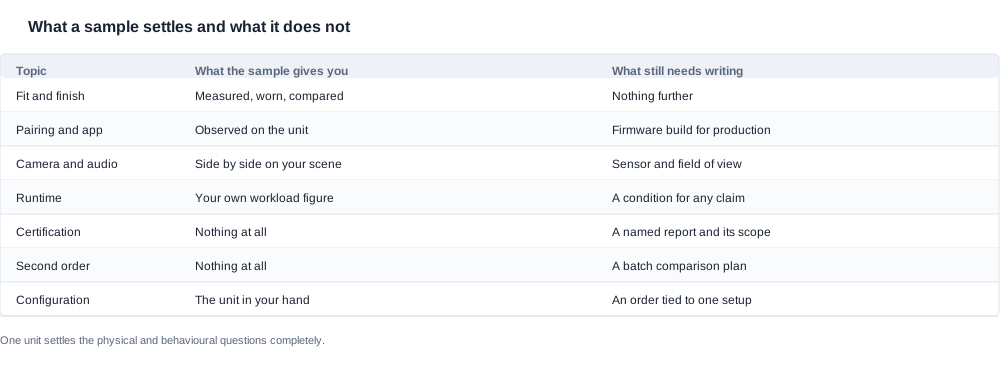
A sample is an excellent witness for anything you can hold, wear, look at, listen to or measure in a room. Fit is the first and most decisive of these, because a frame that does not suit the face of your customer is not a specification problem and no amount of paper resolves it. Finish and build quality come next, because they are visible in a photograph and therefore visible in a review listing. Then the behaviour of the product: the pairing flow, the app, the controls, the capture, the audio, the firmware build, and whether the documentation matches the hardware. All of these are settled by a single unit in a single sitting, provided you look at the right things.
What a sample cannot do is establish anything about scale. One unit is not a yield rate. One unit from one batch is not a consistency claim, because the whole purpose of consistency is that it holds across batches, and that question needs a second batch. A sample says nothing about the certification file, because the file is a set of documents rather than an object you can put on a desk; and it says nothing about the certification scope of the configuration you would actually ship, because that is a commercial and regulatory question settled by a named report against a named model. It also says nothing about the model you did not sample — and the model that ends up in your carton is frequently not the one that was on the table, because a factory will ship whatever the order says and an order left open on configuration will be closed by the factory.
There is a fourth thing a sample cannot establish, and it is the one buyers most often forget: the relationship between the sample and the production unit. Nothing in a sample binds the factory to shipping that configuration. The sample can be a showroom unit with factory firmware, the default device name and stock packaging, while the production run arrives with a different firmware build, a different packaging insert and a different supplier code printed on the label. The sample tells you the product is good. It does not tell you the thing you will receive is the thing you approved.
That is the honest dividing line: a sample settles the physical and behavioural questions, and it settles them completely for the unit in your hand. Everything about the second order — the file, the consistency, the configuration binding — has to be closed in writing, or it remains open.
One further distinction matters inside the physical group, and it is the difference between a representative sample and a merely present one. A representative sample carries the configuration you intend to buy: the colour option, the case or the absence of a case, the accessory list, the packaging level, the firmware build and the labelling. A sample that is present but unrepresentative answers the questions about the product while leaving the questions about your product open, and the second set is usually the larger one. Since colour options exist on only two camera entries in the range and case capacity is published on five, a request that leaves colour and case unstated is very likely to arrive as a default unit — which is fine as a product demonstration and useless as an approval.
OEM ready platforms: how many units, and of which models
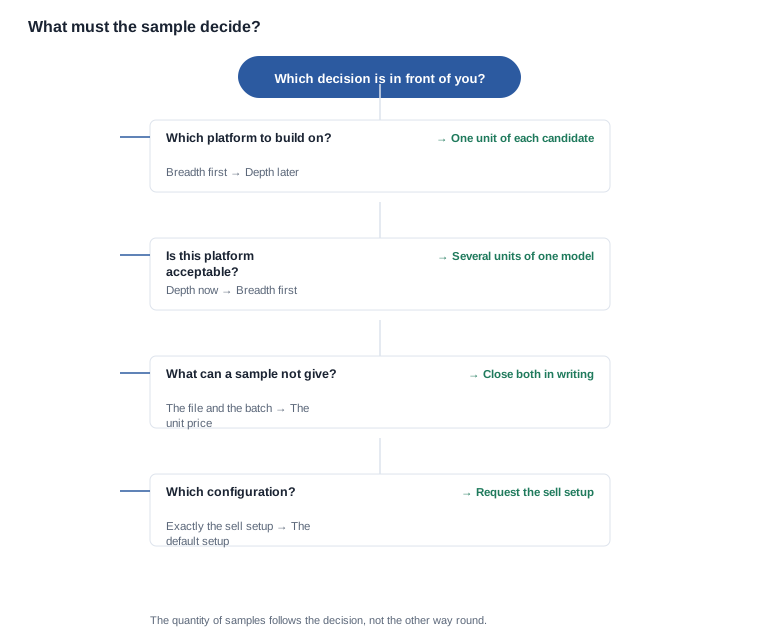
The quantity question follows from the decision question, and it is worth forcing the decision question to the front, because the instinct to buy three units of one model is strong and usually premature.
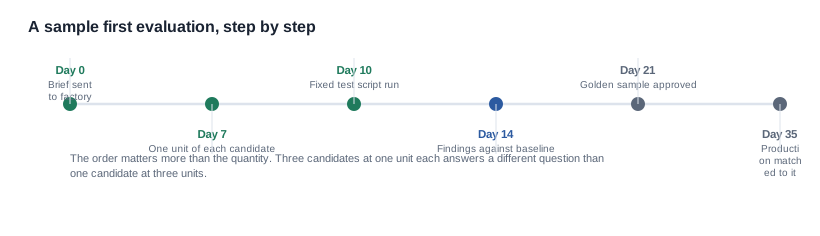
If the decision in front of you is which platform to build a range on, then the sample programme wants breadth: one unit of each candidate, each in the configuration you would actually sell, each run against the same script. Three candidates means three units, and the whole comparison then happens side by side under identical conditions, which is what makes the result usable in a meeting.
If the decision in front of you is whether a platform you have already chosen behaves acceptably — fit, sound, runtime, build — then the programme wants depth: several units of that one model, so that you can see whether your script produces the same result on different units. Depth here has a second purpose, which is to give the factory something to copy. A sample that arrives as a single unit carries no reference; three units give you a baseline the line can be compared against.
The trade-off between the two is worth naming explicitly. Breadth gives you a defensible shortlist and a comparison you can act on, at the cost of learning nothing about variation. Depth gives you variation data and a reference, at the cost of possibly characterising a product you will not sell. If the budget allows only one, the order of preference is breadth first, because the cost of the wrong platform is the whole programme rather than one shipment, and because the units from a breadth programme are still usable later as the beginning of a depth programme.
The shortlist that goes into the request should be built on the published rows first, because those are the only ones that can be compared before anything arrives. Start from the use case and take the category, then split the category on the row that matters most to your channel, and then apply the constraints that eliminate entries outright — a published case capacity if your listing promises one, a published IP54 marking if the product must survive rain, a published colour option if your marketing plan has already fixed the colour. What survives is a shortlist of two or three, and only those two or three need a unit in your hand. Sending a request for eight models does not broaden the decision; it dilutes it, because a review of eight units with a full script takes a day and produces eight sets of partial findings rather than one comparison.
Two configuration rules apply whichever way you go. Ask for units from the current production line rather than from a display or a showroom, since the difference between the two is exactly the difference between a production unit and a sample of the product. And ask for the configuration you intend to buy — the colour, the case or no case, the accessory list, the packaging level — because a configuration change is a different product with different costs and different risks. The catalogue makes the breadth of that decision visible: colour options are published on only two camera entries, the V03 Pro with three options and the V06 with four, and case capacity is published on five, so an open colour and an open case decision are two variables that will change the quotation and the unit together.

OEM ready platforms: the test script that makes a sample worth its cost
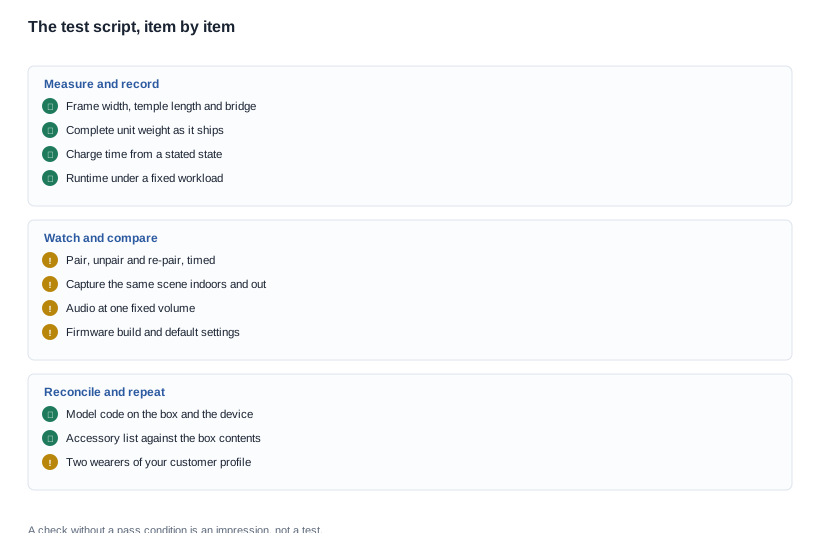
The test script is the part of a sample programme that buyers skip, and skipping it converts a measurement into a conversation. A script is a numbered list of checks, each with a pass condition that can be observed or measured, written before the units arrive and applied identically to every candidate.
Fit and ergonomics. Measure the frame width, the temple length and the bridge with a calliper, and record the numbers. Compare them against a range you decided in advance rather than against your own preference on the day. Fit them on more than one wearer of your customer profile, because a fit that works for a 28-year-old designer is not a fit for the 55-year-old buyer who makes the return. Note where the temple sits after an hour, and note whether the product can be worn over a prescription frame, because a substantial share of the smart glasses market wears glasses already.
Weight. Weigh the complete unit as it ships, with the accessories and the packaging you will use, because a published weight that excludes the case — as the one published weight in the range does — is not the number that goes into your freight model or your comfort claim.
Charge behaviour. Start from the same state every time and record the time to a stated endpoint rather than to exhaustion. Note the ambient temperature, the charger used and the cell state at the start, since a charge figure without those conditions is a number rather than a measurement.
Runtime. Run a fixed workload — the same recording task, the same audio session, the same brightness — for a stated period, and record what the product does at the end of it. A runtime of about five to eight hours is published across the camera entries with no test condition stated, which makes your own workload the only meaningful number for your own use.
Capture. Photograph or record the same scene, indoors and outdoors, at the same time of day, and keep the files. Compare them side by side rather than in isolation, and check the first-article unit and the candidate against each other in the same frame.
Audio and microphone. Play the same source at a fixed volume and record what you hear and what a colleague hears. The range publishes surround audio for one model only, which makes the acoustic comparison one of the few places where the sample is genuinely decisive rather than confirmatory.
Connectivity and firmware. Pair, unpair and re-pair, timing each step. Record the firmware build and the default settings, because the defaults are what the customer sees first and they are the part most often left to the factory.
Documentation. Check the model code on the box against the code on the device, and the accessory list against what is physically in the box. A mismatch here is a small signal with a large cost, because it predicts what your own support team will be asked about.
Anything without a numeric or observable pass condition is an impression rather than a check. Impressions are what a sample review turns into an argument, and an argument is a much worse outcome than a failed sample, because a failed sample teaches you something.
Record the results as you go, in a fixed format, one row per check and one column per unit. A table filled in during the test is evidence; a table reconstructed a week later from memory is a record of the argument. Keep the captured files, the photographs and the timing notes with the results, because the first time a question is disputed is usually weeks after the units arrived, and the unit that settles it is the one with the evidence attached. It also makes the second candidate comparable: the same row, the same pass condition, the same observer, the same session if you can manage it. Where you cannot hold the sessions together, say so in the record, because a comparison across different conditions is a comparison with a caveat, and the caveat belongs on the page rather than in the argument later.
There is a variant worth considering for a buyer with a strong existing specification: send the script as a document, ask the supplier to complete it and return it with the units, and then re-run the same script yourself on arrival. The supplier’s answers are useful because they reveal what the factory measures and how, and your re-run is useful because it is independent. Where the two disagree, the disagreement is itself the most valuable output of the sample programme, because it points at exactly the criteria that need writing down before production.

OEM ready platforms: the golden sample and the drift trap
The most valuable object in a sample programme is not the sample. It is the golden sample — one approved unit, held, photographed, measured and stored by both sides, against which every later unit is compared. It converts the argument about whether the new batch matches the approved product from a memory into a measurement, because two people holding the same object can put the new unit beside it and look.
That memory problem is specific and worth understanding. Someone who approves a unit in a meeting remembers the product as they experienced it — the weight in the hand, the colour under the office light, the sound at one volume. A factory ships a batch that matches the specification. Specification and memory are different things, and in this category the specification is often thinner than the memory, which is why the gap shows up as an argument rather than as a defect report.
Agree the golden sample explicitly rather than assuming it. Which unit it is, what state it is in — configured, packaged, labelled — who holds each copy, where it is stored, how it is protected from damage and from the temptation to sell it by accident, and what tolerance counts as a match. If the product has a colour or a finish, keep a reference swatch beside it, because colour drift is the defect that most often passes inspection and most often appears in a customer's photograph.
Between an approved sample and a shipped batch, four things can change without anyone deciding to change them. A component can be substituted because the original went out of stock. A firmware build can be updated and a default can change with it. A packaging insert can be reprinted with a different month and a label with a different supplier code. A mould can be re-cut for a different run and the re-cut part can differ in a way visible only in a side-by-side comparison.
Each of those is cheap to prevent and expensive to discover, and the prevention is a single routine: compare the incoming batch against the golden sample, item by item, before the batch is packed. The question to ask a supplier is whether that comparison is already part of the line routine or has to be requested, because the answer tells you how much of your own quality burden you are about to inherit.
Two copies is the practical arrangement, and it is worth insisting on it even when it feels fussy. One copy sits with the factory where the line can reach it, and one sits with the buyer where nobody can quietly replace it. Each copy is labelled with the configuration, the date of approval, the firmware build and the approving party, and each is stored so that it cannot be mistaken for stock — a golden sample that gets sold is a golden sample that no longer exists. Where the product has a colour, a small reference swatch travels with each copy, because colour is the property most often judged by eye and most often judged wrongly.
The review that approves a golden sample should be a meeting rather than an email, and it should be the meeting where the pass conditions are signed. Before it, the results exist. During it, the criteria get agreed. After it, the golden sample is the reference and the criteria are the contract. A buyer who approves a unit without fixing the criteria has gained a nice object and lost the argument that the object was supposed to win.

OEM ready platforms: the questions a sample still cannot settle
Four questions survive the sample, and they are worth naming before the programme starts, because the frustration of a sample programme usually comes from expecting it to answer something it structurally cannot.
The certification file. A sample is an object; the file is a set of documents. And in this category the published position is thin: the export certification page on this site is a picture page carrying ten patent certificates, eight design patents and two utility models, with no per-model certification row and no published UN38.3 test summary anywhere. So a sample cannot confirm that a configuration is certified for a destination market, and a buyer who needs that answer has to ask for the named report, the model family it was issued against, the issuing laboratory and the date. The full list is in the procurement certification checklist.
The consistency of the second order. That needs a second batch, and the second batch needs a run of production to exist. A sample can be the reference the second batch is later compared against, which is why holding a golden sample is worth more than testing the sample one last time and putting it in a drawer.
The commercial terms. Unit price, minimum order quantity, lead time, sample fee, warranty duration, payment terms, production capacity and shipping cost are all published nowhere on this site, because they are properties of a live order rather than of a product. A sample fee in particular is worth discussing openly at the request stage rather than discovering later, and the standard route for that conversation is the samples page.
The customisation. Any change to a platform — the colour, the logo, the packaging, the firmware default — can change what a sample proves, because a sample built with the default configuration and a production unit built with yours are not the same object. The customisation points that apply across the range are set out in standard OEM options, and it is worth agreeing which of them will be present on the sample before the sample is built rather than after it has arrived.
There is a fifth point that is not a question but a consequence. The platforms a sample is drawn from are on the OEM ready products page, and the honest observation about that range is that it is written mostly in electrical rows — resolution, cell capacity, charge time, runtime, charging method, case capacity, colour. The properties a sample actually tests, the ones a customer feels, are largely absent from the catalogue. That is not an argument against sampling. It is the argument for sampling, and it is why the sample programme deserves a design rather than an order form.
Related reading
- The range a sample is drawn from — OEM ready products
- The sample protocol — sample evaluation
- The rows a sample cannot settle — certification checklist
- The customisations that change what you sample — standard OEM options
Send us the candidate models and the test script, and we will tell you which published figures it can confirm and which questions need a written answer from the factory.


