
The shape of a sample request says more about a buying programme than the size of its budget does, and the most common shape is the least informative one. One unit of one model answers almost nothing: it confirms that the product exists and it gives you an impression of how it looks. Only two arrangements actually produce information — one unit of each of several candidates, which answers the question of which platform to build a range on, and several units of a single model, which answers the question of whether that model behaves consistently. They are different questions, they need different scripts, and they are routinely confused with one another in the first email of a programme.
Getting this wrong is expensive in a way that is easy to underestimate, because the failure is not visible at the moment it happens. A sample programme with the wrong shape still produces units, still produces a meeting and still produces a decision — the decision is simply made on evidence that cannot support it. The units arrive, somebody likes one of them, and the programme moves forward without ever having established that the chosen product is consistent, or that the rejected one was worse, or that either of them fits the brief it was meant to meet.
The fix is to choose the shape deliberately, and to choose it by starting from the question rather than from the model. That is what this article does: it sets out the positions a buyer can actually be in, explains when a mixed order is the right shape, names the arrangements that reliably waste the budget, and covers what the request has to contain for the arrangement to produce an answer.
It is worth saying why this decision belongs at the start of a programme rather than in the middle of it. The shape of the sample request determines what the programme will know at the point where it has to commit — and in this category that point arrives earlier than most buyers expect, because the catalogue publishes so few of the physical properties that a product decision depends on. The published rows narrow the range; the sample settles the rest. A programme that has spent its sample budget on the wrong shape will know less than one that spent a third as much on the right shape.
Requesting smart glasses samples: start from the question, not the model
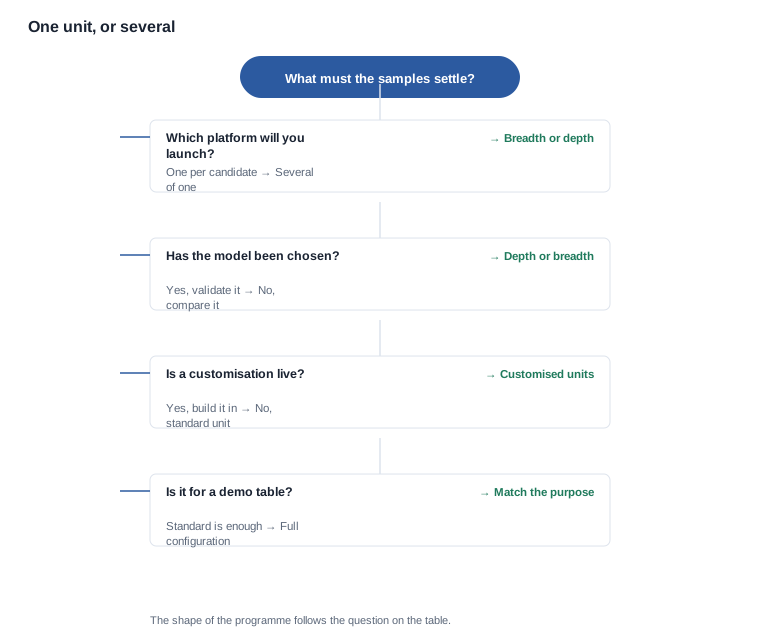
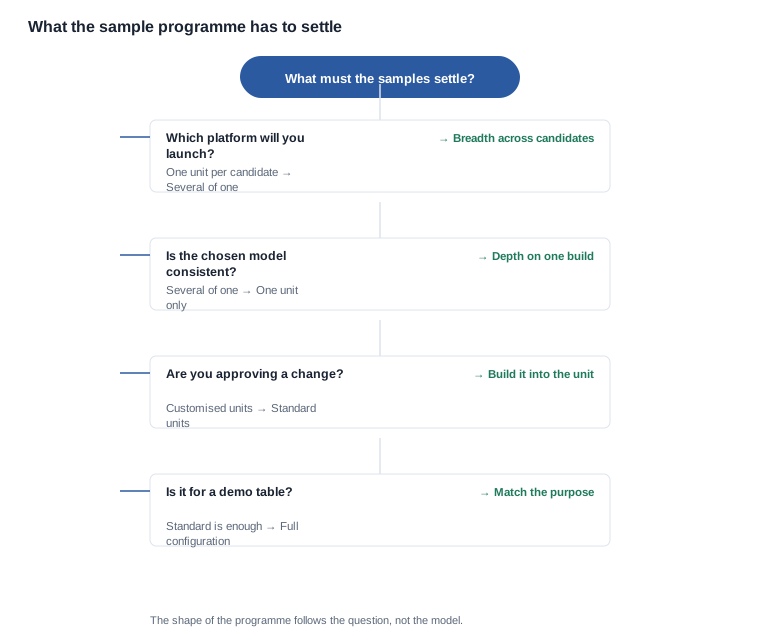
There are three positions a buyer can genuinely be in, and each one implies a different sample programme.
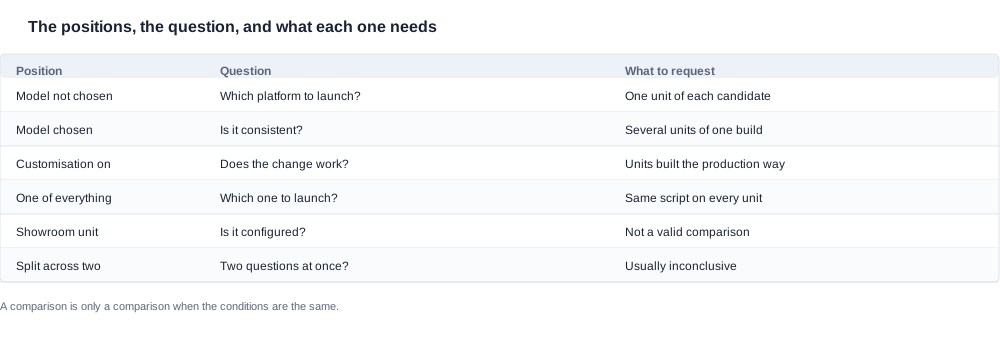
You have not chosen a model. The question is which platform to build on, and the answer comes from comparing candidates against a written brief. This is the case for one unit of each of two or three candidates, and it carries an obligation that buyers often miss: the script has to be identical across all of them. A comparison is only a comparison when the conditions are the same, so the same workload for the battery, the same scene for the camera, the same source at the same volume for the audio, the same wearers for the fit. Evaluating one candidate on fit and another on the camera produces two impressions, not a decision, and it wastes the arrangement that was supposed to produce a comparison.
The shortlist itself should come from the published rows rather than from browsing. The catalogue divides into seven categories with twenty-eight entries, and the published electrical rows — resolution, cell capacity, charging method, charge time, case capacity, colour — narrow that to two or three that can be compared with the same script. A buyer who samples four models chosen by eye has spent four units on a comparison that could have been made on paper.
The shortlist criteria should be written before the candidates are chosen, for the same reason the script should be written before the units arrive. The published rows make the criteria unusually easy to apply: a camera shortlist can be filtered on resolution, on case capacity, on the charging method that is published for seven camera entries, and on the IP54 marking that exists on only two. An audio shortlist divides on the cell configuration, with the doubled-cell entries and the single-cell frame forms on opposite sides of the line. A shortlist that is filtered this way arrives at the sampling stage with two or three candidates that genuinely differ, and a script can then be built on the difference rather than on the whole product.
You have chosen a model and are validating it. The question is whether it behaves consistently and whether it meets the brief, and the answer comes from several units of the same build. This is the only arrangement in which unit-to-unit variation becomes visible at all, because variation between two units of the same batch is not variation. A feature that works on the first unit and fails on the third is a feature that cannot be published, cannot be demonstrated to a distributor and cannot be promised in a listing, and the only way to find out is to hold more than one.
You are validating a customisation. The variable here is the customisation rather than the model, and the units have to be produced the way the production units will be produced. A generic unit tells you about a product nobody is going to buy. If the change is a logo treatment, a colour, a packaging set, a firmware default or a Bluetooth name, then the sample has to carry it — and the more of the configuration the sample carries, the more of the question it settles.
A worked example shows when the mixed shape is the right one. An online audio brand with a channel that already sells lifestyle audio is deciding whether to add a smart glasses line, and it has to decide between a frame-form model with a single cell and a two-earbud model with a doubled cell, because the two imply completely different packaging, a different accessory list and a different return profile. One unit of each is the correct programme: the question is comparative, the two candidates are genuinely different products, and the script can be built on the difference — how the frame sits, what happens when the second bud is dropped, what the box looks like when it is opened. The same example in a different form — a brand that has already decided on the frame form and now wants to know whether the factory can build it repeatedly — needs depth on that one model instead, and a mixed order would have answered a question nobody asked.
That distinction is the whole decision. What varies is not the preference of the buyer, it is the question on the table, and the two shapes of programme are not versions of each other. They answer different things, they cost different amounts, and a programme that mixes them produces results that belong to neither.

Requesting smart glasses samples: when a mix is the right shape
There is a fourth arrangement that is legitimate and that is very often used badly: a single order containing several models, used to settle a product-line question before committing to one of them.
It works when the question is genuinely comparative and the candidates are close enough to be compared on the same script. It works best when the candidates differ in a way the script can capture — a different camera tier, a different form factor, a different cell — because then the comparison has a subject. It works badly when the candidates differ in ways the script cannot reach, because the comparison then produces a vague impression of which one felt better, and that impression is exactly the input that leads to the wrong choice.
Two failure modes are worth naming because they are common and because both are avoidable. The first is the freight and handling overhead of a mixed consignment: four models means four configurations to pack, four lines in the paperwork and a more complicated declaration, and the unit cost of the exercise rises for reasons that have nothing to do with the product. The second is the drift into a compromise arrangement, where each candidate receives a different amount of attention and none receives the full script. That is what happens when a request asks for "samples of your main models" without specifying a script, and it produces four partial results rather than one comparison.
If you run a mix, three things protect it. State that the script is identical for every unit, and that a unit that cannot be tested is to be reported as untested rather than quietly passed. Ask for each unit to be individually labelled with its model code before it ships, so that the units can be matched to the results afterwards. And fix the criteria before the units arrive, including the criterion for what happens when one candidate passes on fit and another passes on the camera — because the honest answer in that case is that the script was not specific enough, and the fix is to write a second pass rather than to declare a winner.
Requesting smart glasses samples: the arrangements that waste the budget
Four arrangements reliably produce nothing, and it is worth recognising them because they look reasonable on paper.
One model, one unit. A formality. It confirms that the product exists, it gives a marketing team something to photograph, and it settles none of the questions the programme is actually blocked on. It costs a unit, a wait and an evaluation cycle, and it is the arrangement most often chosen because the request form asks for a quantity and one is the smallest number on it.
A split order across two models to answer one question. Two questions answered weakly is worse than one answered well, and the typical outcome is an inconclusive result that requires another round, so it costs more than the focused programme it was meant to save. The exception is when the two candidates really are alternatives for the same slot — in which case the split is the design, and the script has to be built for the comparison rather than appended to it.
A showroom unit rather than a production unit. This is the subtlest of the four and the one that catches experienced buyers. A showroom unit has been configured: a Bluetooth name, an interface language, a region setting, a default volume, an update configuration and a packaging set. The unit in the box has none of those. For anything involving software behaviour, a showroom unit is a different product, and the specific defaults it carries are exactly the ones a customer will meet first and complain about.
A mix with no script attached. Covered above, and worth repeating here because the arrangement looks diligent. Sending four units with no criteria is not diligence; it is four purchases that will be evaluated by whoever opens the box first, which is a poor proxy for the decision the programme has to make.
There is a fifth arrangement that is not a waste but is frequently misconceived: the sample used as a demo unit for a trade show, a customer meeting or a channel pitch. That is a legitimate and useful request, and it has different requirements. It does not need a rigorous script, it does need to work on the day, and it needs the accessories and packaging that will be visible. What it must not be is allowed to stand in for the evaluation sample, because a demo unit that looks excellent on a table tells you nothing about whether the second production batch will match it.
The showroom unit deserves one more word, because it is the arrangement most likely to arrive unannounced. A display unit has usually been configured for demonstration: the Bluetooth name carries the showroom label, the interface language and the region settings may have been changed, the default volume may be set high, the update configuration may point at a demonstration build, and the packaging is not the packaging the customer will receive. For anything involving software behaviour, this is a different product from the one in the box. The due diligence check is simple — ask for the build number and for the unit to come from the current production line — and it costs one line in the request.

Requesting smart glasses samples: what to put in the request
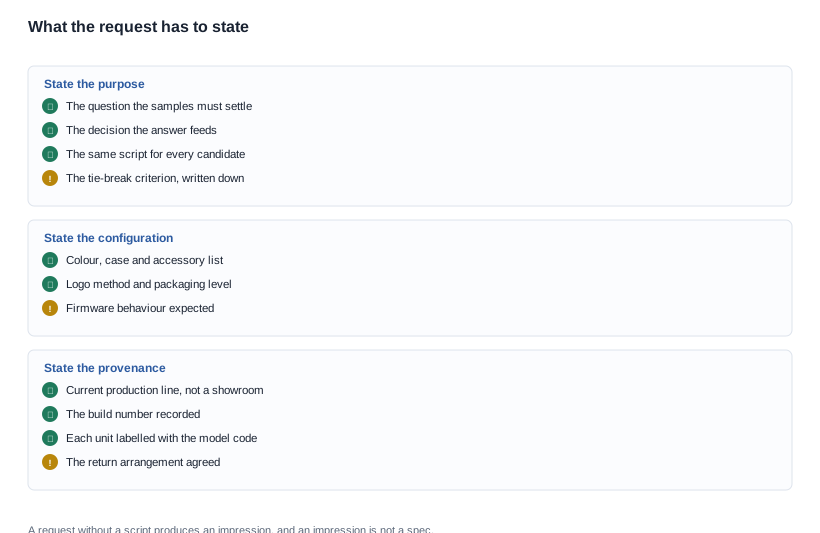
Seven items belong in the request, and the ordering matters because the first two decide whether the units will be worth anything.
- The models, and the reason for each. A factory that understands the reasoning can make a better suggestion than one guessing at the intent, and sometimes the right answer is that two of the candidates are the same platform in different packaging.
- The configuration. Colour, the case or the absence of a case, the logo method, the packaging level, the accessory list and the firmware behaviour expected. The catalogue publishes the customisation points — logo, colour, packaging, temple shape, system and user interface, Bluetooth naming and firmware customisation — and each one changes what the unit will demonstrate.
- The provenance. Ask for a unit from the current production line rather than a display, and ask for the build number. This is the difference between a unit that is evidence and a unit that is a demonstration.
- The script. Attach the numbered test list with the pass conditions. This is the single most useful thing in a sample request and the thing most often left out.
- The accessories and box contents. Charger, case, cable, packaging and what is included, so that the unboxing can be checked against the specification rather than against a guess.
- The documentation. The specification sheet, the model code list and anything else the unit should be checked against. What can be checked against published data is settled; what cannot is settled on the unit.
- The return arrangement. A sample that arrives and cannot be returned is a sample that cannot be tested freely, and a customised unit that cannot come back is a commitment rather than a trial.
The customisations a sample can carry are set out in standard OEM options, the models a sample would be drawn from are on the OEM ready products page, the stage of the programme a sample belongs to is described in the design and prototype stage, and the protocol the units are judged under is in sample policy and cost.
One item on that list is worth expanding, because it is the one that produces the most value to the supplier as well as to the buyer: the reason for each model. A factory that understands why candidate A is in the room — because the fit is the deciding factor for a prescription-wearing customer, or because the case is the deciding factor for a gift set — can act on that reason in ways a buyer did not think to ask for. It can point out that a configuration exists which was not on the shortlist, or that one candidate is the same platform in different packaging and therefore a worse use of a unit than it appears. The negotiation value of a well-reasoned request is not the discount; it is the better shortlist.
Requesting smart glasses samples: what to decide before the units arrive
The decision that has to be made before the units arrive is what happens to them afterwards, and it is the one most often deferred.
A retained reference unit — photographed, measured, labelled and held by both sides — is worth more than any number of additional units, because it is the object every later unit is compared against. A sample that goes into a drawer produced a moment of enthusiasm and nothing else. In a mixed arrangement the retention question is sharper: retain one unit of the model that was chosen, and record it properly, including the build number, the model code, the configuration, the measurements and photographs of the finish in daylight. Colour and finish drift is the defect that most often passes inspection, and a reference photograph is what turns it from an argument into a comparison.
The second decision is the evaluation method. Where the arrangement is a mix, the results have to be recorded in a comparable form — the same table, the same columns, the same units, the same session where the session can be held constant — and a candidate that cannot be tested on a criterion has to be recorded as untested rather than skipped. A comparison with a hole in it will be argued about later, and the argument will be about memory rather than about the product.
The third decision is what the outcome means. If one candidate passes the script and another fails, the programme has a decision to make and the sample has done its job. If two candidates pass, the tie has to be broken by a criterion that was written down in advance, or the sample programme has produced a question rather than an answer and will need a second instrument. Writing the tie-break criterion at the same time as the script costs nothing and is the difference between one round and two.
One further point applies to the mixed arrangement specifically, and it decides which unit to keep. In a mix, the temptation is to keep the unit that was the most impressive on the table, and that is frequently not the unit that was chosen. The unit to retain is the one from the model that was selected, from the same build, with the same configuration that will be ordered — because its value comes from being a reference for the production run and not from being the best demonstration of the range. Where the mixed programme produced two candidates that both passed, the retained unit has to be the one whose configuration the order will actually use, and that is the one whose finish, packaging and accessories the production run will reproduce.
The general principle runs through all of it. A sample programme is a measurement of the thing you are going to buy, and the parts of it that do not measure the thing you are going to buy are the parts that will have to be paid for twice. Which model to sample, how many units of it, and what to keep afterwards are three versions of the same question: is this arrangement going to tell me something I can act on?

Related reading
- The protocol the samples are judged under — sample policy and cost
- The models a sample would be drawn from — OEM ready products
- The customisations a sample can carry — standard OEM options
- The stage a sample belongs to — the design and prototype stage
Send us the models, the configurations and the test script, and we will tell you what we can supply and what each unit would settle.


