

Price tiering in this category fails more often than it succeeds, and the reason is structural: there are more specification differences available than there are differences a customer can perceive. A buyer who builds four tiers from four models will end up with a range that looks competitive on a spreadsheet and indistinguishable in a shop, and the first person to notice will be the retailer's buyer, who will ask the only question that matters, which is why the customer should stock this one rather than the cheaper one.
The second reason it fails is quieter. This category publishes more gaps than comparable consumer electronics categories do. The parameters that would normally carry a tier — image quality, frame weight, acoustic performance, the real runtime under load — are either unpublished or published without the condition that makes them comparable. A tiering exercise run on published data alone therefore has to work with what is left, and what is left is smaller and more physical than a buyer expects.
There is a third reason, and it is about where the tiering decision actually belongs. In a consumer electronics brand, price tiering is often run by the merchandising team with the sourcing team providing cost inputs. In this category that split produces the wrong answer, because the separability of two products is largely a question about tooling, setup, documentation and packaging — all of which sit with the factory — while the price position is a question about the channel. A brand that has not asked the factory which two of its candidate models can actually be separated at all will build a ladder the factory cannot produce at the margin.
So a smart glasses price tiering strategy is mostly a question of which published differences are real tier separators and which are catalogue noise. The case is the clearest separator we publish. Resolution is the most over-used one. And the parameters that would make a good tier — comfort, image quality, sound — are the ones a brand has to go and measure rather than read.
The order of work matters more here than it does in most categories, because the negotiation and the evidence pull in opposite directions. The negotiation wants the ladder fixed first so that the price gap can be argued. The evidence wants the ladder fixed last, because each published gap may remove a separator and therefore a tier. A buyer who negotiates the ladder first and then discovers that the upper tier's separator cannot be evidenced has a price plan with nothing under it. Shortlisting the separators before drawing the ladder — the ones that are perceptible to the shopper and supportable by the factory — costs a day and saves the negotiation from being conducted on a fiction.
Smart glasses price tiering: the difference that actually works
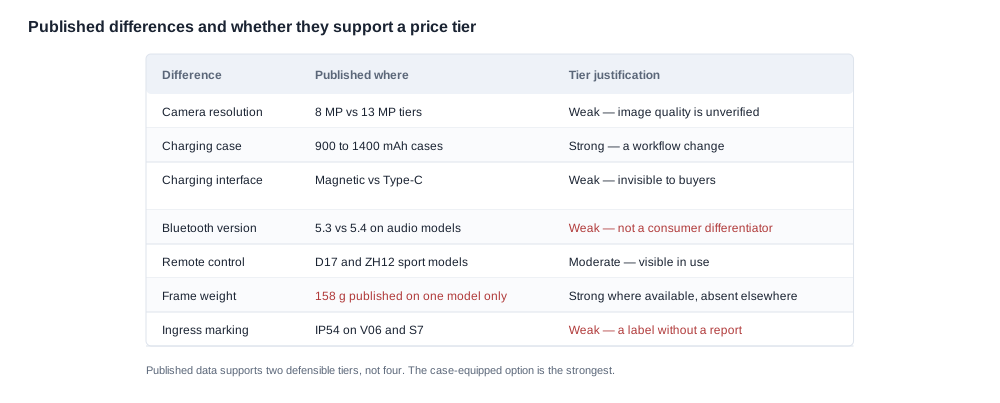
The charging case is the strongest tier separator in our published data, because it changes a workflow rather than a specification.
The published case positions are specific. L1 Pro and CY03, and CY05 carry a 1400 mAh case. L2 Utral is published with either a 900 mAh or a 1400 mAh case, which puts two genuine positions inside one model. MT6 carries a 1200 mAh foldable case. Two further models, KY06 and MT5, have a case with no published capacity. V06 and S7, and V03 have no case row at all, and V03 Pro is published explicitly as having no case.
That set contains everything a tiering decision needs, and it also contains the trap. The trap is that the case capacity is a specification figure, and it is tempting to build the tier on the number — 900 against 1400 — rather than on the object. A customer cannot evaluate 500 mAh of difference. What they can evaluate is whether the product came with a case, whether it fits in a pocket, whether it charges overnight, and whether they can carry it. The number decides what the case can do; the object is what the customer sees.
The L2 Utral is the useful demonstration of the distinction, because it is published in two positions at two capacities. A brand can sell the 900 mAh version as the everyday-carry tier and the 1400 mAh version as the travel tier, and the shopper-facing message is the same in both cases — it comes with a case and it charges differently — while the commercial difference is real and the documentation supports it. That is what a defensible tier looks like in this category: one customer-facing difference, several underlying ones.
Three more reasons the case carries a tier better than a specification does. It raises the achievable basket value at the point of unboxing, where accessory attachment is highest. It is legible in a shop, on a shelf, in a photograph and in a review video, without the customer needing to know anything about the product. And it is the kind of difference that survives a comparison: a shopper comparing two listings that both show a camera will not notice a megapixel difference, but they will notice that one of them shows a case and the other does not.
The commercial consequence is worth stating, because it is the argument that makes the case tier hard to argue against. A tier that adds an accessory raises the shipped value of the basket without the shopper having to spend the difference, which means the retailer captures more value per unit of shelf space. A tier that adds a specification does not change the value of the basket at all, and it may reduce it, because the shopper who was going to buy the accessory at a separate price now gets it included. In a category where the accessory is the difference, the accessory tier and the price tier are usually the same decision, and a brand that treats them as two decisions will price them inconsistently.
There is one caution on the case as a separator, and it is about the models where the data is thin. A case exists on the KY06 and the MT5 with no published capacity, and there is no case row at all for the S7 and the V03, and the V06, with the V03 Pro published explicitly without one. A brand building a case tier across a range therefore has to check the model-by-model position rather than assume it, because the difference between "no case" and "case with no published capacity" is the difference between a deliberate tier and an accident.
Smart glasses tier separators: what a shopper can actually perceive
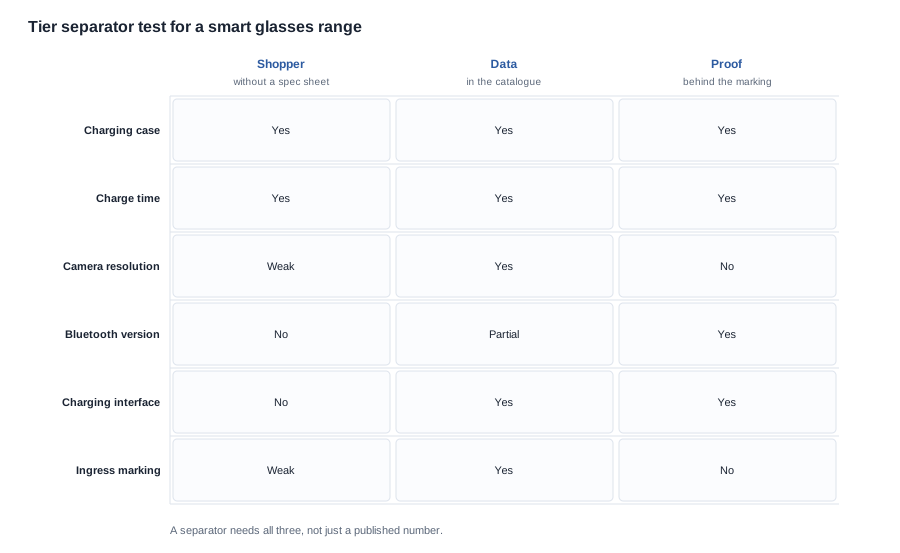
A useful test for a tier separator is not "can the customer see it on the spec sheet" but "can the customer tell, without a specification, that one product is doing more than another". Three kinds of difference pass that test in this category.
The criteria are worth writing down before the range is discussed, because a separator that passes one test and fails another is not a separator — it is a specification. A published difference that the shopper cannot perceive fails the first test no matter how well documented it is, and a perceptible difference that cannot be evidenced fails the second one. Which one of the two you are looking at determines who has to fix it: a perception problem is fixed in the merchandising, and an evidence problem is fixed by a document request.
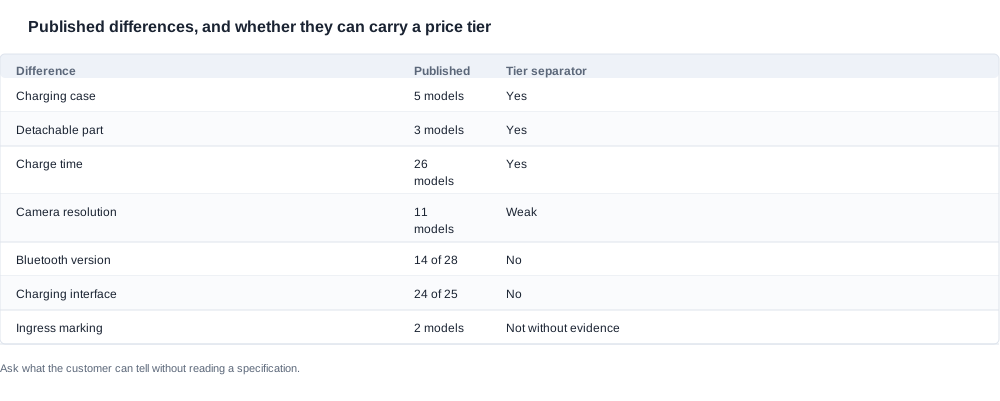
A physical object that is present or absent. The case is the clearest example. The same logic applies to any detachable component, and our range has three published examples — an inner frame on the V06, an inner frame on the S7, and a temple on the G07 — each of which changes what the customer physically has.
A change in what the customer can do. A case that supports a day of use and one that does not is a workflow difference, not a number difference. The charge-time spread in our range supports the same kind of argument: 26 models publish a charge time of two hours or less, and the D17 and the ZH12 publish approximately one hour, which is a real behavioural difference for anyone charging between uses.
Comfort. Frame weight is arguably the strongest separator of all, because it decides whether the customer keeps wearing the product, and a product that is not worn does not generate replacement demand. But it is also the one this category publishes least: we publish a weight figure for exactly one model, the MT6, at 158 g for the glasses alone and explicitly excluding its 1200 mAh foldable case. If comfort is central to your tiering, that is a question for the manufacturer rather than a filter on the catalogue.
The reason weight matters so much here is worth stating, because it is specific to this form factor. In a speaker, a heavier unit is a quality signal. In something worn on the face for hours, weight is a tolerance, and the tolerance is much lower than buyers expect — the point at which a customer stops wearing the product at all is well below the point at which they would describe a speaker as too heavy. That is why the one published weight in our range is on a model with a foldable case, and why a brand planning a tier ladder around comfort should ask for weights across its candidate models before it asks for anything else.
A practical note on how to use comfort in a tier when the figures are not published: weight is a candidate separator, not a usable one until it is measured. A brand that wants a comfort tier needs the figures for the specific configurations it would order, which is a document request rather than a catalogue filter, and it should be made early because the answer can remove a model from consideration entirely.
Against those three, here is what does not work.
Camera resolution. 8 MP against 13 MP is a real specification difference and a weak commercial one, because resolution does not predict image quality. Pixel size, lens and low-light behaviour determine the result, and none of those is published for any model in the range. A buyer building a tier on resolution is making a claim about image quality that the published data cannot support and that a customer may test on the first night. If you build a tier here, verify image quality on samples at both levels first. Otherwise use resolution as a product description rather than as a price justification.
Bluetooth version. It is published for fourteen of the twenty-eight catalogue entries and not published for the eleven camera models, the A05, the A06 and the bone conduction entry. Whichever versions are involved, the customer cannot perceive them. Name them in the specification; do not build a tier on them.
Charging interface. Magnetic on seventeen models and Type-C on seven, with CY05, the CY03 and MT6, and L1 Pro not published. Useful to state for interoperability and for logistics planning. Useless as a price justification, because a customer with a USB-C cable in their bag has no preference.
The ingress marking. V06 and S7 carry IP54 markings and no third-party report number is published for either. A marking without published evidence cannot support a price tier, because the next claim made about it is that the product is waterproof — and "waterproof" is not a claim available to you on the strength of an IP54 marking, whatever the product.
Smart glasses tier structure: how many tiers and what separates them
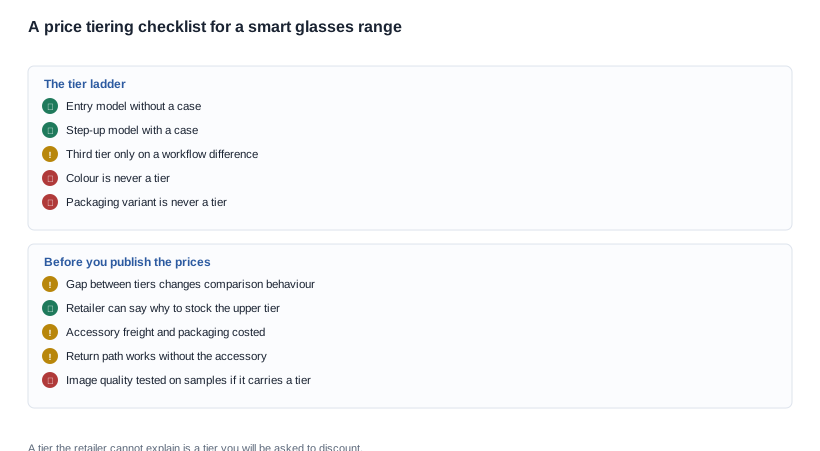
Two tiers, in most channels. An entry model in a bare charging configuration, and a step-up model that includes the case. Everything else in the range is a colour or packaging variant within a tier rather than a tier of its own.
That structure holds because it mirrors the only strong separator we publish, and because a two-tier ladder is the easiest structure for a retailer to stock and for a customer to understand. It also keeps the range small, which matters more in this category than in most, because the deciding variable for the customer is fit and the product is worn on the face — a wide range in a wearable is harder to merchandise than a wide range in a speaker.
For a channel that serves a creator segment, a third tier is defensible if the separator is a workflow rather than a number the customer cannot evaluate. A case that supports a longer working session is the clearest version of that. The requirement is that the third tier must be describable in a sentence that contains no specification at all, and if you cannot write that sentence, the tier is a configuration rather than a tier.
Two rules keep a tier structure from leaking. The first is that a colour is never a tier. Our published colour lists are three options for the V03 Pro and four for the V06, and none of the others publish colours at all — which means a colour-led tier is only available on two models in the entire catalogue, and on every other model it is a material batch with its own sourcing lead time. The second is that a packaging variant is never a tier either, unless the packaging is what the customer actually buys, which in this category it usually is not.
There is a third rule about how the tiers are priced, and it is a commercial one: the gap between tiers should be large enough to change the comparison behaviour. Two tiers separated by a small amount of money generate comparison shopping, and comparison shopping is the mechanism that removes margin on every SKU in the range rather than only on the one the customer chose. A brand whose tiers are close together has effectively priced itself into a single tier with extra colours.
That rule has a negotiation consequence that is worth handling early. The price gap between tiers is set by where the tier boundaries fall, and the tier boundaries are set by which configurations the factory can separate at the margin — which tool, which setup, which documentation set, which packaging run. A brand that fixes its retail prices first and asks the factory to match them will find that the achievable gap is a function of what the factory can do rather than what the channel wants. Getting the factory's position on separability before the price ladder is drawn is worth more than a negotiation on the price itself, because it changes what is negotiable.
There is also a channel-specific variant of the two-tier rule. Some channels price on a single listing with a variant selector, in which case the tier ladder has to be expressed inside one page, and the first thing the shopper sees must be the separator — otherwise the page reads as one product with several prices. In those channels the case is a particularly good separator to lead with, because it is an image the shopper can interpret without explanation.


Smart glasses pricing gaps: the parameters that are not published
Four parameters would ordinarily carry a tier in this category and are not published for any model in the range. They are worth listing together, because a buyer who plans a tiering exercise and then discovers all four gaps at once tends to conclude that tiering is impossible here, which is the wrong conclusion.
Image quality. No sensor model, no field of view, no frame rate, no video format, no stabilisation figure and no storage capacity are published. What is published is the resolution class, and resolution does not predict the result.
Acoustic performance. No acoustic measurement appears for any of the eight audio models. Sound quality claims are therefore not comparable to anything, including to a competitor's, and a tier built on "better sound" is a tier built on a belief.
Frame weight and geometry. One published weight, for the MT6. No frame dimensions and no temple lengths anywhere in the range.
Real runtime under load. The camera tier publishes batteries across the 220–290 mAh band with a rated runtime of roughly five to eight hours, and publishes no test condition for that figure. Two camera models can therefore publish the same runtime band and behave completely differently in a day of use.
There is a fourth gap with a different character, because it is about how a tier is defended rather than about how it is described: the test basis behind a published marking. For the two models carrying an IP54 marking, the report and its method are not published, so a tier that leans on water resistance rests on a claim a brand cannot evidence for the other models in its own range.
The way to handle a published gap is not to avoid it and not to fill it with a plausible number. It is to convert it into a measurement and a deliverable. For image quality, that means samples tested at both levels under the conditions the customer will use. For weight, it means asking the manufacturer for the figure for the configuration you would order, and treating a refusal as a tiering constraint rather than as a gap to work around. For runtime, it means asking for the test condition and writing it into the listing, or dropping the claim.
There is a commercial framing for this that makes it easier to put to a supplier. Every one of these parameters is a specification you would otherwise have to defend in a review, an in-store return conversation or a marketplace claim, and every one of them has a document that settles it. A tiering exercise that ends with "we will confirm the weight, the acoustic figure and the test condition before launch" is a better exercise than one that ends with a number nobody can source. The first one produces a listing; the second one produces a dispute.
It is also worth asking, for each gap, which of the two markets it is a risk in. A gap in a published specification is a documentation risk in a channel that verifies claims and a customer-service risk in a channel that does not. A gap in a claim you have already published is a different problem entirely, and it is one you created rather than one you inherited.
There is a due diligence step here that is cheap and that most brands skip: ask which model the factory itself would put in each tier, and why. The answer tells you which configuration differences the factory considers meaningful, which is a different and better-informed view than the published table, because it is filtered by what the factory has actually built before. It also tends to surface a trade-off you have not considered — usually that the upper tier requires a different cell or a different temple, which is a manufacturing decision rather than a packaging one.
Smart glasses channel reality: what a tier does to the channel
A tier is a claim made to the channel as much as to the customer, and it has consequences the pricing plan does not show.
The retailer's question is the acid test: why should I stock this one rather than the cheaper one. A tier built on a perceptible difference answers it in a sentence. A tier built on a specification difference cannot be answered at all, and the buyer who cannot answer it will take the one that is easier to reorder — which is usually the entry tier, and it is usually the one that ties up the shelf space without earning it.
Stocking also follows the tier structure. Each tier is a separate line in the buyer's plan, with its own forecast, its own packaging, its own artwork and its own accessory line. A range with four tiers and three colourways each is twelve lines to the buyer, not four, and the buyer will do the arithmetic on the shelf space long before they do the arithmetic on the margin. This is the same under-counting that catches out accessory SKUs in a range plan, arriving through the channel rather than through the factory.
Returns are the third consequence, and the case makes it concrete. A product returned without its case is a different commercial event from a product returned with it, and the packaging for a case-equipped tier has to make that visible at the point of return. The same applies to the detachable parts in the published range — the inner frames on the V06 and the S7 and the temple on the G07 — because a detached part is an accessory return, not a warranty claim.
Finally, landed cost. A tier that adds an accessory does not add an accessory to the shipment; it adds a moulded case with its own material, its own freight weight, its own volumetric space and its own packaging. It is the tier most likely to compress margin without appearing in the price comparison, and the reason to check it before the range is fixed rather than after the first shipment has been costed.
Smart glasses tier procurement: the commercial terms behind the ladder
A price ladder is not finished when the retail prices are drawn. Each tier is a separate commercial object, and the commercial terms that apply to it are decided against a configuration rather than against a model name. Six of them need attention before the ladder is published.
The quotation structure. A tier ladder quoted as one range produces one unit price that is wrong for both tiers. It has to be quoted per tier, with each tier's configuration stated, and the tier structure itself written into the quotation so that the price gap is a negotiated output rather than an accident of the costing.
Minimum order quantity and volume tiers. The floor in this category attaches to configurations rather than to purchase orders, which means a ladder with two tiers and three colourways in the upper tier is asking how many floors it has created. Ask whether the floor applies per tier, per configuration or across the range, and which tier carries it if the volume arrives unevenly — because in most launches the entry tier outsells the upper one, and a floor attached to the wrong tier is what turns an early sell-out into a stockout.
Lead time per tier. Two tiers built on one tool do not have two lead times; they have one tool lead time and two assembly lead times. Two tiers built on two tools have two tool lead times, and they do not overlap by default. This is the number that decides whether the upper tier can be launched as a follow-on or has to be launched at the same time — and therefore whether the price ladder is coherent on the day you launch it.
Samples, golden samples and tolerance. A golden sample is signed per tier, not per range, and the colour and finish tolerance should be stated per tier as well. A brand that has budgeted one golden sample for a two-tier launch will find the gap at the approval stage, which is the least forgiving moment in the programme.
Warranty and certification scope. A warranty period is a commercial term that follows the configuration, and so does the documentation scope — and because there is no per-model certification row in our catalogue, that scope has to be written down per tier. Where the upper tier adds a case or a detachable part, the accessory needs its own position in both, because an accessory returned without its case is not a warranty claim on the same basis as a complete product.
Incoterms and payment. A tier that adds an accessory changes the volumetric weight and the carton count, which changes the freight cost and the delivery profile. Ask for the shipment terms against the packaged tier rather than against a nominal unit — a delivery basis quoted on a unit weight will not survive the first shipment, and the correction then lands on the margin of the tier that was supposed to carry the premium.
What we will do with a proposed tiering is straightforward. Send us the channel, the target retail price points and the tiers you have in mind, and we will say which of the published differences can honestly carry each one, which of them rests on a parameter that is not published, where the commercial terms need to be written per tier rather than per range, and where we would rather you measured something than asserted it. The positioning is on the consumer electronics brands page, the camera range detail is on the AI camera glasses page, and the charging interface and case positions are set out on the charging solutions page.
Related reading
- smart glasses for consumer electronics brands
- AI camera glasses range
- charging interfaces and case models
Tell us the channel and price points and we will say which tiers the data supports.


