
A content-creation portfolio is not a range of good, better and best. In this catalogue most of the differences between the camera models are packaging, a charging interface and one pair of tier steps, and a brand that builds three tiers on that basis ends up with three products a shopper cannot tell apart. Smart glasses for content creation product portfolio is therefore a question about how many genuinely distinct products the published rows support, and the answer for most buyers is fewer than they expect and easier to defend than they assume.
This article works through what actually separates the eleven camera models, which two variables are worth separating on, where the catalogue's model naming will cause a problem in a buyer's own listing, and what a portfolio quotation has to settle before the artwork is drawn.
Smart glasses portfolio: how many products the published rows separate
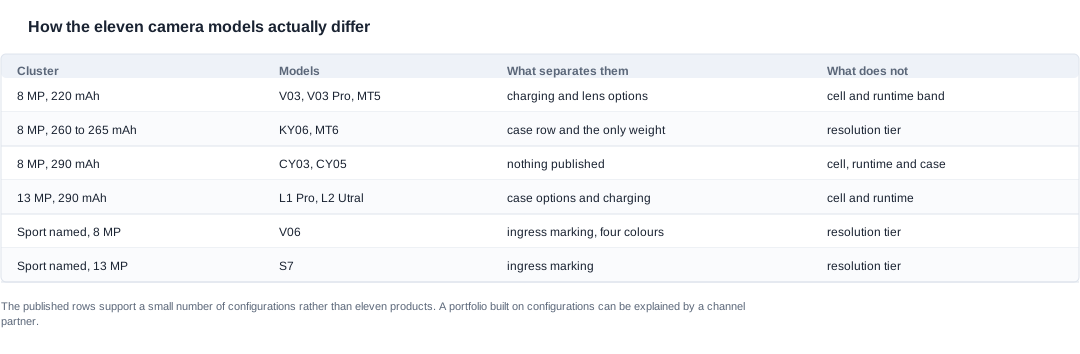
Grouped by their published electrical rows, the camera tier falls into a smaller number of clusters than the model count suggests.
| Cluster | Models | What separates them | What does not |
|---|---|---|---|
| 8 MP, 220 mAh | V03 and MT5, and V03 Pro | charging interface, lens option | cell, runtime band |
| 8 MP, 260 to 265 mAh | KY06, MT6 | case row, the only published weight | resolution tier |
| 8 MP, 290 mAh | CY03, CY05 | nothing published | cell, runtime, case |
| 13 MP, 290 mAh | L1 Pro, L2 Utral | case options, charging interface | cell, runtime |
| Sport-named 8 MP | V06 | ingress marking, four colours | resolution tier |
| Sport-named 13 MP | S7 | ingress marking | resolution tier |
Three conclusions follow directly from that grouping, and each of them changes a portfolio decision.
The CY03 and the CY05 are indistinguishable on published specification. Both publish 8 MP, a 290 mAh cell, a rated runtime of about seven hours and a 1400 mAh charging case. There is no published row on which to separate them, which means a range that puts one above the other is separating them on something the catalogue does not contain. If the two models differ in a way that matters, that difference has to be established in writing before the range is designed around it.
The V03 and the V03 Pro differ on the lens and the port, not on the electronics. Both publish a 220 mAh cell and a band of about five to eight hours. The V03 Pro is the only camera model in the range with a photochromic lens and three published colour options, and it is one of the two camera models charging over Type-C. The V03 Pro also has no charging-case row, and the V03 has no case row either. That combination — a lens-led variant with no case — is a real and describable product, and it is a better portfolio member than a cosmetic difference between two otherwise identical models.
The V06 and the S7 are camera models whose names read as sport. They carry cameras, they carry resolution tiers, and the V06 publishes four colours while both of them publish an IP54 marking. Any portfolio that sorts by the name on the label will put them in the wrong section of the catalogue and, more importantly, will leave a buyer wondering why a "sport" model appears in a content range. The YKC02 is the mirror image of that trap: it is a sport model with a published 2 × 70 mAh cell configuration and no camera, and it must never be counted among the eleven camera models.
The deeper point is about portfolio structure rather than model selection. The published rows support a small number of configurations, not eleven products. A portfolio built on configurations is one that a channel partner can explain and a shopper can navigate. A portfolio built on model names is one that requires a specification comparison to justify.
For a distributor, the consequence is an assortment decision with a cash cost attached. A shelf carrying eleven camera models is a shelf carrying eleven purchase orders, eleven sets of artwork, eleven packing lists and eleven separate documentation files, in exchange for the difference between them that a shopper can see. That is a large amount of working capital spent on distinctions that a creator is unlikely to notice. A shelf carrying two or three configurations spends it on volume per line, on a case that genuinely changes the working day, and on the samples and photographs that have to be produced for each new line.
The reason a catalogue can leave this question open is that the published rows are not a merchandising plan. They are a record of what the manufacturer knows about each model, and several of the gaps in that record are gaps in the record rather than gaps in the product. Which is exactly why a portfolio decision has to be made on evidence from the samples and on a written answer from the supplier, and not by reading the model list top to bottom.
The two smart glasses variables worth separating on
Most portfolio arguments in this category settle on price, and price is the one variable the catalogue cannot help with. There are two that it can.
Resolution, if your buyers produce content rather than capture moments. The step from 8 MP to 13 MP is a real step in the hardware, because the module, the lens stack, the image processing configuration and the thermal design all change together. It is also the only published separator between the camera models that spans a quality tier, and the L2 Utral and the S7, and the L1 Pro sit on the far side of it.
The caveat applies to every buyer: resolution is the pixel count and not the picture. Pixel size, the lens and the low-light behaviour decide the result, and none of those is published for any model. Separating a portfolio on resolution therefore means committing to an unverified assumption, and the assumption has to be tested on samples at both tiers before the range is committed. The camera imaging page sets out what the imaging rows do and do not tell you.
The charging case, if your buyers work in long sessions. A published 1400 mAh case is a workflow change rather than a specification change, and it is the variable that shows up in the reviews a creator leaves. The case row separates CY05 and CY03, and L1 Pro — each at 1400 mAh, L2 Utral at 900 or 1400 mAh, and MT6 at 1200 mAh foldable; KY06 and MT5 have a case without a published capacity; V06 and S7, and V03 have no case row, and the V03 Pro explicitly has none. A portfolio of one platform plus one case-equipped variant gives a channel two clear entry points without asking a customer to pay for a resolution difference that the published data cannot substantiate.
The three published case capacities are not interchangeable, and the choice between them is a different kind of decision from the resolution one. A 900 mAh case and a 1400 mAh case are both real second cells and both change the working day; the difference between them is how heavy the kit is and how many refills a creator gets away from a socket, which is a preference question rather than a specification question. The 1200 mAh foldable case on the MT6 is a third thing again, because foldability is about the pocket rather than about the cell. A brand that publishes a case tier can therefore describe it as capacity, as portability, or as both, and should decide which before the artwork rather than after the first review.
Two further reasons to treat the case as a portfolio variable rather than an accessory. It changes the carton, which changes the freight and therefore the landed cost, and it changes the unboxing, which changes what the shopper sees first. A case-equipped variant is the only configuration in this range where the difference between two products is visible before the product itself is.
Three variables are worth ruling out explicitly, because they come up in every portfolio conversation.
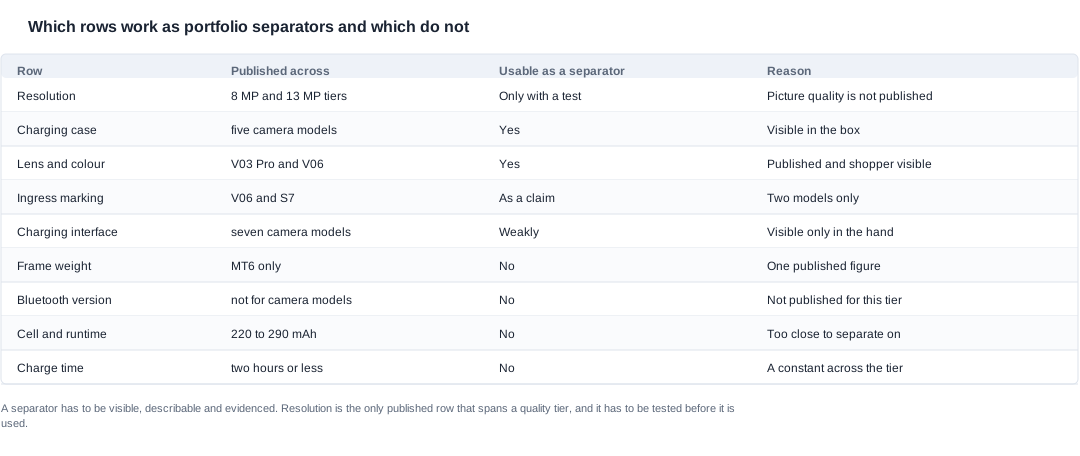
Do not separate on Bluetooth version. Our catalogue publishes a Bluetooth version for fourteen of the twenty-eight models it lists, and the eleven camera models are all in the group where it is not published. There is nothing to separate on.
Do not separate on weight. Exactly one published figure exists in the whole catalogue, at 158 g for the MT6 alone, excluding its foldable case. One figure cannot anchor a tier, and an unpublished weight cannot be promised in a listing either.
Do not separate on charge time. Every model in the range publishes two hours or less, so it is a constant across the tier rather than a variable. Only two models in the entire catalogue publish a shorter figure of about one hour, and both of those are sport models.

Where smart glasses model names collide with your own listing
There is one naming item in the camera tier that a brand should resolve in writing before it reaches any artwork, and it is the kind of detail that is cheap now and expensive later.
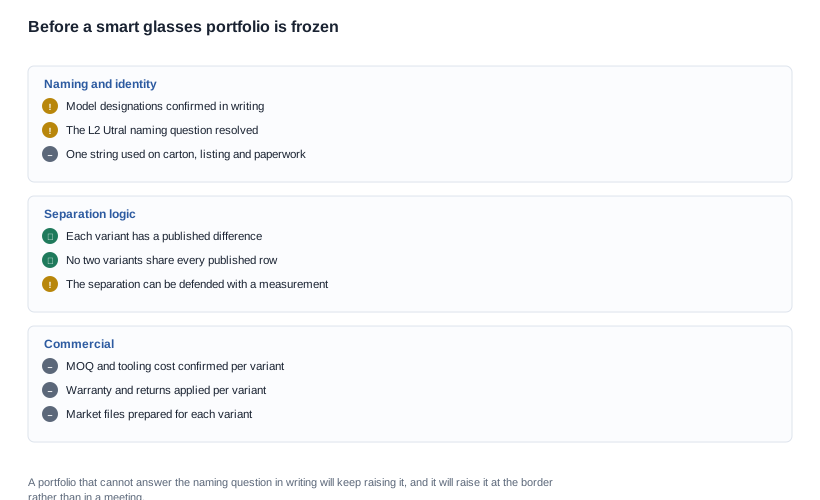
The L2 Utral is listed under a name that reads as a typographical rendering of "Ultra", and the entry also carries an "Utral Pro Max" marking. That is a supplier-side naming inconsistency, and it becomes the buyer's problem the moment a model designation appears in three places that are supposed to agree: the product listing, the carton artwork and the market paperwork. A designation that differs between a supplier document and a buyer's carton produces a customs query, a warranty claim with an ambiguous model string, and a marketplace listing that cannot be matched to a certificate.
The method is unremarkable and it is worth doing in writing rather than in a meeting: ask for the exact model designation that will appear on the carton, the exact designation that will appear in the compliance file, and a confirmation of which one appears on the purchase order and the packing list. If they are the same string, the portfolio has a stable identity. If they are not, the portfolio has a problem that grows with every shipment.
There are two smaller naming items in the same family. The V03 Pro is the only camera model with a photochromic lens, and the three published colour options attached to it are a differentiator that a listing can use. The V06 publishes four colours. Both are useful in a portfolio because they are published, and both have to be described in the words the catalogue uses rather than in a marketing paraphrase, because the paraphrase is what ends up in a listing that cannot be substantiated later.
The three-places rule is worth stating on its own, because it applies to every variant in the range and not only to the L2 Utral. The model designation has to be one string in three places: the product listing a customer reads, the carton and packaging artwork, and the paperwork that travels with the goods. Where those three disagree, the practical cost falls on the party that owns the paperwork, which is the buyer, and it falls at the least convenient moment.
A related discipline applies to the naming of the variants themselves. If a brand invents a name for a configuration — a series name, a capacity name, a colourway name — that name is the buyer's own creation, and it is the buyer's own creation to defend. It should not borrow a catalogue designation in a way that implies a model string the catalogue does not carry, and it should not imply a performance difference that has not been measured. Where a variant name carries a promise, that promise belongs to the buyer, and the acceptance criteria behind it should exist before the name appears on a page.
Building a smart glasses range a buyer can tell apart
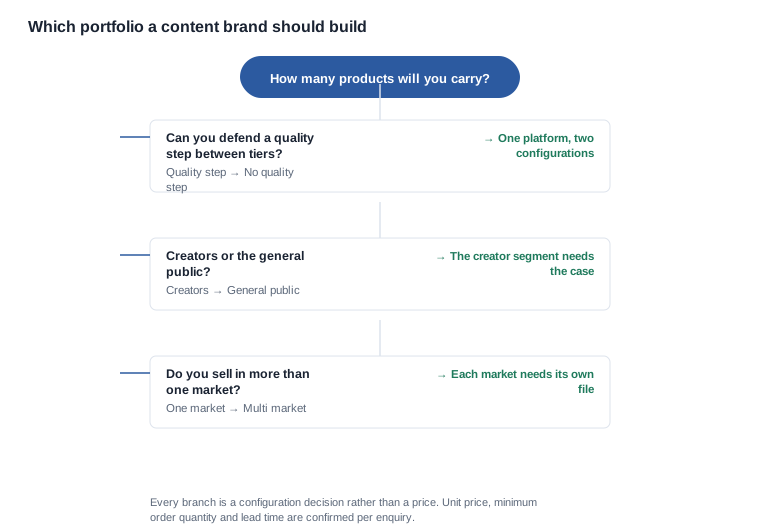
The practical structure that works, for a brand or a distributor serving content creators, is one platform with a small number of named configurations.
A base configuration that carries the camera at 8 MP, the charging interface that is published for the chosen model, and the case if the segment needs one. This is the product that carries the volume, and it should be the one with the simplest story for a channel partner.
A creator configuration that adds the higher-capacity case, and that is genuinely a different product in the hand rather than a different label on the same box. A buyer can explain it in one sentence: the same device, with a case that adds most of a day.
A step-up configuration on the 13 MP tier, if and only if the programme has tested image quality at both tiers and can defend the difference. If it cannot, a step-up configuration is a price point rather than a product, and price points on an undifferentiated specification are the fastest way to teach a channel that the range is arbitrary.
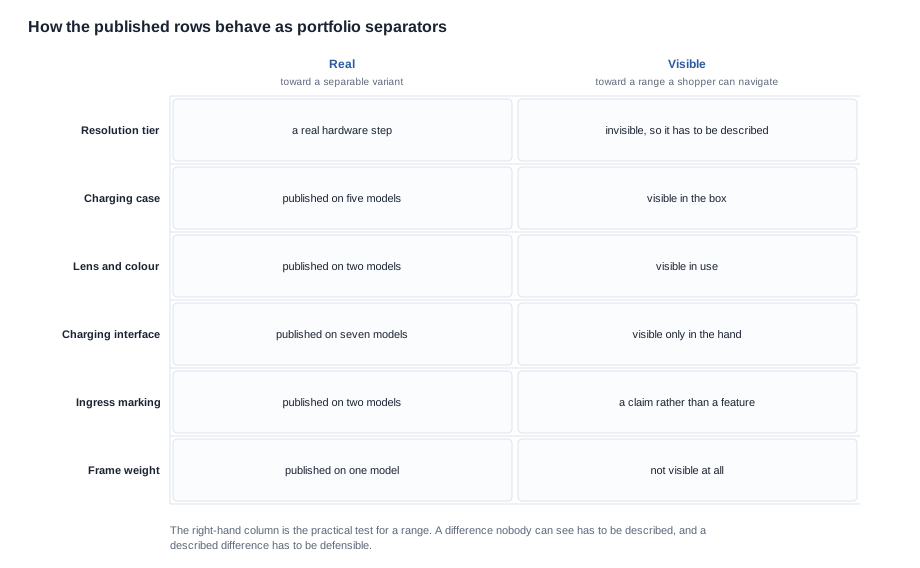
What makes the range legible to a shopper is not the number of products but whether the differences are visible or describable. A charging case is visible in the box. A colour is visible on the shelf. A photochromic lens is visible in use. A charging interface is visible only in the hand. A resolution tier is invisible, which means it has to be described, which means it has to be defensible. That ordering is the reason the two variables above are the two worth separating on.
The base configuration also has to survive the artwork, and that is a smaller constraint than it looks. Four camera models — the CY05, the L1 Pro and the MT6, and the CY03 — publish no charging method at all, so a brand that wants to show a port, a pad or a cable in its photography cannot choose a model on that basis until the interface is confirmed in writing. The same four models are the ones whose charging behaviour a creator will meet in the first ten seconds of unboxing, which is another reason the confirmation is worth chasing early rather than treating it as a footnote.
One thing a brand should decide before it designs the range is whether the range is for a creator or for the general public, because the two need different configurations rather than the same configurations at different prices. A creator buys a case, cares about the runtime and reviews the product on what it captured. The general public buys the object, notices the colour and the lens, and is not going to read a runtime figure. The catalogue supports both, and the V03 Pro with its photochromic lens and the V06 with four published colours sit naturally on the second side of that line, while the 1400 mAh case variants sit on the first.
The one thing a portfolio must not do is publish a difference the catalogue does not carry. There is no per-model certification row in this range and no certification mark named for any model, so a portfolio that differentiates on certification is differentiating on something that cannot be evidenced. The same applies to any ingress claim outside the V06 and the S7, and to any weight claim outside the MT6.
What a smart glasses portfolio quotation has to settle
A portfolio quotation that treats every model as a separate line is a quotation for a catalogue rather than for a decision. The useful version settles the six things below, and each of them has a written acceptance criteria that the first delivery can be checked against.
- The configuration list, with the model string and the option set for each variant, and the reason each variant exists expressed in one sentence that a channel partner could use with a customer.
- The separation logic, stating which published row each variant differs on, and what the buyer may say about that difference in a listing.
- The naming position, with the model designations confirmed in writing against the carton, the listing and the paperwork, including the L2 Utral question above.
- The commercial position per variant: unit price, minimum order quantity, lead time, sample cost, warranty scope and any tooling charge, each confirmed per enquiry because each depends on configuration, quantity, documentation and the current schedule.
- The market position, with the documents required for each variant in each destination market, since a variant that ships into a market needs its own file even where the hardware is identical.
- The evidence position, recording what was measured on the samples, against which acceptance criteria, and which rows remain unpublished for each variant.
Before you order, it is worth running one check on that list yourself: for each variant, ask whether the difference from its neighbour is visible in the box, describable in one sentence, and evidenced by something other than a price point. A variant that fails any of those three tests is a variant that will be returned, discounted or complained about, and the total cost of a portfolio is the sum of its variants' problems rather than the sum of its variants' margins.
Dead stock is the line item that is hardest to see in advance and easiest to feel afterwards. It appears when a variant exists to cover a market segment that turns out not to buy, and it is worst when the variant carries its own artwork, its own packing list and its own documentation file, because every one of those is a fixed cost spread over fewer units. The way to avoid it is to keep the variant count small enough that each one can be reordered against a real number of sales, and to be honest with yourself about which variants exist because a case was opened rather than because a segment exists.
There is a sequencing point as well, and it is the one that ties this article back to the way a programme actually runs. The portfolio decision and the sampling decision should be made together rather than in sequence, because the sample that answers one case usually answers two, and a portfolio designed after the samples arrive tends to inherit whatever the first sample happened to demonstrate. Opening the variants first, with the acceptance criteria written down for each, keeps the range a consequence of the evidence rather than a decoration on top of it.
For the per-model published rows across the whole range, the AI camera glasses range is the reference, and the content creation solution page sets out how a camera configuration fits into a creator programme once the portfolio decision is made. Tell us the segment you are targeting, the session length you need to support and the markets you are selling into, and we will say which published differences serve it and which of them would only add a SKU.
Related reading
Tell us the segment, the session length and the markets, and we will say which published differences serve them.


