
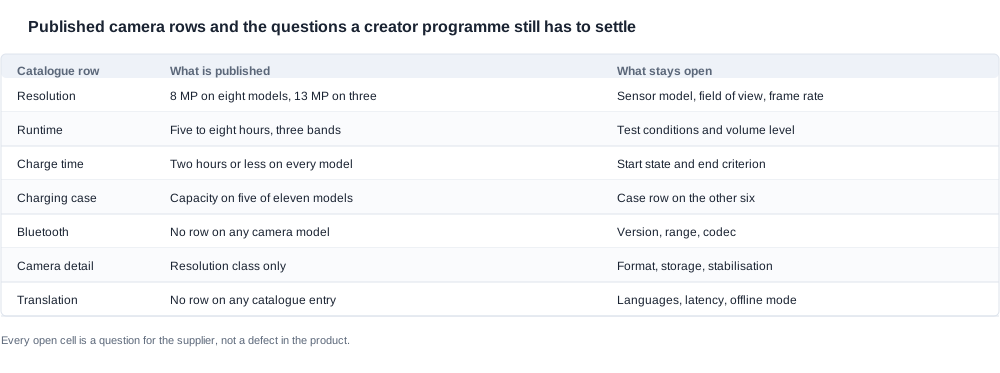
A content-tool brand reselling smart glasses for content creation is not buying a specification sheet. It is buying a claim it can defend to a marketplace, to a distributor and eventually to a customs officer. Our catalogue supports part of that claim and leaves the rest open. Eleven camera models carry a resolution class — 8 MP on eight of them, 13 MP on the S7 and the L1 Pro, and the L2 Utral — alongside cell capacities from 220 mAh to 290 mAh, rated runtimes of roughly five to eight hours, a charge time of two hours or less on every one of them, and a charging case on five of the eleven. What the catalogue does not carry is the part a first-person video programme runs on: no field of view, no frame rate, no video format, no stabilisation, no storage capacity, no sensor model, and no translation row on any model at all.
That gap is the subject of this article. Below is what a creator programme can be built on, what has to be requested in writing before a purchase order is issued, and where the line sits between a published row and a feature a brand has observed elsewhere.
Smart glasses for content creation: the published rows and the empty ones
The catalogue is a specification document, and it behaves like one. Every figure in it was placed there deliberately, and the figures it omits are omitted for a reason — most often because a test condition behind the number has not been established, or because the value differs between production batches and would mislead a reader who treated it as fixed. Neither reason is a defect. Both are reasons a sourcing team has to ask questions rather than copy rows.
Resolution is the only camera figure the catalogue publishes
Eight of the eleven camera models publish 8 MP: the V03 Pro and the CY05, the MT5 and the V06, and the V03 and the CY03, and the MT6 and the KY06. Three publish 13 MP: the L2 Utral and the S7, and the L1 Pro. The S7 makes the point in its own catalogue line, which pairs the 13 MP figure with an ergonomic frame, a removable inner frame and an IP54 marking.
Everything downstream of that number is unpublished. The catalogue publishes no sensor model, no field of view, no frame rate, no video format, no stabilisation figure, no low-light performance statement, no storage capacity and no file format for any camera model. A buyer planning a creator range therefore cannot build a frame-rate ladder, a bitrate budget or an upload pipeline from published data, because none of those quantities exist in the catalogue.
The practical consequence for a content-tool brand is that resolution is a tiering input rather than a specification input. It tells you how to group models, and it tells you that two products in the same group are not interchangeable. It does not tell you whether a model captures usable vertical video for a given platform, and a brand that publishes a frame-rate claim on a product page needs that figure from the supplier first.
Runtime and charge times without their test conditions
Every one of the twenty-eight catalogue entries publishes a charge time, and twenty-six of them publish it as two hours or less — a ceiling, not an estimate. Only the D17 and the ZH12 publish approximately one hour, and those two are the sport models among the named entries. When we describe a charge time in our own material we keep the ceiling wording, because "two hours or less" permits a unit that takes exactly two hours and "under two hours" does not.
Rated runtime is published for all eleven camera models, in three bands: five to eight hours on the V06 and the S7, and the V03 and the V03 Pro; six to eight hours on the KY06 and the MT5; and about seven hours on the L2 Utral and the MT6, and the CY05 and the L1 Pro, and the CY03. What is not published is the condition under which those figures were measured — the playback volume, the recording load, whether the unit was streaming to a phone, the ambient temperature, or whether the figure describes a charge-and-run cycle or a single continuous session.
That missing condition matters more for a creator programme than for almost any other category, because a creator tool is used in long blocks, outdoors, often while recording and rarely with a spare unit in a pocket. A runtime figure without its condition cannot be turned into a schedule. "About seven hours" can mean a comfortable two filming blocks on a cold day at moderate volume, or a little over three hours on a warm day with continuous recording — and only the supplier knows which.
Charging cases: five of the eleven camera models
Case availability on the camera models has three distinct states, and a buyer who treats them as one will mis-state a product page. Five models publish a case capacity: the CY03, the L1 Pro and the CY05 — each at 1400 mAh; the L2 Utral with a row reading 900/1400 mAh, which publishes two capacities on one line without stating which of the two variant names each belongs to; and the MT6 at 1200 mAh in a foldable case, the only foldable case in the range. Two more — the KY06 and the MT5 — list a case but publish no capacity for it. The S7 and the V06, and the V03 have no case row in the catalogue at all, which is different from the V03 Pro, which is explicitly published as having no case.
The practical distinction for a channel buyer is that "no capacity published" and "no case" produce different product pages, different carton contents and different accessory line items. A catalogue that says nothing cannot be quoted as including an accessory.
The rows a creator programme needs and cannot get from the catalogue
Camera models also share two absences that matter for a first-person content product. No camera model publishes a Bluetooth version, while all eight audio models do. And no camera model publishes a weight; the only published weight anywhere in the range is 158 g for the MT6 glasses themselves, excluding its foldable case.
For a creator range, both are commercially load-bearing. A buyer whose creator audience uses a current phone and a current platform has to know the pairing path, and Bluetooth version is the cheapest proxy for it the catalogue offers — it simply does not offer it for these models. Weight decides the positioning of a product aimed at people who record for a living, and again the catalogue declines to answer for ten of the eleven.
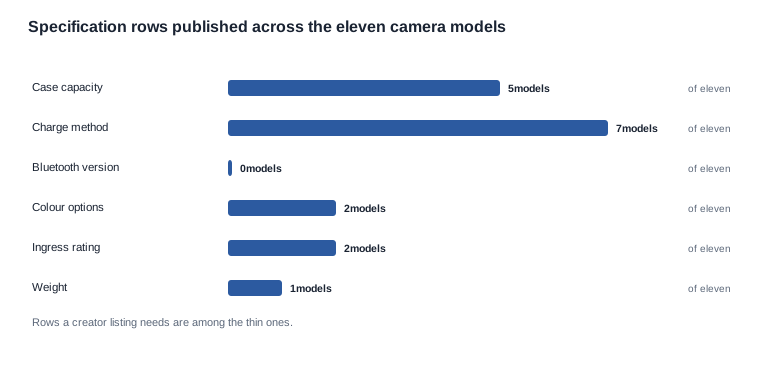
The chart above counts, across the eleven camera models, how many publish each row. The shape of it is the point: two rows are near-total, three are partial, and the rows a creator product is judged on are among the thin ones. That distribution is not a criticism of the catalogue. It tells a buyer where the negotiation has to happen.
Smart glasses translation claims: a published row is not an observed feature
Translation appears in this category more often in marketing copy than in specification tables, and the distinction has to be made carefully because both sides of it carry legal exposure.
What our own product record does and does not say
Our internal product record carries AI translation against one audio row, and it carries it with an evidence grade attached: the record marks it as observed rather than as a confirmed specification, noting that it was taken from our own independent site rather than from a model page. The catalogue itself publishes no translation row on any of the twenty-eight entries. No language list, no latency figure, no offline mode, no translation trigger, no per-pair charge.
That distinction matters because a catalogue row is a statement the supplier stands behind, and an observed feature is a statement about what someone saw. When a brand repeats an observed feature on a product page without the supplier confirming it in writing, the brand is making the claim, not the supplier. If the feature turns out to be absent in the batch delivered, the brand owns the consumer claim, the platform listing and the refund.
Questions to put to a supplier about language coverage
For a programme where translation is a headline feature, the request to the supplier should be specific and written. The questions worth asking are these:
- Which languages are supported on the exact model being quoted, in both directions, and is that list a subset of the full list published elsewhere?
- Does translation run on the device, on a phone application, or on a server, and what does each of those arrangements mean for latency and for connectivity?
- Is a network connection required, and what happens to the feature when there is none?
- Is there a per-pair or per-month charge, and if so, who holds the account — the end user, the retailer or the channel partner?
- What is the measured latency between a spoken phrase and the returned translation?
- Is the feature enabled by default, and can a buyer disable it, which matters for privacy-led programmes?
- Which additional markets does the supplier already support, and is the answer specific to the model or to a platform it runs on?
None of these questions can be answered from a catalogue page. All seven are answerable in a quotation email, and a supplier that declines to answer them has given you the answer.
Why a translation claim moves the compliance burden
Translation is a data-handling feature, and the moment a device records speech and converts it, the programme acquires obligations that have nothing to do with hardware. Audio recorded during a translation session is a recording, and a recording made by a customer in a public place is a processing activity under privacy rules in most of the markets a creator brand sells into. The questions above are commercial questions, but they are also the first step of a compliance file.
A brand that intends to build a creator range around translation should settle the feature's scope before it builds the listing, not after. The AI features section sets out the entry points; the practical step is to write the translation scope into the purchase order as a deliverable, with the model number it applies to, so that the claim and the paperwork describe the same product.

Smart glasses creator selection: criteria, thresholds and the shortlist
A creator range is not assembled model by model. It is assembled by elimination, using criteria that disqualify rather than criteria that rank. The advantage of a disqualifying test is that it can be applied to a catalogue row and still produce a defensible answer.
Three model families and what each publishes
The catalogue holds twenty-five named models and three entries without a model string — the AR glasses, the electrochromic entry and the bone conduction entry — for twenty-eight rows in total. Grouped the way the catalogue groups them, that is eleven camera models, eight audio models, three sport models and three children's models, plus those three unnamed entries. The eight audio models publish a Bluetooth version: V5.3 on the K01 and the K02, and V5.4 on the D11 and the LC-105-2, the YK12 and the G07, and the D12 and the LC-105-1. Three of them publish a feature line of their own — the D11, the G07 and the YK12.
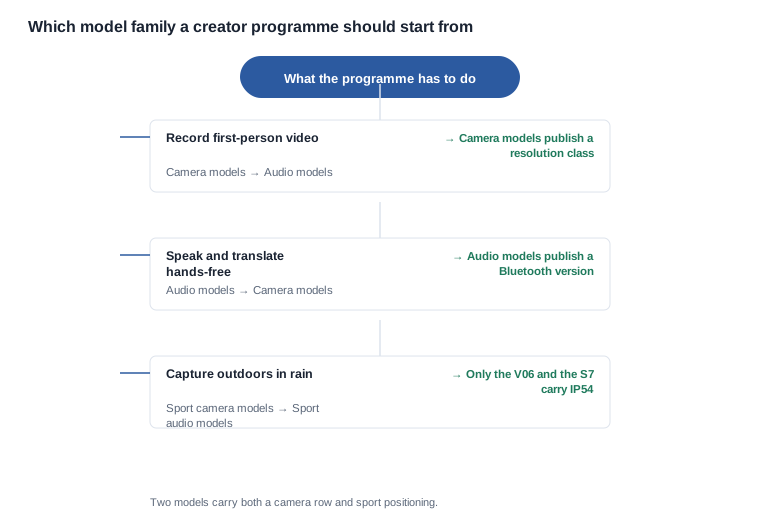
The selection test for a creator programme is not which family is more impressive. It is which family publishes the rows the programme's own product page needs. On that test, a camera model answers the resolution question and leaves the video question open; an audio model answers the Bluetooth question and has no camera row at all; a sport model answers the durability question and carries no camera specification unless it is one of the two that also publish a camera row.
The four questions that eliminate a model
Applied to this category, four questions remove most models from a creator shortlist quickly.
Does the programme need a camera at all? If the product is sold as an audio or call tool, the camera models are the wrong family and the relevant published rows are Bluetooth version, cell configuration and runtime. If it is sold as a first-person camera, the audio models have no camera row and cannot be positioned as imaging products.
Does the product page need a Bluetooth version? No camera model publishes one. If the listing copy references a pairing standard, a generation of hardware or a platform requirement, that value must be requested for the specific model in writing.
Does the product page need a weight? Only the MT6 publishes one, and its figure excludes the foldable case. A listing that gives a shipping weight has to come from a packing list, not from the catalogue.
Does the range need a charging case as a feature? Five camera models publish a case capacity, two publish a case without a capacity, three have no case row and one is published without a case. A listing that mentions a case as an included accessory has to be checked against the specific model.
Each question is answerable from published rows except the last two, and each one narrows the list before any commercial discussion begins.
Building a shortlist you can defend
A shortlist built this way is smaller than a range plan drawn from the catalogue, and it is defensible: every model on it survived a published test, and every model removed from it has a recorded reason. That record matters twice — once when a supplier asks why the list is short, and again when a retailer asks why the product page says what it says.
Two further checks belong in the shortlist stage rather than later. The first is the colour question: only the V03 Pro and the V06 publish colour options, three and four respectively, so a creator range that needs a colour choice has two published candidates and nine that have to be asked about. The second is the certification question, covered below, because it is the one that can stop a programme after the product page is written.
Smart glasses creator programmes: verification, failure modes and commercial terms
The verification stage is where a creator programme either becomes shippable or becomes a dispute. Four things have to be obtained, and they have to be obtained against named models rather than against a family name.
The document list to request before the purchase order
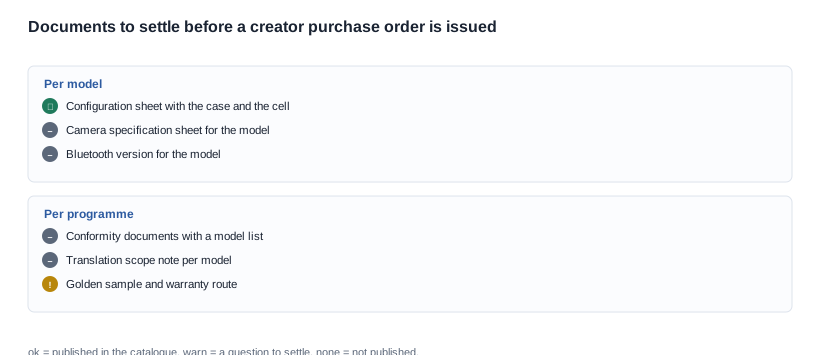
- A configuration sheet per model, naming the resolution class, the cell configuration, the charging method and the case. The catalogue supplies most of these rows; the sheet confirms they apply to the batch being bought.
- A camera specification sheet for each camera model, covering sensor model, field of view, frame rate, video format, storage capacity and stabilisation. These are the values the catalogue does not publish and that a creator listing will need.
- A conformity document set with the model list on it. The catalogue carries a company-level export certification page whose content is images rather than text, and the catalogue text contains no reference to CE, FCC or RoHS at all; there is no per-model certification row anywhere in it. The part that cannot be found in any document we hold is the model list on the conformity document: no certificate number is published for any model in the range, and the children's models carry no certification information at all. For a buyer, that converts a marketing claim into a documentary request with a named model list — and it is the single most useful document to have in hand.
- A translation scope note per model, if translation appears in the listing, as set out in the previous section.
Failure modes a first-person camera programme fails in
The first and most expensive is a specification written in adjectives. "Sharp", "smooth", "cinematic" and "broadcast quality" cannot be inspected at incoming goods, and a unit that fails an unmeasurable specification is not a defect — so a rejection is not available. The fix is procedural: every performance claim on a product page needs a number behind it, and if the number is not published, it has to come from the supplier before the page is written.
The second is a charging claim written as a duration rather than a ceiling. "Charges in two hours" states a fact the catalogue does not support, because the catalogue publishes two hours or less. The same applies to runtime: a runtime figure published as about seven hours is not the same statement as seven hours guaranteed.
The third is a translation feature described in the listing without a scope note. A brand that advertises live translation and cannot demonstrate it in the delivered batch faces a consumer-law problem and a marketplace problem on the same product at the same time.
The fourth is a weight claim taken from a comparable product. The MT6 publishes 158 g for the glasses; no other model publishes any weight, and the MT6 figure excludes its case. A listing that reuses that number on another model, or that includes the case in it, is a fabricated specification.
How a quotation should be structured
A creator programme is quoted per configuration, and the quotation has to name the configuration or it cannot be compared with anything. The lines a buyer should insist on seeing are these: unit price for the exact configuration, the minimum order quantity, the lead time for that configuration, the tooling or development items if any, the certification and translation deliverables, the warranty term, the packing list, and the shipment terms. Nothing on that list is published on our site, and each is confirmed per enquiry because each depends on configuration, quantity, mix and the current schedule.
The sample order route matters here for a specific reason. A creator product's specification cannot be verified from a catalogue page, so the sample is the only point at which the published rows and the real unit can be compared. The pre-production sample proves the configuration works; the golden sample becomes the reference against which production units are accepted. Both belong in the order, with the golden sample retained on the buyer's side.
Defect, warranty and the first line of support
A camera product with no published field of view and no published frame rate has one defensible position on defects: acceptance is judged against the golden sample and against the published rows, not against an expectation. That position has to be written down, along with the warranty period, the party that receives a claim, and the route by which a failed unit travels back. A creator brand that defines this before the first shipment will find it much easier to keep a listing claim standing; one that defines it during the first wave of returns will be negotiating with a customer rather than with a supplier.
Smart glasses for creators: our position and the next step
What we can and cannot supply
We can supply the published rows — the resolution classes, the cell configurations, the charge times, the charging methods, the runtimes and the case capacities, the Bluetooth versions where the catalogue records them, and the colour options for the two models that have them. We can supply the specification sheets and conformity documents that a creator programme needs, and we will say plainly which model numbers they cover. We will not supply product photographs that do not exist: our own record notes that real photography, video material and test reports have not been provided for any of the twenty-eight entries, and generating synthetic product imagery would be a worse problem than the gap it fills.
We will not make a claim on a camera model that the catalogue does not support, and we will not translate an unpublished row into a published one. Where a value is missing, it is written as not published, and the missing value becomes a question to the supplier rather than an assumption in a spreadsheet.
The questions we will answer first
If you are sourcing smart glasses for content creation, send us the market, the customer and the range you intend to carry, and the camera and translation questions above. What comes back is the published rows that apply, the rows that do not exist for those models, and the list of items that have to be settled in the quotation before the first order.
You can compare the camera range against the AI camera glasses product page, the audio models against Bluetooth audio glasses, and the wider channel approach in the AI content creation solution.
Related reading


