

Logistics is the part of a smart glasses programme where the catalogue is least helpful and the consequences are most concrete. The catalogue publishes cells, runtimes, charge times, charging methods and, on five camera models, charging case capacities. It publishes no carton dimensions, no packaging weights, no shipping origin, no freight terms, no dangerous goods documentation and no customs classification. A distributor who plans a shipment from the catalogue alone will have the product facts and none of the file facts, and the file facts are what customs, the carrier and the customer's warehouse each require in a different form.
What follows is a structured answer to the logistics question for this category: which published rows actually affect a shipment, what a freight file has to contain, which four cost drivers a distributor controls, and what the questions to ask are before the first order rather than at the first customs hold.
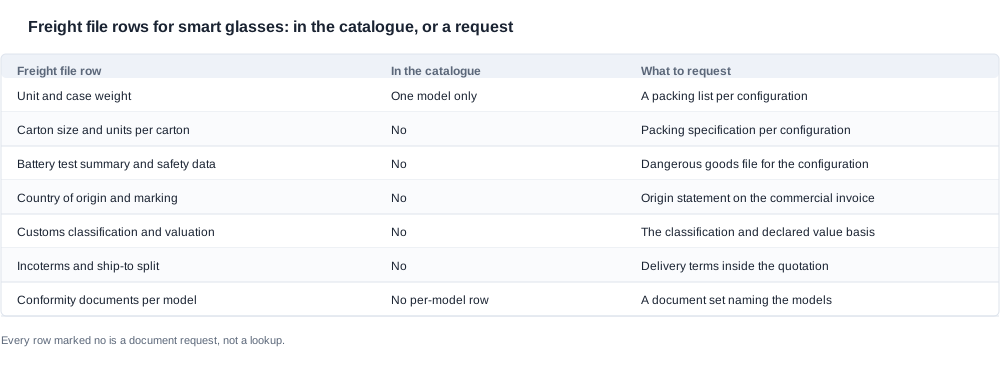
Smart glasses logistics: what the catalogue publishes and what a freight file needs
The published rows that affect a shipment
Four published groups change what a shipment physically is. The cell configuration is the first: published capacities run from 40 mAh on the A05 and the A06, through 55 mAh twice on the LC-105-1 and the G07, and the YK12 and the LC-105-2, 70 mAh twice on the YKC02, 90 mAh twice on the K01 and the K02, 100 mAh on the D11 and the D12, 115 mAh on the D17, 200 mAh on the bone conduction entry and 290 mAh on the L2 Utral and the CY05, and the L1 Pro and the CY03. Those figures determine the cell chemistry declaration, the battery handling category and, in most cases, the packaging instruction for the item.
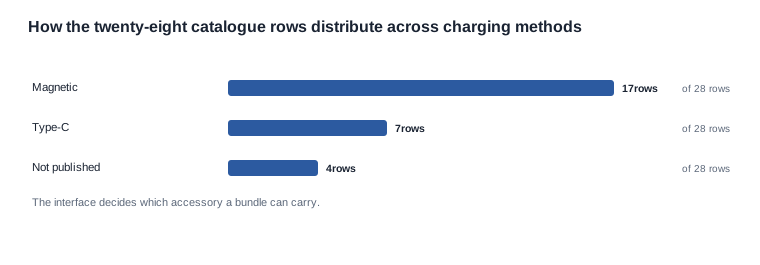
The charging method is the second, because a bundled accessory has to match it. Seventeen of the twenty-eight catalogue rows publish magnetic charging, seven publish Type-C, and four — the CY05 and the MT6, and the L1 Pro and the CY03 — publish no charging method row at all. The charging solution set covers the interface side of that decision.
The charging case is the third, and it is the largest single driver of parcel volume in this category. The picture has four states, not two: capacity published on the L1 Pro and the CY03, and the CY05 — each at 1400 mAh, on the L2 Utral as a row reading 900/1400 mAh, and on the MT6 at 1200 mAh in a foldable case; a case listed with no capacity on the KY06 and the MT5; no case row at all on the V03 and the V06, and the S7; and the V03 Pro published explicitly as having no case. A freight file that treats "no published capacity" as "no case" will under-declare the volume of a shipment.
The fourth is the runtime, because a distributor's replenishment interval is a function of how long a unit is expected to run in the customer's hands, and the published figures differ by family: about twenty hours on the three children's models, five to eight hours or six to eight hours or about seven hours across the eleven camera models, six to eight hours across the audio models, and about six to eight hours on the sport models.
What the catalogue's gap means for a distributor's own systems
A catalogue that publishes the product facts and not the file facts creates a specific kind of operational work for the buyer. Every document in the freight file has to be requested, tracked and versioned by the party that will be audited on it — usually the distributor, sometimes a forwarder. In practice that means a document register: what has been requested, what has arrived, which configuration it covers, which consignment it was used for, and when it expires.
The register is unglamorous and it is what separates a programme that scales from one that stalls. It also answers the question a distributor's own compliance function will ask during an audit: for this consignment, which documents were on file, and did each one name the model it covered. A document that names a family rather than a set of models is the most common failure in that review, because the document was issued for a range rather than for the units actually shipped.
Two practices reduce the work. Request documents per configuration rather than per model, so that a model appears once in the file with its configuration attached. And treat a new configuration as a new document event, because a colour change or a packaging change can invalidate a packing specification without changing anything in the catalogue.
The rows a freight file needs and the catalogue does not have
Everything below has to arrive as a document, and it is worth separating the requests so that they can be made in one message rather than discovered one hold at a time.
| Freight file row | In the catalogue | What to request |
|---|---|---|
| Unit and case weight | One model only | A packing list per configuration |
| Carton dimensions and units per carton | No | Packing specification per configuration |
| Battery test summary and safety data | No | The dangerous goods file for the exact configuration |
| Country of origin and marking | No | Origin statement on the commercial invoice |
| Customs classification and valuation | No | The HS code and the declared value basis |
| Incoterms and ship-to split | No | Delivery terms in the quotation |
| Conformity documents for the model list | No per-model row | A document set naming the models shipped |
A carrier will not book a battery consignment without the dangerous goods file, and a customs authority will not clear a consignment without a classification that matches the invoice. Neither of those documents can be derived from a catalogue page, and a distributor who discovers that during the first booking has a hold on a container rather than a question to a supplier.

Smart glasses logistics: the four cost drivers a distributor controls
The landed cost of a smart glasses programme is decided by four things a distributor controls, and only one of them is the unit price.
The configuration count a shipment carries
Every distinct configuration is a separate set-up: a separate packing specification, a separate label, a separate artwork proof, a separate line in the inspection checklist and a separate place in the warehouse. A programme carrying eleven camera models is carrying at least eleven configurations, and more if colour or packaging differs within a model — which is why the colour question matters here as well as in the range plan. Colour options appear on two models only, the V03 Pro with three and the V06 with four, so the models where colour creates extra set-ups are a published, countable subset rather than a general risk.
The cost driver worth naming is not the number of models but the number of configurations per order line, because a distributor's own operations are usually configured per configuration rather than per model. Two models in one colour in one package is one set-up. Two models in two colours in two packages is two.
Case bulk and the accessory decision
The charging case is the item that changes the parcel, and the four case states make the decision a real one rather than a formality. A model with a 1400 mAh case is a different parcel from a model with no case row, and a foldable 1200 mAh case is a different parcel again. The catalogue's own record notes that the 158 g figure published for the MT6 applies to the glasses and excludes its foldable case, which is the clearest statement available about how the case and the eyewear are counted separately.
Three questions to ask before the first order: what is the published case state for each model on the order, what does the packing specification say about the unit plus the case plus the packaging, and is the case a shipped accessory or a display item that stays in the warehouse. A distributor who bundles the case with a charging accessory is making a decision about parcel size that the catalogue cannot inform, and it should be made with a packing specification in hand.
Battery documentation and the dangerous goods file
Lithium cells in a shipped article carry a documentation obligation that is independent of the product's own compliance story. The file normally includes the cell and battery test summary against the relevant transport standard, the safety data for the battery, the watt-hour or mass calculation that determines the handling category, and the packaging instruction reference on the outer box. Our own record states that no test reports exist for any of the twenty-eight entries, and the catalogue carries no transport documentation of any kind, so every one of these documents is a request rather than a lookup.
The practical sequence is short: request the file per configuration, have it reviewed by whoever handles dangerous goods in your own operation, and confirm that the outer packaging marks match the instruction reference before the first booking. A mismatch between the carton mark and the file is the most common cause of a delayed air shipment, and it is entirely avoidable.
The warehousing and inventory consequences
The catalogue's case states push directly into warehouse design. A model with no case row is a small parcel with a high unit-to-volume ratio, which is efficient to store and inefficient to pick when the line is small. A model with a 1400 mAh case is the opposite: a heavier, larger parcel for the same unit count, which is expensive to hold and efficient to pick in quantity. A mixed order containing both is a mixed order in the literal sense, and the picking route, the carton build and the carrier's weight bands all have to accommodate it.
That is the practical content of a mixed-order policy, and it belongs to the logistics plan rather than to the commercial negotiation. The question to answer before the first order is how many distinct parcel sizes the programme will produce, because that number decides whether the warehouse can be planned as one operation or two. A distributor who knows that half the range ships in a different parcel size can design for it; a distributor who discovers it during the first mixed order redesigns it under time pressure.
Three further consequences belong to the same plan. The shelf life of packaging artwork, which ties a printed element to a model that may leave the range. Obsolescence handling for a model withdrawn while packaging remains in stock. And the inbound side, where a unit received without a matching configuration sheet cannot be checked against what was ordered, so the error is found by the customer rather than by the warehouse.
The insurance and liability boundary
Between the factory gate and the customer's warehouse, responsibility changes hands several times, and each handover has a document behind it. The first handover is the one into the forwarder's custody, and it is covered by the delivery terms and the insurance allocation. The second is the arrival of the consignment at the destination, where the importer takes responsibility for the clearance. The third is the delivery into the customer's own warehouse, where the risk passes to the customer and the question of who inspects becomes a contract question rather than a logistics one.
Three points deserve a line in the agreement rather than an assumption. Whether the consignment is inspected before or after the risk passes, because an inspection after the risk has passed is a claim rather than a check. Whether damage in transit is claimed by the importer or by the distributor, since the party that signs the delivery is not always the party that holds the insurance. And what happens to a consignment held at the border, because a hold that lasts longer than the storage tolerance turns into a cost that nobody budgeted for.
None of this is product-specific, and none of it is published. It belongs in the same document as the delivery terms, and the questions are short enough to put in the enquiry: who insures, who signs, who inspects, and what happens if the consignment is held.
Delivery terms and the split-shipment decision
Delivery terms belong in the quotation, and they move more of the total landed cost than most buyers expect. Free on board at the port and delivered duty paid at the destination place the freight, insurance and duty risk in different hands, and for a programme carrying batteries the difference in handling cost and in insurance terms between the two is not trivial. The questions to ask are which party insures the consignment, who arranges the dangerous goods declaration, which party holds the export declaration, and what happens to the cost of a hold at the border.
The split-shipment decision is the second half of the same question. A programme that launches with a small range and a large order, or a large range and a small order, has one of the two configurations that a freight file handles badly. Several small cartons cost more to book and to clear than one large carton, and a split shipment also splits the compliance file across two consignments. Neither the carton quantity nor the freight cost is published, and both are settled per enquiry.

The sequence above is the one a distributor can control. The last two steps are where programmes lose weeks, and they are also the two steps where the documentation is normally available before it is asked for.
The questions to ask before the first booking
Six questions, asked before the first consignment, remove most of the friction that otherwise appears at the border.
- Which dangerous goods documents apply to the exact cell configuration and packaging of the models on this order, and does the test summary cover the cell as it is fitted in the product?
- What does the packing specification say about the unit, the case and the outer carton separately, and what is the unit count per carton?
- Which documents have to accompany the consignment itself, and which are filed separately but must exist before booking?
- What classification and valuation basis apply to the models on the order, and who signs the declaration?
- Which delivery terms are being offered, and who insures the consignment between the two named points?
- What is the booking lead time for the next available slot, and what happens to the schedule if the dangerous goods file arrives after the booking?
The last question is the one that is usually asked too late. The documentation is the long pole, not the production, and a booking made before the file is available is a booking that has to be re-made.
Smart glasses logistics: the checklist and the return route
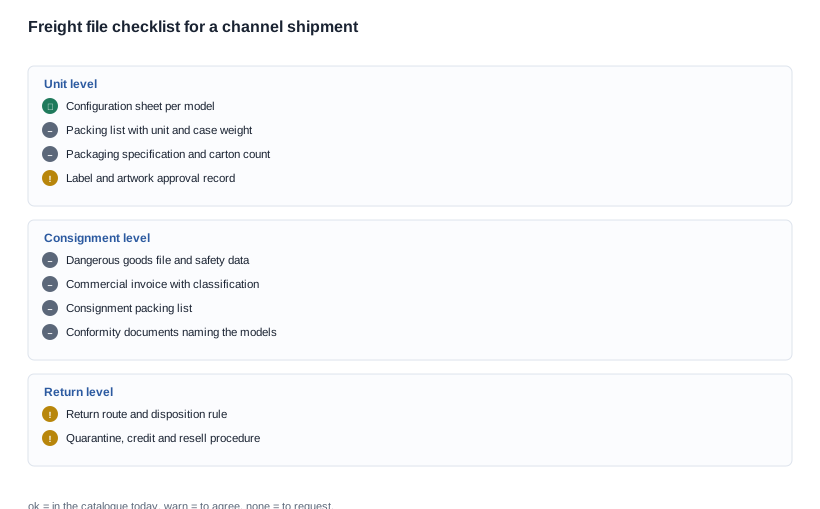
The freight file checklist
The checklist is organised by what the document does rather than by what it is called, because the same requirement often arrives under different names depending on the carrier. At unit level: the configuration sheet for each model, the packing list with unit and case weight, the packaging specification with carton dimensions and units per carton, the label and artwork approval record, and the country of marking statement. At consignment level: the dangerous goods file, the commercial invoice with the declared value and the classification, the packing list at carton level, the certificate of origin where the destination requires it, and the conformity documents covering the models in the consignment. At the commercial level: the delivery terms, the insurance allocation, the payment milestones and the booking lead time for a booked slot.
The items marked as published can be confirmed from the catalogue on the day, which is worth something when a booking deadline is approaching. The rest have to be requested, and the request is far shorter than the wait.
The return route is part of the logistics plan
Returns are usually treated as an after-sales topic, which is why they are usually the least planned part of a logistics programme. A unit returned from a customer reaches a warehouse, and the warehouse has to identify it, quarantine it, and decide whether it is repairable, resellable or scrap — and the answer depends on the configuration sheet existing. Without one, a returned unit is an unidentified unit, and an unidentified unit cannot be dispositioned, credited or resold.
That is the strongest argument for the configuration sheet in a logistics context specifically. It is not a marketing document; it is the document that makes an incoming inspection and a return disposition possible. The after-sales route covers the process on the receiving side, and the question of who receives a return — the distributor or the manufacturer — has to be settled before the first shipment, because it changes the freight plan for every unit that comes back.

Smart glasses logistics: our position and the next step
What the supplier can and cannot put in the file
We can supply the configuration sheet per model, the packing and carton specification once a configuration is defined, the dangerous goods documentation for that configuration, the conformity document set with the model numbers on it, and the published rows — cell configuration, charging method, case capacity, charge time and runtime — that the freight file quotes. We will say which documents cover which models, so that a shipment file and a compliance file describe the same set of units.
We do not publish carton dimensions, packaging weights, a shipping origin, freight terms, a customs classification, a dangerous goods test summary or a lead time for a booked slot, and we will not infer them. Each is confirmed per enquiry, because each depends on the configuration and the current schedule. A freight file built on inferred numbers is a file that fails at the border rather than at the quotation.
Requesting the freight file against a shipment configuration
The practical first step is to send the configuration you intend to ship — models, quantities, packaging and destination markets — and ask for the freight file against it: configuration sheets, packing specification, dangerous goods documentation, conformity set and delivery terms. That exchange is usually the whole of the logistics programme's front end, and it is far faster than discovering the same gaps one consignment at a time. The distributor and retailer programme sets out the wider commercial framework around it.


