

A distributor's real question is rarely whether a category is interesting. It is how many weeks of cover to hold, whether a reorder lands before the promotional calendar does, and which claims can safely be printed on a shelf card and defended when a customer asks where they came from. Those are three separate questions, answered by three separate documents: the product catalogue, the commercial quotation, and the conformity file that accompanies the shipment. Read in that order, the exposure in a first order falls sharply. Read as one document, you will quote a number nobody at the factory has agreed to.
Before that order is placed, a second layer of the same problem has to be untangled: the smart glasses category publishes specification rows unevenly across its range, and the commercial terms that decide a reorder live in a document rather than in the catalogue at all. This page works through the four positions a model can occupy in a range plan, the rows a buyer may use and the rows that need a question, the clocks behind any delivery date, and the paperwork that has to exist before a second order can be scheduled.
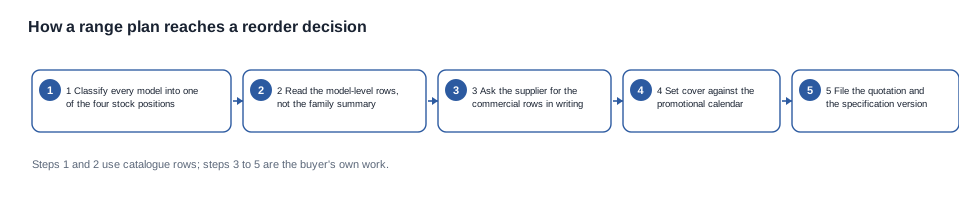
Smart glasses stock planning for distributors: the four positions
A range plan is not a list of models. It is a set of positions — how many models you carry, how many you offer as an option, and how many you describe as forthcoming. Position matters more than model, because position is what decides whether a reorder is a routine operation or a fresh negotiation every time it runs.
The catalogue contains four distinguishable positions, and the distinctions between them are documentary rather than promotional. That is worth stating plainly, because in this category the marketing surface and the documentation surface often look identical. A buyer who treats a catalogue entry as a sellable unit will discover the difference at the returns counter rather than at the purchase order.
The first position is the fully documented model. Here the file publishes the rows a channel operation actually runs on: how long a charge takes, which charging interface the unit uses, which Bluetooth version it speaks, and whether a charging case is included. A model in this position can be reordered without a configuration conversation, because the specification a reorder has to match is already written down. Most of the camera, audio, sports and children's entries sit here or close to it.
The second position is the configuration-dependent model. The unit exists, its specification exists, but part of the bundle changes between order rounds. The charging-case rows are where a stock order has to be written carefully. Five camera models publish a case capacity — the CY03 and the MT6, and the CY05 and the L2 Utral, and the L1 Pro. Two entries are shown with a case and nothing quantified against it: the KY06 and the MT5. Four models print no charging-case row at all: the S7 and the V03, and the V03 Pro and the V06. Those four are an unpublished field rather than a settled one, which is why the second position has to be written onto the purchase order instead of read out of the catalogue. To a buyer this is not a specification detail, it is a shelf-layout detail. A range carrying both a cased and an uncased variant of the same family needs two box positions, two shelf tickets and two reorder lines, and a supplier's written answer about which is which is the only thing that settles the four.
The third position is the thinly specified model. Some of the rows a shop floor asks about are simply not published for most of the range. A weight figure appears against one model only. A colour row appears against two. An ingress rating appears against two as well, and for the rest of the range the claim cannot be made at all. A model in this position can still be sold; it simply cannot be sold with a full specification sheet behind it, which means most of the buyer's questions turn into questions for the factory.
The fourth position is the entry that is not a stock position at all. Three catalogue entries carry no formal SKU: the augmented-reality glasses, the electrochromic model and the bone-conduction model. They are useful in a range plan as a direction of travel, because they show a buyer where the category is heading. They cannot be ordered against, stocked, or printed on a shelf card. For the bone-conduction entry the customisation capability is not disclosed at all, and the published 35 dB figure may place the product inside medical-device regulation rather than consumer-electronics regulation. For the electrochromic entry the file contains no photochromic performance parameters whatsoever. For the augmented-reality entry the position is simply unknown. The commercial question is not whether to mention these three but what a customer is entitled to infer from a mention.
These positions are not equally stable, and their boundaries move. One entry, MT5, carries a page-number annotation that does not sit where it should and a product classification — camera or sports — recorded as doubtful. That small administrative defect has a commercial consequence: a buyer who classifies MT5 one way and the factory classifies it the other way discovers the difference in the packing list rather than in the specification. When you classify a line, write the classification you are relying on into the order and keep it with the paperwork.

The published rows a distributor can quote, and the ones they cannot
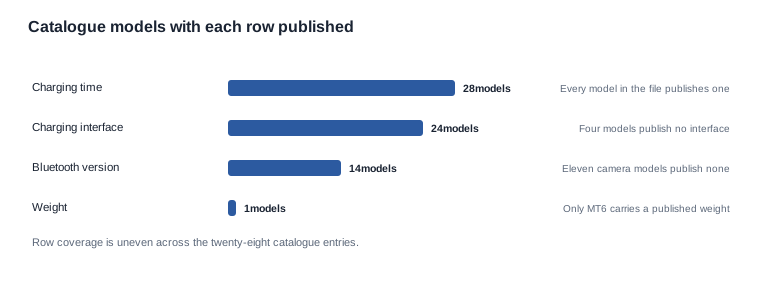
The catalogue is unusually generous about publishing rows and unusually uneven about publishing them per model. That combination is workable, but only if rows are read as model-specific rather than family-wide. A row that exists somewhere in the file is not a claim you may print next to any unit you sell.
Start with charging, because it is the row most often quoted loosely. All twenty-eight models publish a charging time. Twenty-six of them publish two hours or less, and that number is an upper bound rather than a typical case, so the honest shelf wording is "charges in up to two hours" and not "charges in under two hours". Two models publish approximately one hour, D17 and ZH12. The consequence for a channel operation is narrow but real: a customer charging on a shop counter with a magnetic pad and a customer charging over a cable do not experience the same wait, and a store quoting the upper bound for both will generate complaints from the faster half of the range.
The charging interface is published for twenty-four models: seventeen magnetic, seven Type-C. Four models publish no interface at all — L1 Pro and MT6, and CY05 and CY03. For a distributor the interface is a consumables decision rather than a marketing one, because it decides what cable or pad the shop keeps behind the counter, what goes in the box, and what a returned unit is likely to be plugged into.
Bluetooth is narrower still. Only fourteen models publish a version. Two of them, K01 and K02, publish V5.3; the remaining twelve publish V5.4. Eleven camera models publish no Bluetooth version whatsoever, which means a range built around camera units cannot promise a Bluetooth generation to a customer at all.
Two further absences are worth carrying into your sales material, because they are common in this category and easy to overclaim. No capacitive touch row appears anywhere in the file: a search across all twenty-eight entries for touch, gesture or touch-free control returns nothing, so touch control cannot be mentioned in any channel material however it is phrased. There is also no translation row, so a live translation capability cannot be presented as a published specification of any model in the range.
The remaining rows complete the picture and are best used selectively. Pixel count splits eight models at 8MP and three at 13MP, those three being S7 and L1 Pro, and L2 Utral. An IP54 rating appears against V06 and S7 only, and the file records that this marking carries no third-party test report number, so the rating is quotable only alongside that qualification. Weight is published for MT6 alone, at 158 g. Colour is published for V03 Pro in three colours and V06 in four.
Certification sits alongside these rows and follows a stricter rule than the rest. The catalogue's status language is three-valued and all three values need carrying through: certification is named as a framework with no document behind it; for some lines the framework appears with no test report number against it; and for the children's line the certification information is not published at all. The export certification page in the file is an image page, and it holds ten patent certificates — eight design patents and two utility patents — rather than any CE, FCC or RoHS text. So no catalogue statement about CE, FCC and RoHS can be written out as a fact by anyone in this industry, and "certified" without a qualifier is not one any of us should write either.

Why stock depth and lead time are decided by different people
The instinct is to treat stock and lead time as two attributes of one decision. They are not, and in this category the separation is the difference between a replenishable range and a stalled one.
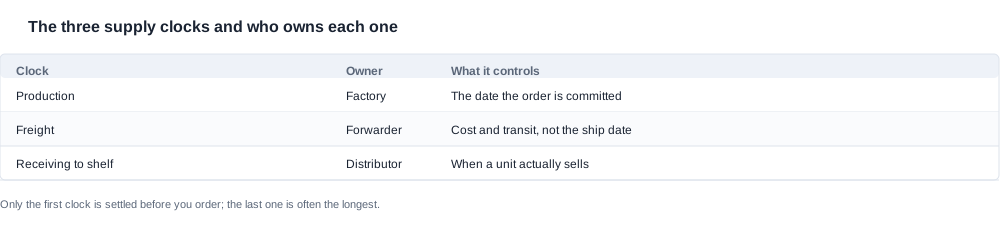
Stock depth is a decision about your own balance sheet: how many weeks of cover, how many open positions, how much cash sits in a category that will eventually be discounted. It belongs to the person who signs the purchase order, and it is argued in unit economics. Lead time is a property of somebody else's calendar — a production slot, a consolidation window, a customs clearance, a drayage slot. It belongs to the factory and the forwarder, and it is argued in days.
Because those decisions sit with different people and different documents, one answer rarely serves both. A purchase order places a quantity and a price. It does not place a date. A forwarder's quote converts a date into a cost. A category manager's promotional calendar converts a date into a revenue window. The only way a buyer avoids being surprised is to insist that the date be stated in writing with its measurement points named: which event starts the clock, which event stops it, which mode of transport, which terms of carriage, and what is explicitly excluded. A lead time quoted without those points is a number that means whatever the reader wants it to mean.
We will not publish a lead time on this page. The catalogue does not contain one, and a number we cannot source is worth less to you than an absence you can plan around.
There is a second reason the two decisions sit apart, and it is specific to this category: the retailer's own receiving-to-shelf time lies outside both. Goods arriving as a container or a pallet pass through customs, a distribution centre, a stock check, a shelf planogram and a replenishment cycle before they reach the counter. A total cost comparison between two suppliers that ignores the receiving-to-shelf step will systematically favour the option with the shorter production time and the more awkward logistics, and the difference will surface as markdown at the end of a promotional window rather than as a saving on the invoice.
The people involved also disagree about what the number is for, which is why the same question produces four different answers in a buying meeting:
- The buyer wants a date that allows a commitment to a promotional calendar with a contractual consequence if it slips.
- The planner wants a date that allows a reorder point to be set, and wants the variance around it rather than the average.
- The category manager wants to know whether the model belongs in the range at all, because a model that cannot be re-supplied during a season is a seasonal unit whether or not anyone labels it that way.
- The shop floor wants to know whether the unit on the shelf is the unit that will still exist in six months, because a warranty claim on a retired model is a support cost with no end.
The useful move is to ask each of them a different question rather than asking everyone the same one. The buyer asks for a contractual date; the planner asks for the variance and the minimum order quantity behind it; the category manager asks whether the model can be re-supplied inside a promotional window; the shop floor asks what happens to warranty spares and returns after retirement. Red flags in this area are specific: a date given without measurement points, a lead time that changes when the order size changes, a supplier willing to commit to a delivery date but not to a configuration, or a minimum order quantity that only becomes visible after the quantity is agreed.

The five questions to settle before the first purchase order is placed
The first order is where documentation gaps cost the least, because the full set of choices is still in front of you. Five questions, taken in this order, close most of the exposure.
1. Which position does each model occupy, and what is the reorder path for it? Take the models you intend to range and place each one in one of the four positions above. For position one the reorder path is a routine purchase order. For position two the reorder path includes a configuration statement: write the case configuration, the interface and the colour onto the order line, because those are the fields that otherwise drift between rounds. For position three the reorder path needs a supplier statement on the unpublished rows. For position four there is no reorder path, and the range plan should say so rather than leave the entry ambiguous. The red flag here is simple: a reorder path that cannot be written down as a line on a purchase order.
2. What is published for the exact model, rather than for its family? Pull the row set for each model individually. A family-level summary is a marketing convenience; a model-level row set is what a shelf ticket, a pre-sale answer and a return investigation actually rest on. Where a row is absent, the honest answer to a customer is that you will confirm it, and the question to the supplier is which published document will carry it and when. The sign that this question has gone unanswered is a shelf card describing a capability the family has and the model does not.
3. What is the lead time in writing, measured from what to what? Ask for the definition before the number: the start event, the end event, the transport mode, the terms of carriage, the treatment of a first order that requires a new configuration, and whether the figure moves with quantity. Then ask for the same thing in a form you can file — a quotation, or a specification sheet carrying a version and a date. Criteria for a usable answer are named measurement points, a stated relationship to order quantity, and a document that identifies itself. A date quoted in an email thread with no measurement points fails this test, however confident it sounds.
4. What does the total cost of the first order look like, including the lines that are not per-unit? Before you order, build the comparison at the level of the whole first order rather than the unit: the unit price, the charges that scale with the shipment rather than with the unit, the cost of the receiving-to-shelf step, and the cost of the returns you expect to absorb because a specification was thin. This is where a genuinely cheap unit can turn out to be expensive, and where a difference in the box can turn out to be the thing that decides the order. Ask the supplier which charges exist and which of them scale with volume, and get the answer into the quotation rather than into a conversation.
5. What evidence will exist when the reorder is due, and where will it be kept? The answer is a document list, not a feeling. Decide now, and in writing, which documents you will hold for each ranged model: the quotation used, the specification sheet and its version, the conformity documentation with its status stated in the catalogue's own three-valued language, the packing list that records the configuration actually shipped, and the shipping documents that establish the clock. If you cannot list them, you have not closed the first order.
Two disciplines make the five questions stick. First, answer them in sequence: the position question changes the meaning of everything after it, and a lead time quoted for a model in position four is meaningless. Second, write the answers into the order itself — the configuration, the model identities, the documentation set you require — so that the second order is a copy of the first rather than a fresh argument.
What belongs on a shelf card, and what belongs in a file
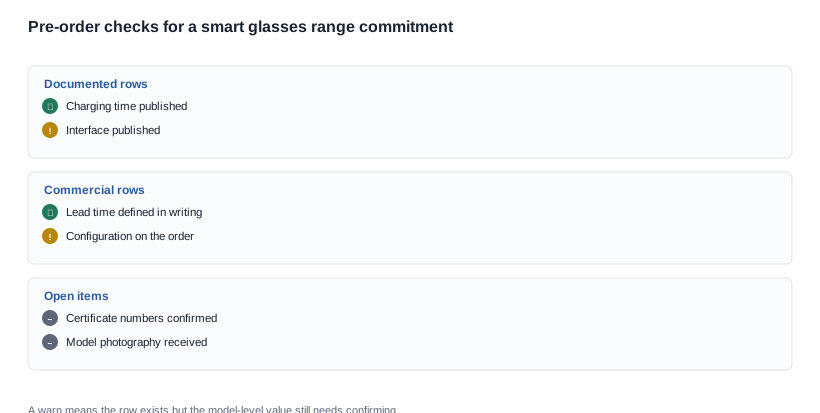
The shelf card is a customer-facing document with one job: to be defensible. Everything printed on it should point to a source, and you should be comfortable repeating it in front of the customer who asks where it came from. The catalogue's published rows are the natural candidates, with their qualifications attached.
Several selling points that circulate in this category are not currently in a defensible position, and the reasons are worth recording. A parameter comparison claiming an advantage over a competitor requires a hands-on comparison with that competitor's actual unit before it can be made publicly. Acoustic performance has no third-party test report behind it, so an audio claim should describe what the unit does rather than how it measures. An ingress rating needs a test report to be asserted externally, which means IP54 on V06 and S7 is quotable only with the catalogue's own note that no third-party report number is attached. The electrochromic file contains no photochromic performance parameters at all, so there is no room for a differentiated claim about it. The 35 dB figure attached to the bone-conduction entry carries the highest compliance risk in the range and belongs in legal review, not on a shelf card. The children's line carries high risk on safety and health claims, which is a further reason to hold it back until its certification status is provided rather than claimed.
That last point generalises the rule. Where the file records a certification framework with nothing identifying it, or with no report number beside it, the shelf card carries the framework and the qualification together. Where the file records nothing, the shelf card says nothing about certification at all.
The file, by contrast, is where the open items go, and keeping them there is what makes a reorder predictable. At the time of writing, the catalogue's own record contains these open questions, and a buyer who carries them as open items rather than as facts will be in a far stronger position at the second order than one who assumes they were quietly resolved:
- A05 and A06 publish identical parameters, and the difference between them is recorded as still to be confirmed.
- The model name L2 Utral appears to carry a spelling error for "Ultra", and the meaning of "Pro Max" in the same line is not defined.
- MT5 carries an anomalous page annotation and a doubtful product classification between the camera and sports lines.
- V06 and S7 both carry anomalous page annotations.
- The electrochromic, bone-conduction and augmented-reality entries have no formal SKU.
- All twenty-eight models are recorded without supplied photographs, video or test reports.
None of these is a reason not to buy. They are reasons to keep the file open and to make sure the answers arrive in writing, inside the version of the documentation that governs the shipment, rather than inside a conversation.
The commercial caution that follows is straightforward. Our position is that a buyer should treat the catalogue as a description of what has been published and what has not, and should treat a quotation as the only document that commits a supplier to a commercial term. Where a claim is pending confirmation, the shelf card carries the claim and the qualification together; where a number is not published, the correct sentence to the customer is that you will confirm it, and the correct action for you is to have asked. When you compare options before you order, apply the same discipline to every supplier: which rows are published, which are claimed, which are absent, and what evidence will accompany the delivery. Total cost is not only the invoice; it is the invoice plus the returns you could have prevented, the promotional window you could have protected, and the evidence you will wish you had kept.
Related reading
- The channel programme behind this page — distributors and retailers solutions
- Where the customisation boundary sits — customisation overview
- The documentation set behind a shipment — certification checklist
- Sampling before a range commitment — sample requests
The most valuable thing you can send us before you order is a model list with the position you expect each unit to occupy. It lets us answer the configuration and documentation questions against the right rows instead of guessing at a family, and it turns the first order into a template the second one can copy.


