
An eyewear brand is not looking for a gadget with somebody else's name printed on it. It is looking for a way to put sound into a frame it already sells, without the frame becoming a different product, and without the engineering ending up on the shelf card in a way the brand cannot defend. That is a harder brief than it sounds, because audio is not one addition but six couplings, and each of them reaches back into design work that is normally finished long before anyone mentions speakers.
This page works through those six couplings, the practical consequences of asking a temple to carry electronics, the documentation that grows before the first working sample exists, the order of operations that protects the original silhouette, and the questions worth putting to a supplier before artwork is signed. It is written for the smart glasses for eyewear brands adding audio to frames decision rather than for the electronics engineer: what changes, what it costs in time, and what evidence you should keep.
Smart glasses audio added to an existing frame: the six couplings
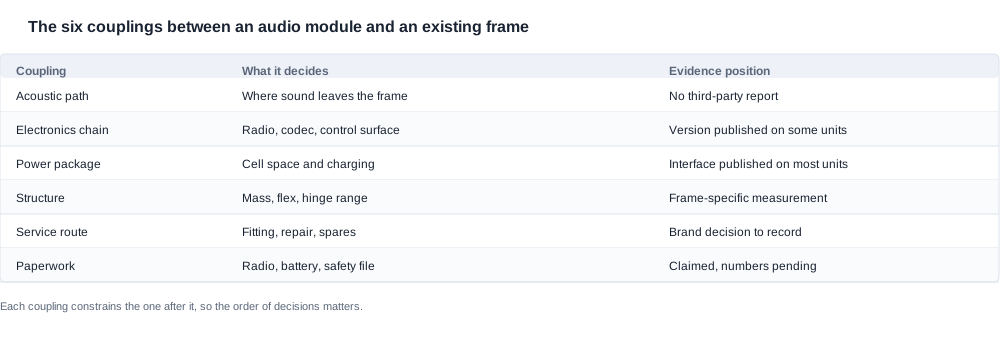
When a brand asks for audio in an existing frame, the conversation usually starts with a sound sample and ends with a battery. That is the wrong order, because sound is the least constraining of the six couplings and the cell is the most constraining. The six couplings, in the order that actually decides whether the project works, are the acoustic path, the electronics chain, the power package, the structure, the service route, and the paperwork.
The acoustic coupling. A frame is a small, stiff, oddly shaped acoustic cavity that sits on the side of the head. The driver has to reach the ear canal without turning the temple into a speaker box the wearer cannot tolerate, and without leaking so much that the conversation becomes public. Where the driver sits, how the cavity behind it is shaped, and whether anything is sealed all change the result. This coupling also has the weakest evidence position in the whole project: acoustic performance in this catalogue has no third-party test report behind it, so any statement about how a unit sounds is a statement the brand will have to make in its own voice, on its own evidence, or not at all.
The electronics chain. Source, radio, codec, amplifier, driver, and a control surface. The chain is where a frame quietly stops being an accessory. It raises a question brands rarely think to ask: how does the wearer control it? There is no capacitive touch row anywhere in the file — nothing in the twenty-eight entries records touch, gesture or touch-free control — so the working assumption has to be a physical control, and that assumption needs confirming rather than inheriting from a competitor's marketing. It also raises the radio question, and the record here is uneven: fourteen units carry a Bluetooth version, K01 and K02 at V5.3 and the remaining twelve at V5.4, while a large block of camera entries leaves that field empty.
The power package. Cell geometry, cell placement, the charging interface, and whether a case is part of the proposition. This is the coupling that usually forces a design change, because a cell is a volume with a rectangular tolerance, and the place in a temple where a cell fits without making the temple look wrong is narrow. Charging time appears for every unit in the file, and the figure is an upper bound — twenty-six of them sit at two hours or less, with D17 and ZH12 nearer one hour — so the claim is "charges in up to two hours" rather than a faster-sounding paraphrase. The interface is on the record for twenty-four units, seventeen magnetic and seven Type-C, and four units leave the field blank, which for a brand planning a retail box means the cable in the box cannot be assumed.
The structural coupling. The temple now carries a cell and a driver, so it carries mass and it carries torsion. This coupling is where a frame's character changes: a hinge that used to close lightly may now close heavily, and a temple that used to flex evenly may develop a dead spot. The brand's designer will feel this before the customer does.
The service coupling. How the electronics get into the frame, how they get out again, and what happens to a unit that fails. A temple with a sealed electronics bay that has to be destroyed to open it is a warranty problem written before the first shipment. The service route is also a parts problem, and it is the one most often deferred. The specific question a brand should write down is who performs the work: the factory, a regional service partner, or the retailer's own bench. Each answer produces a different parts inventory, a different training requirement and a different answer for the customer whose unit fails in month eleven. A programme that leaves this open will have to answer it later under pressure, and the answers given under pressure are always more expensive than the ones given at the design stage.
The paperwork coupling. Radio, battery, safety, and the conformity documentation that travels with the goods. It is invisible on the shelf and it is capable of stopping the shipment.
The order matters because each coupling constrains the next. A decision taken on acoustics that ignores the cell will be redone; a decision taken on the cell that ignores the service route will be redone twice.
A worked illustration, since the coupling model is easier to see on a case than in the abstract. Imagine a brand whose best-selling frame is a slim rectangular metal shape with a narrow temple, a wire core, and a spring hinge, currently sold with a plain temple tip. Adding audio to it collides in four places at once: the temple is too narrow to hold a cell of any useful size without thickening, the spring hinge already uses most of the available torsion, the wire core blocks the route a cable would need, and the temple tip is where the driver would want to sit but also where the brand's finish detail lives. There is no single "add a speaker" answer. There is a set of trade-offs about where the mass goes and what the hinge is allowed to do, and the brand's design team has to be in the room for all of it.
What changes when a temple has to carry electronics
The frame does not change shape on the first day. It changes in a sequence of small concessions, and each concession is visible to somebody: the designer, the wearer, the production team, or the returns team.
Mass and balance come first. A temple with a cell and a driver in it is heavier, and the mass sits toward the rear of the ear. The wearer feels this as the frame pressing at the front or the temple slipping forward on a short nose bridge. For a brand with a strong fit reputation this is the concession least acceptable, and it is the one most often deferred to the end of the programme, which is the worst time to discover it.
Section size follows. A cavity large enough for a cell makes the temple thicker at one point, and a temple that thickens at one point changes the way the frame photographs and the way it reads from the side. The design decision is usually to distribute the thickness as smoothly as possible, or to hide it behind an existing detail — a hinge cover, a temple tip, a rivet line — and either choice commits the brand to a specific appearance.
Stiffness and hinge behaviour follow next. Electronics add mass without adding structure, so the same temple deflects less and the spring range shrinks. A frame that used to open wide for a customer who wears it over a prescription frame may no longer do so. Nobody documents this, and everybody feels it, which is why it belongs in the acceptance criteria rather than in the informal discussion.
Access and assembly change the operations. A temple that has to be opened for service has a seam, a fastener or an adhesive line, and each one is a cosmetic decision and a production decision. The factory that used to assemble a frame in one operation now assembles a frame and fits an electronics module into it, which is a different line, a different skill and a different set of defect modes.
Heat and skin contact need a rule. A cell and an amplifier inside a temple that rests against the temple of the head for hours raises a question that has no standard answer: how warm may the contact point become before the customer notices. Set that threshold in the acceptance criteria or it will be argued after launch.
Weather and ingress are limited by evidence, not by intent. An ingress rating is on the record for two units in the whole file, and the file records that the marking carries no third-party test report number. So the answer to "can my customer wear these in the rain" is not a rating you can print — it is a question to the supplier about what has actually been tested, and a decision about what to write on the card.
Room acoustics are a brand risk. Open-ear audio radiates. A wearer who cannot tell whether their conversation is private will say so in a review. For a fashion-led brand this is a reputational question before it is an engineering one.

Why the certification file expands before the first sample
Adding audio does not merely add paperwork. It changes what kind of object the product is, and the paperwork follows the object rather than the marketing plan. The expansion starts before a sample exists, because the cell, the radio and the acoustic output each have their own questions to answer.
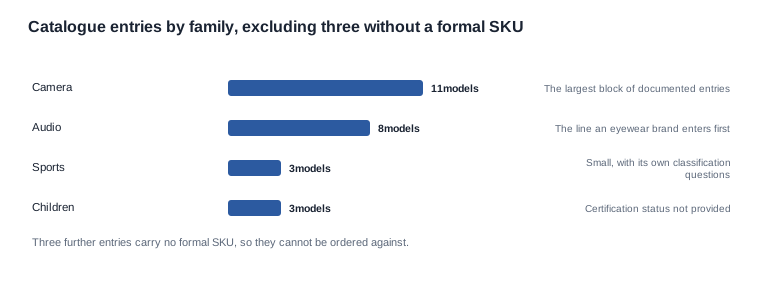
The first question is classification. A frame with a radio and a rechargeable cell is not the same regulatory object as a frame. In this catalogue the audio line covers eight models, and the status language around conformity is deliberately three-valued. In one state a conformity framework is named and nothing identifies the documents behind it. In a second the framework appears again, but with no test report number recorded against it anywhere in the file. In the third, which applies to the children's line, the position is not published at all. A brand that reads the first state as if it were the last will find out at the border rather than at the launch.
The second question is the acoustic one. The catalogue records no third-party test report for acoustic performance, which means the claim cannot be evidenced by reference and has to be either measured by the brand or not made. The third is the power one: a rechargeable cell has its own transport requirements, and those requirements are a documentation exercise with a schedule attached.
The fourth question is the one that catches people out. The bone-conduction entry carries a published figure of 35 dB, and that figure carries the highest compliance risk of anything in the range, because a stated output level can be the thing that moves a product into the medical-device regulatory class rather than the consumer-electronics one. The customisation capability for that entry is not disclosed at all. Any brand considering an open-ear bone-conduction architecture for a sleep, hearing or wellness line needs a regulatory opinion before design, not after.
What the export certification page actually contains is worth stating plainly: an image page carrying ten patent certificates, of which eight are design patents and two are utility models. No CE, FCC or RoHS wording appears there at all. The catalogue's claims about CE, FCC and RoHS are claims in the product table, not evidence on the certification page, and the difference between the two is the difference between a claim and a document.
Three further points belong in the file from the start. First, the documentation set has a version, and the version that travels with the shipment is the one that matters; a certificate that expired before the goods left the factory is not a certificate for those goods. Second, claims travel: whatever the brand says on a shelf card, a distributor will repeat in a trade catalogue and an online listing, so the claims list has to be handed over to whoever writes the copy, not just to the compliance owner. Third, the file should record what is not claimed, because the gaps are what generate the questions in the channel.
A conformity file is only as good as the model identities it attaches to, and those are not fully settled either. Two catalogue rows, A05 and A06, carry the same parameter values, and the file marks the difference between them as unresolved. The name printed as L2 Utral looks like a misspelling of Ultra, and the file nowhere explains what the Pro Max suffix denotes. One entry, MT5, shows an out-of-place page number and a camera-versus-sports classification the file marks as doubtful; the page numbers for V06 and S7 are likewise annotated as anomalous. Three descriptions — the electrochromic, the bone-conduction and the augmented-reality one — have no SKU attached to them at all. And not one of the twenty-eight entries is accompanied by a photograph, a video or a test report. Each of these is a small item on its own; together they are the reason a conformity file has to be maintained as a live document with owners, rather than assembled once at the end.

The sequence that keeps the frame design intact
The frame survives the project when the order of operations protects it. The wrong order — freeze the artwork, then ask what fits inside — produces a design that has been bent to fit the electronics, and no amount of goodwill recovers the original silhouette afterwards. The sequence below keeps the electronics subordinate to the design.
Step one: fix the red line. Before any engineering, the brand writes down what must not change: the front silhouette, the bridge, the hinge position, the lens centre, the temple profile as seen from the side, and the finish detail. Written as a list, a red line is a powerful tool. Spoken, it is a preference that gets eroded one meeting at a time.
Step two: choose the acoustic architecture, not the speaker. The decision is where sound leaves the frame and how it reaches the ear, and it determines what the temple has to contain. Choosing a driver and a cavity first, and then looking for a frame that tolerates them, inverts the whole programme and guarantees that the frame is the thing that changes.
Step three: do the packaging study on the real frame. Take a current frame, put a cell, a driver and the connecting flex into it, and look at the result in the hand. Not a CAD model, not a render: the actual frame, with the actual cell, at the actual scale. This is where the answer about thickness, mass distribution and hinge range becomes obvious and cheap to change.
Step four: build a working sample and measure it. The sample is for measurement, not for photography. Establish what the assembly actually weighs, where the centre of mass sits, how the temple flexes with the electronics installed, how the seam looks under raking light, and how far the acoustic output travels in a quiet room and in a café.
Step five: iterate with the brand's designer in the room. Every iteration that the design team is not present for is an iteration that will be rejected later. The purpose of the loop is to find the smallest number of changes that keeps the red line intact.
Step six: sign artwork last. Artwork locks the tooling and the finish, so it is the point of no return. It should be signed when the last mechanical unknown has been closed, the measurements exist in a form that can be filed, and the conformity position is documented. Signing artwork to a schedule rather than to evidence is the most common way a well-designed frame ends up with a compromised temple.
Step seven: put the change control in writing. After sign-off, every request to move a hole, a seam, a fastener or a finish becomes a cost and a delay. The list of frozen items should be attached to the order, not kept in someone's inbox.
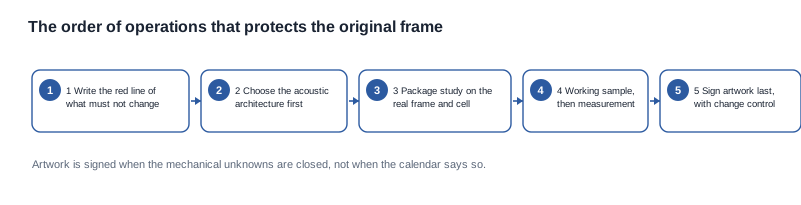
Two of these steps are routinely skipped by brands that assume the factory will handle them, and both are the ones that later become arguments. The red line is skipped because it feels like an internal document, and then a supplier improves the product by moving a hinge cover nobody had written down as fixed. The measurement step is skipped because the sample looks right in the hand, and then the first production run arrives with a centre of mass that nobody measured and everybody can feel. Neither step costs more than a day at the start of a programme and both cost weeks at the end of one.
There is also a question that belongs between step five and step six rather than after them: what happens to the frames already produced, or in production, when the electronics version goes live. A brand with an existing model and an existing sales history usually wants both to exist for a while, which means two configurations in the channel, which means the packaging, the shelf ticket, the retailer training and the returns process all have to know which is which. Deciding that while the artwork is still open is far cheaper than deciding it when the first mixed carton arrives.
The questions to put to a supplier before artwork is signed
- Which temple does the electronics occupy, and how does the module get in and out of it for service?
- What do you measure on the first sample, in what units, and will you share the raw results rather than a summary?
- Where does the driver sit relative to the ear, and what does the frame do to keep the sound directed rather than scattered?
- What changes to the temple's thickness, mass, flex and hinge behaviour once the electronics are installed?
- Which of the claims on the product table are supported by documents you can provide, and which are claims without a report number?
- What does the cell specification say, which charging interface applies, and does the shipped configuration match the published row for the exact model?
- What is the conformity document set for this build, what is its status, and what is the version that will accompany the shipment?
- What happens to a unit that fails after it has left your building, and what parts are you able to supply two years from now?
Those eight answers, written down, are the difference between a programme you can steer and one you can only observe. The questions to ask about the answers are equally practical: how recent is the evidence, does it cover this exact configuration, and who inside the supplier signed it.
The list is ordered so that the questions which can be answered immediately come first, and the ones that need real work come last. A buyer running it as a screen should treat an unanswered question as a red flag rather than as a detail, because the trade-offs in this category are the hidden ones, and hidden trade-offs are what cost money later. Which one of the eight is most worth asking first is easy to decide: the one whose answer would change the shape of the product rather than the timing of the delivery.
The evidence worth keeping is short and specific: the measured sample data, the structural comparison against the frame before and after, the conformity documents with their status and version, the cell and charging specification for the shipped build, and the confirmation that the artwork sign-off matches the sample that was measured. Keep it with the purchase order, not in a project folder.
Vague answers deserve a second round rather than a decision. A supplier who says the temple will feel comfortable has not measured anything; a supplier who says the audio is clear has not produced a report; a supplier who says the certification is in hand has not named a status. The follow-up question in each case is the same: measured how, by whom, on which sample, and can we see the document. A brand that asks these questions early is often surprised by how quickly a supplier produces the evidence once it knows the evidence is wanted. A brand that asks them at artwork sign-off, when the answer has commercial consequences, gets a different kind of reply.
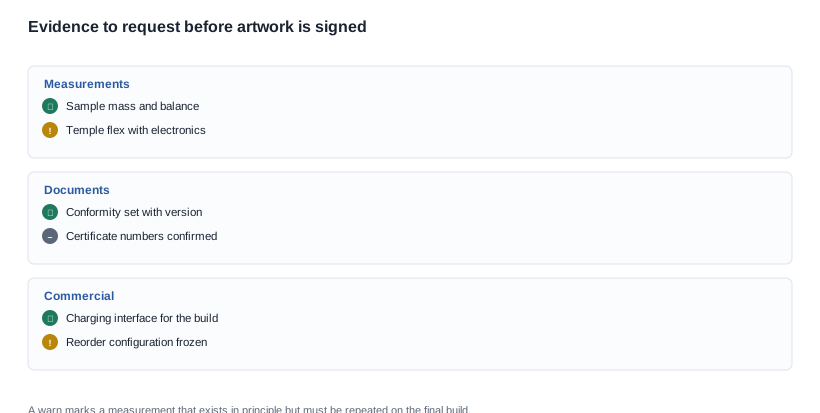
The caution that follows from all of this is about claims rather than about engineering. Our position is that the audio story on the shelf card should describe what the frame does, not how a unit measures against a competitor, because no third-party acoustic evidence exists in the current file and because a comparison claim requires a hands-on comparison with the other product. The same reasoning applies to the electronic-photo and colour-transmission entries, whose files contain no performance parameters of any kind. If the brand wants to lead with a claim, the cheapest route is to commission the measurement and keep the report; the second cheapest is not to make the claim.
Related reading
- Where a frame brand's programme usually begins — eyewear brand solutions
- The line-by-line customisation record — OEM customisation detail
- The documents a first shipment needs — certification document set
- How a development actually runs — the OEM process
Before artwork is signed, the most useful thing to bring us is the frame itself, the red-line list, and the acoustic architecture you intend to use. Those three inputs let the engineering answer the questions above against the real article rather than against a family assumption.


