

Power is the part of a wearable that gets decided late and lived with forever. It cannot be added to a finished frame without changing the frame, it cannot be swapped without changing the accessories around it, and it cannot be discussed without touching the claim your customer will make about how long the product works. For a brand coming to smart glasses for eyewear brands battery integration, the useful question is not "how big is the cell" but "where does the power live, and what does that location commit you to for the next three years".
This page works through the places power can sit inside a frame, the three architectures that follow from those places, the trade-off that only becomes visible after the artwork has been signed, the questions worth settling before the frame is drawn, and the argument for treating a charging case as a channel decision rather than an engineering one. It is written for the buyer who has to live with the consequences, not for the engineer closing the cell in the drawing.
Smart glasses battery integration: where the power can sit
There are fewer options here than the industry conversation suggests, and once you have seen them the choice becomes a question of consequence rather than of imagination.
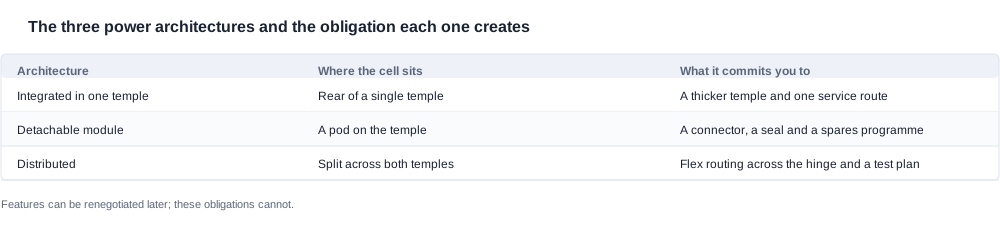
Inside a temple. The cell sits in one temple, usually toward the rear where the mass can be carried close to the pivot, or in the rear third of the temple where the ear relieves the load. This is the most common arrangement and the most self-contained: one part, one seam, one service route. The cost is that the temple becomes a mixed object — a structural acetate or metal element that also has to be a pressure vessel, a thermal path and a space for a connector. The frame's section has to grow, and the mass lands asymmetrically on one side of the head.
In a detachable module. The cell sits in a small pod that attaches to the temple, mechanically or magnetically, and the frame can be bought or worn without it. The pod can carry the cell, or the cell and the electronics, or the cell and a small speaker. This arrangement keeps the frame's thickness and balance closer to the original and creates a genuine accessories story: a spare pod, a second pod, a desk charger. The costs are a connector that must survive sweat and daily handling, a sealing solution for a part that is opened deliberately, and the decision about whether the customer can replace the power in a store rather than in a workshop.
Split across the frame. Power elements are divided between the two temples, or between a temple and the bridge, so that no single component dominates the mass distribution. The obvious motive is balance and comfort; the less obvious motive is that a distributed design gives an electronics integrator more routing freedom along the temple. The costs are that every route between the two halves has to cross a hinge or a bridge, which is where failures live: the flex cable that has to survive thousands of cycles, the connector that has to open and close as the frame is worn.
At the hinge or the temple tip. A smaller amount of power can be placed in a location that is mechanically protected — the hinge area and the tip both absorb impacts that would damage a cell. The trade is that these locations are small, awkward and shared with other functions, and a frame that routes power through the hinge tends to constrain the hinge design rather than follow it.
Whichever location is chosen, three consequences are common to all of them. The cell's mass changes the balance of the frame and therefore the fit behaviour of a product whose whole argument is that it still looks and sits like a normal pair of glasses. The cell's thermal behaviour puts a warm spot against the head for as long as the product is worn. And the cell's service life is shorter than the frame's design life, which means the two will want to be separated at some point, and the separation route has to be decided by somebody.
The published record gives a starting point for the conversation but not an answer. Charging time is stated for every entry in the catalogue, with twenty-six at two hours or less and D17 and ZH12 nearer one hour, and that two-hour figure is a ceiling rather than a typical case. The charging interface is stated for twenty-four entries — the split runs seventeen magnetic against seven Type-C — while four entries, namely MT6 and L1 Pro, and CY05 and CY03, leave it unstated. Whatever the brand decides about cell placement, the specification sheet that comes back has to answer the interface question for the exact unit that will be shipped.

The three architectures and what each one commits you to
The useful way to compare architectures is not by feature but by obligation, because the features can be negotiated later while the obligations cannot.
| Architecture | What it commits the brand to |
|---|---|
| Integrated cell in one temple | A thicker, heavier temple; a single service route; one sealed assembly |
| Detachable power module | A connector and a sealing design; an accessories and spares programme |
| Distributed across the frame | Flex routing across a hinge; a second failure mode to test |
Three commitments deserve to be read twice, because they are the ones that are discovered late.
Integrating the cell into one temple commits the brand to a thicker temple. The section has to grow by whatever the cell depth requires, and that growth is visible from the side of the face. There is no way to hide a cell behind a curved temple without either a thicker tip or a visible step, and a frame that has been widened to carry a cell is a different frame from the one that was drawn. It also commits the brand to a single service route. The frame and the electronics become one assembly, and the practical consequence is that a unit with a failed cell is a unit that goes back to a workshop rather than to a counter.
A detachable module commits the brand to an accessories programme. Once the customer can remove the power, the customer will ask for a spare, and then for a second one, and the channel will want a colourway. The module also forces the frame to be designed in two states — with and without — and every downstream decision about packaging, retail display, returns and even the marketing photography inherits that branch. A brand that has not decided how the frame looks without its module will find that decision made for it by whoever produces the first sample.
Distributing the power commits the brand to a flex path. A frame that routes power between two halves needs a cable that flexes every time the temple opens, and a connector somewhere in the run. The engineering is not difficult; the testing obligation is. It means that the endurance, the drop, the hinge-cycle and the temperature testing all have a second dimension, and the evidence file grows accordingly. For a brand without an existing test regime this is the commitment that is most often underestimated, because it looks like a design detail and behaves like a test plan.
There is a fourth possibility that brands often ask about and that the evidence rarely supports: removing the cell from the frame entirely and carrying it in a pocket, with the frame containing only the electronics. It is possible, and it produces a product that is comfortable and thin, but it relocates the charging problem into a second object, and a second object is a second SKU, a second charging item, a second thing to lose and a second thing to explain. It works for a product whose primary use is audio and whose battery lasts a full day; it works poorly for a product whose promise is that you put it on and forget about it.

The trade-off that only appears after the frame is signed off
The trade-off itself is familiar: capacity against charge time. A larger cell runs longer and charges more slowly; a smaller cell charges quickly and runs briefly. What makes it expensive is the timing. The cell's volume determines the temple's section, the temple's section determines the artwork, and the artwork determines the tooling. Once the tooling exists, capacity is no longer a specification choice; it is a fixed property of the object, and the only remaining variable is the charge time you publish.
That is why the published charging-time figure needs careful handling. Twenty-six of the twenty-eight entries are at two hours or less, and that number is a maximum rather than a typical result, so the honest wording is "charges in up to two hours" and the argument about fast charging has to be made on something else. Two entries, D17 and ZH12, sit nearer one hour, and for a brand whose proposition is "put it on for ten minutes before you leave" that pair of figures is the entire argument — which means the proposition depends on specific models rather than on the range.
The second half of the trade-off is not in the electrical drawing at all. It is the endurance-versus-accessories trade. A product that needs a case to reach a full day of use has a different commercial shape from a product that does not: it has a box item, a counter item, a colourway, a return reason and a shipping weight. Endurance that comes from the cell inside the frame keeps the box simple; endurance that comes from the case adds an object to every channel conversation. This is why the case decision is not a detail that can be deferred until the engineering is finished.
The third half is the one that catches brands: the trade-off between the power design and the durability of the frame around it. A cell that is protected sits where the frame is protected, which is usually away from the point of impact. A cell that is placed for comfort sits where the wearer wants the weight, which is usually the point of impact. Every movement towards comfort moves the cell towards the hinge and towards the temple tip, and both of those are the places where a frame is dropped from.
There is a fourth consideration that sits behind all three and is rarely written down at this stage: the cell does not last as long as the frame. A cell has a cycle life, a calendar life and a sensitivity to storage temperature, and it will lose capacity while the frame around it is still in perfect condition. That mismatch is what creates the awkward moment in a brand's life when the product is technically fine and the customer says the battery no longer lasts. The question to settle early is what happens at that point: does the customer buy a new pair, does the frame go to a workshop for a power replacement, or does the product end? Each of those answers has a different cost and a different effect on the frame line, and choosing one after the product is on sale is the version of this decision that is always most expensive.
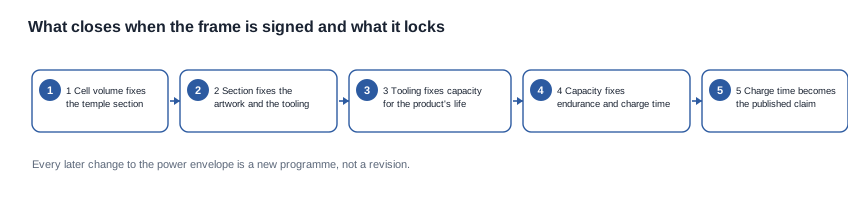
So the trade-off that appears after sign-off is not really capacity against charge time any more. It is the flexibility you have given away. Before sign-off you can change the cell to fit the design. After sign-off the design dictates the cell, and the cell dictates the endurance, the charge time, the case and the claims. The practical mitigation is unglamorous: decide the power envelope before the frame is drawn, write it into the artwork brief as a number and a volume rather than a preference, and treat any later change to it as a new programme rather than a revision.

The questions to settle before the frame is drawn
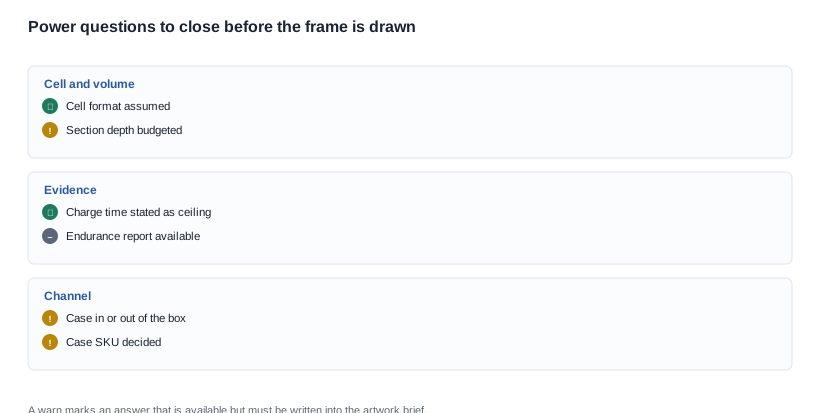
- Where does the cell physically sit, and what is the mass distribution it creates on the wearer's head?
- What cell volume and what cell format does the design assume, and how much of the temple's section is being spent on it?
- What charge time can the design achieve with that cell, and is that figure quoted as a ceiling or as a typical case?
- Which charging interface applies to the exact model that will be shipped, and is that interface stated in the specification the customer will receive?
- Is the power removable by the customer or by a workshop, and who replaces a failed unit?
- If the product includes a case, is the case a different colourway, a different SKU, and a different line on the purchase order?
- What happens to the power when the frame is dropped, bent or stored in a hot car, and what evidence supports the answer?
- What does the customer see when the cell reaches the end of its life, and what does the brand do about it?
Those eight answers belong in the artwork brief rather than in a meeting. Number six in particular is the one that changes the shape of the programme, and it is the one most often answered with a shrug — the assumption being that whether a case is in the box is something the brand already knows. For the models whose row was never printed, it is precisely the thing nobody has established, and a shrug at this point turns into a reprint at the next order, when the box has to be redrawn, the shelf ticket has to be rewritten and the retailer asks what is actually in the carton.
A useful discipline for this stage is to write the answers into three columns: the decision, the source of the answer, and the date the answer was given. When the design is signed six months later, the three columns are what turn a preference into a constraint. Without them, every later conversation starts again from scratch, and the person making the request is usually not the person who made the decision.
Why the case belongs to a channel decision before it is an engineering one
A charging case is not a battery. It is a product accessory, and the moment it exists it becomes something the channel has to hold, sell, ship, stock, colour, explain and take back. The engineering question — what capacity does the case hold, how long does it take to fill — is real but narrow. The channel question is wide, and it starts before the engineering is finished.
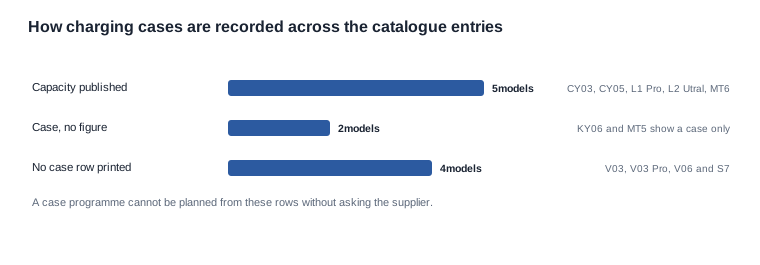
The catalogue's own record shows how unevenly the case question is answered across a range. Five camera entries publish a case capacity — the CY05 and the L1 Pro, and the CY03 — each at 1400 mAh, the L2 Utral at 900 or 1400 mAh, and the MT6 at 1200 mAh in a folding case. Two more, the KY06 and the MT5, are shown with a case and with nothing printed for its capacity. Four entries — the V06 and the V03 Pro, and the V03 and the S7 — have no charging-case row printed at all. That is the whole of what is known, and the third group is where the care is needed: a row that was never printed is not a published statement that a unit arrives without a case, so for those four the question of what sits in the box is an item to put to the supplier rather than a fact to copy onto a packing list. A brand planning a case programme cannot plan it from the record alone — it has to establish, for each model it intends to range, whether a case exists, what it holds, and whether the case is part of the standard box or an accessory.
The reasons the case belongs to a channel conversation are worth stating in full, because they are rarely in the engineering brief. First, it is a stock position: a case adds units to a purchase order, and a case in a different colour from the frame multiplies them again. Second, it is a shelf position: the customer looks at what is in the box, and two models presented side by side, one with a case and one without, reads as an inconsistency rather than as a decision. Third, it is a returns position: a case returned without its frame, or a frame returned with the case missing, is a reconciliation task. Fourth, it is a communication position: the retailer, the distributor and the online listing all have to say the same thing about what is in the box, and the most common source of a complaint in this category is not the product but the description of the box.
There is a fifth reason, and it is the one that keeps the decision out of the engineering brief. The case is the cheapest place to add value and the easiest place to create a promise. A case that adds hours of runtime creates a claim; a claim needs evidence; the evidence for runtime is exactly the kind of claim that this catalogue cannot currently support, because no third-party endurance report exists and because the charging-time figures are ceilings rather than typical cases. The electrochromic file carries no photochromic performance parameters at all, the bone-conduction entry carries a 35 dB figure with the highest compliance risk in the range, and the children's line is where safety and health wording carries the greatest exposure, so that line should be withheld from channel copy until a conformity status exists for it. A case-based runtime claim inherits all of that uncertainty.
Underneath all of this sits a layer of model identity that a power programme has to carry. Several items in the catalogue's record are still open, and each of them touches a power decision somewhere. The pair A05 and A06 share one set of values, with what separates them still to be established. The trailing word in the label L2 Utral reads like a typo, and nothing in the file explains the Pro Max tag beside it. MT5 is filed under an odd page number and sits between two product families in a way the record calls uncertain. The page numbers attached to V06 and S7 are similarly out of place. The electrochromic entry, the bone-conduction entry and the augmented-reality entry are all filed without an SKU of any kind. And across all twenty-eight entries there is no supplied photograph, no video and no test report. None of these blocks a case decision, and every one of them makes a case decision harder, because the case programme is built on model identities and the identities are the part still being confirmed.
The case decision should be made with the channel in the room, at the same time as the box decision, and not as an afterthought of the electrical design. The engineering can tell you what a cell holds; only the channel can tell you how many variants of that you want to stock and how many ways it can be described. If a case is planned, the specification should say so in the same sentence as the charging time, because that is the sentence the retailer will quote.
Where the frame cannot carry the cell volume a brand wants to promise, we will say so at the feasibility stage rather than after the tooling is cut, because the frame volume and the endurance figure are both fixed before the programme opens.
Related reading
- What a frame brand starts with — brand collaboration route
- How a new product development actually runs — OEM and ODM process
- The paperwork that follows the product — conformity documentation
- Where the configuration options sit — OEM-ready platforms
The most useful first step for a brand still deciding is to write down the endurance it wants to promise, in hours and in a normal day of use, and then to check that promise against the cell volume it can actually accommodate in the frame it already sells. Everything else in this page follows from the gap between those two numbers.


