
A certification file is not a certificate. It is a controlled set of documents that ties a specific product, built to a specific configuration, to a set of claims that a specific market will accept — and it is built while the product is still changing. That last part is why the process is worth understanding before it starts, rather than after the first sample arrives with a question attached.
This page sets out the path stage by stage, with the owner named at each step: what the brand is asked to supply, why the difficult part of the work is a document rather than a test, a division of responsibility that actually holds together, and the questions worth asking before the file is commissioned. It is written for the person who will be asked to sign for the claims rather than for the laboratory, and it treats the smart glasses for eyewear brands certification support route as a management problem with a technical appendix.
Smart glasses certification support: the eight stages and their owners
Eight stages is not a superstition. It is the number of handovers it takes between a brand's idea and a file that a customs authority or a distributor can rely on, and every handover is where a stage gets lost.
Stage one, product classification. Someone has to decide what the object is: a pair of spectacles with added electronics, a radio equipment item, a battery-containing product, or something whose output level pushes it into a different regulatory class altogether. The classification drives everything downstream, and it is a decision, not a formality. It belongs to a person with authority to sign, and the answer needs to be written down rather than inferred from what the product looks like.
Stage two, market scoping. Which countries will the product be sold into, and which rules will each of them apply. A brand that intends to serve Europe, North America and several Asian markets inherits three different frameworks and should assume there will be a fourth framework to check. This stage belongs jointly to the brand and the supplier, because the brand knows its distribution plan and the supplier knows which documents usually travel with a shipment to each destination.
Stage three, the radio and electromagnetic work. If the product carries a radio, the spectrum and emission requirements have to be tested against the final build, not a prototype. This is the stage where a last-minute change to the radio module can invalidate work already completed. Ownership sits with the supplier's engineering team, with the brand holding the right to freeze the configuration that gets tested.
Stage four, substance and environmental compliance. Materials declarations for the frame, the printed parts, the cables and the packaging. It is unglamorous work and it is where a surprise about a material can stop a programme. For a brand that designs its own frames, this stage usually sits with the frame manufacturer, with the brand receiving the declarations and keeping them.
Stage five, the cell and its transport. A rechargeable cell brings its own conformity requirements and its own transport requirements, and the transport set is a document in its own right with a life of its own. This stage is owned by the supplier, with the brand needing to know which cell ended up in the shipped build so that the transport document and the product describe the same object.
Stage six, the claims review. Every statement the brand intends to make — on the box, on the shelf card, on the product page, in the trade catalogue — is checked against what the evidence supports. This stage is where most programmes stall, because a marketing team has usually written claims that nobody has tested. It belongs to the brand, with the supplier supplying the technical facts.
Stage seven, file assembly and version control. Somebody collects the documents, names them, dates them and connects them to a specific model identity. This stage has no owner by nature, which is why it fails by nature. It needs a named person, and it needs a rule about what happens when the product changes.
Stage eight, marking, labelling and handover. The packaging, the labels, the instructions and the manual have to agree with the file, and the file has to be handed to the people who will use it: the distributor, the retailer, the customs broker, the after-sales team. A file that lives with one supplier and never reaches the channel is a file that cannot help when a question arrives.
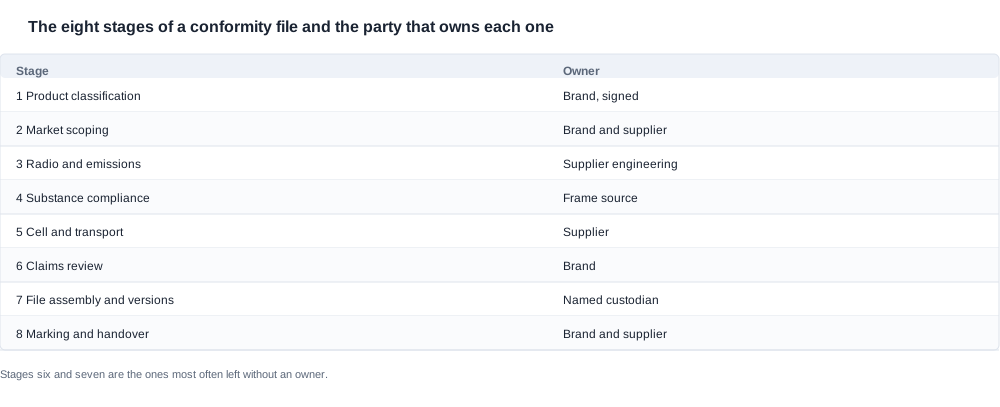
The two stages most often left without an owner are stage six and stage seven, and they are the two that decide whether a programme passes. Stage six is where the brand learns that its favourite claim has no evidence behind it. Stage seven is where the brand learns that the document it sent to the laboratory in March describes a product that no longer exists.

What the process actually asks a brand to supply
The surprise in a certification programme is how much of the work is upstream of any test. A brand that expects to approve a sample is asked instead to supply the following.
- A stable model list. Not a concept, not a draft name — a list of the exact product identities the file will cover, with the naming the documents will use. This is harder than it sounds when the catalogue record itself carries open naming questions, because a file cannot be built on an identity that is still being decided.
- The intended markets. Which countries, in which order of priority, and whether the same build is intended for all of them.
- A claims register. A single list of every statement the brand intends to make, split into product facts, performance statements, comparison statements and marketing language. The register is the most valuable document a brand brings to this work, because it converts a marketing argument into a list that can be checked.
- The artwork and packaging files. Print artwork, packaging structure, labels and manuals, because the marking and labelling stage works on the real files rather than on intentions.
- Material information from the frame source. Declarations covering the frame, the printed components, the adhesives and the packaging. If the brand does not design the frames itself, this has to be requested from the frame maker, which adds a dependency and a delay.
- A change-control position. A written statement of what the brand will and will not change after the tested build is fixed, and who is allowed to approve a change. Without this, the file has no stopping point.
- Entity and contact details. The legal entity the documents will be issued to, the responsible contact for each subject area, and the address the documents will carry.
- The commercial arrangement for testing. Who commissions the tests, who pays for them, and what happens to the cost if the build changes and a test has to be repeated. These are commercial questions and they are asked at the start, not at the end of the first failure.
Two of these deserve a note. The claims register is the item that most changes the speed of a programme, because a brand that arrives with a written list gets the evidence checked in weeks, while a brand that arrives with a folder of marketing copy gets a series of questions. And the model list is the item that most often is not ready, because brands organise themselves around seasons and collections while conformity files organise themselves around product identities, and the two structures do not line up.
A useful discipline is to treat the eight inputs as a single submission with a version, rather than as eight separate requests. When the brand can point to one dated document that answers all eight, the supplier can quote against it, the laboratory can plan against it, and the file has a starting version. It also gives the brand something it can reuse: a second product in the same family inherits most of the first product's file, and a brand with a clear submission template can move from one programme to the next without starting from nothing.
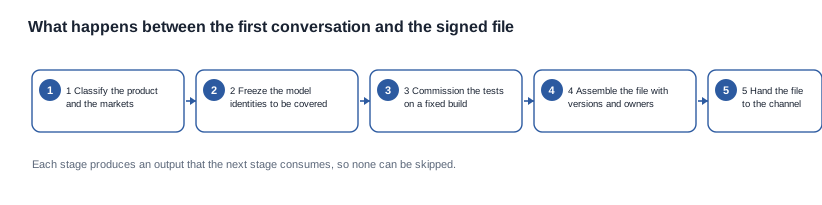
There is a practical trap in the inputs list that catches even experienced brands. The model list looks like a naming task, and teams treat it as one, but what the file needs is not a list of products. It is a list of identities that cannot change without triggering a review. A seasonal collection name is not an identity, a marketing name is not an identity, and a name that two products share is worse than no name at all. The question to ask internally, when you are deciding what goes on the list, is what a customs broker or a distributor would write on a document to identify the goods without ambiguity.

Why the hardest part is a document, not a test
Testing is comparatively easy. A laboratory takes a build, applies a method and produces a result, and the result is repeatable. The difficulty sits in everything that connects the result to the product the customer will actually receive, and that is a document problem.
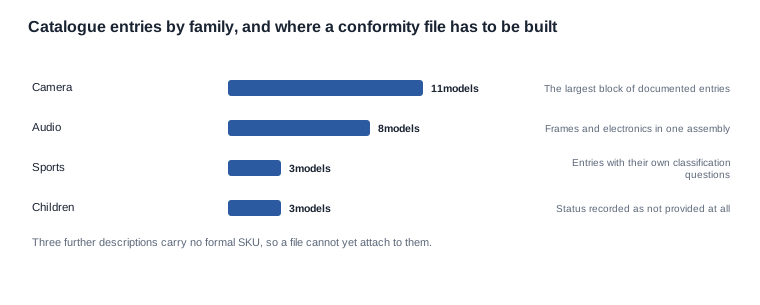
Identity is the first document problem. A conformity document names a product. If the product's name is unsettled, the document cannot attach to it. The catalogue record behind these products carries several such open items, and a brand working from it should expect to resolve them: A05 and A06 share one parameter set while their difference is still unrecorded; the L2 Utral entry carries what looks like a mis-typed final word together with an unexplained Pro Max suffix; MT5 has a page reference that does not line up and a family assignment recorded as doubtful; V06 and S7 show the same kind of page-reference fault; three catalogue descriptions, one electrochromic, one bone-conduction and one augmented-reality, carry no SKU at all; and the catalogue supplies no photographs, no video and no test reports for the twenty-eight entries it lists. A file built before these are settled will have to be rebuilt.
Version control is the second. The tested build, the artwork, the bill of materials, the packaging and the manual all have to describe the same object. Each of them changes on its own schedule, and none of them knows about the others unless somebody makes them aware. This is why the change-control position in the inputs list is not paperwork for its own sake: it is the mechanism that stops the file from drifting away from the product.
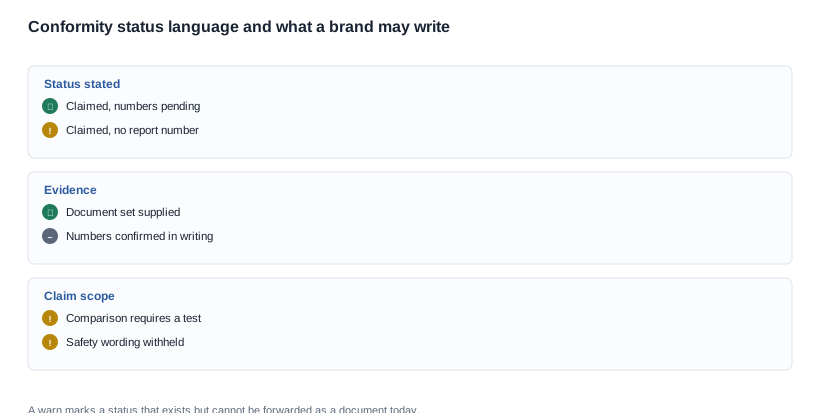
Evidence for claims is the third, and it is where the interesting failures happen. Two things follow from the way this category is documented. Where a statement sets one product above another, the comparison has to be made against the rival unit in the hand before the statement is made outside the building. Where a statement describes sound quality, there is currently no third-party measurement standing behind it, so the honest form of the sentence is about behaviour rather than about performance figures. The ingress marking appears on two entries only and the file itself notes that no report number is attached to it. The electrochromic description carries no photochromic performance parameters whatsoever. The 35 dB figure published against the bone-conduction description is the entry with the greatest regulatory exposure in the whole file, and in the children's range, safety and health wording carries the most risk of all.
The supplier's own status language is the fourth. Three states appear in the file, and a brand that treats them as interchangeable will misdescribe the product. In the first, a certification framework is named and nothing identifies the documents behind it. In the second, the framework appears and no test report number is recorded beside it. In the third, which applies to the children's line, nothing is provided at all. A brand that receives the second and treats it as the first will forward a document it cannot stand behind.
Longevity is the fifth. A conformity file has to survive the life of the product, and products in this category have a way of outliving their supplier's price list. The document set has to be stored somewhere the brand controls, in a form that does not depend on somebody's inbox.
There is also a detail worth knowing early. The certification page in the exported file is an image, and the images are patent certificates: ten of them, eight of them design patents and two of them utility patents. Nothing on that page is a conformity mark, so the CE, FCC and RoHS statements that appear against the products have to be treated as claims for the brand to evidence rather than as documents the brand can forward to a customs broker. Asking for the underlying documents at the start of a programme is far less awkward than explaining the difference at the first shipment.

A workable division of responsibility
The divisions that fail are the ones drawn around organisations rather than around artefacts. A workable split looks like this.
The brand owns the claims, the markets and the model identities. Nobody else can decide what the product is called, where it will be sold, or what will be said about it. This is the part that feels like paperwork and is actually the part that determines whether the programme finishes.
The supplier owns the build and the evidence that describes it. The engineering team owns the tested configuration, the test reports, the material declarations for the components it supplies, and the instruction that the tested build is the build that ships. A supplier that will not commit to that last point is not able to support a file, whatever else it offers.
The frame source owns the material declarations for the frame. If the brand designs the frames, this sits inside the brand and the supplier supplies the electronics declarations around it. If the brand does not, this is a third party and it needs to be managed as one, with a lead time nobody in the electronics project controls.
A third party may own the testing and the technical file, if the brand does not have a compliance function. That is a reasonable arrangement for a first programme. It is worth being clear that the outsourced party can assemble a file but cannot decide the claims, and cannot take responsibility for the commercial consequences of a claim the brand chose to make.
Jointly owned, and therefore at risk: the change-control boundary, the marking and labelling, and the claims review. These three need both sides in the room at the same time, and they are the three most likely to be handled by each side separately. The way to protect them is to put them on a schedule with named attendees rather than on a list of responsibilities.
Two practical rules keep the split working. The first is that every document has exactly one custodian, even where several parties contributed to it; shared custody is how documents get lost. The second is that the file has a version and the version travels with the goods — a packing list that records the document version makes a customs question answerable in minutes instead of days.
The questions to ask before the file is commissioned
- Which product identities will the file cover, and what naming will the documents use for each of them?
- Which markets will the same build be sold into, and does the answer change what has to be tested?
- What is the claim list, split into product facts, performance statements, comparisons and marketing wording, and which of those four categories is the weakest?
- Which configuration will be submitted for testing, and what happens to the documents if the build changes afterwards?
- Which party owns each of the eight stages, by name rather than by department?
- What does the supplier's own conformity status actually say for the model in question, and can the underlying documents be shown?
- Where will the file be stored once the programme ends, in a format that survives a change of supplier?
- Who signs for the claims, and how does that person see the evidence before they sign?
The eighth question is the one that distinguishes a programme from an exercise. A brand that has decided who signs, and that person has seen the evidence, will slow down the marketing language at the right moment. A brand that has not decided will discover the problem at the point where a shelf card is already printed.
Two further pieces of diligence are worth doing before commissioning anything: asking for the document list rather than the marketing summary, so that you see the gaps rather than the summary of them; and asking what has been tested on an earlier, similar build, because a report that covers a slightly different product is a useful starting point and a dangerous one to quote.
The due diligence that matters most is on the supplier's own status language, and the red flags are specific. A supplier who describes certification as "done" without a status and a document reference is telling you nothing. A supplier who cannot produce a document list for the exact model, only for the family, is going to leave you with a gap at the first customs query. A supplier whose answer to "what changes if the build changes" is "we will re-test" without saying who pays or how long it takes has not costed the risk. And a supplier who treats the claims register as an obstacle rather than as the shortest route to a defensible product will quote a lower total cost and then hand you a product the channel cannot describe. When you compare options, the criteria that matter are the ones about the file rather than the ones about the factory floor: which documents exist today, for which identities, in what status, and who signs.
A brand buying into this category should judge the conformity arrangement as part of the product rather than as paperwork attached to it, and should refuse to let a programme begin until the identity of what is being certified is settled. Everything else in this page follows from that: the stages are mechanical, the tests are purchasable, and the only part that cannot be bought is the discipline of naming things correctly and keeping the document true to the object.
Related reading
- The document list behind a shipment — certification file checklist
- Where the product families sit — AI camera glasses range
- The audio line in detail — Bluetooth audio glasses range
- Samples before paperwork — requesting samples
Before commissioning a file, the most useful thing you can send us is a model list, a market list and a claim list. With those three in hand we can tell you which stages apply to your programme, which documents already exist for the models you have chosen, and where the gaps will be.


