
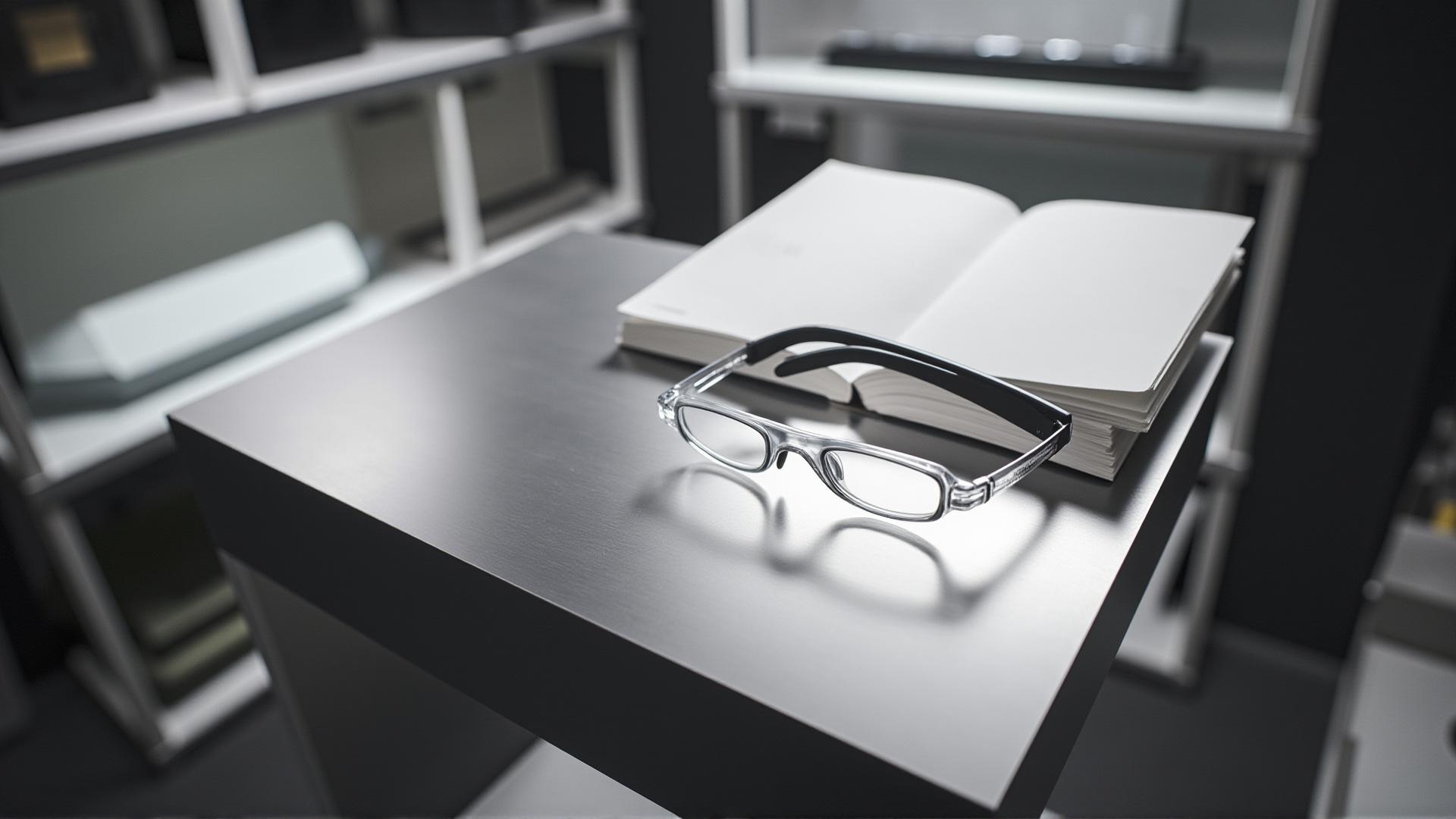
Fit is the one attribute of a frame that a buyer never raises in a meeting and always receives in the returns. It is also the attribute that electronics change most quietly, because the result arrives as a complaint at the counter and is traced back, if at all, to the mass in the temple. A buyer planning an eyewear line that carries electronics has to treat this as a specification item with a measurement attached, not as a finishing detail, and the difference between those two positions shows up in the returns rate within a single season.
This page separates what the electronics genuinely change from what they leave alone, treats the optical question as a separate discipline rather than a chapter of the engineering, lists the physical checks an eyewear brand should insist on before the purchase order is placed, and closes with the commercial consequence: fit-related returns cost a brand more than almost any other mistake available to it in this category. The subject is how a smart glasses product gets specified by a brand, and the reader in mind is the person writing that specification.
Smart glasses comfort considerations: what the electronics change
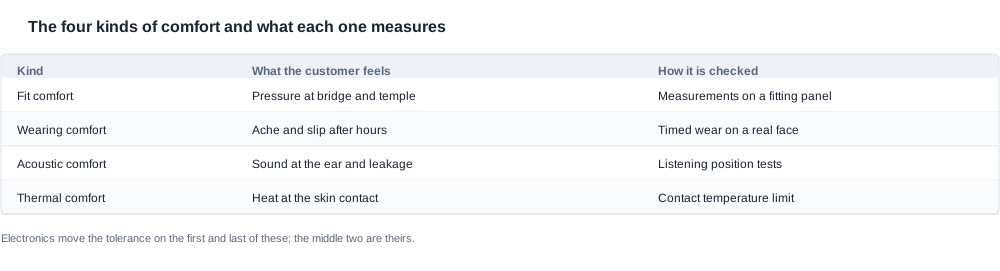
Four different things get called comfort in this trade, and only one of them belongs to the frame. Separating them is the first useful step for a buyer, because each has its own measurement, its own owner inside the programme and its own failure mode.
Fit is the frame against the face: bridge width, temple length, nose-pad behaviour, pantoscopic tilt, how the temples spread. It is the classic dispensing territory, and it is the one the electronics barely touch — although they change the conditions under which it is judged, because a heavier frame is judged differently even when the geometry is identical.
Load over hours is the endurance question: the bearing at the temple, the temperature where the frame meets the head, the ache that appears in the fourth hour of a long meeting, the way a frame slides when the wearer looks down. This is where electronics do their damage, because everything they add is mass, and mass is felt at exactly the points where the frame meets bone.
Acoustic comfort is the experience of sound arriving: how it sits at the ear, whether the person's own voice sounds strange, whether a person alongside can hear it. Very few products in this category address it at all, and it reaches the brand as a defect report rather than as a fit note.
Thermal behaviour is the fourth, and it has its own causes: a cell discharging under load, an amplifier working, and the insulating effect of a temple held against the head.
Given those four, here is what the electronics actually change. They add mass, concentrated at the temple and usually toward its rear third, because that is where the space exists. They add a seam or a joint, because an assembly with electronics has to come apart to be serviced. They add a temperature rise, because power is consumed against the head. They add a sound source a few centimetres from the ear canal. And they add the possibility of a control that gets touched by accident — though it is worth noting that nothing in the file records touch, gesture or touch-free control for any entry, so any control a product offers has to be confirmed rather than assumed from a competitor's brochure.
Mass is the item that decides most of the result, and the reason is geometric rather than technical. A frame's balance is a geometry problem: the mass in the temples is counteracted by the bridge, and the ratio between them sets how the load is distributed across the nose and behind the ears. Add mass at one end of one temple and the balance changes asymmetrically, so the frame tends to rotate, the nose carries more of the load, and the temple holding the electronics presses harder. This is why a pair of smart glasses can fit correctly on paper and still read as wrong after twenty minutes of use. It also explains why the same electronics placed symmetrically in both temples behave better than an asymmetric arrangement, and why an asymmetric arrangement is sometimes chosen anyway to keep one temple's profile clean for the artwork.
The temperature question is smaller but more persistent, because it is felt directly. A cell inside a temple is insulated by the frame material and by the head itself, and it warms while working. There is no published threshold in this category for how warm a temple may become, so a brand has to set one. The practical approach is to write the limit into the acceptance criteria rather than discovering it in a returns report, and to test it on the production build over the length of a working afternoon.
The seam deserves more attention than it usually gets, because it is both a fit question and an aesthetic one. A temple that must open for service has a parting line, and a parting line on a curved temple is visible in profile and can irritate the contact surface if it is sharp or if it moves. The check is simple: run a fingertip along the temple, repeatedly, and feel for the line.
What the electronics leave untouched, and why it still decides comfort
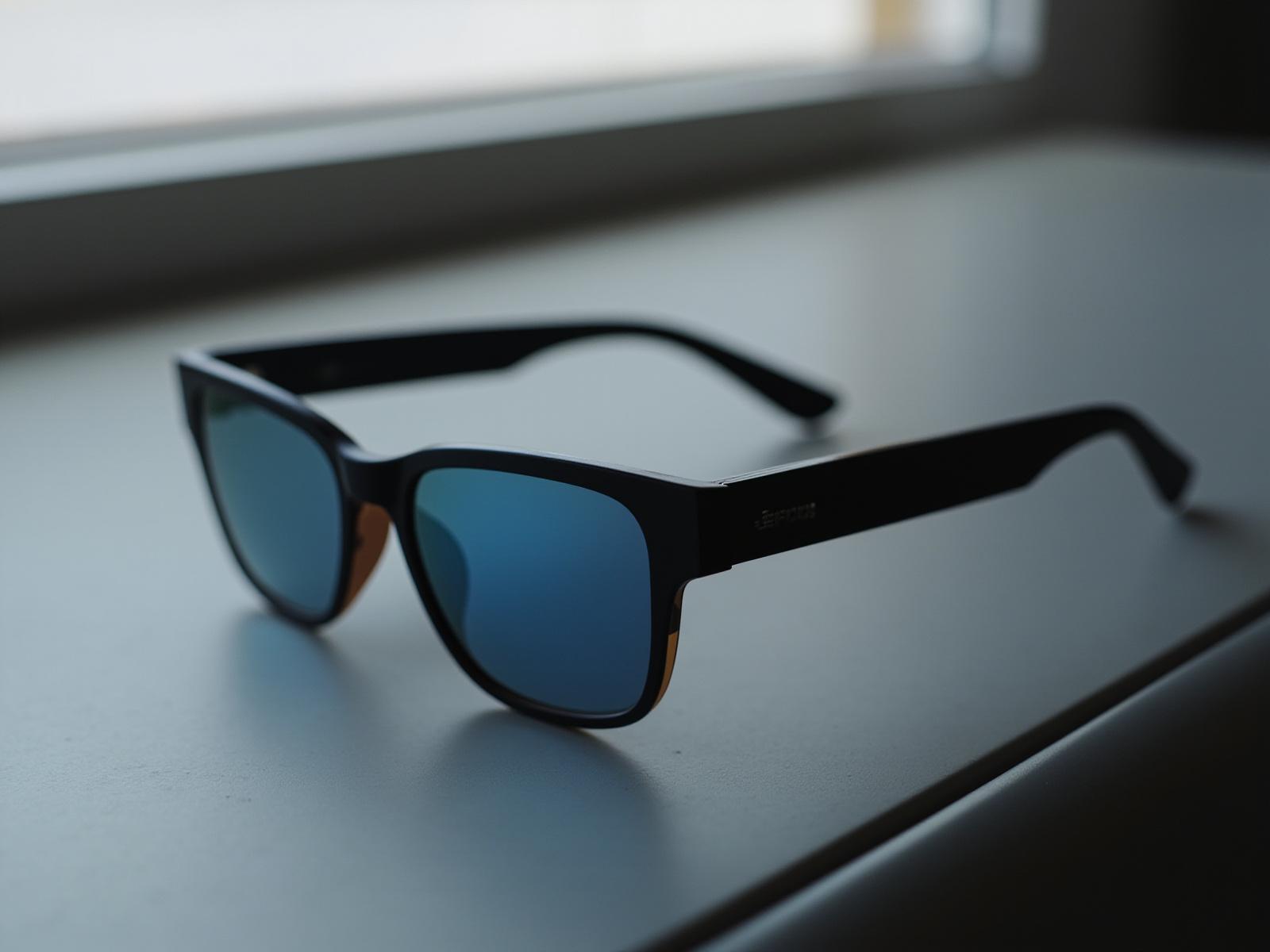
The list of things electronics do not touch is long, and it contains almost everything an optician would ask about. Bridge geometry, temple length, face form, the vertex distance, the pantoscopic tilt, the lens plane, the height of the nose pads, the spread of the temples, the spring of the hinge, the position of the lens centre relative to the pupil — none of these is affected by adding a driver to a temple.
And yet they decide fit more than the electronics do, which sounds contradictory until it is stated properly: the electronics do not set the level, they move the tolerance around it. A frame that sat within tolerance at 24 grams may sit outside it at 32. A frame that was already tight behind the ear becomes painful. A frame with a marginal bridge may have been acceptable because it was light, and now it slides. Nothing about the fit variables changed; the margin between acceptable and unacceptable did.
That is why the order of work matters. The sensible sequence is to establish the fit first, on the frame as it exists today, and only then add the electronics and re-measure. A brand that brings a frame to the fitting stage with the electronics already designed in has skipped the baseline, and without a baseline nobody can attribute a complaint to fit or to weight — and those two have completely different remedies, each with a different change to the artwork and a different cost to the tooling.
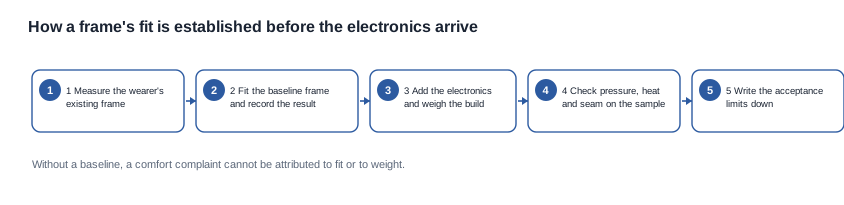
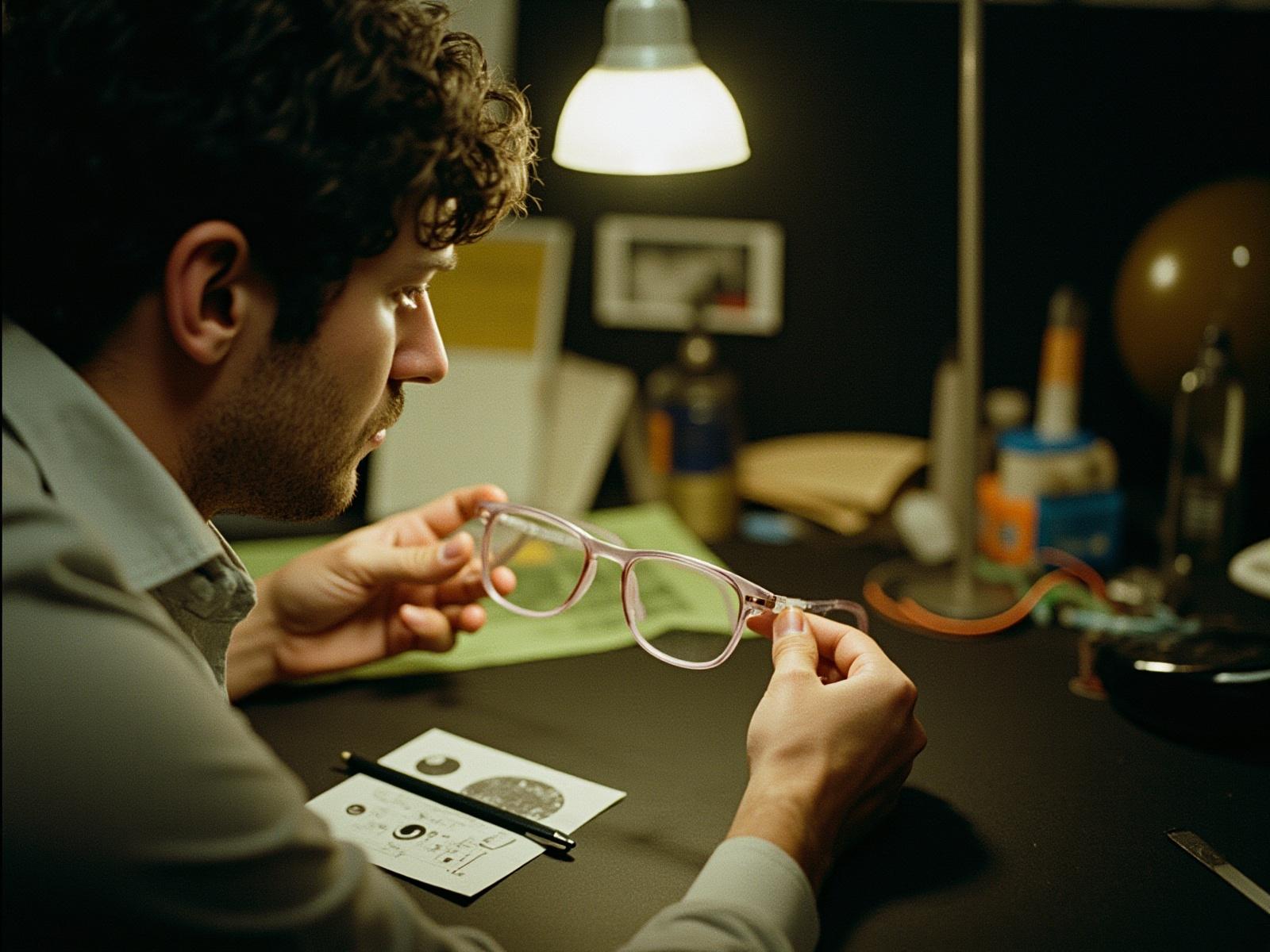
Three baseline disciplines pay for themselves. First, measure the frame the person already owns rather than estimating: temple length, bridge width and total mass are the three numbers that predict fit better than anything else, and they are cheap to collect from a customer in a store. Second, fit the sample on more than one head, because frames that suit one face form are not frames that suit a brand's customers, and a sample tested on one person proves very little for a procurement decision. Third, record the baseline mass of the frame before the electronics, because that number is what every later argument about heaviness has to be measured against, and because a supplier who quotes the finished mass without quoting the baseline has given you half the information.
There is a fourth discipline that is less obvious and belongs to the buying process rather than to the engineering: fit the frame alongside the prescription glasses already in use, where that is how the product will be used. A temple carrying electronics is often slightly wider than the frame it replaced, and the person who had the two in competition will be the first to report the change.
The optical side, which is a separate kind of comfort question
The optical question is not the wearing question, and a brand that merges the two produces both bad frames and bad claims.
The classical optical variables are the ones that decide whether a frame is kept: the vertex distance between lens and eye, the height of the lens centre against the pupil, the tilt of the lens plane, the centration of the prescription inside the frame, and the base curve. Each is a dispensing decision, and each is a decision the eyewear brand already owns and is already good at. Electronics do not change them, and a brand with years of fitting experience holds an asset worth more than the electronics.
What the electronics add on the optical side is interference rather than alteration. A tinted lens reduces the light reaching a camera, which changes how the camera behaves in bright conditions. A strong prescription produces a thick lens, and a thick lens at the edge of a wide frame is heavy at exactly the point where the bridge meets the rim. A frame designed around an audio module in the temple usually has a slightly different rim geometry, because the temple profile has changed, and a rim change changes the available lens area and therefore the thickness of the lens that can be fitted.
The published file does not give a lens specification for the range, so the lens question is not something to be read off a table. It has to be settled with the frame side and the lens side together: what lens powers the frame will carry in practice, what the edge thickness becomes, and how that mass lands in the balance of the whole product. A brand with a strong prescription business already knows the distribution of its prescriptions; a brand that does not should find out before the frame is drawn rather than after the first returns arrive.
The tinted and variable category deserves separate mention because the file is unusually quiet about it. The electrochromic description contains no photochromic performance parameters of any kind — no range, no speed, no transmission figures — so a brand cannot present it as a light-responsive product on evidence, only as a category direction. The same restraint applies to any claim about screen brightness, daylight readability or eye protection. Nothing in this category supports a claim about reducing eye strain, protecting the eyes or relieving fatigue, and those are precisely the claims a customer will ask for. The honest position is that the product is a pair of frames with electronics, and it should be sold on what it does.
What an eyewear brand should insist on checking
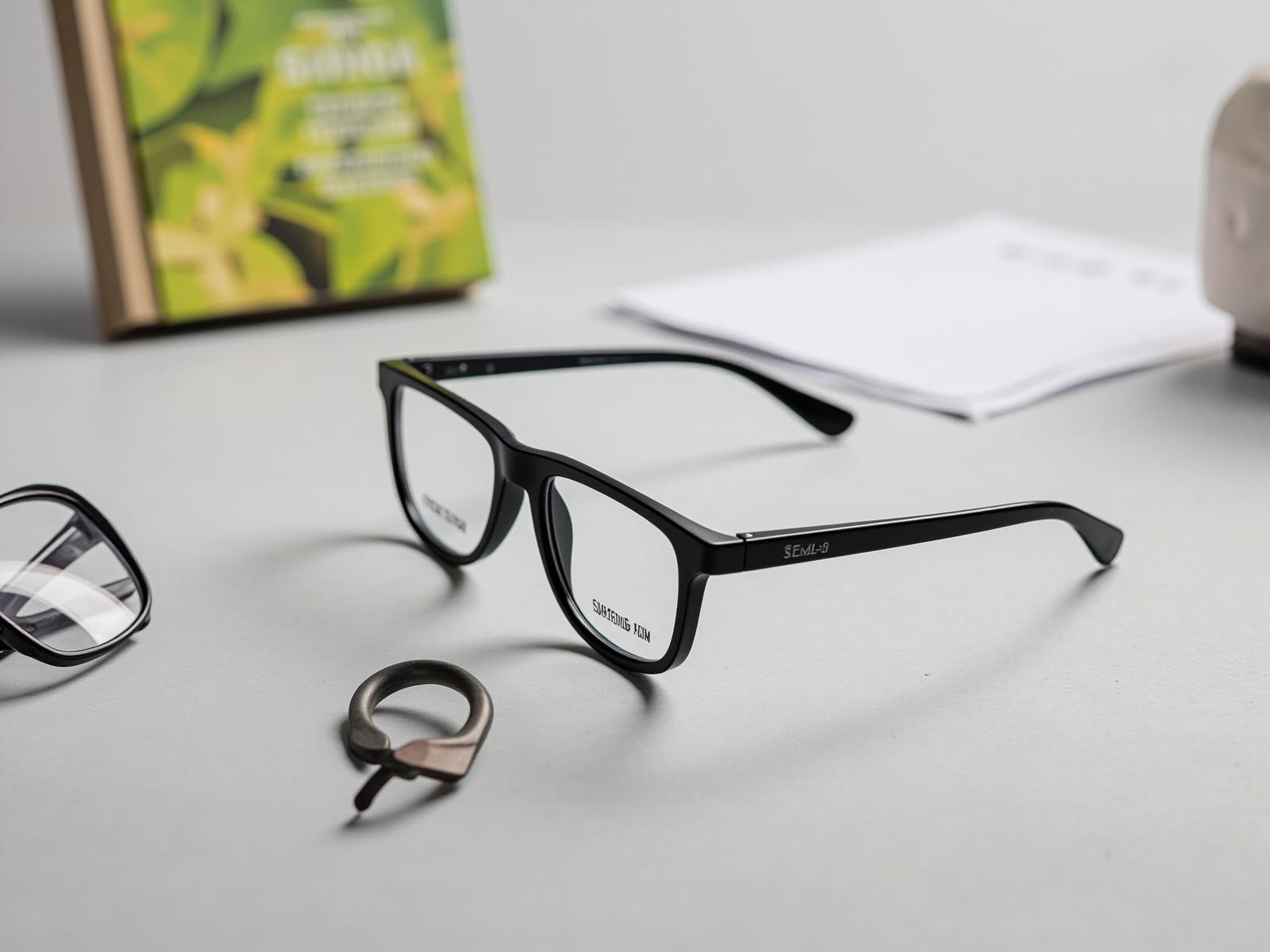
- Mass, measured on the actual production build and not on a prototype, with the baseline frame weighed on the same scale in the same session.
- Fit across several head shapes and sizes, with the fit recorded per size rather than summarised into an average.
- Load after sustained use, at the temple and at the bridge, with the person's existing spectacles in place where that is how the product will be worn.
- Temperature at the contact point after sustained use, against a limit the brand has written down in advance.
- Sound arrival at the ear, the person's own voice, and how far the sound carries to a person sitting alongside.
- Stability: whether the frame slides when the head tips down, when the person walks, or when they turn their head.
- The seam and the internal surfaces, checked by touch and by inspection in raking light.
- Fit over an existing prescription frame, since that is how a large part of a brand's customers already wear glasses.
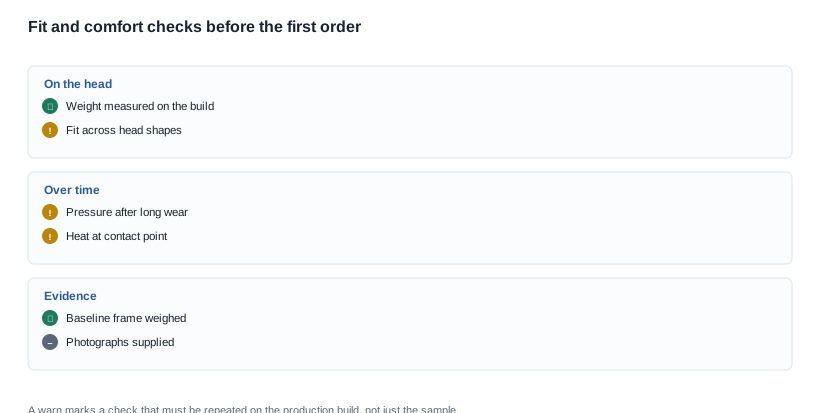
How to choose which of these checks become contractual acceptance criteria is a question about cost as much as about risk. A brand with a broad prescription base cannot put every check into a purchase order, because the testing burden sits with the supplier and is paid for in the quotation. The criteria to apply are these. Checks that can fail silently in the field and are invisible to the buyer belong in the purchase order as a supplier obligation. Checks that depend on the head in front of them stay with the brand as a fitting and sampling discipline. Checks that depend on what the market expects become claims discipline, which means the copy is written against the evidence rather than against the ambition. The red flags in this area are easy to name: a specification full of criteria nobody will ever measure, a sampling programme with no pass mark, and a marketing plan written before any of it was tested.
Two of those checks are worth expanding. On fit across head shapes, the point is not to find the average head but to find where the product breaks: the narrow bridge, the wide face, the high nose, the small ear. A product that fails only at the extremes is a normal product; a product that fails in the middle of the range has a defect, and the difference shows up in the returns rate long before it shows up in a review. On the seam, the reason for checking in raking light is that a parting line invisible under showroom lighting can be obvious in a photograph taken from the side, which makes the issue a marketing problem rather than a comfort one, and photography is where most of a brand's visual assets come from.
The commercial measurement of all this is the fit-related returns rate, and it should be tracked separately from defect returns for as long as the product is on sale. A fit return means the product was described in a way that did not match the head it was made for, and the causes are usually three: the frame was specified for an average head, the added mass was not communicated, or the customer expected the product to fit like the frame they already own. Each cause has a different fix and a different cost, and none of them can be managed while they are counted together. A buyer negotiating the next order should ask for that split, because it changes the remedy from a returns-credit conversation into a specification conversation, and the cost of the specification conversation is a great deal lower than the cost of the returns.
The commercial caution that follows from all of this
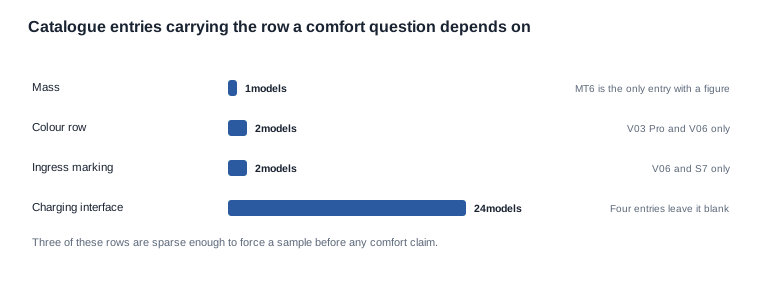
The published file is generous about what a device does and silent about how it sits on a face. Mass appears against a single entry, MT6 at 158 g, and nowhere else. The ingress marking appears on V06 and S7 alone, with the record noting the absence of a third-party report number behind it. No entry publishes a temple length, a bridge width or a face-form range, so a brand cannot plan a fit programme from the catalogue at all.
The record behind the range is equally uneven about the things that decide fit. Two entries, A05 and A06, are published with matching values and no explanation of what separates them; the model written as L2 Utral carries what may be a spelling slip, and the Pro Max tag next to it is never explained; MT5 sits on an out-of-position page reference and is filed against two different families; the page references for V06 and S7 are off in the same way; three descriptions — electrochromic, bone-conduction and augmented-reality — are filed with no SKU at all; and there is no photograph, no video and no test report behind any of the twenty-eight entries.
That last point is the one that matters most for this article. There is no product imagery to judge, no measurement data to compare and no test report to lean on, so fit cannot be assessed from the catalogue. It can only be assessed from a sample, on a head, over hours — which is the argument for treating sampling as a fit study with an acceptance criterion attached, rather than as a formality before an order.
Nothing in the current file should be repeated to a customer as a settled certification. In some places a certification framework is named while nothing identifies it; elsewhere the framework is present but no report number sits beside it; and for the children's range nothing is provided at all.
The caution is about what a brand promises. Our position is that a fit claim should be made as a fact about the product that can be checked on a sample, and never as a promise about the person wearing it. The failure mode in this category is a brand that has never measured a fit on a real head describing the product as comfortable, comfortable and lightweight — a set of words that will be repeated by every distributor and retailer downstream, and tested by every customer who owns a heavy frame and a narrow bridge. The total cost of a fit failure is not the unit cost of the returns; it is the returns, the review pages, the discounting of the units that come back, and the loss of the right to describe the product plainly in the next collection.
Two red flags are worth naming for a buyer weighing a supplier's position on fit. The first is a supplier who quotes the finished mass without quoting the baseline frame, because it makes the number look smaller and removes the comparison a brand needs to make a judgement. The second is a supplier who treats fit as a sample issue rather than a specification issue, meaning that whoever is in the room gets the frame fitted to them and the result is treated as proof. The trade-offs here are not free: every check that becomes contractual adds cost to the quotation, and every check that stays informal adds cost to the returns line. Which one of those two numbers a buyer should believe when a supplier quotes them differently is a decision the brand has to take before the order rather than after the returns. The total cost comparison is straightforward enough to make in advance, and when to make it is a matter of how long the product is expected to stay in the range.
Related reading
- The route a frame brand starts with — eyewear brand collaboration
- How a development is actually run — development process
- Where the audio line sits — Bluetooth audio glasses
- Seeing the product before ordering — sample requests
The most useful thing to bring to a fit conversation is a worn frame and its measurements. Put a frame on the table with its temple length, its bridge width and its mass on a scale, and the question of adding electronics becomes a question about numbers rather than about preferences, which is the only form in which a procurement decision can be closed.


