
Depth is the word buyers use when they ask how much of a smart glasses programme can actually be their own, and it is the word that produces the most expensive misunderstandings in this category. Two programmes can both be described as custom, and one can be a print run on a box while the other is a new product with its own engineering, its own compliance file and its own obsolescence date. The difference between them is not a matter of tone; it is a matter of tooling, documentation and who carries the risk when something goes wrong.
This page sets out the five levels a programme can sit at, separates the work that is really packaging from the work that is really product, names the two lines where the honest answer is that we cannot tell you, argues that the children's range needs its own conversation, and ends with the questions to ask in the order that answers them fastest. It is written for a buyer who needs to know which level a quotation is priced at before the quotation arrives.
Smart glasses customization depth: where a programme goes past packaging
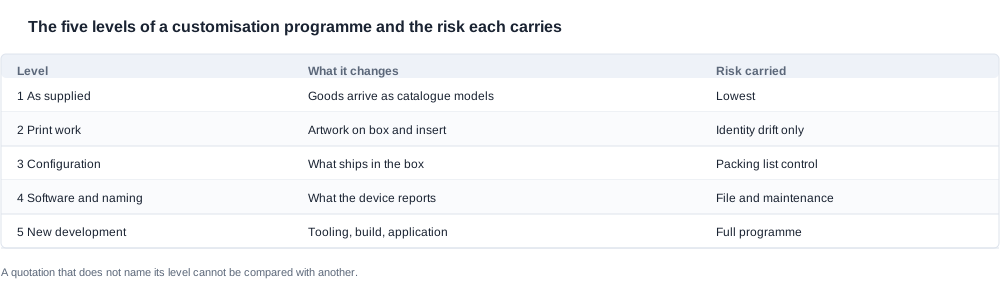
The five levels below are the ones that actually separate programmes in practice. They are worth naming precisely, because most of the confusion in this category comes from calling level two and level five by the same word.
| Level | What it changes | What it costs in risk |
|---|---|---|
| 1 As supplied | The goods arrive as catalogue models | Lowest; no new identity to defend |
| 2 Print work | Artwork on the box, insert and leaflet | Identity risk only, if the copy drifts |
| 3 Product configuration | What ships alongside the unit in the box | Low; a packing-list question |
| 4 Software and naming | What the device reports and what it runs | High; needs a file and a maintenance path |
| 5 New development | New tooling, a new build, a new app | Highest; a programme with its own schedule |
The reason this structure matters commercially is that each level carries a different liability. Level two can be wrong in a way a customer notices in a shop, and the remedy is a reprint. Level five can be wrong in a way nobody notices for two years, and the remedy is a new programme. A buyer who treats a level-two quotation as a level-five programme will find the artwork signed and the tooling ordered before the electronics decisions have been made, which is the single most common way a brand loses control of its own product.
The published record gives a rough depth indicator for each line, although it gives it as a count rather than as a description. The camera line's record carries seven customisation axes, the sports line five, the audio line five, and the children's line two. Read carefully, those counts say something important and limited: they say how many separate points of difference the record allows for that line. They do not say what each axis permits, and the catalogue does not publish that.
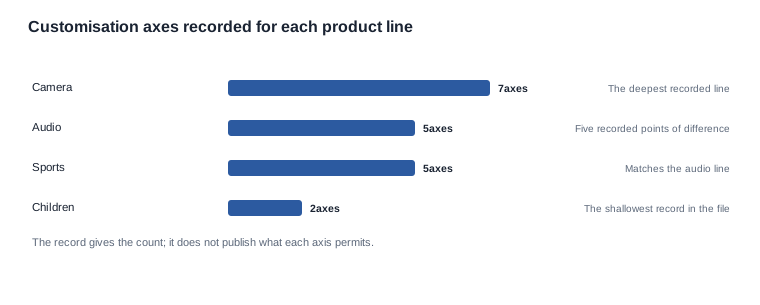
The shape of those counts is itself a planning signal. A line with seven axes offers room for a brand to make a product that is visibly its own without moving into new development. A line with two axes offers almost nothing, and a brand that wants differentiation from it has to create the difference somewhere else — in the box, in the lens, in the accessory set, or in the software, which is the most expensive of those options. The honest conclusion is not that one line is better than another. It is that a brand choosing a line should choose it for the optical and mechanical reasons it knows best, and then ask what difference it needs and where that difference can actually live.
That last point deserves emphasis, because the usual commercial instinct is to assume that more axes means more freedom. It means more freedom in the product, and possibly less in the compliance file, because every additional axis is another document that has to describe the shipped configuration. Two axes and a well-specified product can be easier to certify, to reorder and to explain to a distributor than seven axes and a loose one.
Reading those counts properly is a matter of asking the right follow-up. The count tells a buyer how many points of difference exist; the follow-up questions tell a buyer what they are worth. A brand that wants to know whether the deeper levels are reachable for its chosen line should ask what the record contains at each axis, which of them change the goods and which change only what accompanies them, whether any of them is restricted to particular models within the line, and whether the answer differs for a first programme and for a reorder. These are ordinary questions with ordinary answers, and a supplier who cannot answer them has a catalogue rather than a capability.
The second follow-up is about commercial shape rather than scope: how many of the axes are exercised by the first order, whether the cost of an axis is a programme cost or a per-unit cost, and which of them have to be settled before the artwork is signed. A brand that asks those questions before the quotation rather than after it avoids the common situation where the scope of a programme gets defined by whatever the supplier has already built.

The parts that are packaging rather than product itself
A large share of what a buyer is quoted for in this category is work at the box level, and it is worth separating that work from the product work, because the two carry very different risk.
Print work covers the box, the insert card, the leaflet, the barcode label, the serial label and the leaflet that tells the customer what the buttons do. It is quick, it is inexpensive relative to engineering, and it changes nothing about the object in the customer's hand. It is also the level at which identity errors happen, because the printed material is what a retailer, an online listing and a distributor's catalogue will describe the product from, and a printed description that does not match the goods is a returns problem rather than a manufacturing problem.
Product configuration covers what is physically in the box with the unit: which accessories are included, which colourway is used, what the lens is, whether a case is present. This is a packing-list decision rather than a development decision, and it is reversible between orders, which makes it useful but also easy to get wrong at the moment of the order. If the configuration is not written into the purchase order, the next order can differ from the last without anybody deciding that it should.
The test for whether a programme has really reached the product is simple and worth applying to any quotation: does the goods have its own model identity, or is it a catalogue model with different print? If it has its own identity, there is a specification to maintain, a conformity file to keep in step with it, a barcode to manage, and a reorder that depends on an internal record rather than on memory. If it does not, the programme is cheap to run and correspondingly limited in what it can promise.
Two disciplines make the difference between a programme at level two and one at level four manageable. The first is to write the identity of the goods into the specification, so that every document — the packing list, the label, the online listing, the distributor's data — reads from the same source. The second is to decide which level a change request is allowed to reach. A request that arrives from a distributor wanting a different colour of box is level two. A request that arrives wanting a different colour of unit is level three or four, and it should be handled as a programme question rather than as a favour.
The identity risk at this level is worth describing precisely, because it is invisible in the factory and obvious in the shop. The goods carry a model identity that the record defines; the printed material carries a description written by the brand. When the two are produced from different sources and updated at different moments, the printed material quietly becomes a second and unofficial specification. That is how a shelf ticket ends up promising a feature the goods do not have, and it is why the printed files should be treated as controlled documents with their own owner, version and approval step, exactly as the specification is. The same discipline applies to the data a retailer receives, since much of what describes the product in the channel gets typed in by somebody rather than taken from a file.
The commercial caution here is about what gets quoted. A quotation that does not name the level of the programme it is pricing is a quotation a buyer cannot compare with another, because the two may differ by an entire tier of risk. The questions to ask are in the last section, and the first of them is about the level.

Two lines where the honest answer is that we cannot tell you
The catalogue contains three descriptions without a formal SKU, and two of them fall into a category that most product literature avoids entirely: lines where the answer to a buyer's question is that the capability is not disclosed.
The bone-conduction description is the first. Its customisation capability is not disclosed at all, and it carries a published output figure of 35 dB, which is the highest compliance exposure in the entire range, because a published output figure is itself enough to push a product into a different regulatory class. There is no customisation story to tell here without inventing one, and there is a second reason for the silence: the 35 dB figure raises a question about how such a product is regulated at all, and that question has to be answered before a buyer can be told what can be changed.
The augmented-reality description is the second. Its position is unknown — the file does not record a customisation capability for it at all, and there is no SKU, no photograph, no video and no test report attached to the entry. A buyer asking what can be customised on this line is asking a question the record cannot answer, and the correct response is to say so plainly rather than to offer a plausible answer. That is not a failure of the enquiry. A catalogue that appears to answer every question is harder to buy from than one that marks its gaps.
The electrochromic description sits between the two. Its line records three axes, so there is more on the record than for the other two, but the record for it holds no photochromic data of any kind — nothing on switching range, response speed or transmission — so the line can be presented as a direction of travel but not as a light-responsive product backed by evidence. Commercially it is not something to put on a purchase order.
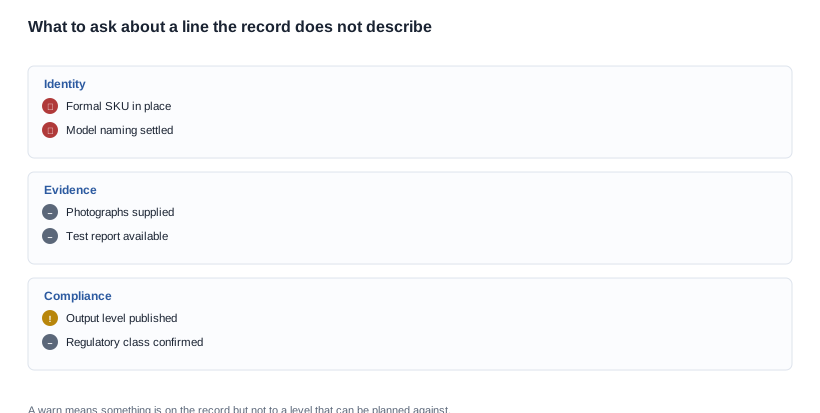
The practical consequence for a buyer is a rule rather than a disappointment. Where the record describes a line, the programme can be planned and the questions can be specific. Where the record does not, the honest transaction is a watch, a question to the supplier, and a decision not to include the line in a range plan or a purchase order until there is something to plan. Several of the file's own records are open in related ways, and a customisation programme inherits every one of them: A05 and A06 are published with an identical set of values and nothing that explains the gap; the L2 Utral label looks as though the final word was typed wrongly, and the Pro Max tag beside it is never explained; MT5 appears against a page reference that does not fit and under a family assignment the record calls doubtful; the page references for V06 and S7 are wrong in the same manner; the electrochromic, bone-conduction and augmented-reality descriptions carry no SKU at all; and no supplied photograph, no video and no test report exists for any of the twenty-eight entries.

Why the children's line needs a separate conversation
The children's line records two customisation axes, the fewest of any line in the catalogue, and it is the one where a brand is most tempted to assume the answer is "everything is fine because there is so little to customise".
That assumption does not hold. Three things make this line different, and the first two are compliance questions rather than design ones.
The certification status is not provided at all. Not claimed-with-numbers-pending, not claimed-without-a-report-number: not provided. For a children's product, that is not a paperwork gap but a gate. A brand that puts a children's product on sale in a market that expects conformity documentation will be asked for documents that do not exist in the current file.
The safety and health wording carries the highest exposure of any line in the range. Claims aimed at children, at sight, at attention or at screen time attract scrutiny that a claim about a camera or a pair of audio glasses does not. No sight-related or fatigue-related wording can be justified on this line — claims about tired eyes, protection or relief have no support anywhere in the current file — and on a children's product the temptation to make one is the strongest and the penalty for it the heaviest.
The app and firmware capability is marked as still to be verified. In other words, the deepest levels of customisation are precisely the ones whose status on this line is unknown, which means the one place a brand would most want to create differentiation is the one place the record is least clear.
There is also a design dimension. A children's range has to work on smaller heads, narrower temples and a lighter frame, and the tolerance for mass that an adult accepts is not available to a child. A programme that adds electronics to a children's frame is therefore working with less room in every direction at once, and the fit work described elsewhere in this section applies with a tighter margin rather than a looser one. A brand should treat the children's line as a separate programme with its own timing, its own sample plan and its own compliance conversation, and should not fold it into an adult programme as a colourway.
The questions to ask, in the order that answers them fastest
The order matters, because the first four questions are answerable in a single exchange and the last three need a supplier to do some work. A buyer who asks them in this sequence closes the programme quickly, and a buyer who asks them out of sequence ends up negotiating the wrong thing.
- Which level is this quotation priced at? Between the goods arriving as catalogue models and a programme with its own tooling, where does this one sit, and which parts of the level are included in the price?
- Which product line is it based on, and how many customisation axes does that line's record carry? The count is published, and it bounds the conversation.
- What changes on the goods themselves, and what changes only in print? If the answer is that only print changes, the programme is cheaper, faster and easier to reorder than the quotation's scale might suggest.
- Does the programme create its own product identity, and if so, who holds the specification? A named owner is the difference between a controlled programme and an undocumented one.
- What does the conformity file have to cover, and which parts of the programme change it? The honest answer may be that nothing changes it, and that answer is worth having in writing.
- What happens to a reorder after a change? The questions to ask here are about the minimum quantity, the configuration confirmation and the lead time, and they should be settled before the first order rather than after it.
- What is the line you cannot answer on? Ask for the areas where the capability is undisclosed, because a supplier who names the gaps is more useful than one who does not.
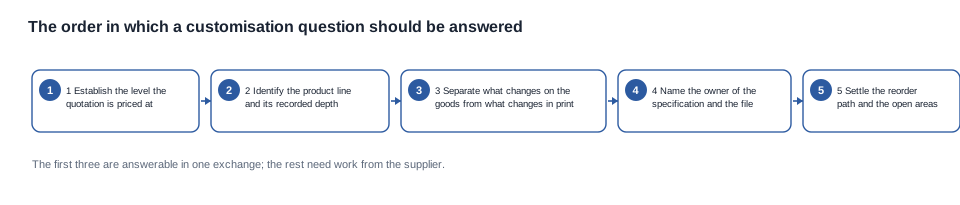
Two of those answers deserve a follow-up. On level, the answer that matters is not the level the programme is described as but the level the price is calculated at, and the two sometimes differ by a whole tier. On the axis count, the useful follow-up is whether the count applies to the specific model in the first order or to the line in general, because a line-level record can conceal a model-level restriction. Both follow-ups are cheap to ask and expensive to discover afterwards, which is the general rule of this subject: the questions in this area are quick to answer and slow to unwind.
The evidence worth keeping is correspondingly short: the level the programme sits at, the axis count for the line, the specification of the shipped configuration, the conformity position with its status in the file's own three-valued language — a certification framework with nothing identifying it, a certification framework with no report number attached, or nothing provided at all — and the answers to the questions about reorder. Keep them with the purchase order.
Depth should be bought deliberately rather than assumed, and the level a programme sits at should be visible in the quotation before anyone signs. A brand that knows it is buying level two can plan the copy, the channel and the returns; a brand that believes it is buying level five and receives level two will find out at the point where the goods reach the customer. Total cost is the sum of the programme, the documentation, the reorders and the corrections, and only the first of those appears in the quotation. Which one to choose is a question about the brand's own strategy, and the questions above are the way to get the information to make it.
Our published customisation list is the depth we can evidence. Beyond it we will tell a brand what would have to be created, what it costs as a one-off, and how long it adds, rather than imply that every change is equally available.
Related reading
- Where a customisation programme starts — brand engagement route
- The documented customisation points — OEM customisation detail
- How a development is sequenced — OEM process and stages
- Evidence before a bulk order — sample programme
The most useful first message to send us is the level you have in mind and the product line you are starting from. With those two answers we can tell you which parts of your programme are within the recorded depth of that line, which parts need a new development, and where the record simply does not yet describe what you are asking for.


