

A brand that has never made an electronic product does not need a supplier who explains electronics. It needs a supplier who understands that the electronics are arriving in the middle of a business the brand already runs well. The frame is the product, the fit is the promise, the lens is the transaction, and the electronics have to earn their place inside all three without disturbing any of them.
This page describes how the work actually starts: the three inputs a first conversation needs, the four things that are specific to a frame maker rather than generic to this category, the questions we ask before anything is quoted, the areas where the honest answer is that we cannot tell you, and the evidence a brand should ask to keep at the end of it. It is written for the smart glasses for eyewear brands how we help conversation, and for the person who has to decide whether to place a first order.
Smart glasses for eyewear brands: where the work actually starts
It does not start with a catalogue, a price list or a sample request. It starts with three inputs, and a conversation that cannot proceed without them.
The frame. Which existing frame is going to carry the electronics, what it is made of, how it is put together, and whether it already exists in production. A frame that is in production tells us what tooling exists and what the factory already knows about it. A frame that exists only as a design tells us that everything is still open, which is exciting and expensive in different ways.
The customer. Who is going to wear this, and what does that person already expect from a pair of frames. This sounds obvious and is the input most often skipped. A customer who buys the same frame every two years has a relationship with the fit, and a product that changes the fit has to earn its place in that relationship. A customer who wears a prescription all day has different constraints from one who does not.
The claim. What the electronics are for, in the brand's own words, before anyone has decided how to phrase it. A camera is a recording device, a pair of audio frames is a private listening device, a game camera is an accessory to something else. These sound like marketing categories, but they are engineering categories, and the difference between them is the difference between a product that can be built and a product that cannot.
Once those three are on the table, the first deliverable is a brief, not a quotation. The brief is a short document that records the frame, the customer, the claim, the things that must not change, the intended markets, the timing, and the open questions. It is deliberately unglamorous, and it is the document that saves an expensive argument later. A quotation issued without a brief is a price for an assumption, and the assumption will surface at the sample stage, when it is most expensive to change.
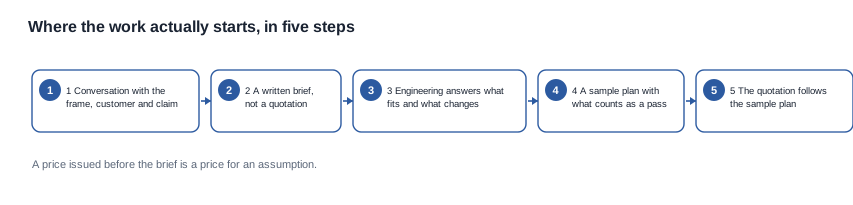
The brief earns its place by being short and by being versioned. Most brands write long documents that nobody re-reads; a brief works because it is one page, because it names a person for each open question, and because it carries a version number. The version matters more than it sounds. When the third revision arrives after a sample has been built, the question is not what the brief says but which version the sample was built against, and a versioned brief answers that in seconds while an unversioned one starts an argument.
The brief also does something no quotation can do: it records what was decided without anyone deciding it. In an electronics programme there are a dozen small questions that get answered in conversations and never written down — whether the case is in the box, whether the control is a button, whether the lens can be tinted. Each one is defensible at the time it is made and indefensible a year later. Collecting them in one document is the cheapest form of evidence a brand will ever hold.
The sequence from there is conventional, but the order carries the logic. Conversation produces the brief. The brief goes to the engineers, who answer the questions it raises — what fits, what does not, what changes the frame. Those answers produce a sample plan, which fixes what is being measured and what counts as a pass. The sample plan produces the quotation, which is finally a price for a defined piece of work. The commonest mistake in this category is to reverse the last two steps and send the quotation first, because a price is what the brand asked for and a sample plan is not.
There is also a commercial reason for the sequence. Each step narrows the uncertainty, and each step that is skipped leaves uncertainty in the programme where it is most expensive. By the time a quotation is issued, the questions it does not answer will be answered by samples, by test reports, by customs queries or by returns from the channel, and every one of those routes costs more than an hour of conversation at the start.
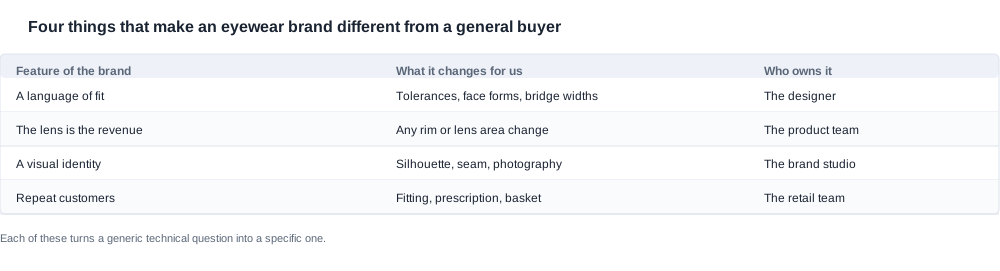
Four things that are specific to a frame maker
Generic supplier guidance does not help much here, because the interesting constraints come from the brand's own business rather than from the electronics. Four of them matter more than the rest.
A frame maker already owns a language of fit. Frames are fitted, not worn: there are tolerances, face forms, bridge widths, temple lengths and dispensing conventions, and the people in the brand think in those terms every day. A supplier who talks about the added mass without talking about the nose bridge will not be understood by the designer, and the designer's disagreement will surface later as a vague sense that something is not right. Bringing the fit vocabulary into the first conversation is worth more than any amount of electronics explanation.
The lens is the transaction. In most eyewear businesses the frame carries the customer and the lens carries the revenue, and the two are bought and sold together. That single fact changes how every electronics decision is judged. Anything that reduces the lens area, increases the edge thickness or alters the rim geometry is not a styling detail; it is a commercial change to the centre of the business. It also means the optical questions have to be answered by the brand, because the brand is the only party that knows the distribution of its prescriptions.
There is a visual identity, and there are photographs. A brand's frames are recognisable, and its images are a marketing asset that takes money to produce and time to replace. Electronics that thicken a temple, add a seam or change the profile of a hinge are, in practice, a photography problem as much as a design problem. The red line — what must not change — usually already exists somewhere in the brand's own material, even if nobody has written it down.
The customers are repeat buyers with prescriptions. Most people who buy a frame come back. The purchase is a basket decision rather than a device decision, and it happens in a store, against a prescription, in a fitting that the brand's staff or its optician controls. That is why a product that arrives as a black box with a screen in the wrong place can fail commercially while passing every technical test, and why the fitting plan is part of the programme rather than a marketing detail.
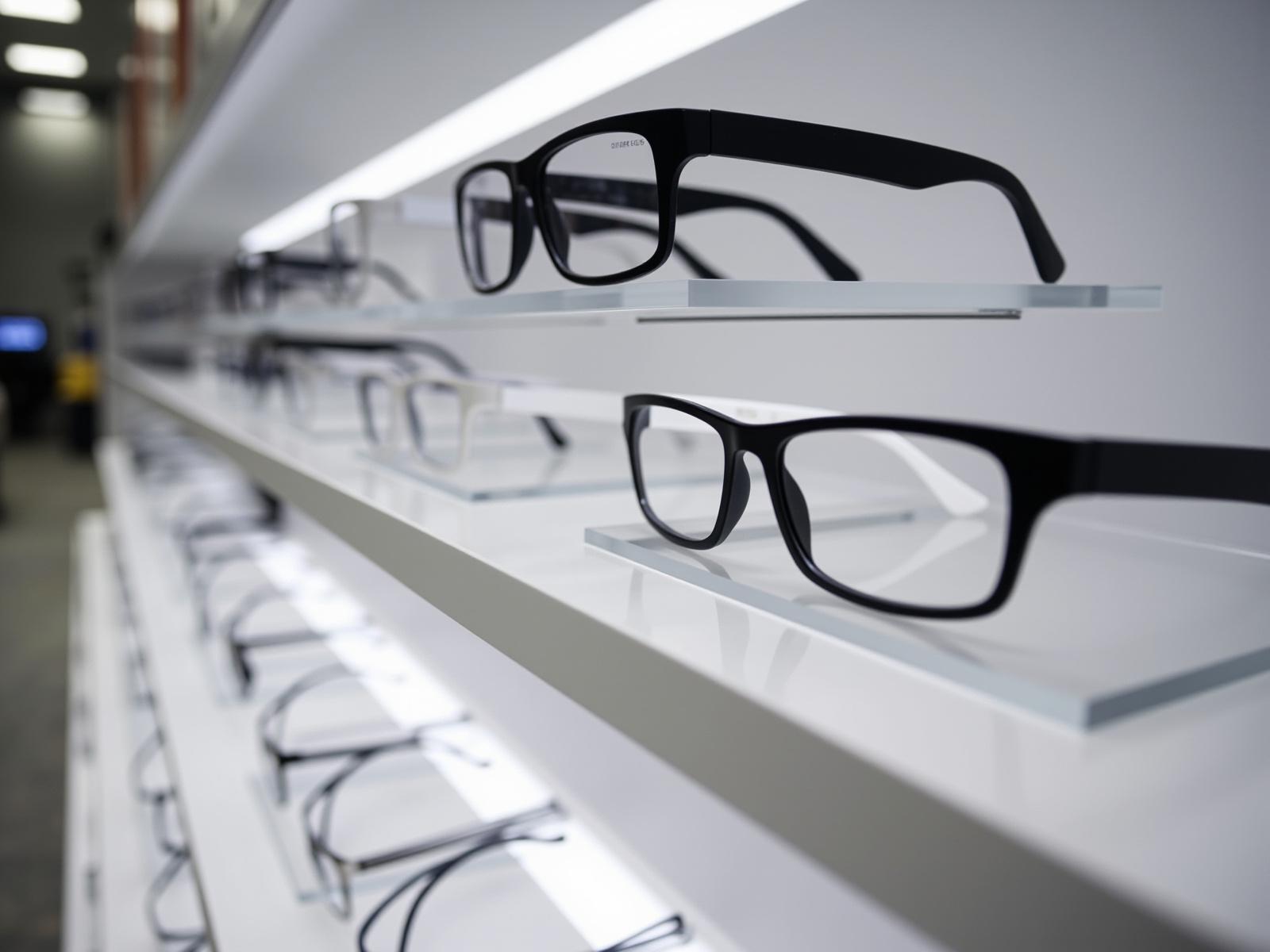
A fifth item sits behind these four and is worth naming because it changes the shape of a first conversation. An eyewear brand's new product is usually constrained by a date — a season, a launch, a trade show — rather than by a technology. Working backwards from a date is fine, provided the date is treated as a constraint on the sequence rather than as a substitute for a specification. The stages that cannot be compressed are the ones that depend on other parties: the frame source, the testing, the documentation, and the shipping of physical samples. A programme that plans those in parallel usually gets to its date; one that plans them in sequence usually does not.
These four characteristics also change what a supplier is asked to produce first. For a brand with no electronics history, the first deliverable is usually a working sample with a written measurement sheet, because the brand needs to believe that the thing exists and works before it can decide anything about the programme around it. For a brand that has done this before, the first deliverable is more often a compliance and documentation plan, because the physical part is understood and the risk has moved to the file. Which of those two a supplier leads with tells the brand quite a lot about how the supplier works, and it is worth noticing the difference.

The questions asked before anything is quoted
These are the questions we ask in a first conversation, in the order that answers them fastest. None of them requires the brand to have decided anything about the electronics, which is why they can all be asked in the same meeting.
- Which frame, and is it already in production? The model, the material, the construction, and whether tooling exists today.
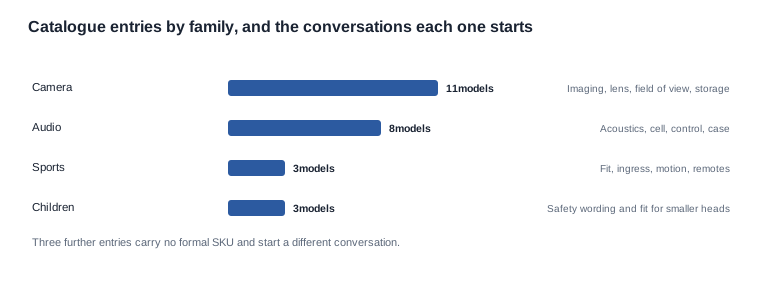
- Which product line is the starting point? Camera, audio, sports or children's — and the reasoning behind the choice, because the reasoning usually reveals the real objective.
- What is the product change, in the brand's own words? Not a feature list. What a customer would notice differently.
- Which markets is this for, and is it one build or several? The answer changes both the file and the packaging.
- What will be claimed about the product, and who signs for it? A name, not a department.
- What must not change? The red line, in the brand's words.
- What is the date, and what is fixed by it? A launch, a season, a show, a contract.
- What is expected to happen on reorder, and who owns the specification? The question that determines whether this is a product or a project.
Two of these carry more weight than their position in the list suggests. The sixth is the one that saves the design: written down, it is a constraint the engineers can work inside; left verbal, it is an intention that gets renegotiated every time somebody asks for an improvement. The eighth is the one that saves the business: a programme with no named specification owner becomes a series of exceptions, and exceptions are what a distributor's reorder becomes.
A ninth question is often asked late and should be asked early. What does the brand already have that this programme can use — a frame in production, an existing lens supplier, a print supplier, a distributor who already sells the frames, a customer list with prescription data. Most first programmes are slower than they need to be because they rebuild something the brand already has.
What happens after the questions is worth stating, because it is where the commercial exposure is created. Some of these questions can be answered from a record, in which case the answer costs nothing and takes minutes. Others need engineering work — a feasibility study on whether the cell fits the temple, a measurement of what the added mass does to the fit, an assessment of what the acoustic architecture does to the frame. Those questions cost time and money before any order exists, and a brand that has not separated them will negotiate one price for work it has not yet defined. The sequence that works is to answer the cheap questions first, to fund the engineering questions explicitly, and to quote only once the second set has produced a scope that can be priced.

What we cannot tell you, and why that is the useful part
There are areas where the record does not support a confident answer, and the useful thing about them is that they are identifiable, bounded, and specific. We would rather set them out than have them surface in a compliance file.
Two lines where the capability is not disclosed. The bone-conduction description has no published customisation capability, and it carries an output figure of 35 dB that carries the highest compliance exposure in the range. The augmented-reality description has no recorded position at all. For both, the answer to a customisation question is that the record does not describe it, and the reason is not a refusal but an absence.
A certification position that comes in three forms. A certification framework may be named with nothing identifying it; it may be named with no test report number recorded beside it; or it may not be published at all, which is the case for the children's line. These are different things, and a brand that treats them as one thing will forward a document it cannot stand behind.
A certification page that contains patents. The export certification page in the file is an image page carrying ten patent certificates, eight design patents and two utility models. It contains no conformity mark. So the CE, FCC and RoHS statements that appear against products are claims for the brand to evidence, not documents the brand can forward to a customs broker.
No product evidence at all. None of the twenty-eight entries comes with product photography, video or a test report. There is also no third-party acoustic measurement behind the audio claims, the ingress marking that appears on two entries carries no report number, and the variable-tint description contains no photochromic data of any kind. A comparative claim against a competitor's product needs a hands-on comparison before it can be made publicly.
Parts of the model record are open as well, and a programme inherits every one of them. The pair A05 and A06 is published with the same values and no statement of what differs. The label L2 Utral appears to end in a word that does not belong, and the Pro Max marking next to it is unexplained. MT5 is filed under a page reference that does not match and a family that the record itself leaves in doubt. V06 and S7 carry the same kind of page-reference error. Three of the descriptions — the electrochromic one, the bone-conduction one and the augmented-reality one — have no SKU attached. And none of the twenty-eight entries comes with product photography, video or a test report.
Why this is the useful part: a gap that is named tells a buyer what to commission, what to ask, and what not to claim. A gap that is hidden becomes a surprise, and surprises in this category arrive at the worst possible moment — at a customs query, at a claim challenge, or in the middle of a production run. Brands who compare suppliers on the number of questions each of them can answer are comparing them on the only thing that matters at the point of purchase.
There is one more thing we will not do, and it is worth saying plainly. We will not quote a programme that we cannot describe accurately, and that includes quoting against a specification we have not seen. A supplier who will do so is not offering a better price; they are offering a different product that will be discovered later.
The evidence a brand should ask to keep
At the end of a programme the brand should be holding five things, and each of them should be in the brand's own possession rather than in a supplier's inbox.
- The brief and its version. The document that records the frame, the customer, the claim, the red line and the timing, with a version and a date.
- The measurements. The fit baseline and the fit after, the mass of the build against the baseline, the thermal result against the agreed limit, and the acoustic results with their method.
- The conformity file with its status. The documents, the version that travels with the goods, and the status of each document written in the file's own three-valued language rather than in a summary.
- The commercial documents. The quotation used, the packing list showing which build was actually sent, and the order terms that describe how a reorder is handled.
- The samples, kept and dated. Physical evidence with a date on it is worth a great deal in a dispute with a distributor, and it is worth nothing in a drawer without the date.
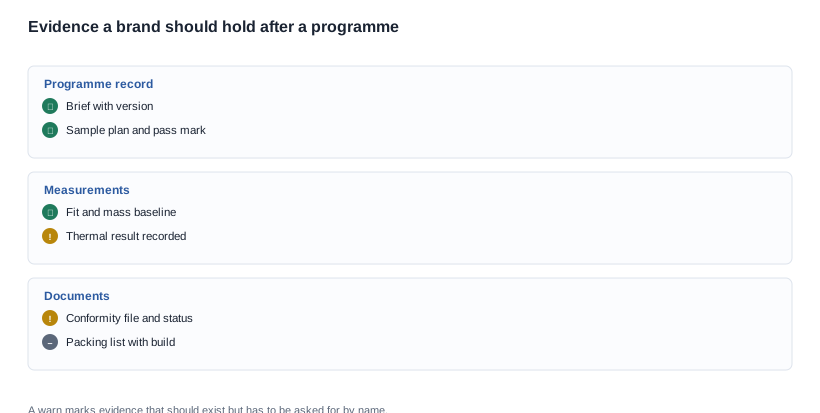
The rule behind the five is simple: the evidence has to live where the brand controls it, in a form that does not depend on one supplier remaining in place. A brand that keeps this record has a defensible position in a returns conversation, a distributor negotiation, a re-order decision and a market entry. A brand that does not keep it has to re-derive everything, usually under time pressure and usually more expensively than the first time.
There is a practical way to make the record survive its own usefulness. Put the five items in one place, with a naming convention that carries the model identity and the date, and ask whoever holds them to confirm them once a year. The annual check is not bureaucracy: models get renamed, suppliers get replaced, and files get reorganised, and each of those events silently breaks the chain between a claim and its evidence. A brand that checks annually finds those breaks while they are cheap to fix.
The value of a supplier in this category is not measured by how much they can promise but by how precisely they can describe what they have not yet proved. Questions to ask before you order, then, are not only about the product. They are about the documents: which exist, which are claimed, which are absent, and who owns the ones that are still being written.
Related reading
- How an eyewear brand programme opens — how a brand works with us
- The stages of a new product build — OEM and ODM development
- What a conformity file contains — the conformity document list
- How sampling runs — sampling and what it produces
Bring one frame, one description of the customer and one sentence about what the electronics are for, and the rest follows from those three: the feasibility work, the specification, the file, the sample plan and the quotation. A supplier who needs more than that to begin is asking for something a brief should be answering.


