

A lens is the last part of a pair of glasses to be decided and the first part of the conversation with a lens supplier, and for an eyewear brand bringing smart glasses into its range it is the decision with the longest tail. The frame can be drawn in a week. The lens question decides what the rim has to look like, what the product can claim, how heavy it will be, whether it works outdoors, whether it works with a prescription, and whether the entity that sells it is the same one that services it.
This page sets out the four routes a lens decision can take, the questions that decide between them, what an eyewear brand needs to know that a distributor will never work out on its own, the questions worth putting to a lens supplier, and where the published record leaves the decision genuinely open. It is written for the smart glasses for eyewear brands lens options question, which is a buying question before it is a technical one.
Smart glasses lens options: the four routes and what each one is for
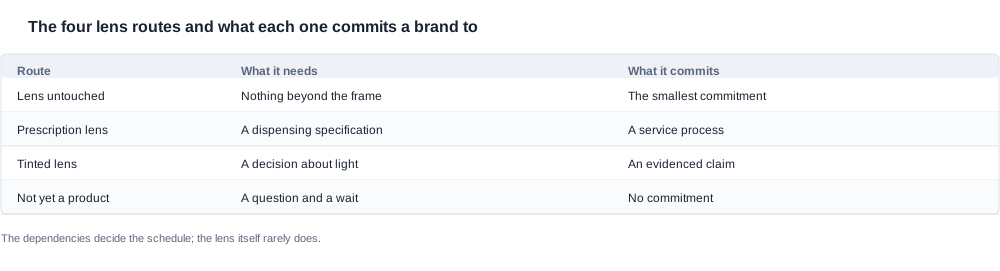
There are four routes, and they are easier to tell apart by what they require of the brand than by what they look like.
Route one: the lens is not part of the product decision. For a product whose electronics do not involve light — an audio frame, most obviously — the lens can remain whatever the frame normally takes. The brand's existing lens supplier continues to do what it does, the frame's rim geometry does not have to move, and the programme reduces to an electronics question. This route is the cheapest and the least differentiated, and it is the correct route for a first audio programme where the priority is the sound and the fit rather than the optics.
Route two: the frame carries the prescription. The frame becomes a prescription frame, which means the rim has to be designed to a lens specification, the optical centre has to be set, and the product enters the brand's existing dispensing relationship. The commitment is bigger than it sounds, because a prescription frame carries obligations that a fashion frame does not: tolerances around centration, the ability to remake the lens if the prescription is wrong, and a service process that the brand either owns or has to buy.
Route three: the lens carries a tint. A darkened or tinted lens is a deliberate product decision with two audiences. It is a commercial decision for the brand, because a tinted lens changes what the product is and how it is displayed. It is also a technical decision wherever the product has a camera, because a tinted lens reduces the light reaching the sensor and changes how the imaging behaves in bright conditions. Neither of those is a detail to be settled after the frame is drawn.
Route four: the lens is an element of a product category that does not yet exist in the range. The catalogue holds an entry for electrochromic glasses and an entry for augmented-reality glasses, neither of which has a formal SKU. For a brand whose interest is in light-responsive products or in a display product, this route exists as a direction rather than as a line that can be ordered. It is worth a watch and a question; it is not worth a purchase order.
| Route | What it needs from the brand | What it commits the brand to |
|---|---|---|
| Lens untouched | Nothing beyond the normal frame | The smallest commitment of the four |
| Prescription lens | A dispensing specification | A service process for the customer |
| Tinted lens | A decision about light and display | A claim that has to be evidenced |
| Not yet a product | A question and a wait | No commitment, and no delivery |
The four are not exclusive. A prescription product can also be tinted. The useful thing about separating them is that each carries a different set of dependencies, and the dependencies are what decide the schedule rather than the lens itself. A prescription route depends on the dispensing relationship. A tint route depends on the optical and display decisions and, where a camera is involved, on how the imaging behaves under the tint. A route that does not yet exist depends on nothing at all except patience.
It is also worth being clear about which route each product line naturally sits in, because most of the confusion comes from mixing them up. A product with audio and no imaging has no optical dependency at all, and the lens conversation for it is a service conversation rather than an engineering one. A product with a camera has an optical dependency whether or not anybody mentions lenses, because the light reaching the sensor is a function of what is fitted in front of it. A product for outdoor use has a tint decision regardless of whether it has a camera, because the display, the housing and the surface all behave differently in strong light. Only the routes that replace a customer's existing frame — prescription in particular — pull the brand's dispensing business into the programme, and that is the largest commitment of the four by a wide margin.
The commercial consequence of choosing early is straightforward. A brand that fixes its lens route in the brief pays for it once and re-orders cheaply. A brand that leaves the route open until the frame is drawn pays twice: once for the frame that has to be redrawn around the lens, and once for the tooling that has to be cut again. Since the tooling is the least reversible cost in the programme, the lens route deserves a place in the brief even if the rest of the electronics specification is still open.
The questions that decide a lens route
The route falls out of a short chain of questions, and asking them in order avoids the expensive mistake of choosing the route by accident.
- Does the product have to be worn over an existing prescription, or does it carry the prescription itself? A product worn over existing glasses is a different object from a product that replaces them, and the frame's rim, temple and lens plane all follow from the answer.
- Is there a camera in the product? If there is, the lens becomes an optical component rather than a cosmetic one, and anything that reduces light has to be assessed against the imaging rather than against the appearance.
- What prescription range must the frame cover? The answer sets the lens area, the edge thickness and therefore the mass of the finished product, and it is the question that connects the lens route to the fit work.
- Is the rim geometry fixed by an existing frame, or can it change? If the frame is in production, the lens route is constrained by the rim; if the frame is a design, the lens route can shape the rim.
- What does the lens have to do for the product to work, rather than for the product to look right? A tint that reduces light has to survive the camera's behaviour, and a lens that changes colour over time has to change it at a rate the product can tolerate.
- Who signs for the lens, and whose name goes on the paperwork? A lens has its own conformity position, and it is usually not the same document as the product's.
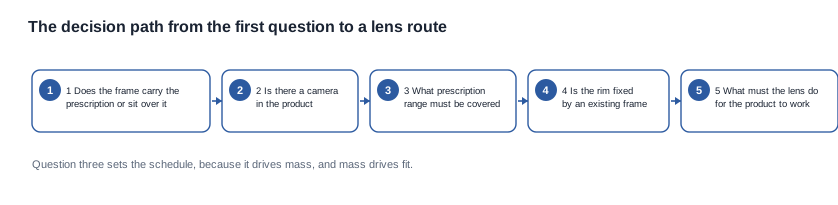
The third question is the one that quietly sets the schedule. Prescription range drives edge thickness, edge thickness drives mass, mass drives fit, and fit drives whether the electronics can stay where they are. A brand that answers questions one, two and four and leaves the third until after the sample stage will find that the frame has to be redrawn around a lens it did not plan for.
There is a fourth consequence of the chain that is easy to miss because it is not optical. The lens route determines the product's service model. A frame worn over existing glasses needs no lens service at all, which keeps the product inside the brand's existing returns process. A frame that carries the prescription needs a lens to be replaced without replacing the frame, which is a service capability the product may not have. A tinted lens that fades, scratches or is lost is a replacement rather than a return, and the channel has to be told which it is. Deciding the route therefore also decides what the after-sales cost of the product looks like, which is a number a buyer should see before the first order rather than after the first thousand units have shipped.

What an eyewear brand needs to know that a distributor does not
A distributor buys a frame with a lens in it and sells the pair. An eyewear brand is closer to the patient: it knows the prescription history of its customers, it knows which half of them need a strong lens, it knows how many of its customers already own the frame they want. That knowledge is commercially decisive and it is the reason the lens decision cannot be delegated to a channel partner.
Four things follow from it.
The prescription distribution is a design input. A brand whose customers need a strong correction has a different lens area requirement from a brand whose customers do not, and the lens route follows from that distribution rather than from a preference. A brand that has never collected it should start with its own sales data, because the numbers are usually already in the prescription system.
The lens is where the transaction value sits. In most eyewear businesses the frame brings the customer and the lens brings the revenue. Any change that affects the lens area, the rim or the edge thickness is therefore a change to the commercial centre of the product, not a styling detail — which is why it belongs in the brief from the first meeting rather than in a later revision.
The remake question is a service question. If the frame carries the prescription, the customer may need a new lens in the same frame, and that requires a rim that can be opened, a lens that can be replaced and a service route that somebody owns. A frame whose electronics make it impractical to open has changed the service model of a product that was previously trivially serviceable.
The lens brings its own documentation. A lens has a conformity position, and in many markets it is the lens maker's name that appears on the product documentation rather than the frame maker's. A brand that has never handled a lens conformity document will meet it at the worst possible moment if it is not expected, and the questions to ask a lens supplier are set out below.
None of this is visible in the published record, and a distributor is not going to work it out. The distributor's job is to know what is in the box, what it is worth, what the warranty position is and whether the reorder works. The brand's job is everything above.
There is a fifth thing, and it is the one most likely to be missing from a first meeting. A brand that has not decided what happens to a customer's existing glasses has not really decided the product. The customer who buys the product is very often wearing the brand's frames already, and the purchase may replace them, sit on top of them, or do neither. Each of those is a different product, a different fit, a different expectation and a different sales story, and the answer determines whether the electronics sit inside a frame that replaces an old pair or a frame that has to accommodate one. It also determines the total cost of the programme, because a product worn over existing glasses is cheaper to fit, cheaper to service and easier to explain on a shelf than one that has to carry a prescription.

The questions to put to a lens supplier
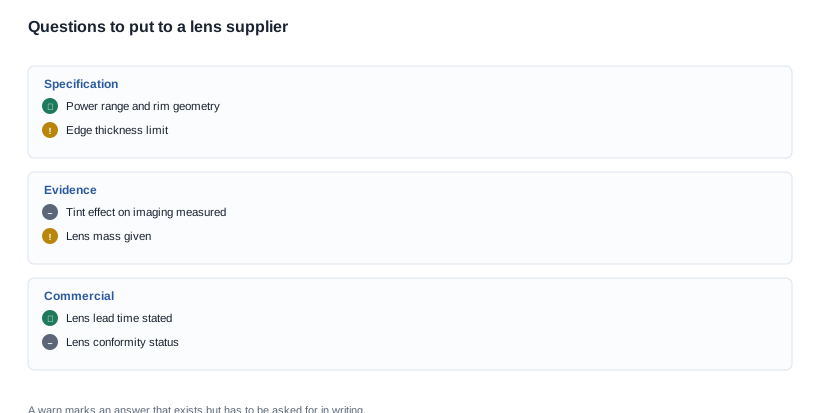
- What lens powers will the frame be built for, and what rim geometry does each power range require?
- What is the minimum edge thickness, and at what prescription does the frame stop being practical?
- What is the mass of the finished lens at the centre and at the edge, so the total product mass can be planned?
- What coatings are available, what do they do to light transmission, and what do they do to reflections in photography?
- Where a camera is involved, what is the effect of the chosen tint on the imaging, and has it been measured?
- What is the lens's own conformity status, and whose name goes on the documentation?
- Can the lens be replaced in service, and what does that do to the frame's construction?
- What is the lead time on the lens specifically, separate from the frame, and what happens to it if the prescription mix changes?
The eighth question is the one that separates a supplier from a catalogue. Lens supply and frame supply often sit in different hands, and the frame lead time tells a buyer nothing about the lens. A programme that assumes one lead time for the finished product will discover otherwise at the assembly stage, when the frame is finished and the lens is missing.
The fifth question is the one that protects a claim. The published file records the sensor resolution — 8MP on eight entries and 13MP on three — but it records nothing about the aperture, the coating or the behaviour of a sensor behind a tinted lens. So a statement about image quality in bright conditions has no support in the current record, and the way to get support is to commission the measurement rather than to infer it.
How to choose between lens suppliers is a comparison of documents rather than of samples, because a lens sample tells you very little about how the product will behave with it fitted. The criteria worth applying are these: the power range the supplier actually supports for the rim in question, the edge thickness at the top of that range, the measured mass rather than a nominal figure, a stated lead time that is separate from the frame's, a conformity position written in the file's own three-valued language, and an answer to the question of who signs the document that goes into the box. Red flags are easy to spot in this area: a supplier who quotes a maximum power without a rim, a mass figure without stating whether it includes the coating, a lead time that matches the frame's because it has not been checked, and a conformity answer that consists of the word "certified" and nothing else.
Where the published range leaves the decision open
The honest summary is that the record does not describe lenses. It publishes a charging time for every entry, a charging interface for twenty-four, a Bluetooth version for fourteen and a mass for one, and it publishes no lens specification for the range at all. The electrochromic entry carries no photochromic data of any kind — no switching range, no response speed, no transmission figures — and the augmented-reality entry has no recorded position. A brand cannot therefore plan a lens programme by reading the catalogue; it has to plan it with suppliers.
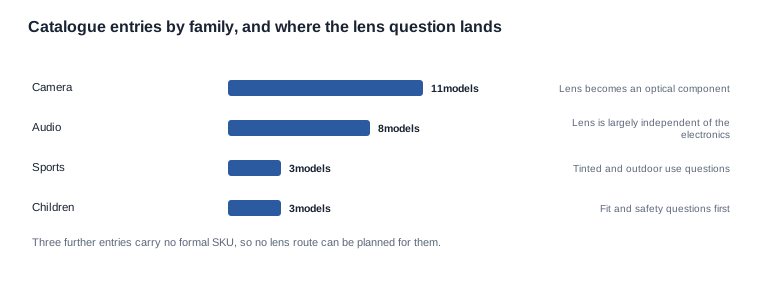
The catalogue's own records carry gaps that matter here too, because a lens decision attaches to a model. A05 and A06 are published with one set of values between them and nothing that says which is which. The L2 Utral label appears to be spelled wrongly at the end, and the Pro Max tag beside it has no meaning attached anywhere in the file. MT5 sits against a page reference that does not belong to it, and against a product family the record itself treats as doubtful. The page references given for V06 and S7 are off in the same way. Three entries carry no SKU of any sort, and the three are the electrochromic model, the bone-conduction model and the augmented-reality model. And not one of the twenty-eight entries has a product photograph, a video or a test report attached to it.
Certification follows its own three-valued pattern here as well. A certification may be claimed while the document numbers are still awaited from the company; it may equally be claimed with nothing recorded beside it that identifies a report; and for the children's line no status is provided at all. A lens adds its own document to that pattern rather than replacing it.
Where that leaves a buyer is straightforward. Three of the four routes can be planned now with a lens supplier, a frame supplier and the brand's own prescription data; the fourth cannot be planned at all, because the record does not describe it and no photograph, no measurement and no document exists for it yet. The decision therefore does not need to wait for a new product to appear. It needs the brand to decide which of the three plannable routes it is in, and to stop treating the fourth as though it were a fourth option.
One practical habit makes the difference between a decision and a postponement. Keep the lens route on the same page as the red line and the claim list, so that all three are reviewed together at every stage of the programme. The three are coupled in ways that are easy to miss: a tint changes what can be claimed about imaging, a prescription changes the rim and therefore the mass, and the red line decides how much of the frame is available to either of them. A programme that keeps them on one page tends to resolve them early and cheaply. A programme that treats them as separate tracks tends to discover the coupling at the sample stage, which is the most expensive place to discover anything.
The lens route should be chosen from the brand's prescription data and its claim obligations, and not from the appearance of the product. Which one of the four routes applies is decided by four inputs — the prescription requirement, the presence of a camera, the prescription range and the fixedness of the rim — and once those four are on paper the route is usually obvious. What is never obvious, and never visible in the record, is the mass, the edge thickness and the imaging behaviour, which is why the sample has to come before the artwork is signed.
We will not present a lens option as a published row where the catalogue does not carry one. The lens route, the coating and the tint behaviour have to be confirmed against the specific configuration and the specific market, not inferred from the product line.
Related reading
- The starting point for a brand programme — eyewear brand route
- How the product itself is built — OEM and ODM process
- The camera line in detail — camera products in detail
- Documents a lens programme needs — certification documentation
Bring the prescription distribution from your own sales data and the answer to the first question, about whether the product carries the prescription or is worn over it, and the lens route can usually be settled in one working session.


