

The conclusion first, because it is the part that saves programmes: this is not an electronics project that happens to involve a frame. It is a joining of two mature disciplines — dispensing optics and consumer electronics — and every avoidable failure comes from the seam between them rather than from either side on its own. The optics half is older, more regulated and more unforgiving than most electronics buyers expect, and the electronics half moves faster than most optics businesses can absorb. A collaboration that treats the seam as the actual project will run; a collaboration that treats it as an interface will stall.
This page sets out what the brand already holds when the programme starts, what the factory has to add to it, the five points where the friction actually appears in practice, and the questions that should be answered in the first meeting rather than the first sample. It is written for the smart glasses for eyewear brands overview that a brand's executive reads before deciding whether to commission a feasibility study at all.
Smart glasses for eyewear brands: an overview of the collaboration
The collaboration has a shape that is fairly consistent across this category, and a buyer who knows the shape can judge a proposal quickly.
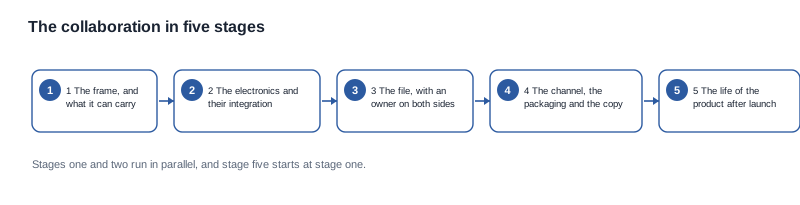
Stage one is the frame. The brand brings a frame, usually one it already sells, and the question is what happens to it when it has to carry electronics. This stage is where the brand's knowledge is decisive and the factory's is not: the frame, its tooling, its fit, its lenses and its place in the range are the brand's assets.
Stage two is the electronics and their integration. The factory brings the electronics, the acoustic and thermal design, the cell, the charging, the control and the assembly method. This is where the factory's knowledge is decisive. The integration work — how much room the cell needs, where the driver sits, how the module is fitted and serviced — is the part that determines whether the frame survives.
Stage three is the file. The conformity work, the testing, the documentation and the claims review. This stage belongs to nobody by nature, which is why it needs a named owner on both sides. It is also the stage where a product that works perfectly can become unshippable.
Stage four is the channel. The packaging, the shelf information, the distributor's data, the retailer's fitting and the returns process. This stage is usually underestimated by both sides because neither of them owns it, and it is where the customer's first impression of the product is formed.
Stage five is the life of the product. The reorder, the spares, the service, the second collection and the eventual end of the model. The five stages have very different durations, and a programme that compresses the first four into a launch date and leaves the fifth to chance will be doing its customers and its own service team a disservice.
Two things are worth saying about this shape. The first is that stages one and two run in parallel from the start, because the integration question cannot be answered without a frame and the frame question cannot be answered without a cell. The second is that stage five starts at stage one. The decisions about how the product can be opened, serviced and reordered are made in the first month, even though they are not exercised until the third year.
Most brands begin this collaboration with a feasibility study, and a feasibility study is worth doing if it is scoped properly. A useful one answers four things: what the electronics will do to this specific frame, what the frame will have to give up, what the file and the claims will require, and what the programme will cost in time before a single unit is ordered. A feasibility study that answers only the first of those is an engineering study, and it will produce an engineering answer that a commercial decision cannot be built on. The difference between the two is usually whether the frame's own constraints — the fit, the lens area, the silhouette, the tooling — were treated as inputs rather than as obstacles.
The cost side of this collaboration is usually quoted as a unit price and a lead time. The real total cost also includes the documentation, the sampling, the tooling, the fit work, the artwork, the packaging, the after-sales capability and the cost of the claims that turn out not to be supportable. A buyer comparing two proposals on unit price is comparing the smallest part of the number.

What the brand already has when the project starts
It is worth writing down what a brand brings, because a surprising amount of it is invisible on a product page and decisive in a programme.
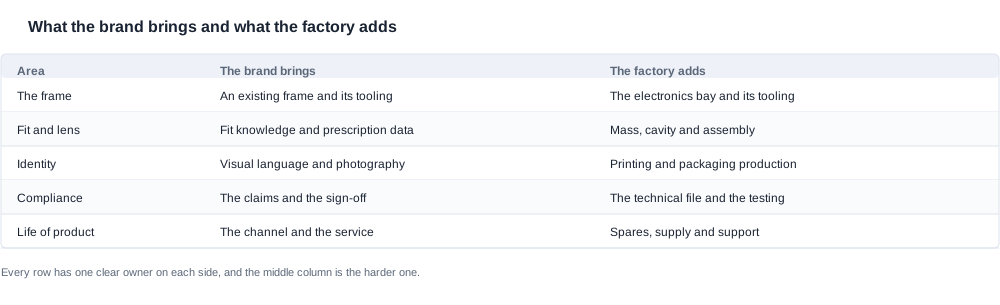
- A frame that works. A frame with tooling, with a known fit, with a lens that fits it and with a place in the range. This is the single most valuable asset in the whole collaboration.
- Fitting knowledge and prescription data. The brand knows how its frames fit real faces, and for most brands it knows the distribution of its customers' prescriptions. That data decides lens areas, edge thicknesses and mass, and it is not something a factory can supply.
- A visual identity and a library of images. The brand's frames are recognisable, and its photography is a marketing asset with a cost and a schedule attached to it.
- A channel and a customer relationship. Retailers, distributors, opticians and a repeat customer base that has already decided what a pair of frames from this brand is like.
- A specification habit. If the brand already writes specifications, draws tolerances and controls artwork changes, the programme inherits an enormous advantage over one that does not.
- Existing suppliers. A lens supplier, a print supplier, a packaging supplier and a logistics partner — each of whom can usually be used rather than replaced.
What the brand does not have, and needs to acquire, is equally predictable: an electronics competence, a cell and charging knowledge, an assembly method for a sealed electronics bay, a conformity file, and an acoustic and thermal engineering capability. None of these are hard to buy. They are hard to buy quickly, and they are hard to buy without a frame to work against.
There is a third category that is easier to overlook: the habits the brand has to unlearn. An eyewear business is organised around seasons, collections and a product that is designed once and sold for a long time. An electronics business is organised around revisions, where a product is designed once and then changed. A brand that carries its season logic into an electronics programme will treat a design change as a normal part of the year and will not understand why a change after the artwork is signed is expensive. The reverse mistake also happens, and it is more common among buyers who have worked in consumer electronics: assuming that a frame can simply be revised, when the frame is the part the business is built on and the part that cannot be re-cut for free.
The single most common mistake at this stage is a brand that assumes its existing suppliers can simply continue. A lens supplier is not a lens supplier for a frame with a sealed electronics bay, and a print supplier is not responsible for the accuracy of what the printed material says about the product. The boundaries have to be redrawn, which is a project in itself.
What the factory has to add to it
The factory's contribution is usually described as manufacturing. It is closer to engineering, documentation and long-term supply, and the buyer who treats it as manufacturing will get a quotation that describes the wrong thing.
The electronics design and the integration. The driver, the amplifier, the radio, the control and the cell, arranged so that they fit a specific temple without breaking the fit or the appearance. This is the work that decides the product's character, and it cannot be separated from the frame.
The tooling for the electronics bay. A temple that carries electronics needs a cavity, a closure, a service route and a finish that survives both. This is a tooling item, and it is usually the least reversible cost in the programme.
The power and the charging. The cell format, the charging interface, the case where one exists, and the charging time the product can actually achieve. The published record gives a charging time for every entry in the range. Twenty-six of those entries are at two hours or less, two of them — D17 and ZH12 — nearer one hour, and the two-hour number is a ceiling rather than a typical case, so it has to be quoted carefully.
The conformity file and the testing. The technical file, the radio and safety work, the material declarations, the claims review and the version control that keeps the file true to the shipped product. The factory's own status language here is three-valued, and it should be read literally. Some certifications are claimed while the document numbers remain to be confirmed by the company; some are claimed with nothing beside them that identifies a test report; and the children's line carries no conformity status at all.
The assembly and the test. How the module is fitted, how the unit is tested at the line, what the defect modes are and what happens when one of them appears in the field.
The service and the spares. Which parts can be replaced, by whom, and how long the factory intends to supply them. This is the part of the factory's contribution that a brand should buy deliberately, because it determines what the brand's after-sales operation will look like in three years.
One of these six contributions is routinely underestimated, and it is the sixth. A brand that buys the electronics without buying the service and spares route acquires a product it can sell once and cannot support twice. The question to settle early is whether failed units come back to the factory, to a regional partner, to a retailer's bench or to nobody at all, and every route has its own consequences for stock, for training and for what the customer is told. It is also the only one of the six that has to keep working after the factory's attention has moved on to the next programme.
A second contribution deserves a note. The assembly and test work determines the defect modes of the finished product, and the finished product's defect modes are not the sum of the frame's and the electronics'. A sealed temple that has to survive a drop test, a sweat test and a hinge-cycle test is a different object from a frame and a different object from a module, and the tests that catch the interaction are the ones worth asking for.

Where the friction usually appears
Five points account for most of the friction in a collaboration of this kind, and they are worth naming because each has a known remedy.
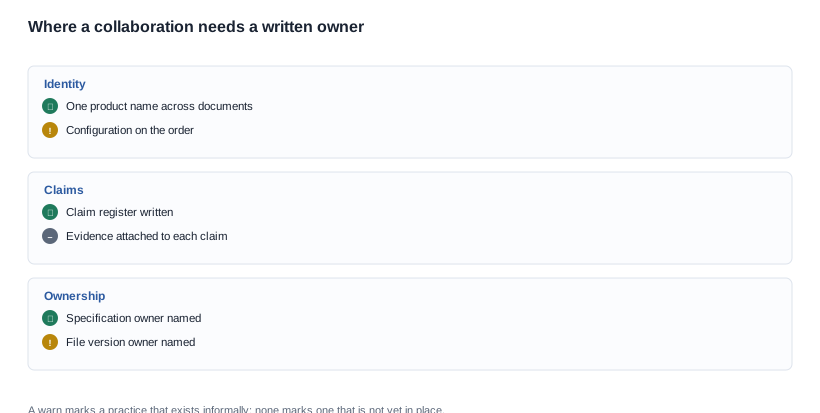
The first is identity. Naming the product, the configuration and the version, and making sure that the name in the specification, the name on the label, the name on the packing list and the name in the retailer's data are the same name. Most of the friction at the start of a programme is a symptom of two organisations using two different names for the same object.
The second is ownership of the specification. If no individual owns the specification, then every question becomes a negotiation between two organisations rather than a decision by one person, and negotiations are slow. One named owner on each side, meeting regularly, removes most of the friction at the second point as well.
The third is claims. Marketing copy is written early and evidence is produced late, and the two are rarely reconciled until somebody asks. The failure cases are well known: a comparative claim against another product, which needs a hands-on comparison before it can be made publicly; an acoustic statement, which has no third-party measurement behind it in the current file; an ingress rating, which appears on two entries and carries no report number; and a statement about the variable-tint category, whose record contains no photochromic data whatsoever.
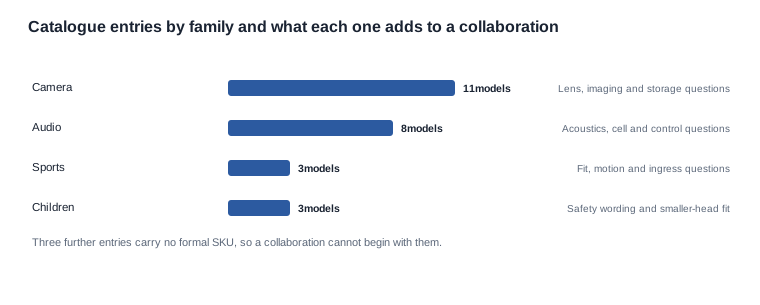
The fourth is configuration control between orders. The first order is described in detail. The second order is described in a hurry, and the third is described by whoever is available. Unless the configuration is written into the order and the packing list records what actually shipped, the range in the channel slowly diverges from the range in the catalogue. The catalogue is not a finished document, and a collaboration that treats it as one inherits its gaps. Between A05 and A06 the published values are identical and the difference is left unstated. The L2 Utral entry ends in a word that appears to be a typing slip, and the Pro Max suffix beside it is not defined. The page number printed against MT5 does not match, and its placement between the camera and sports families is recorded as doubtful. The same kind of page-number fault applies to V06 and S7. No SKU has been assigned to the electrochromic, bone-conduction or augmented-reality descriptions. And across the twenty-eight entries the catalogue holds no product photograph, no video and no test report.
The fifth is the timeline. The brand's date is a commercial date. The programme's real duration is set by the stages that depend on other parties — the testing, the documentation, the tooling, the samples and the shipping of physical units. Programmes that plan those in parallel reach their date. Programmes that plan them in sequence explain their delay to a launch event.
Two further sources of friction are worth carrying on the list. One is the customer who expects the product to fit like the frame they already own, which returns to the brand rather than to the factory. The other is the distributor who describes the product in a way nobody in the programme approved, which returns to the channel data rather than to either party.
Friction has leading indicators, and a buyer who knows them can spot a programme in trouble before the schedule slips. The first is a document count that keeps rising without a version discipline — each new document feels like progress and the absence of an owner becomes the real problem. The second is a claims list that grows faster than the evidence behind it. The third is a sample programme with no pass mark, so nobody can say whether a result is acceptable. The fourth is a change request that arrives after the artwork has been signed, which is the clearest signal in the whole list that the freeze point has been misunderstood on both sides. A weekly review of those four indicators takes half an hour and is the cheapest insurance available in a programme of this kind.
A related question belongs here, and it is the one a buyer asks at the end of a first meeting: how will we know that this programme is healthy? The criteria worth setting are unglamorous, and every one of them can be observed. Is there a named owner of the specification on each side? Is there a dated brief? Is there a sample plan with a written pass mark? Is there a claims register whose every line has an evidence owner? Is there a written list of what is still unknown, and is it shrinking? A programme that answers yes to all five is usually healthy, and one that answers no to the first two is usually behind schedule already, whatever the calendar says. The trade-offs in setting these criteria are small — an hour a week of two people's attention, against the total cost of a programme that discovers its problems in front of a customer.
The questions that should be settled in the first meeting
- Which frame, and is it in production today? The starting point for everything.
- What is the product for, in one sentence, in the brand's own words? This is the claim that everything else has to support.
- Who owns the specification on each side, by name? The single most useful thing to establish in a first meeting.
- What must not change? The red line, written down.
- Which markets, and is it one build or several? This sets the file and the packaging.
- Which of the four product lines is the starting point, and why? The reasoning usually reveals the real objective.
- What is the date, and what does it fix? A launch, a season, a trade show, a contract commitment.
- What can the factory already do, and what needs new development? A question about depth rather than about capability in the abstract.
- What does the brand already have that the programme can use? Existing suppliers, existing data, existing tooling.
- What will the brand and the factory each keep at the end? The brief, the measurements, the file, the commercial documents and the samples.
The tenth is the one that decides whether the collaboration is a project or a partnership. A brand that keeps its evidence and a factory that keeps its knowledge can work together for years, on a second product, on a second collection. A brand that keeps nothing has to start again every time, and the cost of starting again is the hidden cost that never appears in a quotation.
Each of the ten questions has a characteristic answer time, and the ones that can be answered from a document should be answered before the first meeting ends. Which frame and where it is in production can be answered in a minute. Which line is the starting point can be answered in a conversation. The market list, the claims and the red line need an hour. The specification owner can be named in a meeting, and it should be, because a name cannot be circulated as a question and a role can. By contrast, the last question — what each side keeps at the end — is worth half an hour of discussion on its own, because it is the one that determines whether the next programme starts from nothing.
A buyer should treat the ten as a pre-order screen rather than as a conversation. Any of them left unanswered is a known unknown, and the cost of a known unknown before you order is a design change, while the cost of the same unknown afterwards is a programme change. The last two questions on the list are worth flagging to whoever signs the purchase order, because they are the two whose answers determine what the brand will still be holding in five years.
The collaboration is worth starting if the brand can bring a frame, a customer and a claim, and if both sides can name the person who owns the specification. Without those, a feasibility study will produce a number rather than a decision. With them, the first meeting usually produces a brief, and the brief is what makes the rest of the programme manageable.
Our side of that is the published rows: we will tell a brand which of the ten questions the catalogue answers, which it leaves open, and which have to come back from the factory as a written answer rather than as an opinion.
Related reading
- Where a brand programme begins — eyewear brand solution
- How the development is sequenced — the OEM and ODM process
- Where the product families sit — camera products
- What a file should contain — certification requirements
The most useful first message is short: one frame, one customer, one sentence about what the electronics are for, and the name of the person who will own the specification.


