

The silhouette is the asset. A frame is recognised by its profile before it is recognised by its name, and a brand that has spent years building recognition has learned to protect the shape above almost everything else. Which makes the electronics problem harder than it first appears, because electronics want volume, mass and a service route, and all three push against the outline of the frame.
The good news is that most of the frame can be preserved, and the part that cannot be preserved can be identified early. This page separates the changes that leave a silhouette untouched from the ones that move it, explains the single condition under which a substantial electronics build can be hidden inside an existing frame, sets out the changes that force new tooling, and gives the one question to ask before anything is agreed. It is written for the brand designer and the buyer who has to approve the design change, not for the engineer holding the CAD.
Smart glasses added to a frame: preserving the original silhouette
A silhouette is made of four things, and it helps to name them separately, because they respond to change very differently.
The temple profile. The line the eye follows from the hinge to the tip, seen from the side. It is the single most recognisable line on a pair of glasses, and it is the one a buyer checks without knowing they are checking it.
The front geometry. The rim shape, the bridge, the brow line and the proportions of the front as a whole. This is the part that appears in a portrait photograph, and it is the part a brand's own product photography is built around.
The hinge and its position. The hinge is a small element and a disproportionate one. Its size, its cover, its position on the temple and the line it draws all read as part of the frame's character, and moving it moves the whole temple.
The temple tip. The end of the temple, where it flares, bends and carries the finish detail. It is the least protected region visually, because the eye reads it later and less closely than the profile.
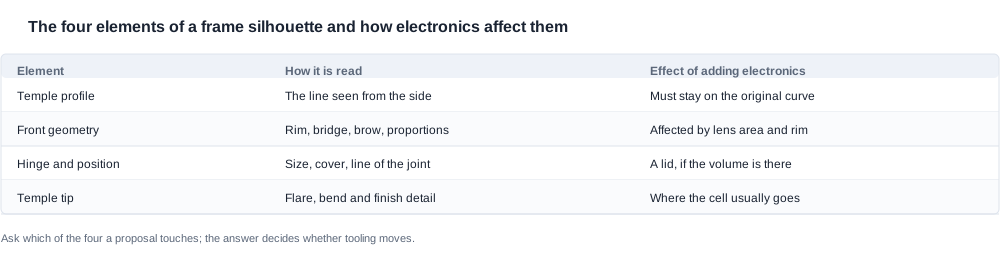
The useful thing about this list is that it gives a buyer a way to interrogate a design proposal. When a supplier describes a change as "hidden inside the temple", the real question is which of the four elements is being touched. If the answer is the tip only, the change is cosmetic to the silhouette. If the answer involves the profile or the hinge, the change is structural, and structural means tooling. A proposal that is unclear on this point is not yet a proposal a brand should approve.
There is a second, less obvious reason to care about the silhouette specifically. In a private-label programme, the frame is usually the reason the customer chose the product. The electronics are the reason the product was bought in the first place, but the frame is the thing that is looked at, photographed, compared in a shop and described afterwards. A product that works and looks like somebody else's frame satisfies one of the two reasons it exists, and it is the cheaper reason that gets remembered.
The silhouette is also judged by three different audiences, and they do not notice the same things. The person in the shop notices the frame in a mirror and in a three-quarter view, at close range, under bright light, and compares it with what they expected. The camera notices the profile and the proportions, and it notices a parting line that a person would not. The customer wearing it for six hours notices the mass and the balance, and nothing else. A change that keeps the profile intact can still be rejected by any one of the three, which is why a brand that protects only the outline has protected the least important of the three things.
The changes that leave the silhouette untouched
Several kinds of change are invisible in the outline, and they are the ones worth arguing for.
Internal changes that keep the outer surface. If the electronics live inside a cavity and the outside of the temple keeps its original curve, thickness and finish, the silhouette is untouched by definition. This is the ideal case, and it is discussed separately below because it is conditional on something specific.
Changes to the surface finish of an existing surface. A different colour, a different surface treatment or a different polish applied to the surface the frame already has does not move the outline. It changes the appearance of the product, which is a brand decision with its own logic, but it leaves the profile, the front and the hinge exactly where they were.
Changes below the temple tip. The tip region can often accept a thicker section, a different end treatment or an extra element without altering the line the eye follows along the profile, because the profile is set by the temple's upper edge and its line of sight from the side. This is the region where a designer is most willing to give something up, and the region where an engineer most wants to put the cell.
Changes inside the lens area. Anything that sits behind the lens — a camera, a sensor, a display — is invisible from outside except through the lens itself, and therefore affects the optical performance rather than the outline.
Two caveats belong with this list, because they are where the disappointment comes from. First, a silhouette can survive while the surface does not: a temple that keeps its profile but gains a parting line, a screw boss or a slightly different gloss reads as a different frame in a photograph, because the eye is much better at detecting surface changes than shape changes. Second, "untouched in outline" is not the same as "untouched in the hand". A frame that keeps its profile but gains two grams of mass at one temple will be noticed by the person wearing it long before it is noticed by the person looking at it, which is why the two need separate acceptance criteria.
The parting line deserves a paragraph of its own, because it is the most common way a preserved outline becomes an altered frame. A joint in a temple has a visual weight that is disproportionate to its size: it catches light, it interrupts the surface, and it draws the eye to the one part of the frame the brand was trying to keep quiet. The three things that determine whether a seam is acceptable are how it is finished, whether it is placed where the frame already has a visual interruption, and whether it is parallel to the temple's line rather than across it. A seam that follows the temple's direction reads as a feature; a seam that crosses it reads as a repair. The design question is therefore not whether a joint can be hidden, but where the joint can sit so that it looks deliberate.
The change that preserves it when the footprint matches
There is one condition under which a substantial electronics build can be added to an existing frame without disturbing the outline, and it is worth understanding it properly, because it is the difference between a programme that protects the design and one that concedes it.
The condition is that the electronics footprint matches a volume that already exists inside the frame. Not approximately — closely enough that the outer surface of the temple can follow its original curve while the cavity sits behind it.
This is a construction question, and the answer depends on how the frame is made. A frame with a hollow or cored construction has internal volume that may be usable, particularly in the thicker part of the temple behind the hinge. A metal frame with a hollow core may have a channel that can be used. A frame built around a wire core has almost no internal volume at all, and a frame with a full acetate or metal section may have volume that belongs to the material's own strength.
Three practical consequences follow. First, the feasibility question is not "does the electronics fit in this temple" but "is there a volume in this temple of the right shape that is not already doing structural work". Second, the answer is a property of the frame's construction, so it has to be established by opening a sample and looking, rather than by measuring a drawing. Third, when the footprint does match, the remaining compromises are the parting line, the access route for service, and the finish — none of which is the silhouette, but all of which are visible.
Testing the condition in practice is straightforward and cheap, and it is worth doing before any design work starts. Take a production sample of the frame, section it, and measure the internal space along the temple. Compare that space with the footprint the electronics need, allowing for the closure and for the thickness of the wall. The measurement is usually more encouraging than a drawing suggests and occasionally much less, and either result is worth having early: a frame with usable volume saves a tooling programme, and a frame without it saves a redesign.
The hinge region deserves particular mention because frame makers have long used it as a cover. A hinge that already exists as a visible metal or plastic element is a natural lid over a bay, and using it in that role preserves the temple's line where adding a separate closure would not. The trade-off is that the hinge then has to carry more than a hinge, and the question of how it opens for service becomes a design question rather than a workshop one.
There is also a version of this condition that applies to the front rather than the temple. Where the frame already has a bridge detail, a brow bar or a decorative element with volume behind it, that element can sometimes host part of the electronics without changing the front's appearance at all. It is worth a designer and an engineer looking at the frame together, because the designer knows which elements are structural and which are decorative, and the engineer knows what shape the electronics need. Neither of those two facts is visible in the other discipline's documents.

The changes that move the tooling itself
Some changes cannot be made inside an existing frame. They require the frame's own tooling to be cut again, and they are the ones a buyer should expect to be quoted for rather than to negotiate away.
Thickening the temple along its visible length. If the cavity does not fit and the temple has to grow, the growth is visible in the profile. It changes the line, and often it changes the weight distribution as well.
Moving, enlarging or restyling the hinge. The hinge is a silhouette element, so this is never purely a functional change. It is also a tooling change, because the hinge geometry is part of the temple's tooling.
Changing the taper or the curve of the temple. A temple that has to become straighter or flatter to accommodate something has changed its outline.
Widening the front or altering the rim line. If the electronics need a wider rim, a deeper brow or a different lens area, the front's proportions change, and the front is what the brand's photography is built on.
Adding a visible bulge, a closure or a parting line along the profile. These are not tooling changes on their own, but they are the changes that make a preserved profile look unpreserved, and they are worth treating as design changes with the design authority attached.
The cost of these is not only the tooling. It is the time to cut it, the time to sample it, and the risk that the new tooling reveals something about the frame that was never intended to be visible. A programme that expects one set of tooling and then changes the temple has to carry a second set, and the schedule consequence is usually larger than the cost consequence.
A practical way to protect the schedule is to freeze the silhouette before the electronics design is finished rather than after. The electronics can be moved, made smaller or given a different architecture; the outline cannot be moved without re-cutting. The order of those two decisions is the whole argument of this page.
That order has a specific consequence for the plan. The silhouette freeze has to happen at the point where the frame is already understood but not yet committed, which in practice means after the sample has been opened and measured and before the artwork brief is written. A brand that freezes the outline at the start of the programme will freeze something it has not measured. A brand that freezes it after the electronics design is complete will freeze something that has already been designed around. The window between those two errors is narrow, and it opens once the sectioning has been done.
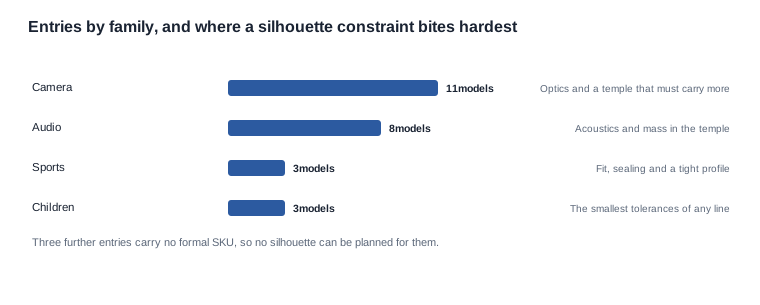
The catalogue behind the product is not a settled document either, and a design decision taken against an unsettled record will need revisiting. Two of the entries, A05 and A06, are published with values that match one another and no statement of how they differ. The model L2 Utral carries what appears to be a mistyped ending, and the Pro Max tag next to it is not explained anywhere in the file. The page reference for MT5 does not sit where it should, and the file records its placement between the camera and sports families as doubtful. The page references for V06 and S7 are wrong in the same way. Three entries carry no SKU of any kind, and they are the variable-tint product, the bone-conduction product and the augmented-reality product. And none of the twenty-eight entries has any product photograph, video or test report behind it.
The single question to ask before any change is agreed
The question is: does this change alter the outline of the frame as the eye reads it?
Ask it of every proposed change, one change at a time, and record the answer. The question works because it is answerable by a designer in a minute, because it does not require anyone to know anything about electronics, and because it sorts changes into two groups that behave completely differently. A change that leaves the outline alone is an engineering decision: it may cost money, it may cost time, and it may be declined, but it can be made without re-cutting anything. A change that moves the outline is a business decision: it re-opens the tooling, the artwork, the photography and possibly the product's identity, and it needs the authority of the person who owns the brand's appearance.
The question has to be asked before artwork is signed, not after. It is also worth asking in a slightly more demanding form, because "the outline" is not the only thing a brand owns: does this change alter the outline, the proportions, the surface, or the way the frame sits on a face? Each of those is a different kind of loss, and the second one is invisible in a photograph and obvious to the person wearing the frame.
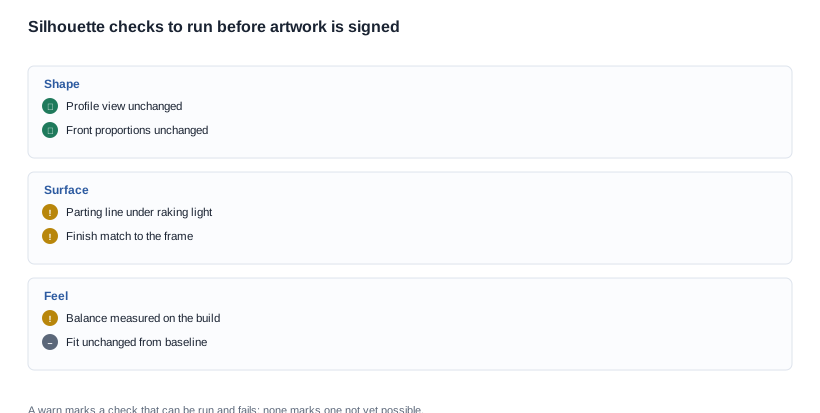
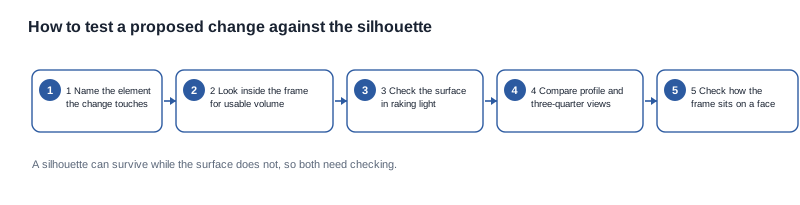
Four checks make the question operational rather than rhetorical, and they are worth putting into the acceptance criteria rather than the conversation. Compare the silhouette in profile view, at the same scale, before and after the change. Compare it in a three-quarter view, which is where most product photography is taken. Check the surface under raking light, which is where a parting line or a finish mismatch becomes visible. And check the way the frame sits on a face, which is where a mass change becomes visible. A brand that has these four as written criteria does not need to argue about the silhouette later.
Conformity is the other thing a design decision inherits. The record uses three different formulations, and they are not interchangeable: sometimes a certification is announced and the document numbers are still outstanding; sometimes the claim is there and nothing beside it identifies a report; and for the children's line nothing has been supplied. A design that carries a claim into production inherits whichever of those three applies, and the artwork stage is not the place to discover which one it is.
There is also a question of who owns the red line, and it is more sensitive than it sounds. In a small brand it is obvious: the founder, the designer or the product lead signs it. In a larger one it can end up owned by nobody, and an unowned red line is not a red line at all — it is a preference that each party argues for in the meeting where it is cheapest for them to argue. The practical fix is unglamorous: name the person who can approve a change to the outline, give them the authority to refuse one, and give them the standing to refuse without escalating. A design decision that has to be escalated every time is a design decision that will eventually be made by schedule pressure.
The silhouette should be protected by a rule rather than by an argument, and the rule should be written before the electronics design begins. A red line that names the four elements, that distinguishes a surface change from an outline change, and that is signed by the person who owns the brand's appearance will hold through a programme that takes a year, because it turns every later discussion into a comparison against a document rather than a negotiation about taste. Total cost is not the price of the tooling; it is the tooling plus the photography that has to be redone, the identity that has to be re-explained and the collections that cannot be built on the frame as it was.
Where a proposed change moves the temple profile, the hinge or the front, we will say that the tooling is affected and what that means for the programme, rather than treat it as a cosmetic decision that can be absorbed.
Related reading
- Where a design programme starts — the brand programme route
- How the design becomes a product — the ODM development process
- How the audio line is built — the audio product range
- Sampling before a design is frozen — sampling before the freeze
Bring the frame and a red line, and the first question becomes answerable in a meeting rather than a month: the temple profile stays, the hinge stays, the front stays, and the tip is where the electronics go.


