

Most supplier conversations in this category are conducted as a feature tour. The supplier presents a catalogue, the buyer recognises a model it has seen before, and both sides leave with an impression. This article proposes the alternative: a case approach, in which a single worked deployment is constructed in full, from the operating constraint backwards to the specification, and every step of it is testable against a published row.
The case below is a hypothetical case rather than a client project. It is not a description of a customer we have supplied, and it is not a reference project. It is a constructed exercise, and it is included because the method is the point: a case that cannot be checked against the catalogue is not a case at all.

The conclusion the method produces is that the specification falls out of the operating constraint. A deployment in a classroom, a stockroom, a shop floor and a training room produce four different answers from the same catalogue, and each answer is reached by asking what the site can actually do rather than which model looks best. Nothing in that sentence depends on a price, and none of the published rows we use are ours to alter.
Starting a case from the operating constraint rather than the model
The question that opens a case
A case begins with one question: what does this site have to work with? Not what it wants, and not what is available, but what it has.
For a retail store the answer tends to include a counter, a stockroom, an opening hours window, and a customer who buys something today and takes it home. For a school it includes a timetable, a corridor with a locked cabinet, a device count per room, and a term structure. For a warehouse it includes a scanner already in use, a pick path, and a shift length. For a training room it includes a projector, a screen, and a group of people who are not employees.
Each of those answers constrains the same three variables, and the three variables are enough to determine a specification. The first is the charging window: the time available between the end of a task and the start of the next one. The second is the interface count: how many distinct charging approaches the site is willing to hold and to train people on. The third is the observation requirement: whether the site needs to capture anything, and if so, what it needs to capture and for how long.
Every one of those three answers is a physical fact about the site, and every one of them can be established in a site visit without involving a supplier. That is why the case should start there. A case that starts from a model and then looks for reasons to justify it is a procurement exercise with a bias built into its first step.
The four sites and what each one constrains
To make the method concrete, the same three variables applied to four sites produce four genuinely different answers.
A retail shop floor has a short charging window and a customer who owns the device after purchase. It also has almost no observation requirement, because the staff member needs to answer a question or show a product, not record anything. The interface count is low, because the shop buys one interface group and stocks one cable type.
A school classroom has an overnight charging window, which sounds generous until the timetable is examined: the devices are in use during the day, the cabinet is in a corridor, and the window is between the last lesson and the first. Its interface count is low for the same reason, and its observation requirement depends entirely on the age of the students and on the school's own policy, which is a decision the school makes before any product is discussed.
A warehouse has the opposite profile: a short window of a few hours between shifts, a high observation requirement because pick accuracy is the whole point, and an interface count that is dictated by whatever the existing scanner already uses.
A training room has a long window, a moderate observation requirement, and an audience that will need the product demonstrated before it is used, which is a merchandising problem rather than a technical one.
The spread is the useful part. Four sites, one catalogue, and four different answers, none of which requires a new product.

Working the case through the published rows
Reading the catalogue against the constraint
Once the constraint is fixed, the catalogue is read against it rather than browsed. The audio models sit in one group of the range, the camera models in another, and the sport models in a third, and the published rows in each group differ in ways that matter to a case.
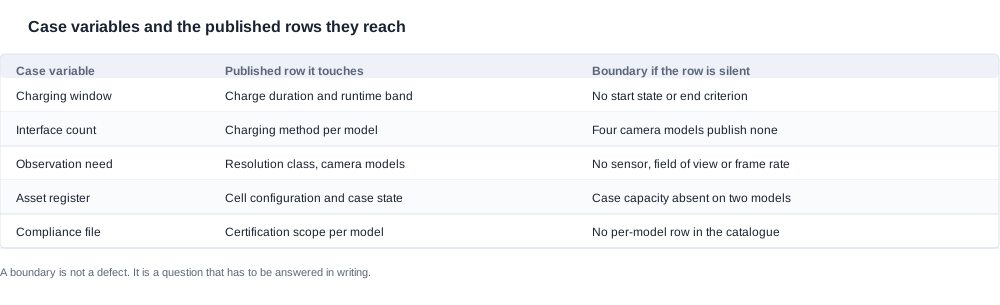
For the observation requirement, the published position is that all eleven camera models carry a resolution class and no more: eight of them at eight megapixel, and the S7 and the L2 Utral, and the L1 Pro at thirteen megapixel. Nothing is published on sensor, frame width, frame rate, container format or capacity for any of them. A case that needs a specific capture behaviour therefore reaches a boundary quickly, and the honest next step is a question rather than a selection.
For the interface count, the published rows are decisive. On the interface row the catalogue divides cleanly. Most of the audio, camera and sport lines charge magnetically; a Type-C socket is the published interface for the V03 Pro and the L2 Utral, for the D11 and the D12, for the D17 and the ZH12, and for the bone-conduction entry; and the L1 Pro and the MT6, and the CY03 and the CY05 carry no charging method row whatsoever. A case that fixes the interface group at one has a long list of eligible models, and a case that needs a specific model and a specific interface has to check that the model is not one of the four silent ones.
Read against the charging window, the published figures are generous: twenty-six models carry a duration of two hours or less, and the D17 and the ZH12 carry approximately one hour. A window that is long enough therefore stops being the constraint, unless it is interrupted.
Where the case has to stop and ask
A case reaches a boundary at every point where the catalogue is silent, and the discipline of a case is to name the boundary rather than to fill it. The most common ones are these:
- The charging method for the four camera models that publish none.
- The charge conditions behind the published duration, since no start state and no termination criterion are published.
- The charging case state for the KY06 and the MT5, which publish a case without a capacity.
- Which of the two L2 Utral case capacities belongs to which of the two variant names the same page publishes.
- Everything to do with certification, where the catalogue text names no CE, FCC or RoHS standard and no per-model certification row exists anywhere.
Each boundary becomes a line in the case file, and each line is a question to be answered in writing before the specification is signed.
The case file as the deliverable
The output of a case approach is not a recommendation. It is a file with six sections, and each section is short enough to be read in a meeting and long enough to be argued with.
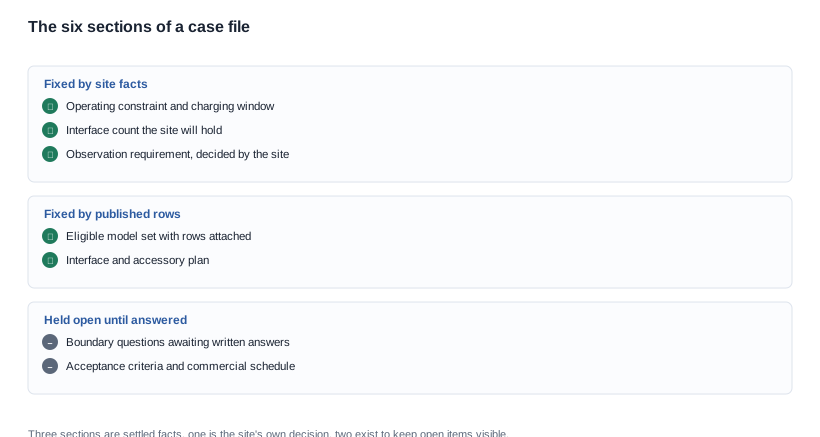
The six sections are the operating constraint, the eligible model set with the published rows attached, the interface and accessory plan, the unresolved boundary questions, the acceptance criteria, and the commercial schedule. Three of them are entirely determined by published facts, one is determined by the site, and two exist to hold the unresolved items in view rather than to lose them.
The commercial schedule is the section most often left out of a case file, and it is the section that decides whether the exercise was worth running. Unit price, minimum order quantity, production lead time and the cost of the accessory plan are handled per enquiry rather than published, because each of them moves with the way the order is configured, how many units it covers and how the production schedule currently runs. A case file that carries the specification but not the schedule has left the buyer without the one input that determines whether the specification is affordable.

Smart glasses for retail and education: what a case fixes and what it leaves open
The distinction a buyer is really negotiating
A case produces a specification, and a specification is not the same thing as a commitment. The distinction matters because the two are commonly discussed in the same conversation, and because a buyer who cannot tell them apart will sign for the wrong one.
What the case fixes is the operational answer: which models are eligible for this site, what they are specified to do, how they are charged, and what evidence has to exist at delivery to show that a delivered unit matches the specification. Everything in that list is traceable to a published row or to a site fact, and it is stable before any price is discussed.
What the case leaves open is everything the published rows do not carry, and that list is longer than buyers expect. It includes the charging method for four camera models, the charge conditions behind every published duration, the case capacity for two camera models, the correspondence between the two L2 Utral capacities and the two published variant names, the Bluetooth version for the eleven camera models, the frame weight for every model except one, and the entire certification scope of the range. It also includes every commercial term, because unit price, minimum order quantity and production lead time depend on configuration, quantity, mix and the current schedule and are confirmed per enquiry rather than published.
A case that closes the open list has effectively become a commitment, and it should close it deliberately, in writing, with the answers attached to the specification rather than summarised in a meeting note.
The questions that convert a case into a quote
A buyer who has run the case can ask for a quotation without further discovery, because the operational questions have already been answered. The remaining questions are commercial, and they are the ones a supplier can actually price:
- What is the unit price for the model set the case selected, and what does that price depend on?
- What is the minimum order quantity for that configuration, and how does it change with mix?
- What is the production lead time for the quantity and the configuration in the case?
- What is included in the delivered carton, and which of the accessories are quoted separately?
- What is the warranty period and the returns policy for a defect against the acceptance criteria?
- Which of the open boundary questions can be closed from your records, and which need factory confirmation?
The last question is the one that distinguishes a supplier from a catalogue. It invites an honest answer, and the honest answer is usually a split: some items come from the product records immediately, and the rest need to go to the factory. A supplier that answers all six from the catalogue has answered none of them, because the catalogue is exactly what does not carry those answers.
What the case does not do
Two things a case approach deliberately does not do, and both are worth stating because they are what buyers ask for at the end of a well-run exercise.
It does not produce a recommended model, and it does not produce a price. A case narrows the field to a defensible shortlist with the published rows attached, and it produces a specification the buyer can issue for quotation. Which model on that shortlist wins, and at what unit price, depends on commercial terms that are not published and on the buyer's own risk position. Presenting a single recommended model as the output of a case would misrepresent what the case established.
It also does not close certification questions by paraphrase. The catalogue contains no reference to CE, FCC or RoHS and no per-model certification row, so a case that needs certification scope to be settled needs documents: scope per model, reference numbers that the issuing body is able to confirm, and for any IP rating the buyer intends to advertise, the test report behind it. The internal record that accompanies the catalogue does not take a different line from the catalogue itself: it carries the same absence, and for the sport category it describes the IP54 marking as a catalogue entry rather than a laboratory result, with no test report number named behind it. That is the honest starting position for the question, and the certification checklist is the right instrument for closing it.

What changes when the deployment is an institution
The same models, a different accountability
An institutional deployment changes who is accountable for the device, and that change propagates into every section of the case.
In retail, the customer owns the device after the transaction, and the shop's responsibility ends at the point of sale. In an institution, the organisation owns the device for its whole service life, which means the register, the charging routine, the damage process and the replacement provision all become the buyer's responsibilities rather than the end user's.
The published rows do not change between the two channels. What changes is which published row becomes a specification line and which becomes a question. In retail, the charging interface is mostly a packaging matter. In an institution, it is a procurement specification that determines the accessory order, the training material and the total cost of the deployment.
What the register has to contain
An institutional case needs an asset register from the first delivery, and the published rows determine the fields it can start with. Serial number, model, the published cell configuration, the published charge duration, the published runtime band, the published interface, and the case state where one is published.
The register is also where the unresolved questions become visible, because a model with no published charging method cannot be issued to a user until the interface is known. Two published details deserve a specific field rather than a general note. The first is the case, because the four published case states mean a case may exist with a published capacity, may exist with no published capacity, may not be mentioned at all, or may be published as absent, and the field has to hold that distinction without collapsing it. The second is certification scope, which is not published per model in the catalogue and therefore cannot be a populated field until the supplier provides it in writing.
The register is what turns a fault into a claim. A claim needs three things attached to it: the serial number, the date and a description of the fault, and where the purchase order never said what the carton would carry, the first of those three cannot be supplied and the claim cannot be raised at all.
The question about models without a published Bluetooth version
One published gap deserves naming because it is easy to miss and it is specific to the camera models: the catalogue publishes a Bluetooth version for the audio models, with the K01 and the K02 at version 5.3 and the rest of the audio line at version 5.4, and it publishes no Bluetooth version for any of the eleven camera models.
In a retail case, a camera model with no published Bluetooth version is a line on a product page. In an institutional case it is a compatibility question, because the site has existing equipment, and the question is whether the imaging models interoperate with it. That question goes into the case file, and it is one of the clearer examples of a case approach earning its cost: a buyer who had only browsed the catalogue would have assumed the row existed.
The case approach in practice
How to run one without wasting the meeting
A case works when it is prepared on both sides, and it fails when it turns into a live product demonstration. The sequence that works is short.
- Establish the operating constraint from site facts, without reference to any model.
- Build the eligible model set from the published rows, filtered by the constraint.
- Attach the published rows to each candidate so the comparison is on facts.
- List the boundaries where the catalogue is silent, as questions.
- Write the acceptance criteria that the case will be judged against.
- Only then discuss the commercial schedule.
The reason for the order is that a demonstration in step one anchors the whole conversation on a model, and every later step then becomes a search for reasons to keep it. A case that reaches step six with a model set still open is a better procurement position than one that reached step one with a single model, because the buyer knows which published row each remaining option rests on.
The evaluation criteria are worth stating in advance, because they are what the case is judged against. The criteria are interface closure, window adequacy and case closure, in that order, and each one is answerable from the published rows plus the site facts. A case that cannot answer all three has not finished its work.
The three ways a case goes wrong
The failure modes are consistent enough to name. The first is the substitution of a published row with a derived one, most often a combined cell capacity written into a column headed with the catalogue's own notation. The second is the collapse of a silence into a negative, where the absence of a case row or a charging method becomes an assumption that the model has neither. The third is the premature closure of a boundary, where a question about certification scope or charge conditions is answered by a paraphrase of a catalogue page that does not contain it.
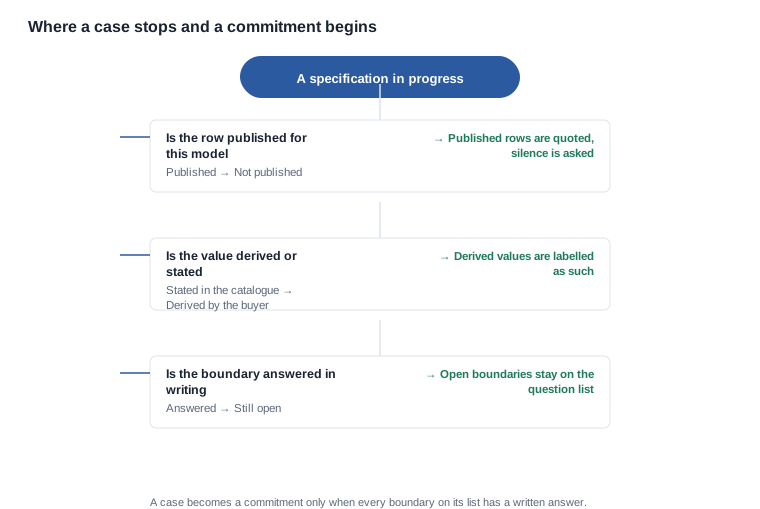
All three are avoided by one habit, which is to keep the case file's third column honest: if the row is not published, the cell reads as a question, and a question stays a question until it has an answer in writing.
There is a fourth failure mode specific to the institutional case, which is to let the register grow faster than the specification. Units that arrive before the acceptance criteria are signed end up in a store room with no inspection record, and a batch that has been drawn from stock cannot be inspected against a sample that was never approved. The remedy is procedural rather than technical: no unit is issued until the acceptance criteria and the approved sample both exist.
What comes out of a case
The output of a case approach is a specification that a supplier can quote against, an acceptance criteria sheet that an inspection can be run from, and a list of questions that were asked before the order rather than after it. It is also, occasionally, the conclusion that the site does not need this category yet, which is a legitimate and valuable outcome of a well-run case.
The commercial terms that follow from the case are the ones worth putting in writing at the same time: the unit price and the configuration behind it, the minimum order quantity for that configuration, the production lead time, the warranty period and the returns policy for a defect against the acceptance criteria, and the delivery terms. The contract terms page covers how those clauses are usually structured; the sample order route is how the questions that the case raises about a specific model get closed.
The retail and education solution page carries the category positioning that a case starts from, and the quality consistency discussion covers the part of the case that happens after a specification exists.
Send the operating constraint, the site facts and the interface count, and we will return the eligible model set with the published rows attached and the boundary questions listed.


