

A sports brand does not want a single product; it wants a range, because the customer who rides to work on a Sunday morning and the customer who runs a marathon in August are not the same customer and should not be sold the same device. The interesting part of building that range is that the two features a sport customer wants most — an ingress marking and a remote shutter — are published on different smart glasses in our catalogue, and a portfolio designed without noticing that ends up with a range nobody buys twice.
Smart glasses sport portfolio starts with the customer
A range is a customer decision first and a catalogue decision second, and the order matters because the catalogue is the easier of the two to argue about.
The sport customer divides three ways. There is the recorder, who wants to capture a ride or a run from the first person and does not care about anything else. There is the action user, whose sport involves speed, movement and moments where touching the frame is not possible. And there is the long-session user, who wears a device for hours, takes calls on it, and wants the ear left open for traffic. Those three customers do not fail in the same way, they do not value the same features, and they do not read the same product page.
That division is also what makes a sport range commercially worth running rather than merely assembling. A single model carries one set of packaging artwork, one listing, one set of claims and one inventory position. A range of three carries three of everything and gives the distributor a reason to stock all three, because the customer who buys the first one is a candidate for the second. The range only works when each tier has a reason to exist on its own, and when the customer can move between tiers without the brand having to argue that the cheap one is nearly as good.
There is a fourth consideration that belongs at the start rather than the end: the markets. A range sold into the European Union and the United Kingdom will be asked about ingress marking. A range sold into schools, clinics and corporate training will be asked about entirely different things, and the certification position is not published per model in our catalogue, which means it has to be established per destination market before the range is announced rather than after the first enquiry.
The fifth consideration is the channel, and it is where a range either works commercially or does not. A distributor will carry a range that gives the retailer a choice and a margin on each unit. A single-model brand is easy to stock, easy to reorder and easy to discount when the season turns. A range is more demanding and more valuable: the retailer has more units to reorder, the customer has more reasons to come back, and the brand has more to say about which one fits which activity. The cost of that is the working capital sitting in slow units, which is exactly why the accessory line and the minimum quantities have to be settled before the range is announced rather than after the first season.
The three tiers and the smart glasses rows behind them
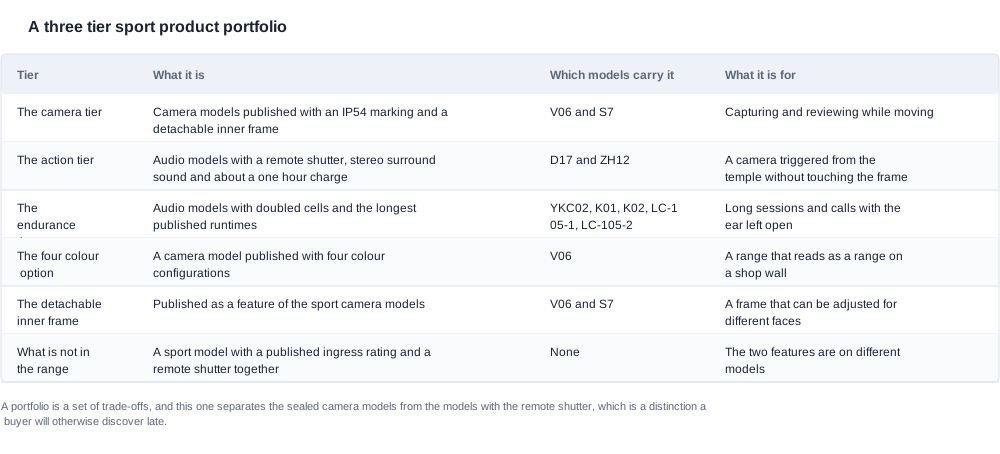
The camera tier. The V06 and the S7 are the two models in the catalogue published with an IP54 marking, and both publish a detachable inner frame and an ergonomic frame. The V06 is published at 8 MP with a 260 mAh cell, a charge time of two hours or less, a rated runtime of five to eight hours and magnetic charging, and it is the only model in the whole catalogue published with four colour configurations: orange, white ice blue, black and black ice blue. The S7 is published at 13 MP with the same cell, the same charge time and the same runtime, also with magnetic charging and the same IP54 marking.
The ingress marking is a splash rating and a dust rating, and in a European or United Kingdom market it is the row a retail buyer will interrogate first. It is also a catalogue annotation in our documentation, without a third-party test report number behind it, so a buyer planning to print the rating on a box has a question to ask before the artwork is released.
The action tier. The D17 and the ZH12 are the two models published with a remote shutter, stereo surround sound and a Type-C charge time of approximately one hour, which is the fastest charge figure published anywhere in the range. The D17 publishes a 115 mAh cell and a rated runtime of about seven hours, and the ZH12 a 100 mAh cell and about eight hours. Both publish Bluetooth 5.4.
The remote shutter is the feature a sport customer understands immediately: a capture the customer can trigger without touching the frame or the phone, which is what makes a first-person action recording usable rather than a sequence of missed moments. The one-hour charge matters for the same reason, because an action customer will charge between activities rather than overnight, and a device that needs two hours or more in that window simply goes out unused.
The endurance tier. The YKC02 publishes Bluetooth 5.4, a doubled a charge time of two hours or less, 70 mAh cell, magnetic charging, about eight hours of runtime and surround sound. It is a sport model in the published tier, and it should not be filed with the audio range when a range plan is written. The audio models published for long sessions include the K01 and the K02 at Bluetooth 5.3 with a doubled 90 mAh cell and about eight hours of runtime, and the LC-105-1 and the LC-105-2 at Bluetooth 5.4 with a doubled 55 mAh cell and about eight hours. These are the models for long sessions, for calls, and for the customer who wants the ear left open.
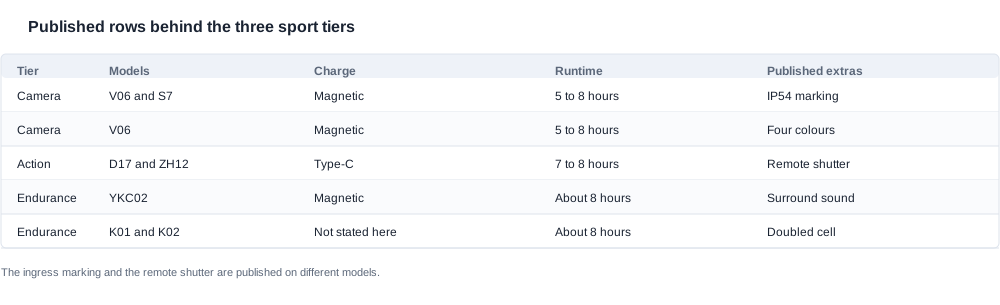
The tiers differ in a way that is easy to miss and expensive to discover. Two of them charge magnetically and one charges over Type-C. Two publish an ingress marking and one does not. One publishes a remote shutter and the other two do not. A range plan that treats the tier as a marketing device and the rows as an afterthought will build a portfolio whose claims differ from one SKU to the next, and the claims are what the legal team reads last.
The endurance tier raises the opposite problem. Its models are published for long sessions and calls, and their selling point is comfort over hours rather than protection against a knock. A range that carries an ingress story on the camera tier and an endurance story on the audio tier is making two different promises, and the retailer needs to be able to say which is which without consulting a comparison table. That means the product names, the box artwork and the listing copy have to carry the distinction themselves, which is a design task rather than a copy task, and it is cheaper to plan than to retrofit.
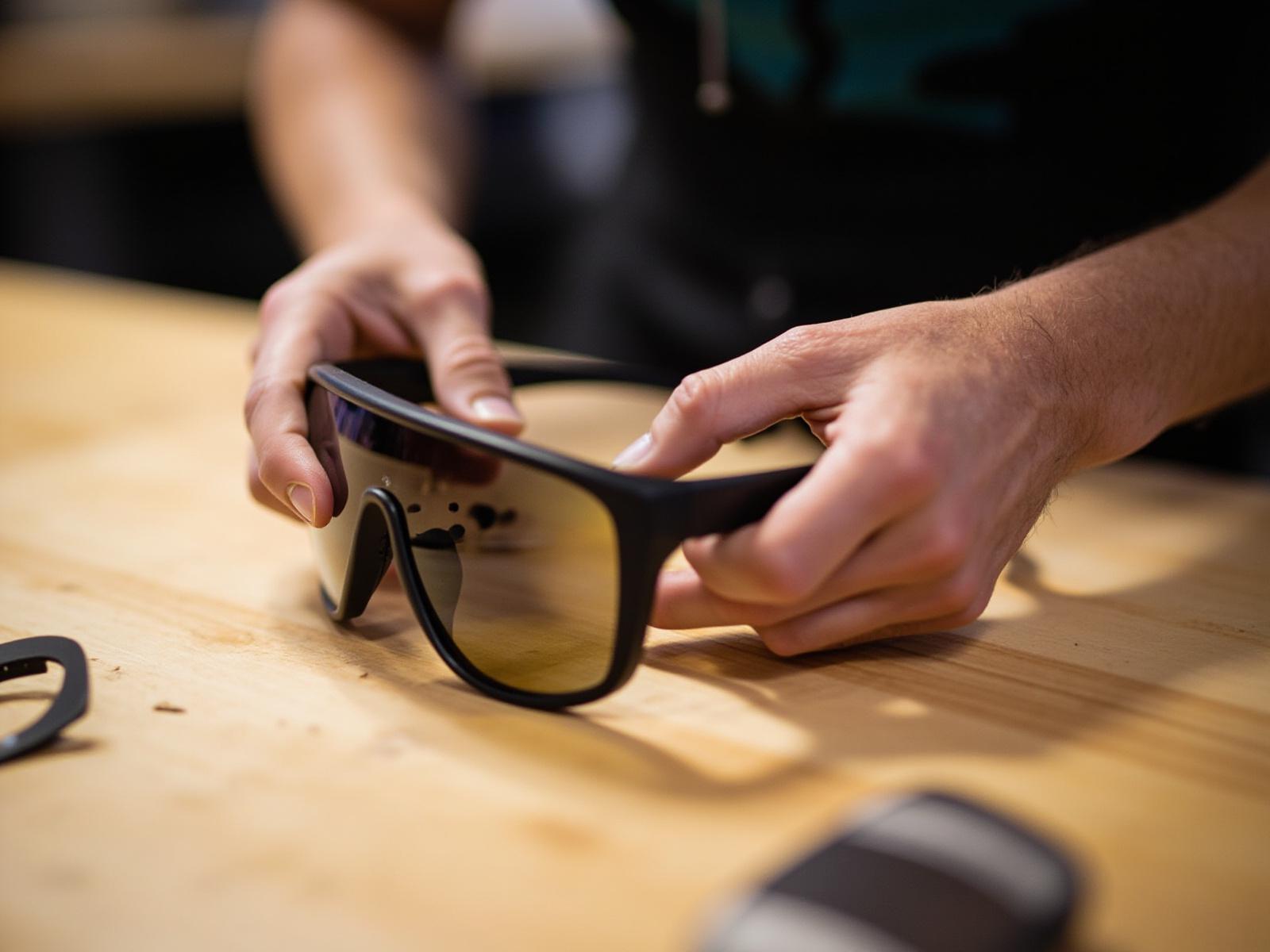
The detachable inner frame on the camera tier deserves a second mention, because it does something for a range that no other published row does. A single frame that fits one face is a product; a frame with a detachable inner fit that can be swapped is a fit system, and it is what lets one camera SKU serve more than one head shape without adding a stock-keeping unit. That is the difference between buying a second model and buying a spare part, and in a range plan the second is almost always the better commercial decision.
The structural gap a smart glasses portfolio has to resolve
The awkward fact in this catalogue is that the ingress marking and the remote shutter are on different models. The V06 and the S7 are sealed and carry a detachable inner frame but publish no remote shutter. The D17 and the ZH12 publish the remote shutter, the one-hour charge and the stereo surround sound, but publish no ingress marking.
For a portfolio this is more than a product question, because it decides how many platforms the brand is running. A range built on the sealed camera models cannot carry the remote shutter without a development, and a range built on the remote shutter models carries no ingress claim at all. Those are two different claim sets, two different product pages, two different packaging stories and two different sets of wear accessories, held together by one brand. That is an entirely legitimate choice, but it should be made deliberately rather than discovered halfway through.
The combination is not impossible in principle. A remote shutter is a small electronic control and a sealed housing is a design choice, but the two together change the tooling, the seal path and the radio environment around the antenna. That makes it a development rather than a configuration, and a development has a cost, a lead time and a set of new checks that nobody has run yet. The honest way to price it is to ask, in writing, whether the combination exists on the platform under consideration and what it would require.
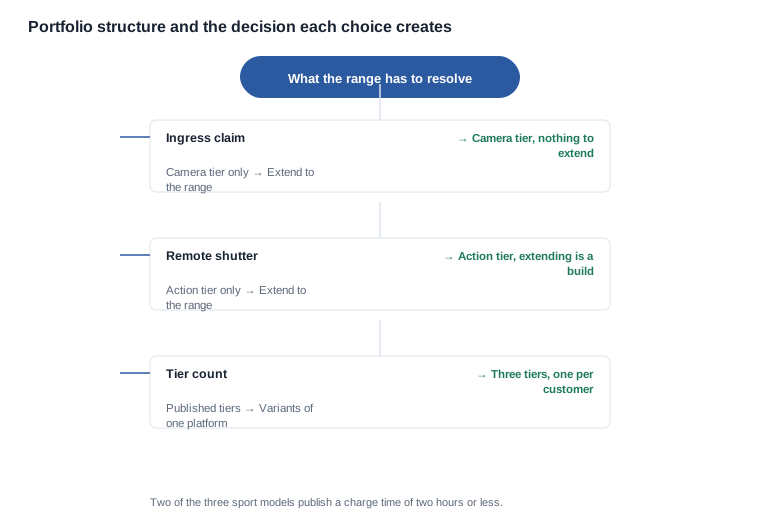
The other structural question a portfolio has to answer is how many stock-keeping units it runs. Every additional unit carries a packaging artwork, a listing, a claim set, a spare-parts line and an inventory position, and each one of those is a cost that is invisible until the range is live. A three-tier range built from published rows is defensible. A six-unit range built from variations of the same platform usually is not, because the customer cannot tell the tiers apart and the brand is carrying the difference in stock rather than in value.
Running two platforms has a second-order cost that belongs in the same calculation. Two platforms means two sets of tooling amortised across smaller volumes, two lead-time profiles to manage, two sets of documentation to keep current, and two sets of quality checks at incoming inspection. The numbers work differently depending on the split between them, which is why a range plan should be costed at the level of platforms first and models second. A brand that takes the sealed camera platform for two tiers and the remote shutter platform for one is making a different commercial bet from a brand that spreads four models across two platforms, and the per-model cost of that bet is invisible until the quotation arrives.

How to build a smart glasses range that sells twice
- Start from the customer, not the model. The three tiers exist because the sport customer divides into a recorder, an action user and a long-session user. The range should mirror that division rather than mirror the catalogue's structure.
- Decide the camera question first, because it is the one that changes the platform. A range built on the sealed camera models cannot carry the remote shutter without a development, and a range built on the remote shutter models carries no ingress marking.
- Use the colour option deliberately. The V06 is the only model in the catalogue published with four colours, and a range that has to read as a range on a shop wall needs exactly that kind of visible differentiation.
- Publish the ingress marking carefully. Say what IP54 means rather than saying the product is waterproof, and make sure the warranty terms say what happens to a unit that has been immersed. The IP ratings reference sets out what the designation does and does not establish.
- Keep the endurance models separate from the action models, because they are sold on different promises and they fail differently. The audio tier is on the Bluetooth audio glasses range page, and the sport models are on the sport smart glasses range page.
- Settle the accessory strategy early. A sport customer often buys spare tips and sometimes a second case, and a case is a case, a cradle and a cable. Three models in the catalogue publish a case capacity and two more publish a case whose capacity is not published, so the accessory line is a live commercial decision rather than a footnote.

The order of the first two steps is what most portfolios get wrong. The customer division is what justifies the range, and the camera question is what determines whether the range can be built without development. Deciding the camera question first and the customer second tends to produce a range that is technically varied and commercially thin, because every unit was added for a capability rather than for a customer.
Launch sequencing follows from that order and is worth deciding before the artwork is approved. A range that appears in one release is simpler to announce and harder to correct, because everything is visible at once; a range that appears in two releases gives the brand a chance to learn from the first before the second is committed. The middle path is the one most private-label programmes take: one hero model to establish the claim architecture and the packaging, then the remainder of the range once the hero has been through a season. Whichever path is chosen, the accessory and spare-parts line should be live at the same time as the model it supports, because a customer who cannot buy a replacement tip at the same time as the frame is a customer who does not buy a second frame.
Questions worth putting to a smart glasses supplier
Which models carry an ingress marking? The V06 and the S7, as an annotation without a published test report number behind it, and no other model carries one.
Which models carry a remote shutter? The D17 and the ZH12 only. We will not read that feature across onto the rest of the sport family, and a range plan that assumes it is available on every sport SKU will fail at the artwork stage.
Which models have a doubled cell? The YKC02 and the LC-105-1, the K01 and the K02, and the LC-105-2, and a doubled cell is what allows the second earbud in the audio configurations.
What is the detachable inner frame? It is published on the V06 and the S7, and it matters for a sport customer because it is what allows one frame to fit a range of faces, which is the difference between a model that suits a customer and a model a customer keeps.
What is published for charging across the range? Seventeen models publish magnetic charging, seven publish Type-C, and four models publish no charging method at all. That last group matters more than it looks, because a range plan cannot promise a charging story for a configuration whose charging method is not published.
What is not published? The frame dimensions, the weights — the catalogue publishes a weight for one model in the whole range, the MT6 at 158 g for the glasses alone — the acoustic figures, the colour options for most models, and the ingress evidence behind the marking we do publish. We will tell you that rather than fill those rows in.
What about certification per tier? Not published per model anywhere in the catalogue. The catalogue body names no certification scheme, and the export certification material is a picture page carrying ten patent certificate images — eight design patents and two utility models — which describes intellectual property rather than market access for a product. A range plan that spans three tiers in two destination markets therefore needs the certification position established for each model and each market, and it needs it requested rather than inferred from a family page.
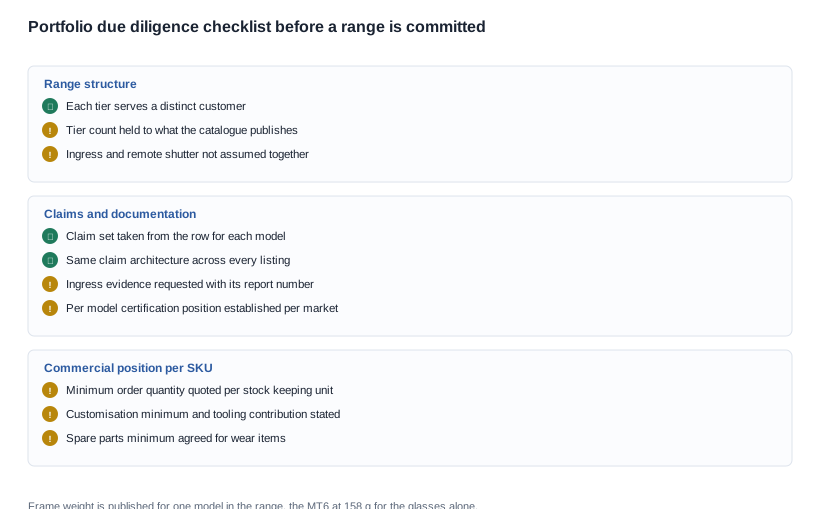
The commercial side of a range plan deserves its own line. Unit price, minimum order quantity, lead time, sample fee and warranty are not published on this site and are confirmed per enquiry, and for a range the relevant question is not the minimum for one unit but the minimum per stock-keeping unit, because a range that needs five hundred of each of four models is a very different order from one that needs five hundred in total. The models available to build a range from are listed under OEM ready platforms, and the due diligence on them is short: the minimum per SKU, the customisation minimum, the tooling contribution, and the lead time for the custom artwork.
Warranty is worth treating tier by tier rather than as one brand-wide term, because the failure modes are not the same across the tiers. A camera tier product fails on seals and joints; an action tier product fails on the remote, the interface and the battery under load; an endurance tier product fails on the tips, the hinge and the hours. A single warranty paragraph across all three is either too generous on one tier or too tight on another, and it is usually discovered during the first season rather than at the quotation stage.
The portfolio criteria we would set for smart glasses
The shortlist criteria for a sport range are worth writing down before the first sample arrives, because a range evaluated on appearance will always end up with too many units that look alike. Six criteria carry most of the weight, and each of them can be checked against a published row, a document or a measurement.
- A distinct customer for each tier. If two tiers serve the same buyer, one of them does not need to exist.
- A published claim set per SKU. Resolution, charging method, charge time, runtime and any ingress marking, taken from the row rather than from a family description.
- A consistent claim architecture. The same category of claim made the same way on every SKU, because a retailer will compare the pages side by side.
- A colour and accessory story that survives contact with the shop floor, which is what the four-colour published configuration on the V06 does for a camera tier.
- An accessory and spare-parts line for the items that wear out, with a minimum quantity attached to each.
- A commercial position per SKU — minimum order quantity, customisation minimum, tooling contribution and lead time — so that the range can be costed rather than guessed at.
Where a criterion cannot be satisfied from a published row, the answer is to request it. That is normal for a range plan, and it is much cheaper than the alternative, which is a range that ships with claims nobody can support. The route we take is to map your customer segments, your markets and your price bands onto the published rows, and to tell you which gaps exist and which of them is worth a development.
One last criterion belongs on the list even though it is not a product attribute at all: how quickly the range can be corrected. A range built from platforms where the specification rows are published is a range whose specification can be re-checked whenever the catalogue changes, and a brand that re-checks it will find the drift before the retailer does. A range assembled from assumptions cannot be re-checked at all, which makes the correction cycle as long as the tooling cycle. For a category that moves as quickly as this one, that difference is worth more than an extra colour.
The sell-in material is the last piece and it is cheap. One page per tier, built from the same published row that the product page uses, gives the distributor a document that answers the three questions that actually come back from a retailer: which model fits which activity, what the marking covers and does not cover, and what the accessory line is. A distributor working from those pages stops inventing the answers, and the retailer stops receiving a different story in each market.
Related reading
- The sport models in detail — sport smart glasses range
- The audio models for the endurance tier — Bluetooth audio glasses range
- What an ingress rating does and does not mean — IP ratings explained
- The models available to build a range from — OEM ready platforms
Tell us your customer segments and your markets, and we will map them onto the range and flag the gap.


