
Buying a smart glasses product for the outdoor channel is not like buying one for the general consumer market, because the outdoor buyer is not purchasing a gadget; they are purchasing a piece of kit for a specific environment with a specific set of consequences. That equipment has to survive rain, sweat, sand, cold, heat and being dropped, and it has to do so while a person is relying on it for the duration. The checklist below makes that environment explicit before a model is chosen, because most of the disappointing decisions in this category come from a specification sheet read without the environment in mind. It is written for the buyer running that check before the shortlist is set.
Who runs the checklist, and what it decides
A brand owner is deciding which models enter an outdoor range, and the environment has to be written down before the models, because the environment decides them.
A procurement manager is building the request, and the checklist tells them which rows to ask for and which ones will come back open.
A channel buyer is writing the packaging and the listing, and the wording on the box is one of the checks rather than a detail. The select by market solution covers how a range is organised once the models are settled.
The two questions that decide the model choice
Is a camera essential or incidental? Essential, and the sport camera models are the V06 and the S7 with their IP54 marking and detachable inner frames, and the eight- or thirteen-megapixel choice between them. Incidental, and the audio models are lighter, simpler to document and easier to support, and the D17 and the ZH12 bring the remote shutter and the roughly one-hour Type-C charge.
Is the customer buying for a moment or for a day? A moment, which is a camera, a remote and a case. A day, which is adjustment, standby behaviour and a fit system, and the camera becomes a cost rather than a feature.
Smart glasses equipment checklist: what the environment decides
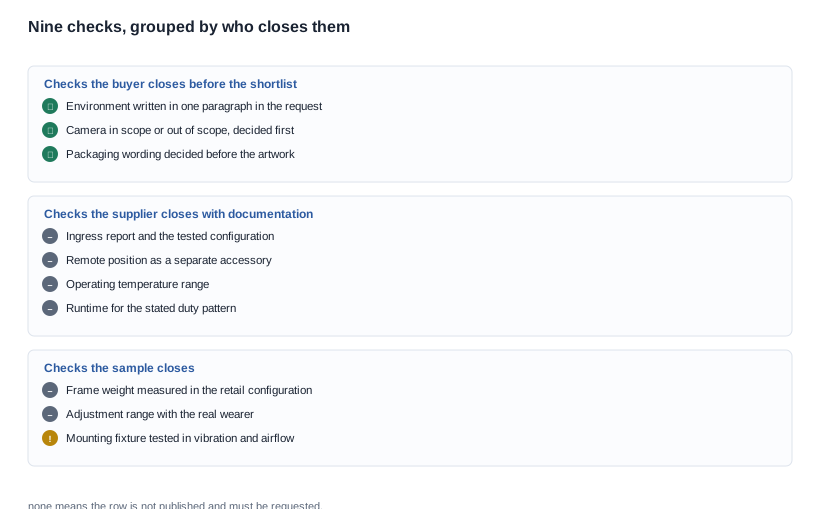
Nine checks cover the outdoor category, and the first one is the one that decides the other eight. Before any model is evaluated, the environment has to be written down in a paragraph that a supplier can read and act on.
Rain in a city street is a different exposure to a riverbank, a dust road, a sand dune or a sea wall. Write down where the product will actually be used, for how long, and how often. Almost every other check depends on the answer, and a supplier that cannot see the environment will answer generically, which is the most common reason a request produces a response that is technically correct and practically useless.
Three further environment facts change the shortlist rather than the details. If the product sits in direct sun on a saddle, the cell is exposed to a temperature the catalogue says nothing about. If it is carried in a vehicle, the storage temperature is a second exposure the catalogue says nothing about. If it is worn by children or by a mixed-age group, the whole compliance position changes, and the three children's models in the range carry a completely different set of published rows from everything else.
The criteria the checklist is scored against
A checklist that produces a yes-or-no answer for each check is a checklist that produces a false answer half the time, because most of the rows in this category are blank rather than negative. The better structure is to score each check against three states — published and sufficient, published and insufficient, and not published — because the third state drives the request and the second state drives the exclusion.
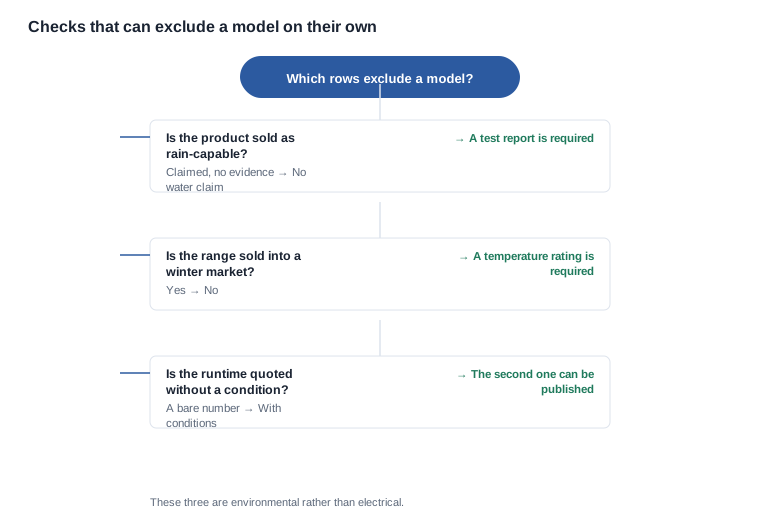
Two checks have the power to exclude a model on their own, and both are environmental rather than electrical. The ingress check excludes any model that will be sold as rain-capable without evidence, because the only ingress marking in the range is the IP54 annotation on the V06 and the S7 and there is no test report number published for either. The temperature check excludes any model that will be sold into a winter market, because no model in the range publishes an operating temperature range at all.
The published rows a checklist can be built on
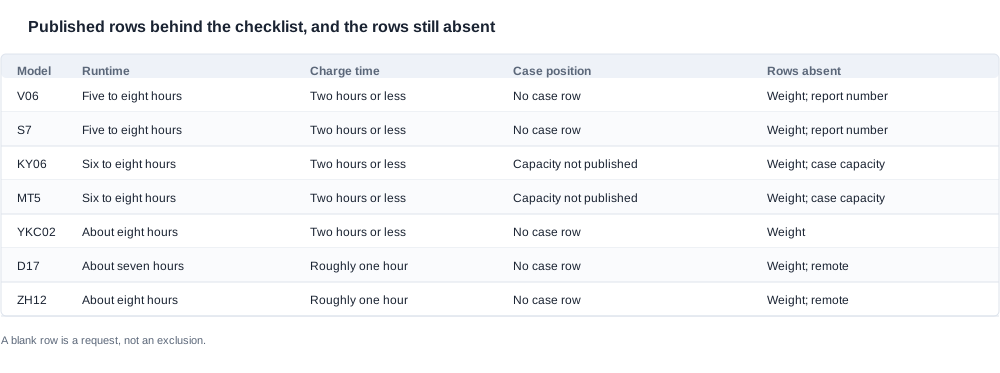
Before the checks are applied, the buyer needs the inventory of what exists. The table below is the published position for the models that come up in an outdoor range, and the final column is the working list of rows to request.
| Model | Charge time | Runtime | Case position | Rows absent |
|---|---|---|---|---|
| V06 | Two hours or less | Five to eight hours | No case row | Weight; report number |
| S7 | Two hours or less | Five to eight hours | No case row | Weight; report number |
| KY06 | Two hours or less | Six to eight hours | Capacity not published | Weight; case capacity |
| MT5 | Two hours or less | Six to eight hours | Capacity not published | Weight; case capacity |
| YKC02 | Two hours or less | About eight hours | No case row | Weight |
| D17 | Roughly one hour | About seven hours | No case row | Weight; remote |
| ZH12 | Roughly one hour | About eight hours | No case row | Weight; remote |
Three distinctions that a request must preserve
A blank row is not a negative row. The V06, the V03 Pro and the S7, and the V03 have no charging-case row in the catalogue, and no camera model in the range carries a published statement that it comes without a case. A blank row means the question was not answered, and the answer has to come from the supplier.
A ceiling is not a figure. Twenty-six of the twenty-eight models publish a charge time of two hours or less, and only the D17 and the ZH12 publish roughly one hour. A checklist that writes "two hours" has converted a ceiling into a point value, and the difference matters when the product has to charge between two segments of a day.
A published cell figure is not a published weight. Cell capacities are published across the range in the catalogue's own form, but no sport model carries a weight row, and the one weight figure in the whole catalogue belongs to the MT6 glasses body at 158 g, excluding its foldable case.

What the published rows reveal about the range
Read together, the published rows describe a range with three runtime bands and one conspicuous gap, and the gap is the same for every model in it. The camera models sit in three bands: five to eight hours on the V06 and the V03 Pro, and the S7 and the V03; six to eight hours on the KY06 and the MT5; and about seven hours on the CY03 and the L2 Utral, the L1 Pro and the CY05, and the MT6. The audio and sport models occupy their own bands, running from about six hours on the G07 and the YK12 to a top band near eight hours covering the K01, the K02, the LC-105 pair, the YKC02 and the ZH12.
What none of the eleven camera models publish is the Bluetooth version, and that is a striking gap when the audio models in the same catalogue publish it for every model. It means a buyer assembling a connected product range cannot rely on a single protocol row across the two halves of the catalogue, and the request has to settle it per model rather than once for the range.
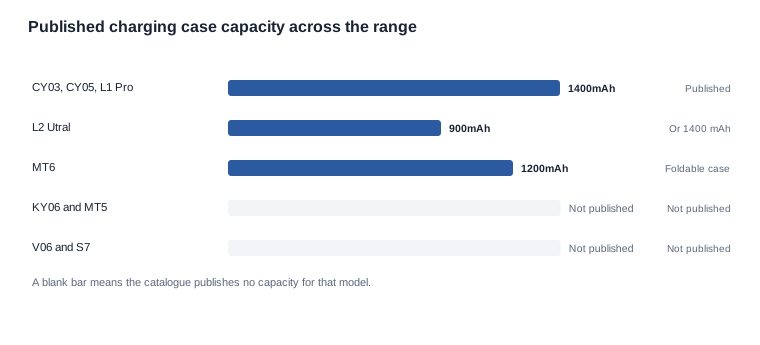
The second thing the rows reveal is where the accessory complexity sits. The camera models that publish a case capacity publish it in the 900 to 1400 mAh band, the KY06 and the MT5 carry a case without a published capacity, the V03 and the V03 Pro, and the S7 and the V06 have no case row at all. A range built from more than one of those positions needs more than one packaging configuration and more than one item in the distributor's service kit.
The third is the charge-time split. Twenty-six models publish a figure of two hours or less and two publish roughly one hour, and both of those two are Type-C models in the sport class, so the fastest published charge time in the catalogue sits inside one interface family rather than being spread across it.

Nine checks, and the row that closes each one
Each check below names the published position, the threshold or the question that settles it, and who closes it. The last column is the one that turns a checklist into a plan, because a check with no owner is a note.
| # | The check | The published position | The threshold or the question | Who closes it |
|---|---|---|---|---|
| 1 | The environment, written precisely | — | Rain in a street, a riverbank, a dust road and a dune are different exposures. State where, for how long and how often, in the first line of the request | The buyer, before the shortlist |
| 2 | The ingress position | The IP54 marking appears on the V06 and the S7, without a third-party report number, and no other model carries a rating | The report and the tested configuration, because a rating measured on a development sample is not a rating on the ordered product | The supplier, with the report |
| 3 | Whether a camera is in scope | The V06 and the S7 publish cameras; the audio models do not | A camera alters the compliance position, the privacy discussion, the mass and the runtime. Answer it before the model list exists | The buyer, in the brief |
| 4 | Whether a remote is needed | Only the D17 and the ZH12 publish a remote shutter | A remote is a separate accessory with its own housing and its own water exposure. Ask about it separately rather than assuming the frame's rating covers it | The supplier, with the remote's own position |
| 5 | The mounting | The mounting hardware is not part of the product | A helmet bar, a handlebar, a strap or a collar each need a fixture that keeps the unit away from vibration and out of the airflow. Design it before tooling | Buyer and supplier together |
| 6 | The temperature range | Not published for any model | A cold cell has less available capacity and a stiffer seal, and a hot vehicle softens a moulded part. Ask what range the product is rated across | The supplier, with the rating |
| 7 | The adjustment range | No dimensions for any model | Who wears it, for how long, and over what clothing. A full day on a sweaty face needs an adjustment system rather than a fixed temple | A sample, and a trial with the real wearer |
| 8 | The runtime for the duty pattern | The published figure is a ceiling without a test condition | Outdoor workloads mix long idle periods with short active ones. Ask for the figure for the pattern that will actually occur | The supplier, then the buyer by measurement |
| 9 | The packaging wording | — | Decide what the box says next to the rating before the artwork exists. A splash rating printed beside the word waterproof is the most reliable way to generate a return in this category | The buyer, before artwork |
The order in which the checks should be applied is not the order in which they are numbered, and the sequence matters more than the list.
- Write the environment first, because a supplier that cannot see the exposure will answer generically.
- Apply the two exclusion checks next — the ingress position and the temperature range — because each one can remove models from the list before any further effort is spent.
- Compare the published rows only across models that survived the exclusions, because the comparison is meaningless otherwise.
- Settle the camera and the remote questions before the runtime, since both change the load the runtime has to cover.
- Leave the packaging wording until last, because it depends on everything above it and because it is the cheapest check to run and the most expensive one to get wrong.
The checks that most often get skipped
Two of the nine are skipped more than the rest. The temperature check is skipped because no winter market raises it first, and it is the check that decides whether a range can be sold into a season at all. The packaging wording check is skipped because it is the only one that costs nothing to complete, and it is the check that determines how many returns the channel generates for a reason that has nothing to do with the product.
The third check that disappears is the certification coverage, and it disappears because it belongs to the artwork rather than to the product. It also sits on the longest external path, since a certificate number that arrives after the packaging is printed cannot be added to the box without reprinting it. Starting that check early costs nothing and shortens the critical path; starting it after the range is committed costs a reprint and a delay to the launch. The remedy is procedural rather than technical: every check is scored against the date the range is intended to ship, not against the date the request is sent.
Building the request that closes the open rows
A checklist becomes useful when it turns into a document that can be sent. The request below is assembled from the checks that scored as unpublished rather than as insufficient.
Send the open rows in one submission. The ingress report and the tested configuration, the remote's own position, the operating temperature range, the frame weight, the dimensions and the adjustment range, the runtime for the stated duty pattern, the case position, and the certification coverage per destination market. One request produces comparable answers; five requests produce five incomparable ones.
Ask for the configuration each answer covers. Almost every blank row in this category becomes usable once it is attached to a configuration — a weight for a specific variant, a runtime for a specific load, a rating for a specific tested configuration. The supplier's answer is usually correct; the ambiguity is in what it describes.
Record which rows stay open and who owns them. A checklist with open rows and named owners is a live document. A checklist with open rows and no owners is a record of a worry, and it will be read as a completed one.
The questions to put in the request
What is the frame weight, and does it include the cell, the camera and the case? What is the ingress test basis, and what configuration was tested? What is the operating temperature range, and what changes at the extremes? What is the runtime for a stated duty pattern, and what are the conditions? What is the case capacity, and does the unit charge while it sits in the case? How many insertions should the charging interface be expected to survive? Which parts are field-replaceable and which require the unit to be returned? What does the supplier inspect during production, against what written standard, and what is the remedy when a batch falls short? These are the questions the catalogue leaves open, and the answers are what turn a model into a specification.
A question about the quality control regime is worth more in this category than a question about the unit price, because the failure modes here are quiet ones. A contact that stops charging reliably, a temple that develops play and a seal that hardens all pass a visual inspection, and all three generate a return. Ask what is inspected, at what point in the process, against what written standard, and what the remedy is when a batch falls short. That last part belongs in the agreement rather than in the request, because a remedy that only exists in a conversation is not a remedy.
Supply and pricing terms the checklist has to settle
The checklist is also a commercial instrument, because most of the terms that decide whether an outdoor range works are settled before the first sample arrives.
What the accessory and packaging rows decide
A model shipped with a case carries a second lithium cell in every unit, and four things change with it: what the carton declares, the wording of the packing instruction, the class the consignment travels under, and the weight of the parcel. The capacities the catalogue gives for cases — 900, 1200 and 1400 mAh — put a figure on that decision. A range where the case is optional needs two packaging configurations, and a range where it is mandatory needs one, and the difference between those two is a decision rather than a default.
Negotiating the lines of a first outdoor order
- Price and the volume breaks — negotiable, with the configuration attached to each.
- The accessory and mounting set — its own order quantities.
- The carton — the packaging specification, and how a delivery is split.
- Payment — against a passed inspection.
- Warranty — the period and the response written inside it.
- Returns — the policy for an outdoor channel.
- Terms of a first small order.
- Certification and tooling — set by the testing body and the factory rather than by negotiation: the amount and the schedule follow the body that performs the testing, tooling is often amortised across an opening allocation, and certification is billed for each family the factory holds. Ask which of the two the quoted line actually names.
We publish the sport and outdoor rows in the form the catalogue uses, and we do not fill in a row that the catalogue leaves open. Where a number does not exist we say so, and where a marking exists without a report number behind it we publish the marking and the absence together.
Smart glasses for sports and outdoor equipment checklist is complete when every row is either published and sufficient, published and insufficient, or not published with a named owner — not when every model has a decision attached to it.
The sport smart glasses range lists the models this checklist applies to, the sports and cycling brands solution covers the parallel programme, and the ip ratings reference sets out what a marking establishes and what it does not.


