

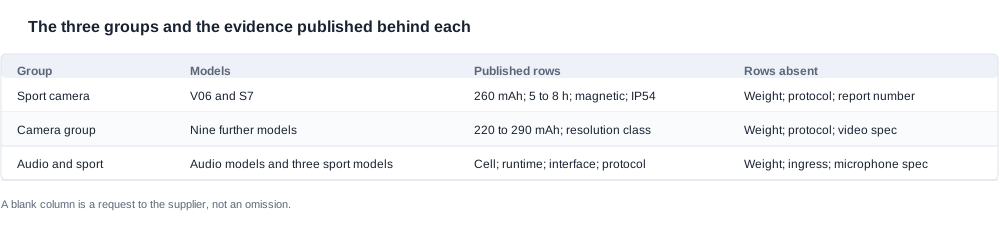
Conclusion first: our sport and outdoor range is not one product with options on it. It is three groups of models carrying three quite different sets of published evidence, and the most common sourcing error in this segment is treating them as a single shortlist and then discovering, late, that the documentation behind each group is not comparable.
Two of the groups are camera models and one is an audio and sport group, and the published position divides along a line that is easy to miss. The camera models publish a resolution class and nothing else about their imaging, publish no Bluetooth version, and publish no weight. The audio and sport models publish a Bluetooth version and a cell configuration and a charging interface for every model, and publish no ingress marking at all. The single exception that sits across both groups is the ingress marking itself, which appears on two camera models and on nothing else in the range.
That is smart glasses for sports and outdoor overview as the documentation actually stands, and the useful question for a buyer is which group the product they are building belongs to, because the answer determines what they will be able to say about it afterwards.
Who reads this overview, and what for
A brand owner is deciding whether the sport and outdoor segment is worth a range at all, and this page sets out what the segment is and is not.
A procurement manager is building a request, and the request has to be split by group because the open rows are different in each one.
A channel buyer is comparing our models against a competitor's line, and the comparison has to be made on rows that both catalogues publish, which is a narrower set than the comparison usually attempted.
Smart glasses for sports and outdoor: the range in one view
The range divides into three groups, and the division is visible in the catalogue's own product names rather than in a marketing structure.
The sport camera models. The V06 and the S7, both published at 260 mAh with a five-to-eight-hour runtime and magnetic charging, and both carrying three feature rows that are worth reading together: an ergonomic design line, a removable inner frame, and an IP54 marking. The V06 is published at eight megapixels and the S7 at thirteen, and the V06 additionally publishes four colourways.
The wider camera group. The other nine camera models in the catalogue, running from 220 mAh on the V03 and the V03 Pro to 290 mAh on the CY03 and the L1 Pro, and the CY05 and the L2 Utral, and including the MT6 with its foldable 1200 mAh case and the 158 g glasses body that is the only weight figure in the range. Four of these publish their charging method as magnetic, two publish Type-C, and four publish no charging method row at all.
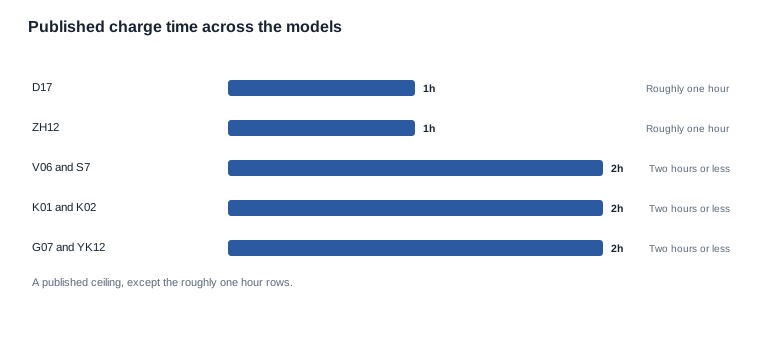
The audio and sport group. The audio models and the three sport models, which between them publish a Bluetooth version for every model, a cell configuration for every model, a charging interface for every model and a runtime for every model. The D17 and the ZH12 publish the only charge times in the catalogue that are better than the two-hour ceiling, at roughly one hour.
Each group leaves a different set of rows open, and the sets are the reason the request has to be split. The sport camera models leave the frame weight, the ingress report number and the imaging detail open. The wider camera group leaves the same rows open, plus the charging method on four models and the Bluetooth version on all eleven of them. The audio and sport group leaves the frame weight, the acoustic measurement and the operating temperature range open, and it is the only group where every model publishes both its charging interface and its protocol version.
A buyer who knows which group a product belongs to knows which document to ask for, and the difference between a request that closes in two rounds and one that closes in five is usually just that.
The criteria for reading the range
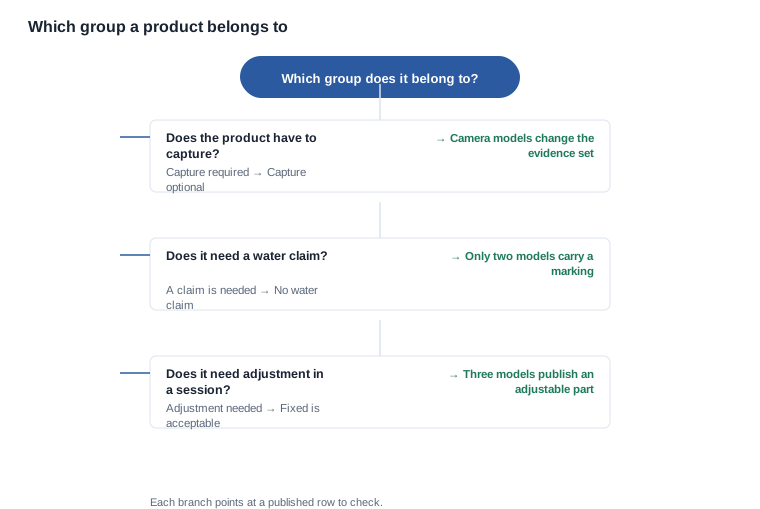
Three criteria decide which group a product belongs to, and they are worth applying before any model list exists.
Does the product have to capture? A camera changes the compliance position, the privacy conversation, the mass and the runtime, and it adds a second lithium cell to the parcel wherever a case is included. It also removes a large amount of the acoustic value, because the microphone array in a camera model is not published to be the same as the one in an audio model.
Does the product have to survive water? Only two models in the entire catalogue carry an ingress marking. If the channel requires a water claim and the evidence behind it, then the shortlist is two models long before it starts, and the rest of the work is documentation rather than selection.
Does the product have to be adjusted during a long session? A removable inner frame on two models and a detachable temple on one audio model are the only adjustment features published in the range, and they sit in different groups.
The camera models and what separates them
Eleven models in the catalogue carry a camera, and they divide by resolution into eight at eight megapixels and three at thirteen. The division by resolution is the only division the catalogue publishes, and it is worth knowing what it does not tell a buyer.
The eleven camera models at a glance
The eleven camera models divide into two resolution classes, and the list is worth having in front of you rather than reconstructing from memory.
- At eight megapixels: the CY05 and the V06, the CY03 and the V03, and the V03 Pro and the MT6, and the MT5 and the KY06.
- At thirteen megapixels: the L1 Pro and the S7, and the L2 Utral.
That is eight models at eight megapixels and three at thirteen, and the two classes are otherwise a decision about cells, cases and interfaces rather than about imaging. The L1 Pro publishes a 290 mAh cell and a 1400 mAh case with no charging method row, the L2 Utral publishes the same cell with two variant names and two case capacities and a Type-C row, and the S7 publishes a 260 mAh cell with magnetic charging and an ingress marking. Three models in one resolution class can still be three different purchasing decisions, and the resolution label does not tell them apart.
What separates the models
The V06 and the S7 share an electrical platform and differ in resolution class; the L1 Pro and the L2 Utral share the thirteen-megapixel class with the S7; the remaining eight camera models carry the eight-megapixel class. Because the resolution class is the only published imaging figure, a buyer who is comparing two camera models is comparing a resolution number and nothing else, which is not enough to support a claim about image quality in any listing.
What is not published for any camera model: the sensor model, the field of view, the frame rate, the video format, the stabilisation behaviour, the low-light performance, the storage capacity and the file format. A brand with an editing pipeline has to request all of that before it can decide whether the product is usable in its own production flow.
What the L2 Utral publishes that no other camera page does
The L2 Utral is the only camera page in the range that carries two variant names and two case capacities in the same row, and the catalogue does not say which capacity corresponds to which name. That is a real distinction from every other camera model, and it is also the reason the page should be read literally: two names and two values, with no published correspondence between them. A buyer who assumes a mapping will get it wrong.
What the camera group does not publish at all
Beyond the imaging detail, two absences run across the whole camera group and both matter commercially. The Bluetooth version is published for every audio model in the catalogue and for none of the eleven camera models, which means a range spanning both halves cannot rely on one protocol row. And no camera model publishes a weight, which for a product sold against lightweight eyewear is a significant gap in the comparison the shopper will actually make.

The audio and sport models and what separates them
The audio and sport group is the better documented half of the range, and the differences inside it are about interfaces and runtimes rather than about imaging.
The interface split is the first decision
Magnetic charging appears on the K02, the K01, the LC-105 pair, the G07, the YK12, the YKC02 and the AR model, and Type-C on the D11, the D12, the D17, the ZH12 and the bone-conduction model. The two families carry different accessory consequences, different wear exposure and different packaging, and the D17 and the ZH12 are the only two models in the whole catalogue whose charge time is published as roughly one hour, which makes the interface choice and the charge-time choice the same decision rather than two separate ones.
The cell configuration is the second decision
Cell values are published for every model, in the catalogue's own form, and the two-cell configurations are worth separating from the single-cell ones because the mass is distributed rather than concentrated. The K01 and the K02 use two 90 mAh cells, the YKC02 uses two 70 mAh cells, and the LC-105 pair, the G07 and the YK12 use two 55 mAh cells. The 55 mAh pair occupies the four models, of which two publish about six hours — the G07 and the YK12 — and those two are distinguished by their feature rows rather than by their electrical rows, with the G07 publishing a slim detachable temple and the YK12 publishing a surround-sound line.
The models that publish an adjustment feature
Three models in the whole range publish an adjustable part, and they are worth isolating because adjustment is what decides a long session.
- The V06 publishes a removable inner frame, alongside an ergonomic design line and an IP54 marking.
- The S7 publishes the same removable inner frame, at the other resolution class.
- The G07 publishes a slim detachable temple, on an audio model with two 55 mAh cells, magnetic charging and a published runtime of about six hours.
The first two sit in the camera group and the third sits in the audio group, so a range that wants adjustment in both halves of the catalogue cannot get it from one product family. The distinction also matters for a different reason: a removable inner frame and a detachable temple are serviceable parts, and the ability to replace one for a fraction of the unit's cost is what keeps a high-return channel economic.
The runtime bands are the third decision
The audio and sport runtimes sit in three bands: about six hours on the G07 and the YK12, about seven hours on the D11, the D12 and the D17, and a third band close to eight hours that spans the K02, the K01, the LC-105 pair, the YKC02 and the ZH12. The children's models sit apart again at about twenty hours, on much smaller cells.
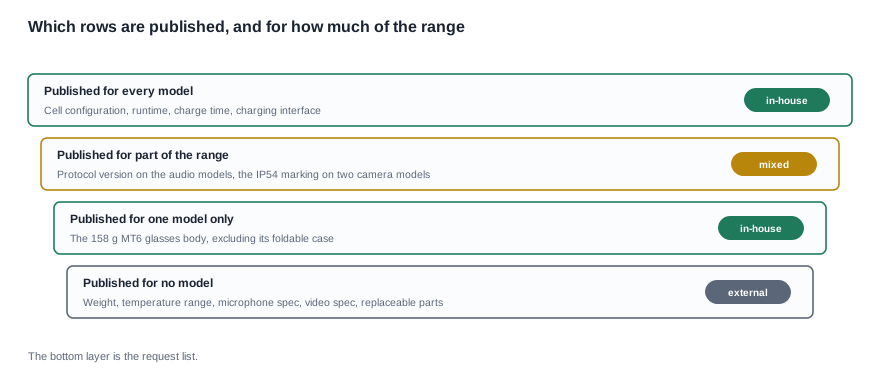
The rows that are published for everything, and the rows that are published for nothing
Two lists decide how long a request will take, and a buyer who has both lists before writing the request will finish in a fraction of the time.
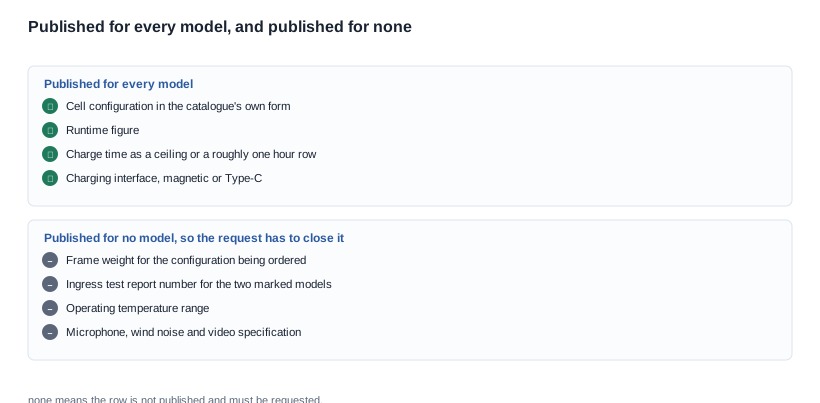
Published for every model in the range: cell configuration, runtime, charge time, charging interface, and for the audio and sport models the Bluetooth version. Published for the camera models additionally: the resolution class for the eleven camera models, and the case position for five of them.
Published for no model in the range: frame weight, except for the MT6 glasses body at 158 g; the ingress test report number, for the two models that carry a marking; the operating temperature range; the microphone and wind-noise specification; the coating specification; the field of view, frame rate and video format on the camera models; and the field-replaceable parts list.
The first list is what a quotation can be built on. The second is what a request has to be built on, and it is the reason a sport and outdoor programme in this category is a documentation project at least as much as a selection project.
Where certification sits
The catalogue carries a company-level export certification page whose content is images rather than text, and the catalogue text itself contains no reference to CE, to FCC or to RoHS. There is no per-model certification row anywhere. The compliance block that an earlier version of the site carried has been removed rather than repeated, and no certificate number can be quoted for a configuration being ordered. The certification checklist sets out how to request that documentation properly rather than assuming it.

Three questions to put to a supplier about this range
Which configuration does each published row apply to? Almost every row in the range describes a configuration, and the configuration is what a buyer is actually ordering. A weight for one variant does not cover another, a case capacity that sits in the same row as two variant names is ambiguous until the correspondence is published, and a colour list applies to one model rather than to a family.
Which of the absent rows can the supplier close in writing, and which cannot? A supplier who can close the frame weight, the ingress basis and the temperature range converts three open rows into three decisions. A supplier who cannot leaves the buyer with a sample programme and a longer schedule, and that is a legitimate answer as long as it is given as an answer rather than as a silence.
Which destination markets does the certification cover, per configuration? The catalogue carries a company-level export certification page whose content is images rather than text, and no per-model certification row. The certificate numbers and the model scope therefore have to be requested against the ordered configuration and the destination market, and a request that asks for a general answer will receive a general answer that cannot be printed on a box.
How to read the range against your own shortlist
An overview is only useful if it changes what a buyer asks for, and in this category it changes three things.
It splits the request. The camera models and the audio models need different documents. A camera request needs the sensor and video specification, the storage behaviour and the imaging pipeline; an audio request needs the acoustic measurement, the microphone behaviour and the leakage figure. Asking for both in one letter is what produces a generic reply.
It narrows the water claim to two models. If the range requires a published ingress marking, the shortlist is the V06 and the S7, and the request is about the report rather than about the product. What a marking establishes, and what it leaves open, is set out in the ip ratings reference, and it is worth reading before the wording goes onto artwork.
It moves the frame weight question to the top. No sport or outdoor model in the range publishes a weight; the single weight the catalogue records sits on a camera model that ships with a foldable case. A range whose selling point is lightness will be compared on lightness in the channel, and that comparison has to be settled with a measured sample rather than with a catalogue row.
What this overview does not settle
This page does not recommend a model, and it is not able to. It does not price anything, and no price, price tier or comparison against another supplier's pricing appears in it or in our documentation. It does not state which configuration suits which channel, because that conclusion cannot be traced to a published row. And it does not settle the three rows that decide most of the commercial outcome in this category: the frame weight, the ingress test basis and the operating temperature range.
Two further things are deliberately absent. There is no price, no price tier and no comparison against another supplier's pricing anywhere in this page or in our documentation, because a range is compared on the rows it publishes rather than on a number we do not publish. And there is no warranty period, no lead time and no minimum order quantity stated, because those are the terms of a quotation rather than properties of a product, and they belong in a document that is specific to a configuration and a volume.
What it does settle is the structure. Two camera models carry an ingress marking, three camera models carry a thirteen-megapixel class, every audio and sport model publishes a protocol version and an interface, and the rows listed above as published for nothing are the ones a request has to close.
We publish the sport and outdoor range as the catalogue records it, with the model names, the cell configurations, the runtimes, the charge times, the charging interfaces, the published case positions and the two ingress markings, and we do not extend a marking into a claim or a cell capacity into a weight. Smart glasses for sports and outdoor overview is a map of what is documented and what is not, and the second half of that map is the part a buyer has to commission.
The sport smart glasses range lists the models in full, and the wider position of the segment is covered on the sports and outdoor solutions hub.


