

Running inverts the usual priority order in this category. A long hike, a race or a ski day makes endurance the binding constraint, because the session outlasts the battery. A run does the opposite: the session is short enough that every published runtime in the catalogue covers it several times over. What binds instead is whether the product stays on the head through sweat and repetition, whether the rider can hear the road beneath the audio, and whether the charging routine survives contact with a runner who charges the device at night and does nothing about it for the rest of the week.
So smart glasses for sports and outdoor running use case is best assessed against those three things first, with the published data showing exactly where the assessment stops.
Who is making the call
A running brand owner is deciding whether a smart glasses line belongs in a running range, and in this category the deciding question is usually durability rather than capability.
A procurement manager is assembling the request, and the rows that matter for a running product are the frame weight, the ingress basis and the interface, not the runtime.
A channel buyer is comparing candidates against a shelf of lightweight sports eyewear, where the weight comparison is made before any feature is read.
Smart glasses for sports and outdoor running use case: what a run actually asks for
Three conditions distinguish a running product from an outdoor product generally, and each of them lands on a row the catalogue either fills or leaves empty.
Sweat is persistent liquid contact. A runner's head is wet for the duration and the moisture sits exactly where the electronics, the control surface and the charging contact are. On the V06 and the S7 the ingress marking reaches only as far as water splashed from any direction; sweat is something else entirely, a continuous film held against the contact, and it is the reason a magnetic interface is the part of a running product that matters most.
Repeated impact at the temple. A footfall puts a vertical load through the arm on every stride. Over a long run, that is thousands of cycles at the temple joint, and it is the load path that separates a product which lasts a season from one that does not. No model in the range publishes an impact rating or a vibration rating.
Nothing is charged mid-session and nothing is adjusted mid-session. A runner charges the unit the night before and adjusts the product once, if at all. That makes the charging routine a weekly event rather than a daily one, and it makes the adjustment a fixed property of the unit rather than something the wearer manages.
Why the charge routine matters more than the charge time
A runner charges the device once a week at best, and that changes what the interface has to survive rather than how quickly it can fill. A charge time of two hours or less is irrelevant to a product that sits in a drawer for six days; what matters is whether the contact still works on the seventh day after the last time it was wet.
That is the practical reason the interface split matters more in running than the charge time does. The YKC02, the V06 and the S7 charge magnetically, and the D17 and the ZH12 charge over Type-C. A magnetic contact sitting in a damp temple develops a film, and the symptom is a unit that charges intermittently on the one evening a week it is actually charged. A sealed port has no mating surface to corrode, and it has a cost instead, which is the cable a runner has to carry and the second cable type a range that spans both interfaces needs.
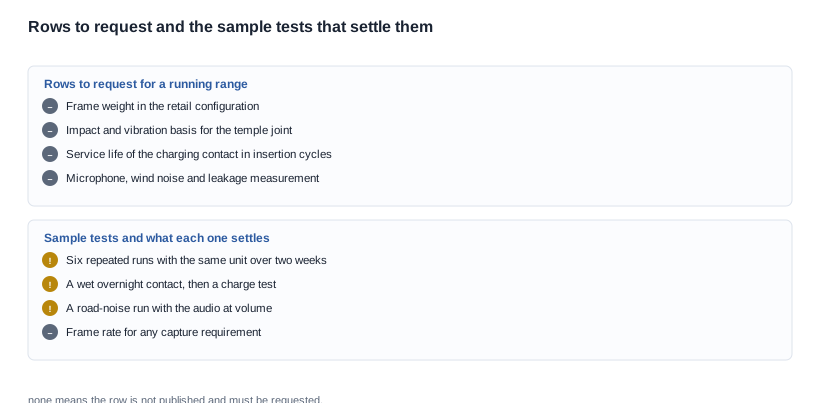
Neither side of that trade-off is published as a wear figure, because the service life of a charging contact in insertion cycles is not published for any model in the range. That absence is the single most commercially useful gap to close in this category, and it is a one-line question to a supplier.
The criteria a running decision is judged against
Four criteria decide this category, and the order is the reverse of the one used in the longer outdoor sessions.
Does it survive the season? This is first in running and it is decided by rows that are not published: no impact rating, no vibration rating, no service life figure for the charging contact and no field-replaceable parts list for any model.
Does it stay put through sweat? The published adjustable features are the removable inner frame on the V06 and the S7 and the detachable temple on the G07. The frame weight is published for a single model in the whole catalogue, the MT6 glasses body at 158 g excluding its foldable case, and not for any running candidate, so the hold question is answered by a sample rather than by a row.
Can the runner hear the road? No model in the range publishes a microphone specification, a wind-noise figure or a leakage measurement, and running is the case where a wind-noise figure would matter most, because airflow across the ear is continuous and the microphone is close to the source.
Does the charge routine work? The published charge times are two hours or less for twenty-six of the twenty-eight models and roughly one hour for the D17 and the ZH12. For a product charged once a week, the charge time barely matters; the interface and the contact's resistance to sweat do.
The published rows behind a running range
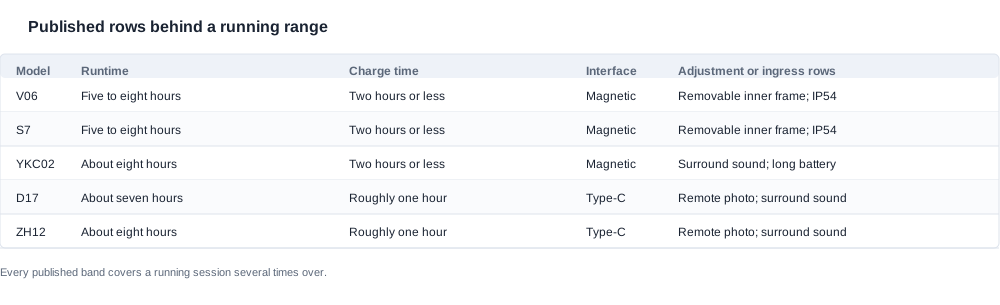
The table below sets out the published position for the models that come up in running conversations. The right-hand column is the request list.
| Model | Published runtime | Published charge time | Published interface | Published adjustment or ingress rows |
|---|---|---|---|---|
| V06 | Five to eight hours | Two hours or less | Magnetic | Removable inner frame; IP54; four colourways |
| S7 | Five to eight hours | Two hours or less | Magnetic | Removable inner frame; IP54 |
| YKC02 | About eight hours | Two hours or less | Magnetic | Surround sound; long battery life |
| D17 | About seven hours | Roughly one hour | Type-C | Remote control photo; surround sound |
| ZH12 | About eight hours | Roughly one hour | Type-C | Remote photo; surround sound |
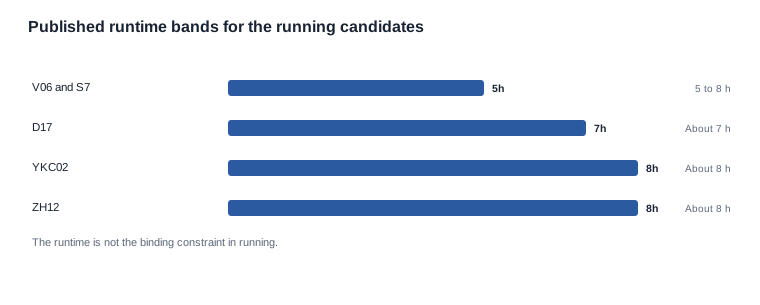
The runtime row is not the constraint in running
It is worth stating plainly, because it changes what a buyer asks for. The published runtime bands for the candidates are five to eight hours on the V06 and the S7, about eight hours on the YKC02 and the ZH12, and about seven hours on the D17, and a run of thirty minutes to two hours is covered by every one of them. Nobody should select a running product on the runtime row, and a buyer who does will have chosen on a figure that does not discriminate.
What the runtime row does tell a running buyer is about the duty pattern. A product rated for a long session is not the same as a product that survives being switched on and off many times a week, and the catalogue publishes no figure for the second case. The practical consequence is that the weekly charge is the routine, and the routine is where the interface has to be specified.
The ingress marking and the charging contacts
Two models carry an ingress marking and neither carries a test report number behind it. There is a second question specific to running that the marking does not answer either: whether the rating was established with the charging contacts capped. On a magnetic model those contacts are exposed, and they are the most likely ingress path on the product.
That is not a reason to avoid the two models. It is a reason to know that the claim is a claim, and if a channel needs evidence rather than a marking, that evidence has to come from a test report for the ordered configuration. The ip ratings reference covers what a marking establishes.
What the published rows say about colour and configuration
The V06 publishes four colourways and the V03 Pro publishes three, and those are the only two colour rows in the catalogue. For a running range, that is a narrow but real constraint: the sport camera model has a documented palette and the audio models have none, so a brand planning a colour story across the range has one documented source and one set of requests.
The configuration question that follows is the same one the range has to ask about every other row. Which colourway does a published weight refer to, and does the colourway change the charging method or the case position, and is a published ingress marking held for every colourway or only for the ones that were tested. None of that is published for any model, and all of it is a reasonable thing to put into a request.

Choosing between the camera models and the audio models for a running range
When capture is the proposition
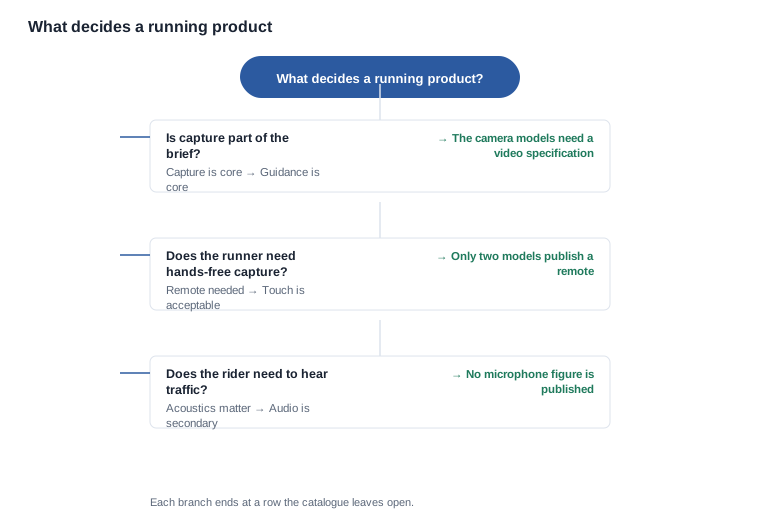
A running camera product is a content product, and the published rows that matter are the ones about the image pipeline. The V06 and the S7 publish the resolution class and nothing else about imaging: no sensor model, no field of view, no frame rate, no video format, no stabilisation behaviour and no storage capacity. For running specifically, that list has one item in it that cannot be deferred, which is the frame rate, because a runner's movement and the camera's exposure interact and a low frame rate changes what the footage is usable for.
The published five-to-eight-hour runtime and the 260 mAh cell are the same on both models, so the decision between them is a content decision rather than an electrical one.
When guidance is the proposition
An audio product for running is simpler to document and simpler to support, and the two models with a published remote shutter, the D17 and the ZH12, are the only ones that remove the need to touch the temple during a run. For a running brief that centres on hands-free capture, that is the relevant published row.
Both of those two models are Type-C and both publish roughly one hour of charge time, which means one cable type covers a range built on them.
How to choose between the two when both are in the range
A running range that carries both a camera product and an audio product is making two purchases, and the way to choose between them is to separate the decision the runner makes from the decision the brand makes.
The runner chooses on what the product does during the run, which is capture, guidance or both. The brand chooses on what the product does after the run, which is the return rate, the documentation burden and the parcel. A camera product wins the first comparison when the channel is content-led, because the audio performance of a camera model is not published and cannot be set against the audio models on a row. An audio product wins the second comparison almost always, because it carries fewer unclosed rows and a simpler parcel.
The two decisions are often made by different people inside the same brand, and the mistake that follows is to let the first one set the second. Writing them down separately, with the published rows each of them depends on, is the cheapest way to avoid it.
When the product is a coach or a companion experience
A third running brief exists in which the product is not for the runner at all, and the published rows that decide it are the acoustic ones. Whether a runner can hear a coaching instruction with traffic present is a function of leakage, of the microphone behaviour and of the output level, and none of those three is published for any model in the range. A brief in this shape has to be tested acoustically on a sample, and it has to be tested in the conditions the runner will meet rather than in a quiet room.

Testing a running configuration before the range is committed
Three of the checks are short enough to run between two sessions, and that is the practical advantage of running over hiking.
The repeated-run test. The same unit, run five or six times over two weeks rather than once. This is the only way to see what a single demonstration cannot show, because the failures in this category are progressive: a contact that charges slightly less reliably, a temple that moves slightly more, a hinge that develops slightly more play. A single run shows none of them, and a season of them is what a channel actually experiences.
The sweat immersion test. The unit used for a run, then left in a wet environment overnight, then charged. A contact that has been wet overnight is the commonest cause of the intermittent-charging complaint in this category, and the test takes a minute and costs nothing.
The road-noise test. The unit worn on a busy road with the audio running, recording what the wearer hears and what the microphone captures. The certification checklist covers the documentation side of the same decision, and it is the right place to read before the listing wording is written.
What the repeated-run test actually shows
The repeated-run test is the only one in this category worth the effort, and it works because the failures it looks for are progressive rather than sudden.
A contact that charges intermittently is not intermittent from the first run; it is intermittent from the fourth or fifth, and each run adds a little more film to the same surface. A temple that moves is not obviously loose on the first run; it is a little looser than it was, and the runner adjusts it a little further each time. A hinge that develops play follows the same curve. None of these is visible in a single demonstration, and all three are what a channel experiences over a season.
Running the same unit five or six times over two weeks also produces the return-cause data the category is missing. Most distributors collect the reason for a return when the unit arrives, and most of them collect it in a way that mixes the causes together. A repeated-run test with a note for each symptom turns the demonstration into the beginning of a dataset, and that dataset is what makes the quarterly supplier questions answerable.
What a running range costs to source and support
A running range is a high-volume, low-price, high-return category, and the commercial structure follows from that rather than from the specification.
The returns dominate the economics
In a category where the product is bought on impulse and used hard, the return rate sets the margin rather than the unit price. That makes the two unpublished rows — the frame weight and the interface service life — the two rows with the largest commercial consequence in the whole request, because one of them determines whether the product stays on the head and the other determines whether it keeps charging.
The accessory set is small and must be exact
A running range rarely ships with a case, because the published case positions in the camera group include three models with no case row at all and one model has no charging-case row. What it does ship with is a cable, and the interface split means the cable type has to be right for the model. The sport smart glasses range lists the models, and the sports and outdoor solutions page places the segment in the wider catalogue.
The two documents the range has to produce
A running range has to produce two documents, and both of them are usually left until too late.
- The product documentation, which is where the weekly contact check, the storage instruction and the exposure wording belong. A routine that lives in a support article reaches the customer after the failure; a routine that lives in the box reaches them before it.
- The channel listing, which is where the weight, the runtime and the water wording are published. Every figure on that listing has to be traceable to a row or to a measurement, and the two that are most often not traceable are the weight and the water claim.
A third document, the service kit instruction, follows from the same work and is usually the one that is missing entirely, because it depends on a supplier's answers about the seal and the recommended wiping method, and those answers are requested only when the first return arrives.
The lines a running range is decided on
A running range is a high-volume programme with a low unit price, which means the terms that decide whether it works are the ones attached to volume and the ones attached to returns.
- Unit price and the volume breaks — negotiable.
- The cable and accessory set — its own order quantities.
- The packaging specification, and how a delivery is split.
- Terms of payment — released against a passed inspection.
- Cover — how long it runs and what reply it promises.
- Returns for a running channel — how a returned unit is handled.
- The conditions of an opening order.
- The cost of certification and of tooling — outside negotiation: the amount and the schedule follow the testing body, tooling is often spread over the launch tranche, and certification is charged per product family. A quoted line that names one of them does not name the other.
What a running agreement should contain: the published rows for the configuration ordered, the frame weight as measured, the interface and the service life stated for it, the ingress marking with the tested configuration where a claim is made, and the warranty period with its stated response.
Omitted on purpose: a wind-noise or microphone specification, a waterproof or immersion claim, a weight that was not measured, and an image quality claim that was not checked on a sample.
We publish the running-relevant rows as the catalogue states them, and we do not turn the marking the V06 and the S7 carry into a rain or sweat claim. Smart glasses for sports and outdoor running use case is decided by what survives a season of sweat and repeated use, and for the candidates in our range that is a question for the sample rather than for the datasheet.


