

Safety in a sports or outdoor product is usually discussed as a design property, and in this category it is closer to a documentation property. That is not a criticism of the engineering; it is a consequence of the fact that the published specification in this range is thin enough that a safety claim cannot be substantiated from a catalogue alone. This page is written for the brand and the distributor who have to decide what may be claimed, and it sets out what has to be established before a safety claim can be made and what the published data supports.
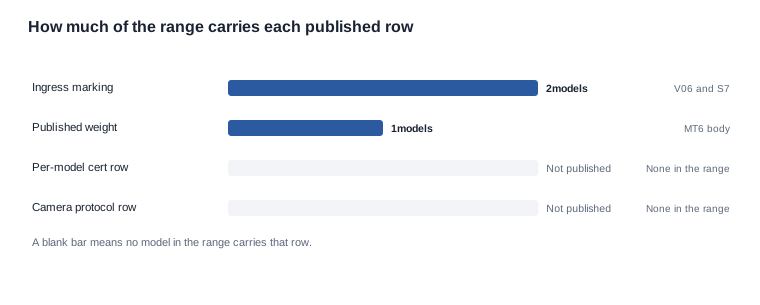
The published position in the sport and outdoor range is narrow and specific. The V06 and the S7 carry an ingress marking, and no third-party test report number stands behind either. An export certification page exists at company level in the catalogue, though the page itself is pictures rather than words, and the written catalogue names neither CE nor FCC nor RoHS. Per-model certification rows do not exist anywhere in the range. No model publishes an impact rating, a vibration rating or an operating temperature range, and the only weight figure in the catalogue is the 158 g MT6 glasses body, excluding its foldable case.
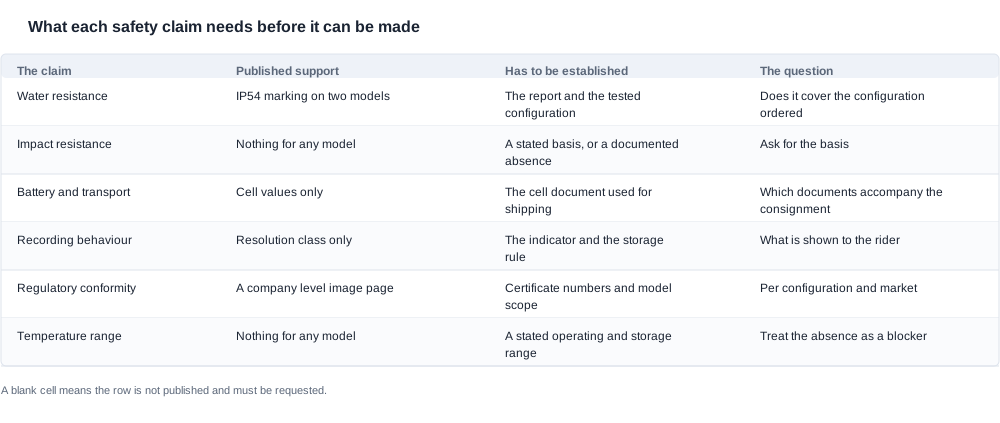
Who carries the risk, and who makes the claim
A brand owner is deciding what may be printed on a box, and a safety claim that cannot be defended becomes a warranty claim and then a regulatory exposure.
A distributor is deciding what goes on a shelf card, and a shelf card is a public statement of the brand's position.
A procurement manager is deciding which open rows have to be closed before a channel can be entered at all, and which are acceptable to leave open for the first order.
These are three different exposures of the same underlying fact, and the documentation set that satisfies one of them does not automatically satisfy the other two.
Smart glasses for sports and outdoor safety: what may be claimed and what may not
The working rule in this category is simple. A claim is defensible when it is backed by a document that exists, names the configuration it applies to, and says what it does not cover. A claim that is backed by a catalogue annotation, by a product name or by a customer's expectation is not defensible, however reasonable it sounds.
Six claims a sport product invites
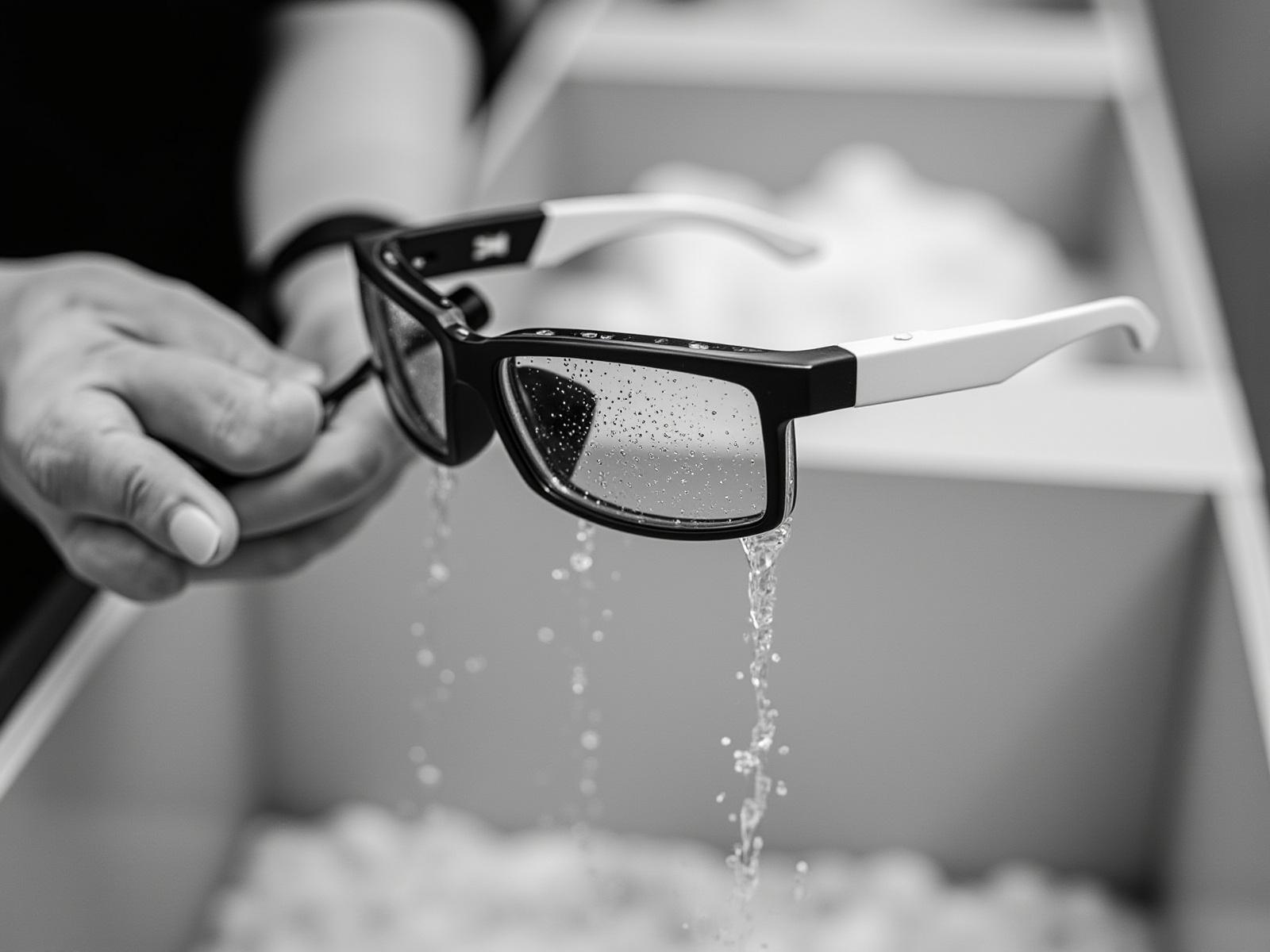
Water resistance. This is the claim most often made and the most often overstated. In that notation the second digit of a 4 speaks only to water arriving from any direction; immersion, a pressure jet and a unit left wet overnight in a closed bag all sit outside what it covers. A marking is also a claim about a configuration, and the configuration is rarely stated.
Impact and durability. A sport product invites the claim that it is built for the sport. Nothing in the published rows supports a specific impact or vibration figure for any model, and the frames in this range are heavier than an optical frame of the same geometry because the section carries electronics.
Battery safety. A lithium cell is involved, and a brand that ships into multiple markets has to deal with the transport requirements that follow from it. The cell's test documentation is part of the shipping paperwork, and none of it is visible in a product catalogue.
Recording and privacy. A camera product records other people in a public place. What the rider is shown, where the file goes and how long it is retained are not published for any camera model in the range.
Regulatory conformity. CE, FCC and RoHS are the questions a European or North American buyer asks first. The catalogue text does not mention them, and there is no per-model certification row.
Children's use. The range includes three children's models, and the published rows for them are different in kind from the rest of the catalogue. Any safety or health statement for those models carries a higher exposure than a statement for an adult product, and the correct position is that the brand makes no such statement.
What a certification answer has to contain
When a supplier answers the certification question, the answer is useful only if it contains three things, and it is worth asking for all three in the same request because a partial answer creates another round.
The certificate number. Not the standard name, not the test body, not a statement that the product is compliant. The number, because the number is the thing a distributor's file records and the thing that can be checked against the model scope.
The model scope. Which models the certificate covers, and whether a variant within a model — a different colourway, a different case position, a different charging interface — sits inside or outside the scope. The certification scope is where a brand discovers that the configuration it ordered is not the configuration that was certified.
The date and the issuing body. Because a certificate that has been withdrawn or superseded has to be caught before it is printed, and because the buyer of the product is not the same party that obtained the document.
Asking for the three together is also the fastest way to establish whether the answer will exist. A supplier that can produce all three for a configuration has a documentation process; a supplier that answers with a standard name alone does not, and the difference shows up later as a slow response to every compliance request.
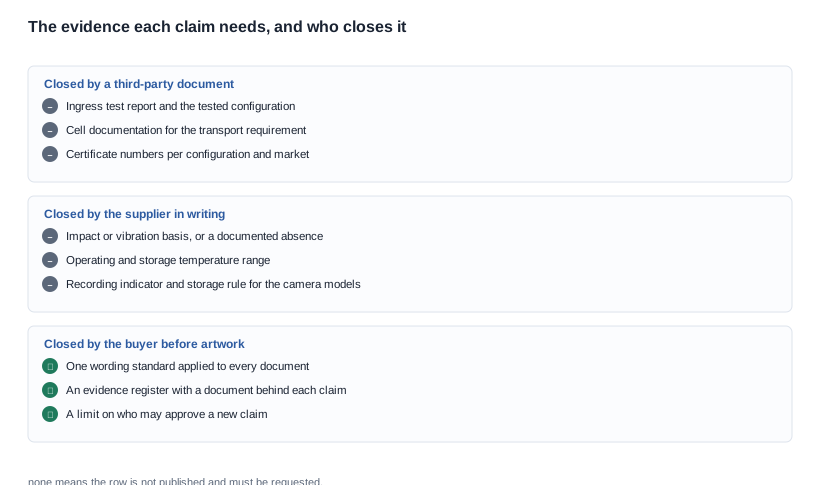
The claims a sport product invites, and the evidence behind each
| The claim | What the published data supports | What has to be established | The threshold or the question |
|---|---|---|---|
| Water resistance | An IP54 marking on the V06 and the S7, with no third-party test report number published | The report, the tested configuration and the condition the test covered | Does the report cover the configuration ordered, and does it cover the contact area |
| Impact resistance | Nothing for any model | A stated impact or vibration basis, or a documented absence | Ask for the basis; if none exists, describe the construction instead |
| Battery and transport | Cell configurations for every model; no transport documentation published | The cell test documentation used for shipping | Ask which documents accompany the consignment |
| Recording behaviour | Resolution class on the camera models; no recording indicator published | What the rider is shown and how the stored file is managed | Ask for the recording indicator and the storage rule |
| Regulatory conformity | An image-only certification page; no per-model row | The certificate numbers and the model scope per destination market | Ask for the numbers against the ordered configuration |
| Temperature range | Nothing for any model | A stated operating and storage range | Ask for the range; treat the absence as a blocker for a winter market |
The questions a distributor's compliance team actually asks
The questions a buyer asks in a due diligence file are narrower than the ones a marketing team worries about, and they come down to four.
Which document supports this statement, and which model does it cover? A distributor's file does not need the product's capabilities; it needs the document, the model scope and the date. A claim that cannot be answered with those three is normally removed from the listing rather than defended.
What is the limitation on the same page as the claim? This is the question that decides whether the wording survives contact with a customer's own reading of it. A splash rating with a limitation that says so is defensible. The same rating with the limitation only in an internal document is not, because the customer will only ever see one of the two.
What happens when the claim is wrong? The distributor's question is about its own liability, and the answer that satisfies it is a warranty position with a stated response time and a stated remedy, rather than a general assurance that the product is safe to use.
Which markets is it sold into, and does the evidence change per market? A certificate with a scope that covers one configuration and one market is a different document from one that covers a family in several markets, and the second is the one most brands believe they have.
None of the four questions is answered by a product page. They are answered by the evidence register, which is why that document is the practical output of a safety review rather than a formality attached to one.
Where the evidence for a claim actually comes from
Three of the six claims above cannot be closed by a catalogue page at all, because the catalogue is not where the information lives. The ingress evidence is a third-party document. The regulatory evidence is a certificate with a number. The battery evidence is a cell document that travels with the consignment. A brand that expects to answer a due diligence question from a product catalogue is going to be disappointed, and a brand that expects to answer it from a supplier document package is going to be fine.
That distinction also settles an internal argument that runs long in this category. The question is never whether the product is safe to sell; it is whether the brand can demonstrate what it is selling. The second question is answerable with paperwork, and it is the one a distributor's compliance team will actually ask.
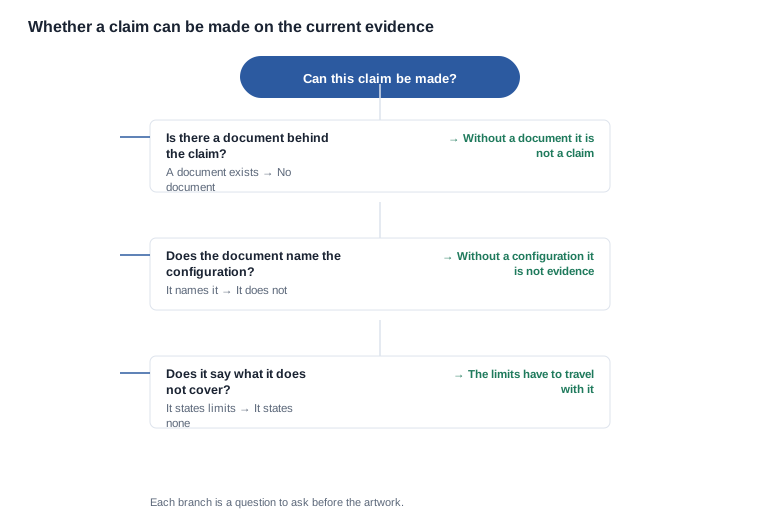
The published position behind those claims
Three facts about the catalogue decide most of what can be said.
The ingress marking exists on two models and nowhere else. The V06 and the S7 carry it; no other model in the range carries any ingress marking, and no report number from a third-party test is published for either. A range that wants a water claim has two candidate models, and the evidence for the claim is a document the brand has to obtain rather than a line it can quote.
There is no per-model certification row. The export certification page in the catalogue is an image page rather than a text page, and the catalogue text names none of CE, FCC or RoHS. Our published material names none of those three either, and the compliance block that an earlier version of the site carried has been removed rather than repeated. The consequence for a buyer is precise: there is no certificate number to quote for a configuration being ordered, and the number has to be obtained before the artwork is produced.
Several rows that a safety argument would use are empty. No impact rating, no vibration rating, no operating temperature range, no seal material, no coating specification and no interface service life in insertion cycles are published for any model. A safety argument built on those rows has to be built on something else.
The three children's models and their own exposure
The range includes three children's models, and they need to be handled separately rather than as a variant of the adult range. The A05 and the A06 are published with the same set of feature rows, which name a fogging unit, correct and incorrect posture-and-distance prompts, and lens clarity and lens fogging. Those rows are the catalogue's own, and what they describe is a device that senses and prompts.
What they do not describe, and what must not be inferred from them, is any protective or corrective effect on eyesight. A brand that repeats those rows as a benefit claim has converted a description of a function into a claim about a person's vision, and that conversion is the single largest avoidable exposure in this catalogue. The A07 publishes a 70 mAh cell, a magnetic interface and a Bluetooth version, and it carries no feature rows at all.
The commercially correct position is that the catalogue lists these rows for the two models and that the brand's own literature describes the functions without a health or protective outcome attached to them. Any question about whether that is sufficient belongs with a compliance reviewer before the product is listed, not with the copywriter.
Building a safety case a channel will accept
A channel will accept a safety position that is specific, limited and documented. It will not accept a general assurance, and it does not need to.
Four documents that make up the position
- The evidence register. A one-page list of every safety claim the brand makes, with the document behind each one, the configuration it covers and the date it was obtained. This is the document a due diligence request is answered from.
- The wording standard. One sentence that defines what the brand will and will not say about water, and it is applied to every artwork, listing and instruction sheet without exception.
- The limitation set. The conditions the evidence does not cover, written in the same place as the evidence, so that they travel with it. An ingress report that covers a splash test and a limitation that says so are the same sentence, not two documents.
- The escalation path. Who signs off a new claim, and what evidence they require before signing.

What an evidence register looks like in practice
A register is a table, and the value of it is entirely in what the columns are. The useful version has one row per claim and the following columns: the exact wording as it appears in the listing, the document behind it, the models the document covers, the conditions the document excludes, the date it was obtained, and the person who approved the wording. Anything shorter than that becomes a list of intentions rather than a register, and a list of intentions cannot answer a compliance question.
Two disciplines make the difference between a register that works and one that does not. The first is that a claim cannot be added to any document without a row in the register, which means the artwork and the register are checked against each other rather than separately. The second is that a row is closed when its evidence expires, not when it is forgotten, because the most common failure in this category is a claim that was supported two years ago and whose supporting document has since lapsed.
There is a third discipline that costs nothing and that most brands skip: a column for the claim the brand decided not to make, and the reason. A record of the refused claims stops the same argument being reopened every time a new channel or a new market is added, and it is the cheapest way to keep a safety position stable across a catalogue that is growing.
What the brand should not do
Three habits cause most of the problems in this category. The first is printing the marking next to a stronger word, because the two are read together and the stronger word is the one that is remembered. The second is generalising a claim from one model to the family, which is safe only where the evidence actually covers the family. The third is treating a supplier's verbal assurance as documentation, because the point of the evidence register is that it can be handed to somebody who does not trust anybody.
Where a safety position costs money
Certification is the cost everybody expects, and it is the one that is hardest to compress, because the testing body sets the schedule rather than the factory. Tooling is the other, and it is often amortised across a first order while certification is charged per product family, so the quotation has to be read for which of the two it actually prices.
- Price per unit and the tier boundaries — negotiable.
- The accessory set — order quantities of its own.
- The packaging and labelling specification — where the wording standard is operationalised, and it is cheaper to get right as a packaging item than as a legal one.
- Payment terms — released once the inspection clears.
- Cover — how long it runs, plus the response time.
- The returns policy for the channel — what decides whether an unsupported safety claim becomes a cost centre.
- The conditions of a trial order.
- What certification costs, and what tooling costs — set by the testing body rather than by the factory, and a buyer should establish which of the two the quoted line actually prices rather than reading the single line they were shown.
A safety position is only defensible if the agreement behind it is written down, and the written part should carry: the published rows for the configuration ordered, the ingress evidence with its tested configuration, the certificate numbers and their model scope per destination market, the cell documentation that accompanies the consignment, the wording standard, and the warranty period with its stated response.
Nothing enters that has not been evidenced: no waterproof or immersion claim, no impact or durability figure, no protective or corrective statement about eyesight, and no recording or privacy assurance the published rows do not support.
We publish the ingress markings exactly as the catalogue states them, we publish the absence of per-model certification rows rather than a general assurance, and we do not convert a feature row for the two children's models into a protective or corrective claim. Smart glasses for sports and outdoor safety considerations is settled by what the brand can evidence for a specific configuration, and the catalogue is the starting point for that evidence rather than the end of it.
The sport smart glasses range lists the models this position applies to, the outdoor solutions hub places the segment in the wider catalogue, and the ip ratings reference covers what a marking establishes and what it does not.


