
The homework-table problem
Parents are nagging about distance and fog, not asking for more screens
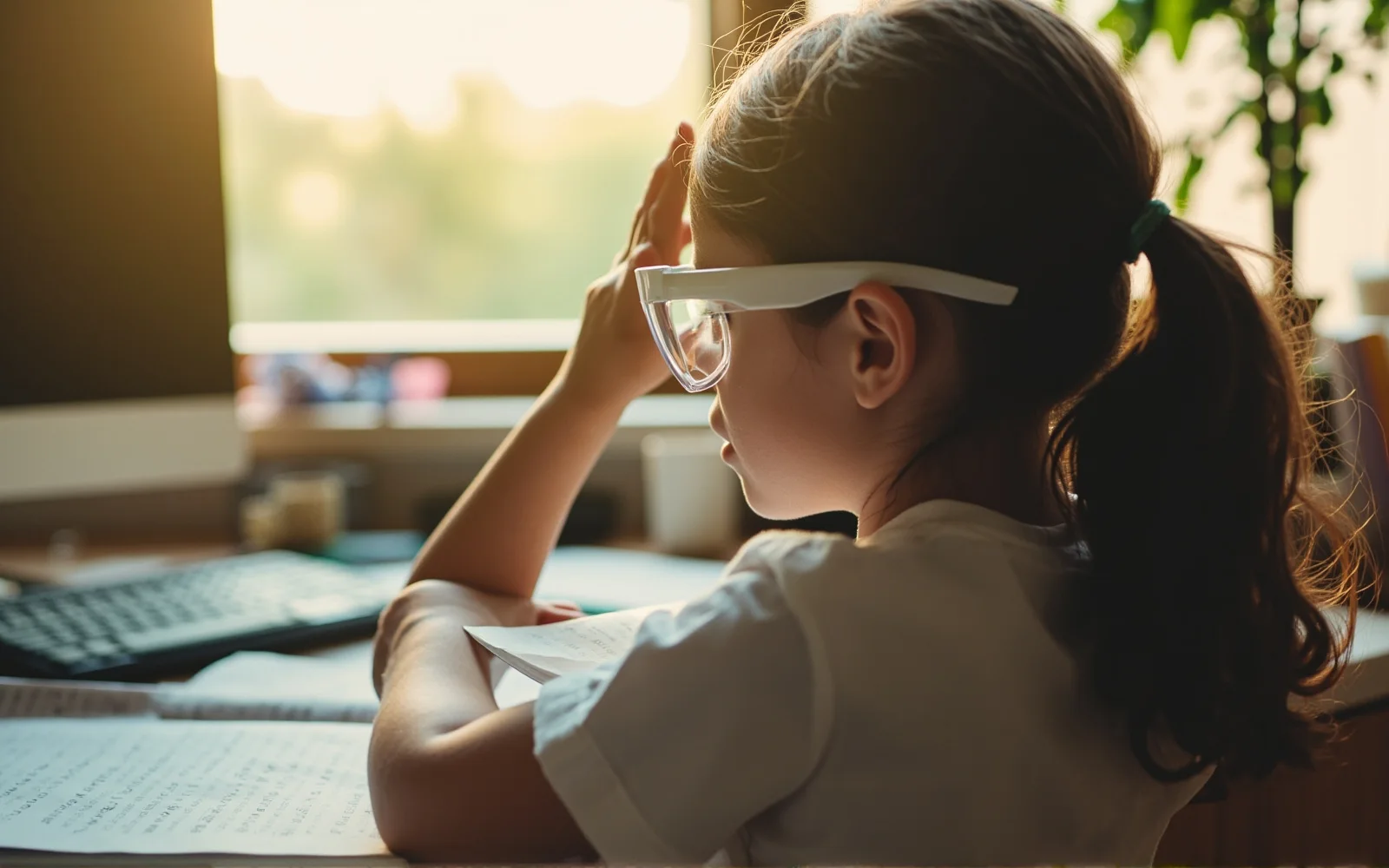
Watch a seven-year-old settle into homework and the pattern is immediate. Five minutes in, the book is on the chest and the chin is almost on the table; twenty minutes later the lenses have fogged from masks, weather changes or simply running indoors, and the child is rubbing them on a sleeve. Parents repeat the same two corrections all evening — sit up, move the book back, wipe your glasses — and children learn to tune them out.
The instinct of many consumer-electronics brands is to answer this with another connected screen and another dashboard. That is the wrong product for this audience. Parents do not want to add a display to the one activity where they are already trying to manage screen time. What they want is the object already on the child’s face — the glasses — to handle two small jobs quietly: keep vision clear, and offer a gentle, neutral cue when reading distance or posture drifts.
The A05 and A06 kids protection frames are designed around exactly those jobs. An electronic anti-fog atomizer helps keep lenses clear through temperature changes, masks and active play, while posture and reading-distance reminders encourage a more comfortable viewing distance and an upright position. Neither feature asks the child to look at a screen; both run on ordinary-looking glasses.
The honest boundary matters here, because parents are rightly skeptical of medical marketing. These are comfort and habit aids for everyday eyewear, not medical devices. They do not diagnose, treat or correct vision, and they make no clinical claim about myopia. The general category and its limits are described on the kids smart glasses pillar; specific product claims are confirmed per program.
How the aids work
Anti-fog atomizer and posture reminders, as a child actually experiences them
The two features solve different moments in the day and are worth specifying separately rather than bundling into a vague “eye protection” promise.
Keeping lenses clear
Fog is the small annoyance that decides whether children keep glasses on. Stepping from a cold schoolyard into a warm classroom, wearing a mask in winter, or simply playing hard creates the temperature and humidity change that fogs a lens, after which children either stop seeing well or stop wearing the frame. The electronic anti-fog atomizer helps keep the lens surface clear so vision stays comfortable without constant wiping. How the feature behaves — when it activates and how the child or parent controls it — is configured per program.
Gentle posture and distance cues
When the child drifts into a very close reading distance or a slumped position, the glasses can deliver a gentle reminder rather than a parental instruction. Because the cue comes from an object instead of a person, it sidesteps the nagging loop: the child adjusts without an argument, and the parent stops being the reminder. The exact cue style, sensitivity and schedule are configurable, so a brand can match them to the age group and to the companion application its solution partner provides.
It is important to say what the reminder is not. It is not a medical measurement, not a vision test and not a guarantee of any clinical outcome. It is a habit nudge — the digital equivalent of a parent’s hand lifting a book to a comfortable distance. That framing is both more truthful and easier to merchandise to parents, who consistently distrust exaggerated vision claims in children’s products.
Beyond the homework table
Where clear lenses and habit cues get used every day
The strongest retail story for these frames is that the value shows up across ordinary daily settings, not only during a single homework session.
- Reading and homework. Distance and posture cues support a comfortable working position during the long, head-down stretches where parents intervene most often.
- School transitions. Moving between cold playgrounds and heated classrooms fogs ordinary lenses; the anti-fog atomizer keeps vision usable through the change.
- Mask-wearing and winter play. Masked commutes and temperature swings are the classic fogging moments that push children to stop wearing their glasses.
- Drawing, crafts and tablets. Any close, sustained head-down task benefits from the same neutral cue, without introducing another screen.
Families that also want audio — stories, music and family calls without an in-ear device — can pair the protection frames with the camera-free A07 in one range. That division is explained in the parental and safety controls guide, which covers the privacy questions parents actually ask.
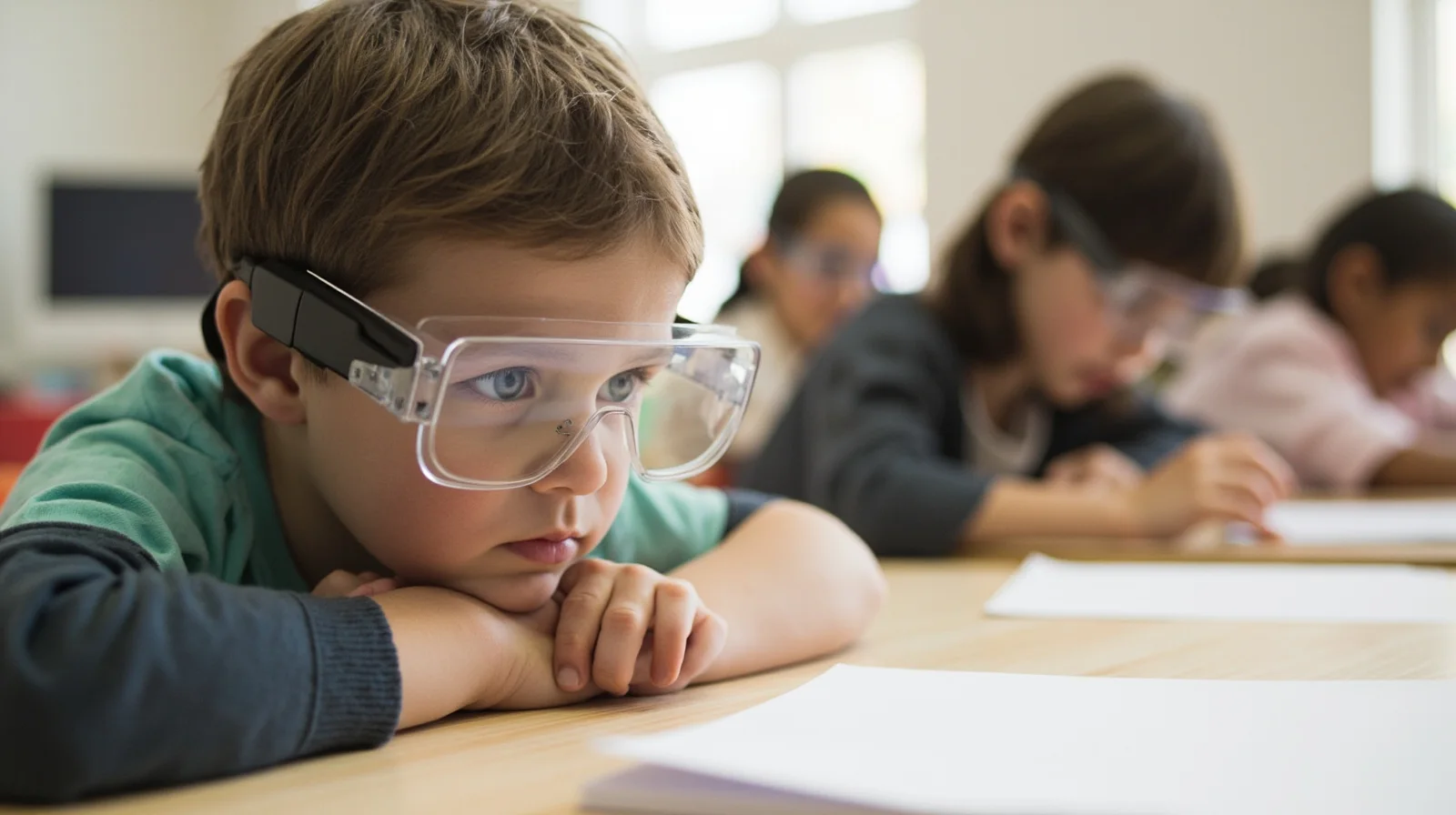
For mothers-and-baby and family retailers, the two feature sets map cleanly onto two shopper missions: “help my child read more comfortably” and “give my child audio without another screen.” A tiered range answers both from one shelf.
Specifying the hardware
Light frames, soft contact points and configurable reminders
Adult eyewear logic fails on children. A frame that is slightly heavy or slightly firm on an adult face is simply refused by a child, which is why kids geometry is an engineering brief rather than a colorway choice.
- Weight and balance first. Children notice every gram across a school day, so weight distribution, nose contact and temple pressure are reviewed rather than assumed. Final weights are stated on the program datasheet.
- Soft, durable contact points. Nose pads and temple tips use soft-touch materials selected for small faces and daily handling; frame finishes are chosen to survive being dropped into school bags.
- Configurable cue behavior. Reminder sensitivity, timing and style are set per program so a brand can match age groups and its companion software rather than shipping one fixed threshold.
- Power matched to the feature set. The power budget covers the atomizer and reminders across a realistic day; figures are confirmed per program rather than promised generically.
Materials, finishes and supporting safety documentation are aligned to each destination market’s requirements for children’s products — not asserted with a generic certificate logo. Lens options and the exact behavior of the anti-fog feature are likewise confirmed on the program datasheet.
For brands and retailers
How kids, maternity and family brands build a private-label range
The buyers for this category are rarely pure electronics companies. They include maternity and baby-product brands, children’s eyewear labels, family-lifestyle retailers and education-adjacent brands extending a trusted name into connected products. For all of them, the commercial logic is the same: the family already trusts the brand with products around the child, and connected eyewear extends that trust without requiring the brand to build a factory.
Most programs launch as a tiered range on the reference platforms. The A05 and A06 protection models lead the eye-care story, and the A07 camera-free audio model covers stories, music and family calls; the model-by-model choice is set out in the kids glasses buying guide. Shared frame language, colorways and packaging make the tiers read as one family on the shelf.
Branding depth follows the standard routes. Logo, color, case and family-friendly retail packaging are handled through customization; custom kids geometry, sizing and accessory tooling are possible through an ODM program with a proper engineering cycle. The Bluetooth pairing name and companion-app identity carry the brand, never a reference-model name. The same tiered approach is documented for consumer-electronics brands planning a connected kids line.
Building the program
From samples to a defensible kids product
A responsible kids program moves more cautiously than an adult consumer program, because the claims and the materials will be read by skeptical parents and cautious retailers. The sequence below is what we run through with brand partners.
- Scope the feature story honestly. Confirm that anti-fog and posture/distance cues are positioned as comfort and habit aids, with no vision-correction or medical language in packaging or retail copy.
- Select the platforms. A05/A06 protection frames, the camera-free A07, or both as a tiered assortment, matched to the shopper mission.
- Fit and materials review. Evaluate kids geometry, soft contact points and durable finishes on real children’s faces through fit samples.
- Market documentation. Align materials and safety documentation to the destination market, with exact claims and figures confirmed on the program datasheet.
- Sample, then commit. Reference-platform samples support retail and quality trials before volume; volumes, lead time and terms are confirmed per program.
Evaluation units are available through the samples process, and volume tiers are summarized on the MOQ guidance page. To start a specific brief — age range, target market, protection versus audio mix — use request a quote. The result is a kids product parents believe, because it promises the two small things it genuinely does rather than a medical claim it cannot stand behind.
Buying considerations
What to put in a kids eye-care eyewear brief
Age range and fit
Target age group, face-size range and whether fit trials with children are planned.
Feature mix
Anti-fog atomizer, posture/distance reminders, or both — and how the cue should behave.
Claim boundary
Comfort and habit-aid language only; no medical or vision-correction claims in any copy.
Materials and finishes
Soft contact points, durable frame finishes and the destination market’s kids-product requirements.
Power profile
A realistic school-and-home day for the configured feature set, stated on the datasheet.
Range structure
A05/A06 protection frames, camera-free A07 audio, or a tiered range sharing one identity.
Browse the application
More kids smart glasses guides
Keep exploring
Related reading
FAQ
Frequently asked questions
Do the glasses correct or protect a child’s eyesight?
How does the posture and reading-distance reminder work?
Can we add our own brand and packaging?
What is the battery life with the atomizer active?
What is the MOQ, and can we evaluate samples first?
Build this use case into a private-label program
Tell us the workflow, environment and volume. Engineering scopes the platform, optics, power and documentation per program.