

Most smart-glasses sourcing problems are not engineering problems. The hardware gets built, the line runs, the units arrive, and something is still wrong: a claim cannot be substantiated, a model string does not match a document, an inspection dispute has no reference point, and nobody can produce the record that was supposed to settle it. The gap is almost never a missing machine. It is a missing document.
This article is about the document set a buyer should hold onto, gate by gate, in the CYNRIN development framework. It covers what each document has to settle, how to organise the file so that it survives a staff change or an audit, and the questions to ask about documentation itself. It follows the development process overview and complements the account of the design and prototype stage in design and the prototype stage with the companion piece on how development actually runs.
Development process documentation: the gate-by-gate document set
The framework has six gates, and each one produces a document before it produces anything else. A gate is finished when a document exists and is signed, not when a date arrives. That is the whole organising principle for the file you keep.
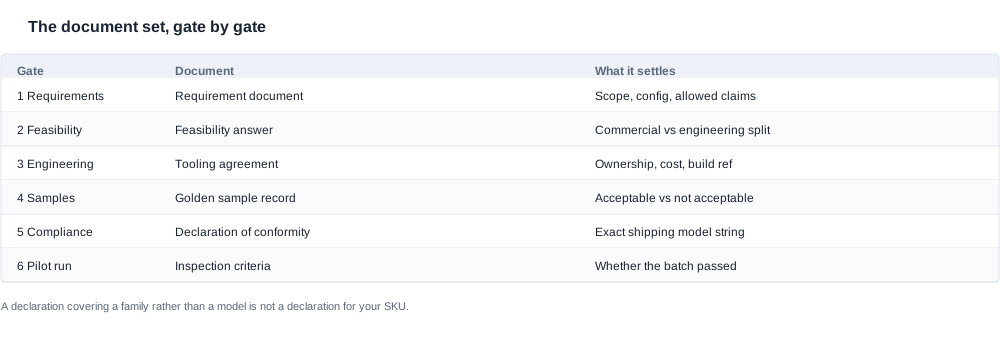
The full set, in gate order:
- Requirements frozen — the signed requirement document. States the target market, the models in scope, the configuration, the packaging, the delivery documentation, and, critically, which claims the product is allowed to make. This is the authority for the whole programme. Every later document is a descendant of it.
- Feasibility reviewed — the written feasibility answer. Whether the request can be built, and what it costs in engineering and tooling. The output is a boundary, not a verdict: what is commercially possible, what needs engineering investment, and the earliest date on which a real answer can be given. "Yes" and "no" are not useful answers here.
- Engineering and tooling — the tooling agreement and the firmware build reference. The tooling agreement records what tooling is being cut, who owns it, what happens to the tooling cost if the project stops at this point, and how ownership changes if it continues. The firmware build reference identifies the build, its version, and its feature configuration relative to the frozen requirement.
- Samples built and verified — the signed golden sample and its verification record. The golden sample is the physical reference that defines acceptable and not acceptable. The verification record is the written evidence covering pairing, audio, charging, any camera function, and control behaviour.
- Compliance file closed — the declaration of conformity and the underlying reports. The declaration covers the exact model string that will ship, and it sits on top of the reports that support it plus the market-specific requirements that apply. A declaration that covers a product family rather than a model is not a declaration for your SKU.
- Pilot run before mass production — the inspection criteria and the pilot run record. The inspection criteria are written against the golden sample. The pilot run record is the evidence that a run on production tooling, at production volume, passed those criteria.
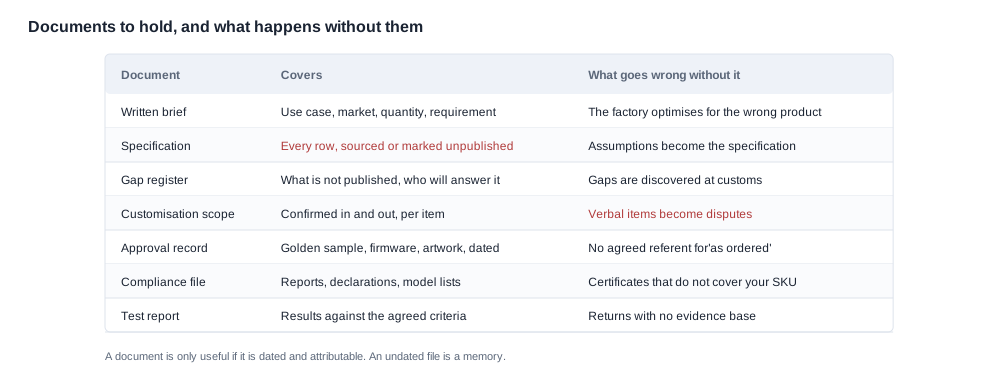
Alongside these six, three further items complete the file and are frequently omitted because nobody classifies them as gate outputs:
- The artwork and packing approvals. Dieline, print artwork, carton structure, labelling, and the approved master artwork file. These are signed and versioned because artwork changes late, often for a trivial reason, and an unversioned artwork file on both sides guarantees that the packaging in the warehouse does not match the packaging in the drawing.
- The open-items and deviation log. Every requirement line that was closed against a named component, every line that could not be closed, every deviation from the frozen requirement, with an approval for each. This is the document that stops the product on the line from quietly diverging from the product that was signed.
- The change record. Any change to the requirement, the specification, the firmware build, or the artwork after its gate was closed, with the date, the reason, the approval, and which downstream documents were reissued because of it.
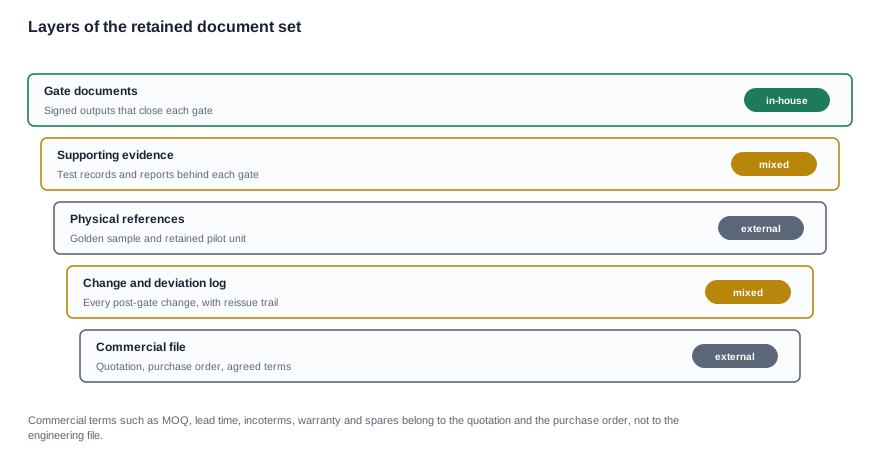
Note what is deliberately not in that list, and why. Capacity figures, stage durations, indicative schedules, prices, MOQ levels, lead times, sample fees, warranty terms, certificate numbers, factory size, headcount and annual output are not published by us and are not part of this framework's documentation set. That is not a way of hiding commercial terms; it is that those are quotation and agreement artefacts, not engineering records. They belong in the quotation, the purchase order and the contract — and, where you are evaluating a supplier, you should ask for them directly as commercial terms rather than expect them to emerge from a technical file. A supplier who cannot quote MOQ, lead time, incoterms and warranty terms without hedging is telling you something about their commercial operation that no engineering document will reveal.
What we will produce at every gate is the document that gate exists to produce, in a form that can be filed and referenced: requirements frozen as a signed requirement document, feasibility reviewed as a written boundary, engineering and tooling as a tooling agreement and a firmware build reference, samples verified as a signed golden sample and its verification record, compliance closed as a declaration scoped to the model string, and the pilot run recorded against written inspection criteria. Where a figure is commercial rather than technical, we will point you to the quotation rather than place it in the engineering file, so that the engineering file stays readable as an engineering record.

What each gate document has to settle
The value of a document is not its length. It is whether it settles a question that would otherwise be settled by memory, by assumption, or by whoever happens to be in the room.
The requirement document settles what the product is. If it has been written well, it can be checked against a delivered unit without asking anyone anything. Its weakest point is usually the claims section. Buyers routinely write the requirement around features and forget to write the marketing claims, then discover during compliance review that a claim discussed in a meeting was never written down and is now sitting on the product page. Claims must be in the requirement document, with an explicit statement of which claims the product is permitted to make. A claim discussed verbally but not written into the frozen requirement returns during compliance review, and it returns at the worst possible moment, because by then there is artwork, packaging and shipped units depending on it.
A related failure mode is easy to miss because it sits inside the buyer's own organisation. The requirement document is often signed by the product owner, while the compliance obligation lands on somebody else. A product owner can specify a feature. Only the person who owns the compliance file can specify what may be claimed about it. Where those are two people, the requirement document needs a named claims section and a sign-off that includes the compliance owner, not only the owner of the feature list. If that person never sees the document, the claims list gets written at the compliance gate instead, when artwork is approved and marketing copy is drafted, and the outcome is either a delay or a claim that goes out without being cleared. This is one of the cheapest problems in the whole process to fix and one of the most expensive to fix late.
The feasibility answer settles what is possible and what the earliest answer would be. Its usefulness to a buyer is entirely in its boundaries. A feasibility answer that says "possible" and nothing else has told you nothing. What you need is the split: what is commercial as-is, what requires engineering development, and what cannot be answered until a specific piece of investigation is done. That third category is the one buyers lose, because it is phrased as a date rather than a condition. The correct way to read a feasibility answer is as a list of dependencies.
The tooling agreement settles who owns the tooling and what happens to the tooling cost if the project stops. This is the single most consequential document in the file and the one most often left implicit. Tooling is where the cash goes and it is the least reversible step in the programme: once the steel is cut, the geometry is fixed, and every unit that follows is built to that geometry. Three things must be in the agreement: who holds title to the tooling, what happens to the tooling cost if the project ends at this point, and what the process is if the project continues. If the answer to any of them is "we will discuss it later", then later is when it will be expensive.
The firmware build reference settles which software the product runs. A build identifier, its version, and its feature configuration, expressed against the frozen requirement so that anyone can see what is enabled, what is disabled, and what the default settings are. Without it, the firmware is not an object that can be held — it is a state that existed on a bench, and the next conversation about a defect becomes an argument about which version was running.
The golden sample and its verification record settle what acceptable means. The golden sample is the physical reference; the record is what makes it usable, because it captures the baseline in written form: pairing behaviour, audio output and channel behaviour, charging behaviour and indication, any camera function and its control behaviour, and the observable cosmetic baseline. The record should also state the custody arrangement — where the unit is stored, who has access, and what condition it must be in to remain a valid reference. A golden sample that has been in a hot vehicle is no longer a reference, and nobody will tell you that.
The declaration of conformity and the reports behind it settle what you may claim and in which market. The declaration must cover the exact model string that will ship. A declaration covering a product family rather than a model is not a declaration for your SKU, and this is the most consequential distinction in the entire file, because the model string is what appears on the product, in the paperwork, in the shipment and in your listing. Where your catalogue carries more than one model derived from the same platform, each shipping model string needs its own coverage. If the supplier offers you a family declaration and you intend to ship three SKUs, ask which of the three strings is on it.
We will provide the declaration scoped to the exact model string, together with the reports it relies on and the market-specific requirements it addresses, and we will state plainly which markets a given declaration does not cover. That last part matters: a document that says what it does not cover is far more useful to a buyer than one that says what it does, because a buyer who asks the second question gets the first answer anyway.
The inspection criteria and the pilot run record settle what a batch is allowed to contain and whether the batch passed. The inspection criteria are written against the golden sample, item by item, so that two different inspectors on two different lines produce the same judgement. The pilot run record is the evidence that a run on production tooling, at production volume, was inspected against those criteria and passed. This is where substitutions get caught: engineering samples never reveal a sourcing change or a process variation, because they are built by hand with the right part in the right place. A pilot run does.
The artwork and packing approvals settle what the packaging is. Dieline, artwork, carton, labelling, and the versioned master file. Packaging approvals are a common source of late, expensive change precisely because they are treated as trivial and therefore left unversioned.

How the file is organised
A document set that is complete but unusable is worth less than a smaller set that someone can actually navigate. Three rules make the difference between a file and a pile.
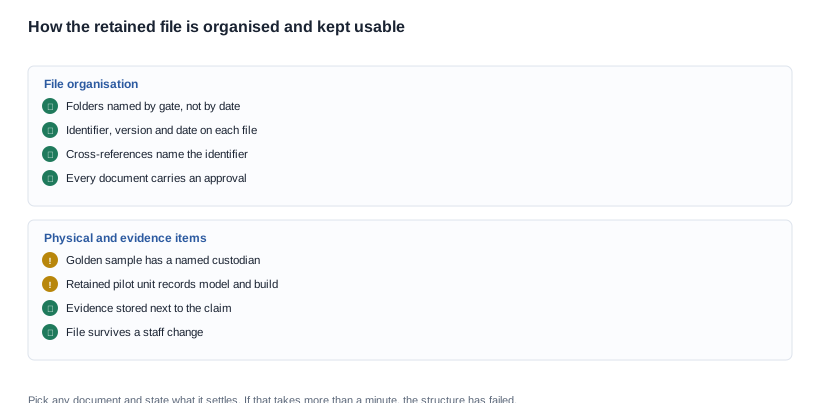
Organise by gate, not by date or by document type. Each gate gets one folder. Inside it, the gate's documents live together with the gate's supporting evidence. A date-based structure forces the reader to reconstruct which gate a document belonged to, and that reconstruction is exactly the work you are trying to remove. A type-based structure — all specifications here, all reports there — spreads one gate's evidence across four folders and makes the gate boundary invisible.
Every document has an identifier, a version, and a date, and every cross-reference names the identifier. Not the file name, not the date, the identifier. A requirement document that says "per firmware build 2.3.1" and a firmware reference that says "per requirement CY-RQ-001" can be reconciled in seconds. Two documents that both say "the latest version" cannot be reconciled at all.
Every document carries an approval. Name, role, date, and what was approved. A document without an approval is a draft that happens to have been sent, and the distinction becomes impossible to reconstruct after a few months when people have moved on.
There is one more convention that pays for itself quickly, and it is the one we will follow in every project file we supply: a short index at the root of the file, one line per document, showing the identifier, the title, the version, the date and the gate it belongs to. It takes an hour to maintain and it turns the file from something a person has to navigate into something a person can search. Auditors, incoming managers, and customers all read from the index first.
A workable structure looks like this:
- Gate 1 — Requirements. The signed requirement document, the claims list, the approvals, and the artwork brief if artwork was requested at this stage.
- Gate 2 — Feasibility. The feasibility answer with its three boundary categories, the dependencies list, and the decisions taken.
- Gate 3 — Engineering and tooling. The tooling agreement, the buildable specification, the firmware build reference, the open-items log with its closures, and the deviation log.
- Gate 4 — Samples. The signed golden sample record, the verification record, the custody arrangement, and the prototype acceptance conditions and evidence.
- Gate 5 — Compliance. The declaration of conformity for each shipping model string, the reports behind it, and the market applicability statement.
- Gate 6 — Pilot run. The inspection criteria, the pilot run record, the findings and dispositions, and the release decision.
- Cross-gate. The change record, the correspondence log, and the commercial file — quotation, purchase order, and the agreed commercial terms such as MOQ, lead time, incoterms, warranty and spares.
Two further practical points about keeping this usable. First, keep the file in a location that is not one person's mailbox or one person's laptop, because the value of this file is precisely that it survives the departure of the person who assembled it. Second, keep the evidence in the same place as the claim. A declaration separated from the reports behind it is a declaration you cannot defend when someone asks why.
A third point concerns the physical items in the file, which are easily forgotten when everything else is digital. The golden sample is a physical object with a legal function, and it needs a named custodian, a storage location, and a condition check at whatever regularity your quality system already uses for calibration or reference assets. The same applies to a retained second unit from the pilot run, which is often the most useful comparison unit you will ever own because it came off a real line rather than a bench. Where you retain a production unit for reference, record which model string and which firmware build it carried, because a reference unit without those identifiers cannot be matched to anything.
There is also the case of a supplier who does not work this way. Some shops genuinely do not produce documents, and their output is good. That is a legitimate operating style, but it is a risk you should price as one rather than discover later. The practical test is not whether the supplier has a documentation department; it is whether you can obtain the evidence you would need to defend a shipment to a customer or to an inspector. If the answer is that the evidence exists but nobody has written it down, ask for it as a condition of continuing, and understand that producing it is engineering work with a cost. If the answer is that the evidence does not exist, then the project cannot close its compliance gate the way you intend, and you should know that before tooling is committed rather than after.
And the test of organisation is simple enough to apply at any moment: pick any document at random and ask what it settles and what else depends on it. If the answer takes more than a minute, the structure has failed.

Questions to ask about the document set
Documentation is not usually contentious at the start of a project. It becomes contentious when the commercial pressure peaks, usually near the pilot run, and it becomes expensive when it is missing at a customs or market-entry check. These are the questions worth asking, and the order matters less than the fact of asking them before the pressure arrives.
- Can we get the document set, gate by gate, as it stands today? A supplier with a working process produces this without effort. A supplier without one will find reasons it takes time, and the reason is the answer.
- Is there a signed requirement document, and does it list the claims the product is allowed to make? Not the features — the claims. If there is no claims section, that is the gap to fix now, at a point where changing it is cheap.
- Which model string is on the declaration, exactly? Ask for the string and compare it character by character with the model string that will appear on the product and in the paperwork. Ask for each SKU separately, not for the platform.
- Who owns the tooling, and what happens to the tooling cost if we stop at this point? Three questions in one: title, cost treatment, and continuation process. The answer belongs in a signed agreement, not in an email.
- What is the firmware build identifier and its feature configuration? Ask for something that can be checked against the requirement rather than a version number alone.
- What does the golden sample verification record actually cover? It should cover pairing, audio, charging, any camera function, and control behaviour, with measured results rather than a pass mark.
- Where is the golden sample stored and who has custody? A reference unit in a shipping carton in a hot warehouse is not a reference unit.
- What are the inspection criteria, and were they written against the golden sample? Criteria written from a drawing are different from criteria written against a unit, and only one of them catches a manufacturing deviation.
- Which artwork version is approved, and is it versioned and signed? Ask for the master artwork file reference, not a description of it.
- What changes were made after their gate was closed, and were the downstream documents reissued? The change record is the document that reveals drift. A supplier with a disciplined process answers this in minutes.
- What is not published, and what should we ask for instead? Ask for MOQ, lead time, incoterms, warranty, sample fees and spares terms as commercial terms in a quotation. Ask for certification evidence per model string. Where something is genuinely unavailable, ask what the supplier needs from you to produce it.
- Can a new person on our side pick up this file and understand it? The honest way to test this is to nominate someone who has never seen the project and ask them to answer a question from the file.
Two behaviours on the supplier side are worth naming as good, because they are rarer than they should be. The first is supplying the open-items list even when it is uncomfortable, which shows that the engineering work is being done against the requirement rather than against a sales narrative. The second is explicitly scoping a declaration to one model string rather than stretching it across a family, even where the stretch would have been convenient.
What we will do on our side is treat the document set as part of the deliverable rather than as internal paperwork: each gate produces its document before it produces its hardware, the documents carry identifiers and versions and cross-reference by identifier, and the compliance gate is closed against the exact model string that ships. If a question at any stage cannot be answered from the file, the correct response is to say so and produce the missing document, not to answer verbally and leave the file incomplete.
A claim discussed in a meeting but not written down returns during compliance review. A declaration covering a family rather than a model does not cover your SKU. Those two sentences are the reason this file is worth keeping. Everything else in the set is administrative; those two are the ones that cost you a market entry.
For the wider sequence and how the gates relate, see the development process overview. For the quality gates and what each one is meant to prevent, see development process quality gates. For what to verify before accepting a shipment against this file, see the certification and compliance checklist.


