

A quality gate is not a milestone, a meeting, or a status update. A quality gate is a checkpoint where somebody with authority has to decide, in writing, whether the programme is allowed to move to the next stage — and what happens if it does not. The word "gate" does the work. A gate either opens or it does not, and the thing that opens it is a piece of evidence, not a feeling that things are going well.
This matters for smart glasses specifically, because the product category rewards suppliers who can describe a process and punishes suppliers who have one. A pair of glasses that looks identical from the outside can contain an entirely different optical stack, a different radio module, and a different firmware branch, and two units from the same production order can behave differently on camera control behaviour, pairing, and charging. Without gates, the difference between those units is discovered by your customers instead of by your quality system.
What follows is the gate structure we run, expressed as evidence rather than as activity. For each gate we set out what it has to prove, what document proves it, and what a buyer should ask to see. The framework is the same six-step chain used across our OEM and ODM work: requirements frozen, feasibility reviewed, engineering and tooling, samples built and verified, compliance file closed, and a pilot run before mass production.
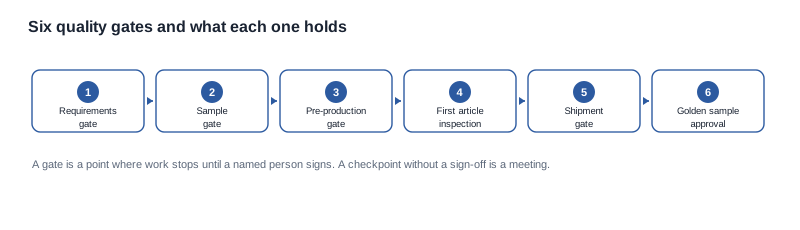
Development process quality gates: what each gate checks
A gate checks one thing: whether a specific claim about the product is now supported by evidence that survives scrutiny. If the claim cannot be stated in a sentence, the gate is not defined well enough to run.
Take the sample gate as an example. The claim it checks is not "the samples are good." The claim is "a unit built to the frozen requirement, using the intended parts and the released firmware, exhibits the defined behaviour across pairing, audio, charging, and any camera function and control inputs, within the tolerances written in the verification record." That sentence is long, which is a good sign. A gate whose claim fits in five words usually has nothing behind it.
Three properties separate a real quality gate from a checkpoint dressed up as one.
- It has a named owner. Somebody has the authority to stop the programme. A gate that any stakeholder can wave through is a status meeting with a diagram.
- It has a defined evidence artifact. A document, a signed reference unit, or a report. If the evidence is "the engineer's judgement", the gate will be passed on optimism, and optimism is not a process.
- It has a defined failure path. What happens when the gate does not open. A gate with no failure path is a gate that always opens, which means it was never a gate.
That third property is the one most often missing from supplier processes, and it is the one that costs buyers the most. If there is no defined consequence for failing a gate, the gate will be closed on the basis of the schedule rather than the evidence, and the schedule pressure arrives from a party who is not accountable for the defect. We will define the failure path in the programme plan, because a programme where nobody has considered what happens when a gate fails is a programme where the failure is discovered by the customer.
There is a further distinction worth making early, because it is the source of most confusion in supplier evaluation. A quality gate is not the same as an inspection, and it is not the same as a test. An inspection asks whether this unit conforms. A test asks whether a defined procedure produces a defined result. A gate asks whether the programme may proceed, which is a decision about risk rather than about one unit or one measurement.
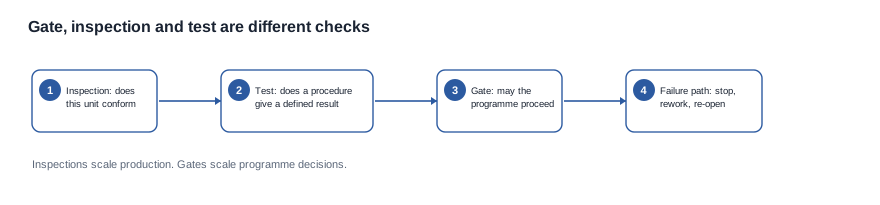
The practical consequence is that a supplier can have an excellent inspection regime and still run a weak gate structure. Inspections scale production. Gates scale programme decisions, and programme decisions happen a small number of times. A buyer evaluating a supplier should ask for the gate list separately from the inspection plan, and should expect them to be different documents with different owners.
A fourth, practical property is worth naming, even though it is not visible in most process diagrams: a gate must be able to be reopened. Requirements change. A component becomes unavailable. A certification requirement shifts for a market. If the gate structure only supports forward motion, the first real change forces a choice between the change and the process, and the process almost always wins because it is the thing people understand. we will allow a gate to be reopened, with the same evidence requirement as before, and with the reopened gate treated as a new decision rather than an administrative note.

The six gates and their evidence
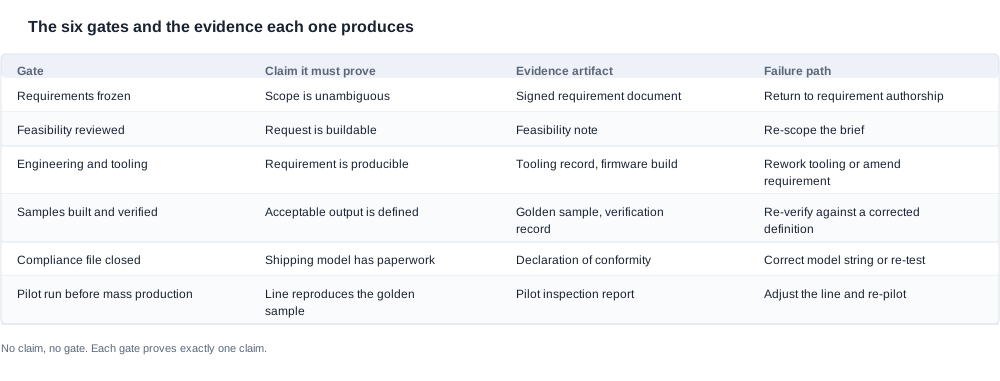
Six gates, in order. Each one has to prove a specific claim, and each claim is backed by a specific document or object.
| Gate | Claim the gate must prove | Evidence artifact | Failure path |
|---|---|---|---|
| Requirements frozen | The scope is unambiguous and the claim list is agreed | Signed requirement document, versioned | Return to requirement authorship |
| Feasibility reviewed | The request is buildable, and the cost boundary is known | Feasibility note naming commercial and engineering parts | Re-scope the brief |
| Engineering and tooling | The frozen requirement is physically producible | Tooling verification record, released firmware build | Rework tooling or amend requirement |
| Samples built and verified | Acceptable output has a single agreed definition | Signed golden sample plus verification record | Re-verify against a corrected definition |
| Compliance file closed | The shipping model has valid market paperwork | Declaration of conformity for the exact model string | Correct model string or re-test |
| Pilot run before mass production | Production tooling reproduces the golden sample | Pilot inspection report against the golden sample | Adjust the line, re-pilot |
The first row is where most programmes quietly fail, and it fails in a way that is invisible from inside. An unfrozen requirement does not announce itself. It surfaces later as a disagreement about whether a feature was in scope, which usually arrives in the form of "I always assumed we were including that". The evidence artifact for this gate is therefore as much about what is written as who signs it. A requirement document that is internally consistent but has no claim list still leaves the most commercially expensive ambiguity open, because the claim list is what binds marketing, packaging, and the compliance file to the same product.
The second row is the gate buyers most often expect to be a formality, and it is the one that does the most work when it is done properly. The feasibility note has to separate what is commercial from what needs engineering, and it has to state the earliest date on which a real answer is possible rather than a date on which a reply is expected. The difference between those two dates is the difference between an answer and an acknowledgement, and a buyer who cannot tell them apart cannot plan around either. Where the answer is that a request cannot be built in the shape submitted, the note says so, and the programme re-scopes rather than absorbing the change silently.
The third row deserves a note on the word "reproducible". Engineering and tooling passing means the tooling has been verified and the firmware build matches the frozen requirement. It does not mean the product is finished, and it does not mean a pilot order will pass. It means the pieces exist and are individually correct. The distinction between this gate and the last one is the difference between a prototype programme and a manufacturing programme, and conflating them is a common shortcut.
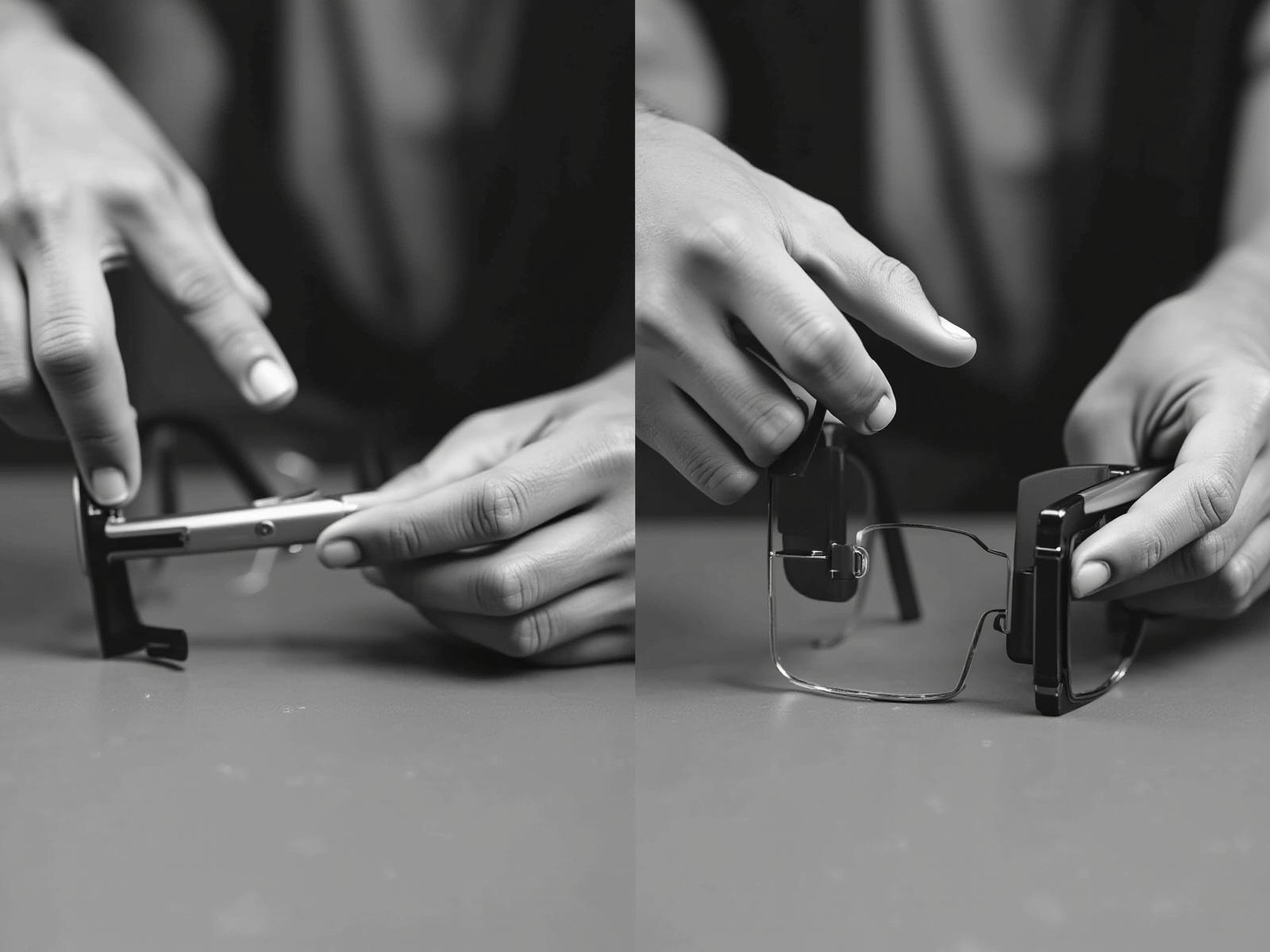
The fourth row is where the golden sample earns its name. A golden sample is a reference unit that defines acceptable versus not acceptable. It is not a marketing sample, it is not a unit pulled from the first batch, and it is not something the supplier hands over as a courtesy. It is signed by both sides, and every subsequent unit — sample, pilot order, production — is inspected against it. Where a configuration includes a camera function, the golden sample also anchors the control behaviour, because control behaviour is exactly the kind of requirement that reads as obvious in a brief and turns out to be ambiguous once two engineers interpret it differently.
Evidence also has a custody dimension, and it is the part that is easiest to overlook. The golden sample does not sit in a supplier drawer; it is held against a reference number, and the verification record travels with it. When a later unit has to be judged, the question is whether the comparison is being made against the original signed reference or against something that has merely been called the golden sample. Programmes that lose the chain of custody here lose the ability to argue about defects at all, because the argument becomes two opinions about two different objects.
The fifth row carries the most legal weight. A declaration of conformity covering a product family is not a declaration for your specific SKU. The declaration must name the exact model string that will ship, and the model string must match what appears on the packaging artwork, on the listing, and on the units coming off the line. If your product names change between the packaging artwork and the compliance file, one of them is wrong, and you will not find out which one until the units are in your warehouse. and we will treat the model string as a tracked identifier across every document in the programme for exactly this reason, and the certification evidence attached to it will be held at model level rather than at family level.
The last row is the gate that protects the business, not the product. A pilot order on production tooling at production volume is the only activity that exposes substitutions, line drift, and assembly variation at a scale where they matter. Engineering samples and even pre-production builds are made with attention that a production line cannot reproduce. Pilot runs catch the things that only appear when the line runs at speed: a component that arrived from a different batch, an operator instruction that is ambiguous, a supplier who changed a sub-tier without telling anyone.
One more structural note: the six gates are a chain, so a failure late in the chain is more expensive than the same failure early. That is the whole argument for gating rather than reviewing. A requirement change after the requirement is frozen costs a document revision. The same change after tooling is verified costs tooling rework. The same change after the pilot order has been inspected costs you the pilot order. We will price a late change accordingly, not as a favour, and we will say so at the time it is requested rather than after it is granted.
Where a programme usually slips
Programmes do not slip because nobody is paying attention. They slip because a gate was allowed to close on partial evidence, and the gap resurfaces downstream where it is more expensive. These are the patterns we see most often, in the order they tend to appear.
- The requirement gate closes without a claim list. Everything else then proceeds on two different interpretations of the same feature, and the disagreement is discovered during the sample verification rather than during requirement authorship, where it would have cost nothing.
- The feasibility gate is answered verbally. The answer exists, but only as a conversation, so it cannot be checked later against what was actually built. When the built product differs from what was discussed, both sides believe the other changed the deal.
- Tooling starts before the tooling cost conversation is finished. This is the single most expensive slip on the list. Tooling is the least reversible step in the chain, and the treatment of the tooling cost if the programme stops there has to be agreed in writing before tooling begins, not negotiated afterwards when the supplier's position has hardened.
- The golden sample is accepted informally. If it is not signed, and if the verification record does not define pass conditions for each function, there is no reference to inspect against later — which means the pilot order has nothing to be compared with and the inspection becomes a matter of opinion.
- The compliance file is closed against a family rather than a model string. The paperwork looks complete and the specific SKU is not actually covered.
- The pilot order is treated as a formality. If it is a small build on the sample line rather than a production run on production tooling at volume, the only substitutions it catches are the ones that fail immediately, and the ones that matter get through.
The trade-off behind most of these is the same trade-off every time: gate rigour against calendar pressure. Someone wants to start tooling, or sign a purchase order, or announce a launch date, and the missing evidence is not actually required for the thing they want to happen. The evidence is required for the thing that happens next.
We will hold the gate when the evidence is missing, and we will say clearly what is missing and how it can be produced. What we will not do is close a gate and note the gap informally, because the informal gap always becomes a formal dispute later, and the party that has to resolve it is whoever holds the paperwork.
Two mitigations help more than any single inspection. The first is to keep the requirement document under version control with a written change process, so that "we agreed to add that" becomes a dated entry rather than a recollection. The second is to agree, before tooling starts, exactly which components are locked by part number and which may be substituted, with a notice period and a re-verification step attached. That single page of agreement removes most of the substitutions that a pilot order would otherwise have to catch.
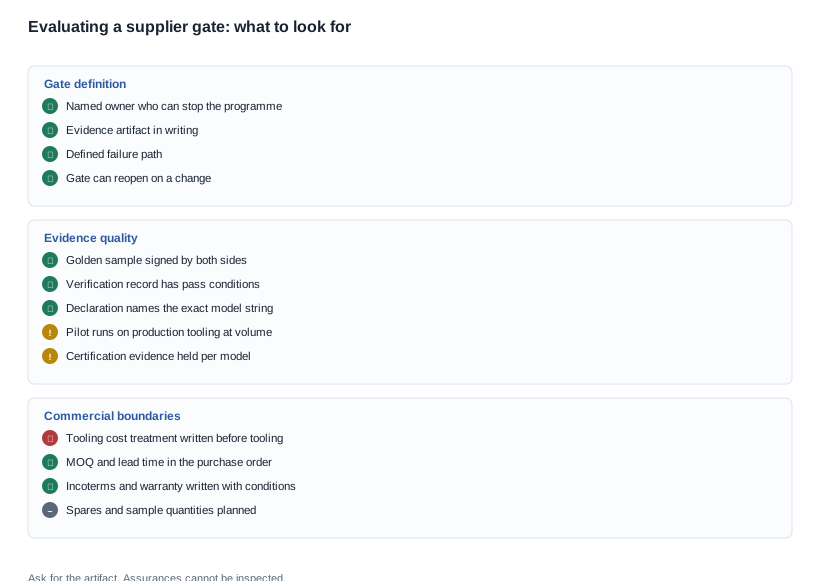
A note on what "slips" does not mean. It does not mean the supplier is slow or incompetent, and it does not mean the programme failed. A gate that does not open is the process working, exactly as intended — it is the mechanism that stops an unproven assumption from becoming a production commitment. The measurable difference is where the correction lands: inside the programme, at a document, or outside the programme, in your market, at a cost that no gate can recover.

Questions to ask about a supplier gate
Ask these of any supplier, and expect documents rather than assurances. The value of the list is that it is a ready-made what to ask the supplier checklist, and it works even when the supplier is not us.
- Can you send me the gate list, with the evidence artifact named for each gate? A list of stages without named artifacts is a project plan, not a gate structure.
- Who is allowed to open each gate, and who can stop it? If the same person does both, there is no gate.
- What happens to a gate that does not open — what is the defined failure path? If the answer is "we would discuss it", there is no failure path.
- What is the evidence for the samples stage, and where is the golden sample held? You want a signed reference unit with a verification record that has pass conditions, not a photo of a prototype.
- Does your declaration of conformity name individual model strings? A family-level document does not cover your SKU, and this is the point where buyers most often accept a document that turns out not to be about their product.
- What is your pilot order, in terms of tooling type and volume? Ask whether it runs on production tooling at production volume, because that is the only version of the activity that catches substitutions.
- Which parts are locked by part number, and which can be substituted? Ask about the notice period and the re-verification that follows a substitution.
- What happens to the tooling cost if we stop the programme at the engineering gate? This must be in writing before tooling starts. It is the most important commercial question in the whole structure, and it is the one most often deferred.
- Where do the commercial terms live? Prices, MOQ, lead time, incoterms, and warranty terms belong in the quotation and the purchase order with their conditions attached, not in a web page. If a supplier refuses to put them in a document, that refusal is more informative than the terms themselves.
The pattern to notice across these questions is that they ask for artifacts rather than assurances. Every one of them can be answered in a sentence by a supplier with a mature process, and none of them can be answered by a supplier without one. we will answer all nine with documents from our own programme records, because the alternative — describing our gates without showing them — tells you nothing you could use.
If you want the wider picture of how the gates sit inside a full OEM and ODM engagement, the OEM and ODM process page sets out the surrounding structure. For the sample stage in particular, development process sample validation goes deeper on what a verification record should contain and how the golden sample is established. For the commercial framing around sample quantities, spares, and purchase orders, see procurement and samples. For what a factory quality system should cover independently of the programme gates, see smart glasses OEM quality expectations.
The last question on the list is the one that determines whether any of the others can be relied upon. A supplier who will not put MOQ, lead time, incoterms, and warranty terms in the quotation and the purchase order, with the conditions attached, is telling you that those terms are provisional. A supplier who will put them there, tied to a specific configuration and quantity, is telling you that the gate structure is attached to a real commercial transaction rather than to a description of one.
The honest limitation is that no gate structure removes the trade-off between rigour and speed. It only makes the trade-off visible, and makes it possible to negotiate it deliberately rather than by accident. Where you are willing to negotiate — on the depth of a verification record, on the breadth of a pilot order, on what a golden sample covers — we will do that openly and put the resulting scope in writing. Where a gate protects a fact that cannot be recovered later, such as the model string on a declaration of conformity, we will not trade it, and we will explain why rather than simply declining.
What we will publish is the structure, the evidence, and the questions. What we will not publish is the numbers that only make sense inside one specific programme — and we will convert each of those into something you can put in front of any supplier, including this one.


