

Most engineering customisation programmes do not fail because the supplier was incapable. They fail because the buyer started them without a written scope, and the scope was negotiated verbally for several weeks before anyone tried to write it down. By the time the requirement document was drafted, the disagreement had already hardened into two incompatible positions and the conversation had to be redone in a legal register instead of an engineering one.
This article is about the first six weeks of a customisation programme and nothing else. It covers what a buyer should prepare before the first conversation, how to write a requirement brief that will survive being frozen, how to set up a decision path so that a late decision does not stall a build, and the questions to put in writing so that the programme starts on a documented footing rather than a hopeful one. It is written for brand-side buyers and for channel procurement managers who have to bring a branded product to market through an OEM/ODM partner.
The framework used throughout is the six-gate sequence common to engineering customisation work, set out in full under engineering customisation and in the wider OEM/ODM process overview: requirements frozen, feasibility reviewed, engineering and tooling, samples built and verified, compliance file closed, and a pilot run before mass production. The defining property of that sequence is that a stage is finished when it produces a document, not when a date arrives. A programme that follows the sequence properly can be audited at any point, because at every stage there is a specific artifact to point at.
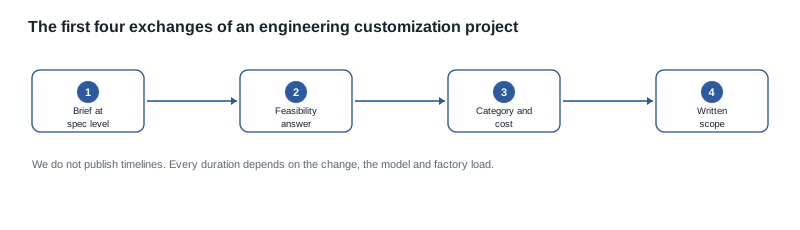
The purpose of getting this right at the start is not administrative neatness. It is that every unstated assumption made in the first month is later converted into engineering effort, and paid for twice: once in the quotation, and again in the change request that arrives once the assumption turns out to be wrong.
Engineering customization: what to prepare before the first call
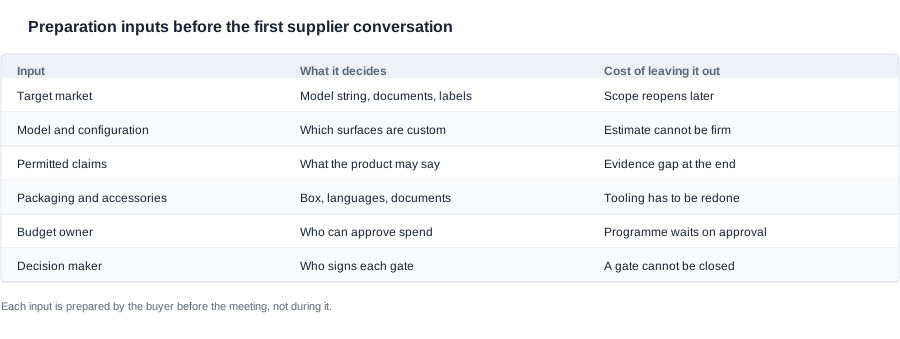
The first conversation is usually an exploratory one, and exploratory conversations have a habit of producing commitments that nobody intended to make. The purpose of preparation is to let the conversation be exploratory while keeping the commitments out of it. A buyer who arrives with a written input pack can spend the meeting asking sharp questions; a buyer who arrives with nothing will spend it filling in silence, and silence becomes agreement.
In this section we will work through the six inputs that make the difference, and we will be explicit about why each one is a question for you rather than something the supplier can supply.
1. The target market and the destination documentation requirements
The target market determines a great deal downstream, and it is usually discussed far too late. The same hardware can carry a different model string, a different plug, different packaging, different documentation and different destination-market requirements depending on where it is going to be sold. For a brand selling into several markets, this is not one answer but a matrix: model string per market, documentation per market, packaging per market.
Write down the destination first, not the product. The market tells you which regulatory framework applies, which documentation the importer will ask for at the border, which languages the packaging and the quick-start guide need, and which claims the product is allowed to make. The product does not determine any of that on its own.
If you are not certain which markets you will ultimately serve, say so, and ask what the cost of holding two variants is. This is a legitimate question to ask at the outset and an expensive one to ask after the tooling has been committed.
2. The model and configuration scope
Scope is where engineering customisation programmes usually become ambiguous. The catalogue for this range covers twenty-eight models: eight audio models, three sport models, eleven camera models, three kids models, and three listed without a model number. A programme that says "we want to customise our glasses" has not chosen anything. A programme that says "we want to customise the behaviour and packaging of one camera model and one audio model for a single market" has chosen something that can be costed.
Bring a shortlist, not a catalogue. Two or three candidate models, with the reason each is on the list, and the reason the others are not. Then bring the configuration detail: which published attributes matter to you, which do not, and which ones you need to change.
It is worth saying plainly which attributes are not published for the models you are considering, because that determines where your questions need to go. Bluetooth version is published for fourteen models and is not published for the eleven camera models, for A05, for A06, or for the bone-conduction entries. Remote control shutter is published only on D17 and on ZH12. An IP rating of IP54 is published only on V06 and on S7. No capacitive-touch attribute and no translation attribute appears anywhere in the catalogue. Each of those gaps is not a problem — it is a line item on the question list you bring to the supplier, and it converts a vague conversation into a specific one.
3. The claims you want the product to make
Every product needs a set of statements it is permitted to make, and a set it is not. "Battery lasts eight hours" is a claim. "Suitable for running" is a claim. "Water resistant" is a claim. Those three are examples of the kind of thing that has to be settled in the requirement document, because the specification sheet, the packaging copy, the manual and the declaration all have to agree with it.
Bring a list of claims you want, marked as either required or nice-to-have, and be ready to say which ones you are prepared to drop. A programme that keeps every claim through every gate is a programme that will stall, because each claim is a test, a document and a piece of evidence.
4. The packaging and what goes in the box
Packaging is a common source of late-stage conflict because it depends on decisions made in other departments. A brief should cover the box structure, the printed languages, the accessories included, the documentation set, the labelling requirements, and the sustainability or recycling marking rules that apply in the destination market.
Note that the accessory list is not independent of the firmware scope: a charging case, a cable type or a printed quick-start guide that describes a pairing step all connect back to behaviour that a buyer has already said something about. Bring the packaging outline and the accessory list to the same meeting as the behaviour questions.
5. The budget owner and the decision-maker
This is the input buyers most often omit and most often regret. A customisation programme is a sequence of approvals, and the approvals are only as good as the people who make them. You need to know, before the first conversation, who can approve a change to the requirement document, who can approve a quotation, who signs the golden sample, and who signs off the compliance file.
If those are four different people, say so at the start, and put their names and roles in the brief. If they are one person, that is useful information too, because it tells you the programme can move quickly.
6. The evidence you will need at the end
Write down now what you will have to be able to show a customer, an importer, an insurer or a retailer when the programme completes. Usually this includes the declaration of conformity for the exact model string that will ship, the underlying reports behind it, the packaging artwork, the user manual, and the verification record behind the golden sample. Deciding this at the start means the requirement document can be written to produce those things rather than merely to describe the product.
The rule for all six inputs is the same: bring them as written material, and treat the first conversation as the point at which you find out what is missing rather than the point at which you create it.

Writing a requirement brief that survives freezing
The requirement brief is the document that will be frozen, and freezing is the moment the programme stops being a conversation and starts being a commitment. A brief that does not survive freezing is not a document that was too informal; it is a document that failed to answer the questions the supplier needed answered. Our notes on the requirements phase of the development process set out the same ground from the engineering side, and the two views should be read together.
In this section we will look at what a freezable brief has to contain, and at the specific ways a brief tends to fail. The good news is that the failures are structural and therefore predictable, which means they can be designed out.
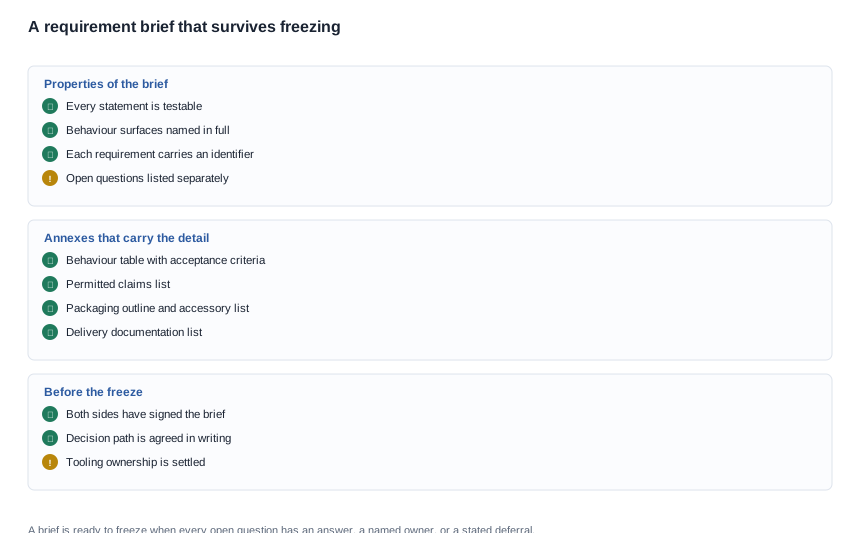
The four properties of a brief that can be frozen
- Specific. Every statement is written so that two engineers could read it and agree on what it means. "Good pairing" is not specific. "A second host device cannot silently take over an active connection" is specific.
- Complete on the surfaces that matter. The brief names the behaviour areas that the programme touches, including pairing, control behaviour, the device name, charging and battery indication, the camera function where the model carries one, and the companion app. A brief that is silent on a surface has left it open, and open surfaces get decided later by whoever happens to be in the room.
- Traceable. Each requirement carries an identifier, so that a test result, a verification record line, a packaging statement or a specification sheet entry can all point back to it.
- Signed by both sides. The freeze is a mutual act. A brief signed only by the buyer is a demand; a brief signed by both parties is a baseline.
The five ways briefs fail, and the fix for each
- They describe the product but not the behaviour. Fix: require a behaviour statement for every surface in scope, with a stimulus, an expected response and an observable condition.
- They mix requirements with hopes. Fix: split the brief into two lists — committed and requested. The requested list is explicitly non-binding until it is agreed and added.
- They omit the claim list. Fix: attach the permitted-claims list as a numbered annex, and state that no other claim may appear in the packaging, the manual or the sales material.
- They leave the packaging out. Fix: attach the packaging outline and the accessory list as annexes, so they freeze with the brief.
- They are frozen with open questions still inside. Fix: run a closing review where every open question is either answered, moved to a named later decision with a deadline, or explicitly deferred and marked as not required for this programme.
The closing review matters more than it sounds. The most common failure pattern is a brief frozen with a dozen open questions scattered through it, which means the supplier is building against an interpretation of each open question rather than against a decision. Those interpretations surface during the sample stage, when the cost of changing them is highest.
The annexes that make a brief usable
A brief that stands alone is less useful than a brief with a small set of disciplined annexes, because the annexes are where the specific, checkable content lives. Four of them carry most of the value.
- Annex A — the behaviour table. One row per behaviour in scope, with a requirement identifier, the expected behaviour in plain terms, the acceptance criterion, and the stage at which it is verified. This table is the bridge to the feasibility answer and to the verification record, and it is the first thing worth asking the supplier to work from rather than from prose.
- Annex B — the claims list. Every statement the product is permitted to make, each with an identifier and the evidence that will support it. Anything not on this list is not to appear in packaging, the manual or the sales material.
- Annex C — the packaging outline and accessory list. Box structure, printed languages, labelling, accessories, documentation set, and the recycling marking required in the destination market.
- Annex D — the delivery documentation list. What accompanies the goods: the declaration of conformity for the exact model string that will ship, the underlying reports behind it, the user manual, the packing list, and any batch or serial numbering convention used for traceability.
The point of numbering the annexes is that requirements, claims and packaging statements can then be quoted precisely in later documents without paraphrasing. Paraphrase is where drift starts: a claim written one way in the brief and a different way in the packaging is a dispute waiting for a customs officer to find it.
A short closing note on language. The brief should be written in the language that will be used in the programme's records, and where a source document exists in another language, the brief should record which version governs. Mixed-language programmes otherwise spend their critical weeks translating, and every translation introduces the opportunity for a requirement to shift by a shade that nobody notices until it is moulded.
Turning the brief into a checklist
A brief that also carries a checklist is worth noticeably more, because the checklist is what the feasibility answer and the verification record are built against. For each behaviour in scope, the checklist names the expected behaviour, the acceptance criterion, the test method and the stage at which it is verified.
This is also the point at which the buyer supplies the inputs the supplier will need: the behaviour specification, the test accounts used for pairing and app verification, and the written acceptance criteria. Missing any of the three turns a verification activity into an opinion, and an opinion cannot close a gate.

Setting up the decision path
A decision path is the agreed route by which a question gets answered, by whom, and with what consequence for the programme if it is not answered in time. Programmes that stall usually do not stall because a decision was hard. They stall because nobody had been named as the person who makes it, so the question waited in a mailbox.
Setting up the decision path early is one of the highest-value things a buyer does, and in this section we will break it into the four decisions that recur in every customisation programme, together with the practical arrangements that keep them moving.
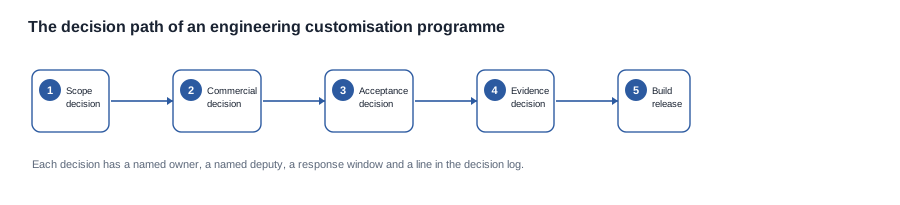
The four decisions that recur
- Scope decisions. A new request, an interpretation query, or a request that was not in the frozen brief.
- Commercial decisions. Approving a quotation, an incoterms arrangement, a MOQ or a pilot order, and accepting how a change request is priced.
- Acceptance decisions. Signing the golden sample, signing the verification record, and accepting or rejecting the pilot run against the golden sample.
- Evidence decisions. Confirming that the compliance file is closed for the exact model string that will ship, and approving the certification evidence that supports the claims being made.
Arrangements that keep decisions moving
- A named decision-maker per decision type, with a named deputy. A deputy is what prevents a holiday from becoming a programme event.
- A response window per decision type. If a decision is not made inside the window, it escalates rather than sitting. This is the single most effective anti-stall mechanism available to a buyer.
- A decision log. One document, one line per decision: what was asked, who decided, what was decided, when, and what the requirement document or specification sheet changed as a result. The log is what makes a late decision cheap to absorb rather than expensive.
- A standing change window. Changes are collected and processed at a fixed point rather than continuously, which keeps the build sequence predictable and reduces the number of rebuilds.
- A freeze-date discipline. Once the brief is frozen, changes are exceptions with a named cost and a named consequence, not a routine part of the week.
The point of all five arrangements is the same: they move ambiguity to the front of the programme, where it is cheap, instead of the back, where it is not.
Tooling ownership and cost, before anything starts
Tooling is the least reversible step in the entire programme. Once the moulds and the production fixtures exist, the sunk cost cannot be recovered by renegotiating anything else. It follows that the agreement about tooling ownership and tooling cost has to be written before the first tool is cut, and that agreement should state, in plain terms: who owns the tooling, who pays for it, whether the cost is amortised into the unit price or charged separately, what happens to the tooling cost if the programme stops partway through, and what happens if the programme stops after the first production order.
There is also a question about the sample units and the golden sample themselves. Who owns them, where are they stored, how long are they kept, and what is the arrangement for the units the supplier retains for reference? These units are the physical evidence behind the programme, and they should be treated as programme assets with a named custodian. The sampling mechanics that sit underneath this are covered in our procurement guide to samples.
On the commercial terms generally: MOQ, lead time, incoterms, sample fees, pilot order terms, spares quantities and warranty arrangements are all matters for the purchase order and the quotation. They should be recorded in the programme record from the start, because every one of them constrains a later decision even though none of them is a technical question.
Questions to ask before you begin
The final section is the working list: the questions to put in writing before the programme starts, so that the answers form part of the record rather than part of somebody's memory. We will group them by the stage of the programme they protect, and we will keep the intent of each one visible, because a question without a purpose tends to get answered vaguely.
Before the requirement brief is written
- Which markets do you support, and what destination documentation and labelling does each require?
- Which models do you consider in scope for this programme, and which published attributes of each are fixed versus variable?
- What behaviour surfaces are open to customisation on the model we are scoping, and which are fixed by the platform?
- What claims do you expect the product to make, and which claims may not appear?
- What do you need from us — the behaviour specification, the test accounts and the written acceptance criteria — and in what form do you want to receive them?
Before the brief is frozen
- Which document becomes the frozen requirement, and who signs it on each side?
- What is the process for a change requested after the freeze, and how is its cost and its effect on the programme shown?
- Who approves scope, who approves the quotation, who signs the golden sample, and who signs off the compliance file?
- What is the response window for each of those decisions, and what happens if a window lapses?
Before anything is committed
- Who owns the tooling, who pays for the tooling cost, and what happens to the tooling cost if the programme stops?
- What is the tooling write-off and ownership arrangement if the programme stops before the first production order, and what if it stops after?
- How will the samples and the golden sample be handled, retained and signed?
- What are the sample terms, the pilot order terms, the MOQ, the incoterms and the warranty position, and where will each be recorded?
Before the compliance file closes
- What certification evidence will be provided, in what form, and scoped to which exact model string?
- What is the reissue path if a behaviour changes after the evidence has been issued?
- Who confirms that the model string on the declaration matches the model string that will be printed on the box and shipped?
As the programme runs
- How do we know a build has been superseded, and what is the process for withdrawing one?
- What is the escalation route when a decision has been outstanding longer than its window?
- Where does the programme record live, and who is its custodian?
The value of writing these questions down is that the answers become reusable on the next programme. A requirement brief format, a decision log template, a tooling ownership clause and a golden sample signing record are assets that a buying organisation keeps between programmes, and each new programme is faster because the previous one left the templates behind.
That is the whole of the case for starting properly. Nothing here requires more budget, a larger team or a longer negotiation. It requires a written scope, a named decision-maker, an agreed tooling position and a set of questions answered before the irreversible step. The programmes that run smoothly are the ones where the hard questions were asked early, when they were still cheap to ask.


