

A smart glasses development is not one event. It is a sequence of gated stages, and the first gate is the one most programmes treat as paperwork. The requirement document is where a buyer and a manufacturer stop describing what they would like and start stating what will be built, what may be said about it, and how both sides will know the work is finished. Get this stage wrong and every later stage inherits the ambiguity: engineering optimises for the wrong thing, tooling is cut for the wrong case, compliance is assembled around the wrong model string, and the pilot order arrives at a warehouse that cannot describe the product it is supposed to be checking.
The requirement document is not a wish list, a marketing brief, or a summary of the last email thread. It is a frozen, signed statement of what will be built and what may be claimed about it. We will use the term frozen deliberately. It means the content stops moving by agreement, not that the project stops moving. Requirements still get amended — every serious programme amends requirements — but an amendment has to be written, dated, and signed by the same people who signed the original. The difference between a frozen document and a frozen version of a document is the difference between a project with a known baseline and a project with a known document that everybody has read at a different point in time.
This matters because the first gate of any development process has a single measurable output: a signed requirement document. Not a call, not a shared drive folder, not a quotation that reflects an earlier conversation. If a buyer cannot point to one document, one version, one set of signatures, then the project has not passed the first gate, no matter how many sample rounds have been discussed.
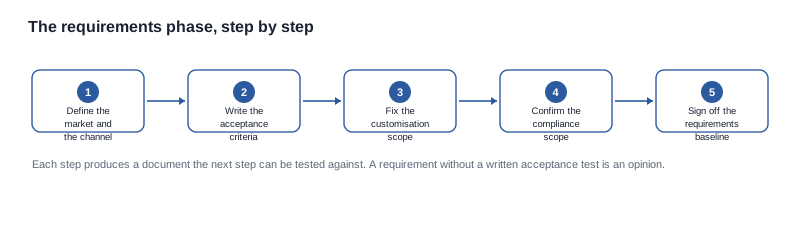
Development process requirements phase: what the document is
The requirement document is the agreement about scope and about permitted claims. Scope answers the question what is being bought. Permitted claims answers the question what may be written on the box, on the product page, on the spec sheet, and in the marketing collateral. Those two answers live in the same document because they constrain each other. If the requirement says the product must support a particular function in a particular market, and the compliance position for that function in that market is not settled, then the claims you may make about that function are constrained by the compliance position — not by your ambition.
The most common failure we see is a requirement document that describes hardware and behaviour but stays silent on claims. The buyer assumes claims will be handled later, perhaps at packaging artwork stage or during the compliance file. In practice, the claim decision is the single most expensive late decision in the whole programme, because claims travel: they appear on the carton, on the product listing, in channel partner training material, on trade-show graphics, and in the warranty registration flow. Changing a claim after artwork is signed does not change one box, it changes a batch of boxes, a set of listings, and a relationship with a channel partner who has already briefed their salespeople.
Who has to be in the room to sign it is worth spelling out, because it is usually broader than the buyer and the account manager. A workable signing group has six roles, and each of them represents a decision that will otherwise be made by default later:
- The brand or product owner — owns what the product is, what it does, and the claims strategy. Without this person, the document is an engineering artefact rather than a commercial one.
- The regulatory or compliance lead — owns the permitted claims and the market-specific requirements. If no one in the buying organisation owns compliance, the claims section will be signed optimistically and revisited painfully.
- The engineering contact at the manufacturer — owns the feasibility of each stated requirement and flags, in writing, anything that cannot be built as written. This person is not signing to agree; they are signing to confirm that the document describes something buildable.
- The packaging or artwork owner — owns what physically ships, what is marked on it, and what the artwork brief needs. Their sign-off catches label-space problems and marking-rule conflicts while they are still cheap to fix.
- The channel or logistics owner — owns how the goods will be received, stored, and presented. They own the delivery documentation section, because the person who receives the shipment is the one who will complain if the documentation does not match reality.
- The commercial owner — owns MOQ, incoterms, packaging cost tolerance, spares, purchase order terms, and warranty handling. They sign to confirm that the stated requirements are deliverable at an agreed commercial shape, not merely technically possible.
If one of these six cannot attend, the correct move is to delay the signature rather than to sign around them, and we will ask for a missing signature in writing rather than accept a verbal approval. A requirement document signed by three people where three were absent will generate the exact ambiguity you were trying to remove, and the cost of that ambiguity is paid later, in the engineering change, the rework, or the returned shipment. This is a trade-off the buyer should make explicitly and in writing: a short delay in getting every signature on the baseline document is cheaper than an unsigned baseline, and it is the only point in the programme where delay is genuinely cheap.
A note on how the document relates to the rest of the process. The requirement document is the input to the feasibility review. The feasibility review produces a boundary — what is commercial, what needs engineering work, and the earliest date on which a responsible answer can be given — rather than a simple yes or no. That boundary then governs the engineering and tooling stage. So the requirement document does not predict the outcome of the programme; it determines whether a responsible outcome can be calculated at all. A requirement document that is vague enough to be read several ways cannot produce a useful feasibility answer, because the feasibility team will be answering a question nobody asked. This is the practical reason to spend effort here: the quality of the requirement document sets the ceiling on the quality of every answer that follows it, including the quotation that the commercial owner has to negotiate against.
For buyers who want the surrounding framework rather than only this gate, the development process overview explains where the requirement stage sits relative to the others, and the quality gates article covers how each gate is closed and evidenced.

The sections it has to contain
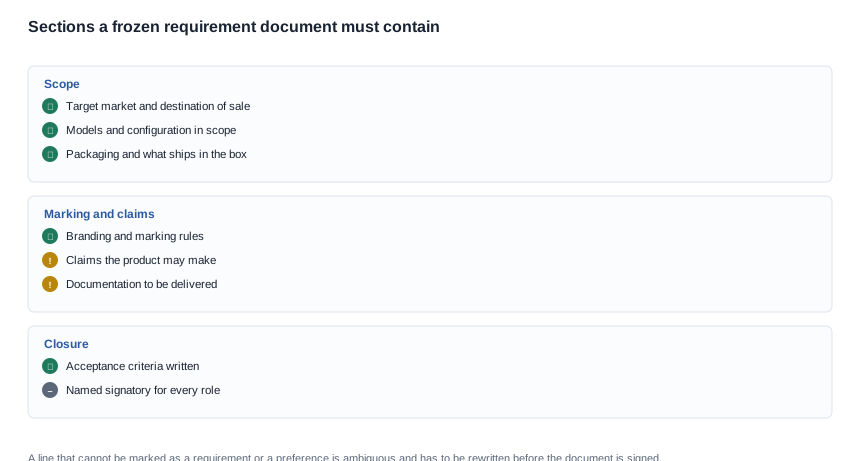
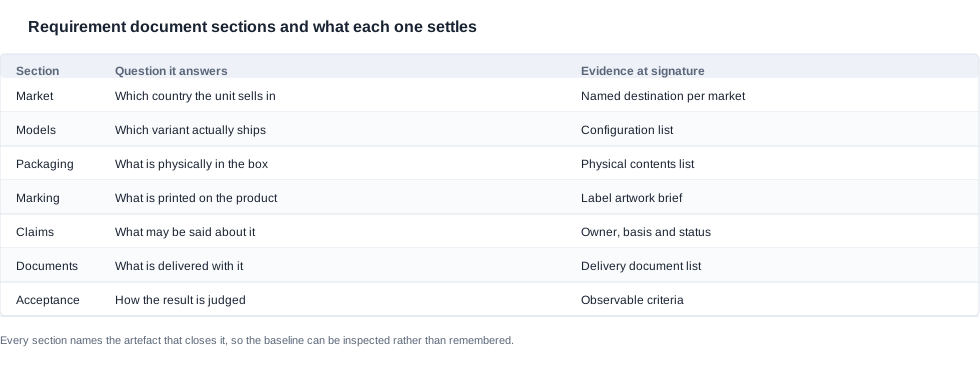
A requirement document that a manufacturer can quote from, tool from, and build a compliance file around needs a fixed set of sections. Seven of them, in this order, cover the scope of a real programme:
- Target market and destination of sale. Not "global" and not "Europe". The destination market determines the language of the manual, the plug and charging standard, the radio certification position, the labelling and packaging requirements, and the documentation set. A programme that serves several markets needs the destination stated per market, with the differing requirements written down next to each other rather than averaged into a single compromise specification.
- Models and configuration in scope. Which product models are covered, what the configuration of each one is — colour, storage, connectivity, packaging tier, bundle contents — and what the configuration baseline is. This is the section that stops a later "that is not the variant we ordered" conversation. If you will take one model with two colourways and one with a different charging case, write three configurations, not one sentence.
- Packaging and what ships in the box. The physical box, the accessories inside it, the printed marking, and the language of the box. Everything that reaches the customer as an object belongs here, including the charging cable, the case, the paperwork, and any brand insert. A packaging requirement that does not list the contents is a packaging requirement that will be interpreted by the factory.
- Branding and marking rules. What may be printed where, what may not be printed, whether the manufacturer's name appears at all, whether the label is a customer label or a customer-approved manufacturer label, and what claims the marking may and may not carry. This section interacts with the claims section and should be read together with it.
- Claims the product is allowed to make. The permitted claims, the claims that are explicitly not permitted, and the language that must be used for each permitted claim. Where a claim depends on a certification position that is not yet closed, the document should say so and name the condition — the claim is permitted once a specified condition is met, not from the date of signature.
- Documentation to be delivered. The instruction manual, the language and format of it, the declaration of conformity, the underlying reports that support it, the packing list, the labelling file, and any test records the buyer wants to hold. Ownership and format matter as much as the list itself, because a PDF of the declaration is worth very little to a channel partner who needs to file it.
- Acceptance criteria. The objective conditions under which the delivered product and the delivered paperwork are accepted. This is the section that prevents the final conversation from being an argument about taste. Acceptance criteria should describe observable behaviour — pairing with a specified host, audio output at a specified configuration, a charge reaching a specified state within a specified condition, camera behaviour and control behaviour where those functions are in scope, the marking present on the unit, the documentation present in the delivery.
Two sections are deliberately absent, and their absence is a feature. There is no section for preferences, and there is no section for everything that could be improved later. A requirement document is the scope of what is being built at what shape; preferences belong in a later discussion and must be promoted formally into a requirement, with a signature, before they become scope. During review we will mark every line of the draft as either a requirement or a preference, because a line that cannot be marked is a line that will be argued about later.
The distinction between a requirement and a preference is the distinction between a commitment and an aspiration, and the failure mode is expensive because preferences are indistinguishable from requirements in tone. Everyone writes "the case should feel premium" with the same conviction as "the case must be a USB-C charging case with a 500 mAh internal cell". The first sentence cannot be built, verified, or refused; the second can be built and refused on sight. A good test is whether a competent engineer could draw the requirement, and whether two engineers could draw it the same way. If the drawing would differ, it is a preference.
What happens to a requirement that is left ambiguous is worth being blunt about: it does not sit still waiting for clarification. It gets resolved by whoever happens to be closest to the decision, at the moment that decision becomes necessary, with no obligation to tell anyone else. An ambiguous charging specification gets resolved by the engineer choosing the connector that is on the bench. An ambiguous claim gets resolved by the artwork designer choosing the bolder wording. An ambiguous scope gets resolved by whoever is filling the remaining engineering slot. Each of those resolutions is local, sensible, and invisible to the party that would have been affected — which is precisely why it must be prevented rather than corrected. This is also where the money leaks. Tooling cost is committed against a specification, so an ambiguity that survives into the tooling stage is not a documentation problem any more; it is a sunk cost on a mould, a jig, or a fixture that may have been cut for a case that never ships.
The acceptance criteria section also carries the technical function of being the input to the verification record at the samples stage. The golden sample is judged against the frozen requirement, and the acceptance criteria are what makes that judgement objective. A requirement document without acceptance criteria produces a golden sample that is judged by whoever is most disappointed, which is not a measurement at all.
If you want a field-level version of this list to use as a working template, the smart glasses OEM requirements checklist covers the same ground in a form that can be copied into a brief.

Why the claims section matters most
The claims section is the most important part of the requirement document, and it is not close. Here is why.
Hardware requirements are transactional. A brightness level, a battery capacity, a port type, a colour — these are values that can be built, tested, and compared. If a value is wrong, it is corrected and the cost is engineering time. Claims are different in kind, because a claim is not a property of the product. A claim is a statement you make to a regulator, to a marketplace, and to a customer, and it carries a legal and commercial consequence that no amount of later engineering can undo without invalidating paperwork that has already been used.
Think about what a claim actually is. "Water resistant" is a claim. It implies a test standard and a rating. "IPX4" is a claim with a specific meaning and a specific test basis. "Noise cancelling" is a claim with an ordinary industry meaning that a customer will hold you to. "Suitable for running" is a claim about safety that changes the wearer's behaviour. "Records and streams video" is a claim that invites a privacy question in every market you sell into. Each of those is a sentence on a listing, and each one is a commitment you have made to somebody you may never meet.
The requirement stage is the last point at which claims are cheap to decide, because the claims section is the upstream input to the compliance file. The declaration of conformity that closes the compliance stage has to cover the exact model string that will ship and the underlying reports for it. If the requirement document says the product makes a claim that the compliance route cannot support for that model, then the compliance stage either fails or the claim has to be withdrawn at a point where the packaging has usually been printed, the listings have been drafted, and the channel partners have been briefed. Withdrawing a claim late is not a copy edit. It is a batch of obsolete packaging, a set of corrected listings, a sales conversation with every channel partner who quoted the old copy, and a credibility cost with the marketplace that carries the listing.
The rule we would write into the document is straightforward: every claim has an owner, a basis, and a status, and nothing gets printed anywhere until all three are settled. The owner is the person in your organisation who can withdraw the claim. The basis is the evidence that supports it — the standard and the test report, the internal validation, the certification evidence held by the manufacturer, or the explicit statement that the claim is a market-specific requirement. The status is one of: cleared to use, cleared to use once a named condition is met, or not permitted. A claim with no owner is a claim that will be used by default, because somebody has to write the copy and the marketing team will find the wording attractive.
Note what is deliberately not in this section. There is no claim about certification status per model, and no claim about factory capability, because none of that is published and none of it is the buyer's problem to invent. Where you need to know what evidence exists behind a claim, the correct move is to ask the supplier for the certification evidence behind a specific model string, and to ask what the underlying reports cover. "Is it certified" is the wrong question — it has no useful answer, because certification is per model, per market, per claim. "For model X, sold into market Y, what evidence supports claim Z" is the right question, and it is the question the requirement document should have already answered in writing. We will not restate a supplier's certification position on their behalf, and we will not infer one either; we will ask for the evidence and record what it covers.
The same discipline applies to the claim that the product is a particular category of device. Categories carry regulatory weight. Saying that a device is a headset for a particular application can pull in requirements you did not budget for, and saying less than the device actually is can put you on the wrong side of an obligation. This is a case where the claims section and the compliance stage have to be written by people who talk to each other, and it is a case where a buyer's own legal or regulatory function has to be inside the process rather than consulted after the fact.
Two practical consequences fall out of all this. First, the claims section is the part of the requirement document most likely to be written by someone who is not in the room with engineering, and it is the part most likely to be approved by someone who reads it quickly. Both of those are reasons to give it its own explicit sign-off. Second, it is the part most likely to be treated as marketing copy rather than as a set of commitments, because it reads like copy and it lives in the same document as a product specification. If you want one habit to change, change that one: the claims section is a list of permitted statements with conditions attached, not a set of adjectives.
There is a quieter version of the same point. Even a requirement document that says nothing about claims still makes claims, by omission. If the document is silent on noise cancelling, on water resistance, on the suitability for sport, on the camera, on battery claims, on connectivity claims, then the people downstream will fill the silence in the direction that is easiest to market. Silence is not neutrality in a requirements document. It is a default grant to the most enthusiastic reader, and a good negotiator on the manufacturer side will accept that grant without argument if the buyer has not written the section.

Questions to ask when you receive a draft
A draft requirement document is an invitation to interrogate it before you sign. These are the questions that expose the problems that would otherwise be discovered at the tooling stage, the sample stage, or the pilot order. In practice we will ask them in the order that catches the most expensive problems earliest.
- Is there a single version of this document, and who has signed it? If there are competing drafts, or if the version you are holding is a summary rather than the source, do not proceed to the next section. Establish which document is the baseline before evaluating content.
- Which models and which exact configurations are in scope? Ask for the configuration list, not the model names. A model name with no configuration is a range of things that will be built and shipped.
- What exactly ships in the box, item by item? Ask for a physical contents list. Where the answer is "standard package", ask what standard package means in writing.
- Which claims are permitted, which are not, and who owns each claim? Ask for the claims table with the owner, the basis, and the status of each. An unowned claim should be treated as not approved.
- What evidence supports each claim, and what is the model string it covers? This is what to ask the supplier in its most literal form: which underlying reports apply to which exact model string, and what certification evidence supports a named claim. Ask for the evidence rather than a yes or no answer, because a yes or no answer cannot be filed.
- What is the acceptance criteria for the delivered product and the delivered paperwork? Ask for observable behaviour. If the answer is that quality will be judged against the sample, ask what the sample is and how it was approved.
- Which of these statements are requirements and which are preferences? Ask the author to mark each item. Items that cannot be marked are ambiguous by definition and must be rewritten before signature.
- What happens if a requirement changes after signature? Ask how an amendment is made, who signs it, and how it affects the engineering and tooling work already committed. The cost of a change after tooling is a different conversation from the cost of a change before it, and the tooling cost question should be answered in writing before the tooling is released rather than after.
- What does the feasibility review need that is not yet in this document? Ask this in the other direction. The missing inputs to a feasibility answer — the destination market volumes, the target retail position, the certification route assumptions, the accessory and packaging constraints — are frequently the real reason a programme is slow, and they are much cheaper to supply now.
- Which commercial terms are already assumed and which are open? Ask about MOQ, incoterms, packaging cost tolerance, spares, purchase order lead time, and warranty handling. These terms are not published by the manufacturer as standard, so they belong in the written requirement or in the commercial agreement that accompanies it — leaving them implicit is how the two sides end up with different expectations about the same order.
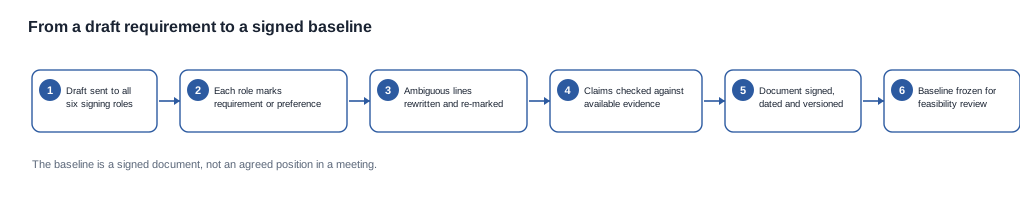
Two closing habits are worth forming. The first is to treat the requirement document as a controlled document with a version, a date and a signature block, the way you would treat a drawing or a test specification, because that is exactly what it is. The second is to read the acceptance criteria section last, after reading everything else, because it is the section that tells you whether the rest of the document can actually be verified — and a requirement that cannot be verified is a requirement that will be argued about later instead of built.
None of this requires the supplier to publish anything it does not publish. It requires the supplier to write down what it is building and what it may say about it, and to sign that writing. If a manufacturer cannot produce a signed requirement document, the discussion about tooling, samples, and the pilot order will happen without a shared definition of the product, and that is the most expensive way to run a smart glasses development.
For the wider sequence, see the development process overview and the quality gates breakdown. The full OEM and ODM engagement model, including how the requirement phase sits against the commercial shape of the engagement, is described on the OEM and ODM process pillar.


