
Choosing a model by market is not a question about taste or about which specification sheet is the most impressive. It is a question about which conformity route your product needs in each destination, and about which of our platforms can serve a route that has not been settled yet. Most of the range serves most markets. Two corners of the range do not, and the reasons are entirely different from each other.
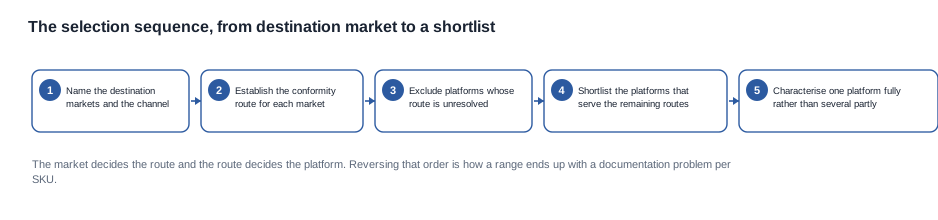
So how to choose by market selecting smart glasses by market works as a five-step sequence: name the destination, establish the route, exclude the platforms whose route is unresolved, shortlist what remains, and only then characterise a platform fully. Buyers who reverse the order — pick a model because the specification is attractive, then work out what it needs — end up buying a documentation problem per unit they add.
The general rule is that a Bluetooth radio product needs a radio route, a market-access file, and a claims position, and those three are decided per market rather than per model. Where a model is unencumbered — no camera, no AI feature, no health claim — the market question is usually straightforward, because there is very little left to defend.
That rule cuts both ways, and the second direction is more useful. Every additional claim attached to a platform adds an obligation in every market it enters, so the platforms that are easiest to place are not the most capable ones. Selection is a trade-off between capability and the number of claims you have to support, and the honest answer is to minimise claims first and add capability where the market and channel genuinely require it.
How to choose by market: selecting the platform, not the model
The unit of selection is the platform, not the individual model, and the distinction is worth being precise about because it changes how a range is specified.
A platform is a shared electrical and mechanical design: a chipset, a radio, a display, a standard firmware branch and a bill of materials. Several of our models sit on the same platform and differ by configuration — cell capacity, charging interface, camera tier, colour. Those differences are configuration choices within one compliance position. Moving to a different platform is not a configuration change; it opens a different technical file, a different characterisation scope and usually a different assessment scope.
The practical consequence is that a buyer who selects one platform well has made most of the market decisions for several products at once. A buyer who selects five models individually has made five market decisions, and the risk is that they are inconsistent — one model carries a claim the other four do not, so the documentation scope is the union of all five rather than the intersection.
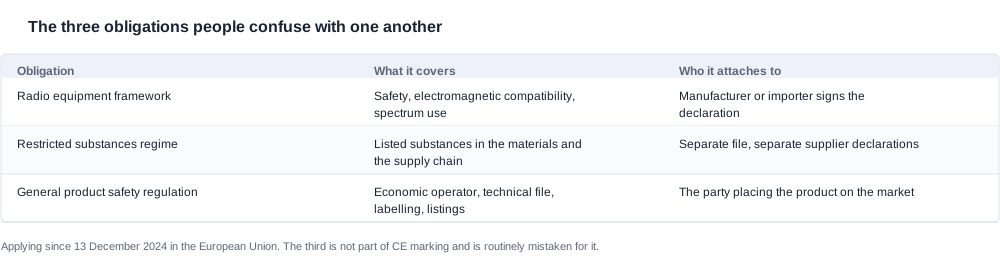
This is why the market decision comes first. The obligations above attach to a party and a product, not to a model family, and two obligations that a buyer considers separate turn out to be three once the economic-operator question is asked. The certification checklist sets out how the route is scoped in practice, and the GPSR route sets out the sequence for the European layer specifically.

The European Union: three obligations people run together
Three separate pieces of work, and they are frequently confused with one another. The radio equipment directive framework covers safety and health, electromagnetic compatibility and spectrum use, with a declaration of conformity signed by the manufacturer or the importer. The restricted-substance regime is a separate obligation with its own documentation and its own supplier declarations. And the general product safety regulation, applicable since 13 December 2024, adds the economic operator, the technical file, the labelling and the online listing information — all of which attach to the party placing the product on the market rather than to the hardware itself.
The practical consequence for a selection is that the open-ear audio range is the easiest thing to take into the European Union. Those models publish no camera specification, no AI feature and no health claim, which means the claims work is minimal and the documentation is a straight conformity file plus the market-access layer. A camera platform is still entirely achievable in the European Union; it simply adds a characterisation scope, a privacy consideration and a support script that the audio tier does not have.
Two things are worth watching. The EN 18031 series is scheduled to become a mandatory component of CE marking for radio equipment from 1 August 2025, which is after this article's publication date and so is not a requirement today — but a product launched into the European Union now will be in the market when it becomes one, so the security documentation position is worth asking about now rather than at the point of launch. And two models carry an IP54 catalogue marking with no test report number published behind it, the V06 and the S7, so a European outdoor claim needs the report before the claim is made on packaging or in a listing.
A third point applies to any market and is frequently missed: the labelling is a separate workstream from the technical file, and it is frequently the one that misses the launch date. Local language warnings, the responsible party identification and the market-access information all have to be printed on the packaging, which means artwork approval, which means a print run lead time. A programme that has completed its technical file and not yet commissioned its packaging artwork is closer to the market than a programme that is still assembling evidence.
The United Kingdom and the United States are not variations of it
The United Kingdom runs a separate conformity claim alongside the European route. The radio work and the market-access work both have to be repeated, and the item buyers most often forget is that the economic operator, the listing information and the labelling are UK requirements as well as European ones. Which means the UK is normally a second set of labels rather than a second product — a packaging cost rather than an engineering cost.
It is worth asking a supplier to confirm in writing that the same hardware can be placed on both markets with a different label, because that is exactly what makes a pan-European launch economical. A supplier who answers that the UK requires a separate radio assessment for the same hardware is describing a scope question worth resolving early, and one whose resolution determines whether the two markets can share a platform at all.
The United States radio route is the FCC equipment authorisation, and the market-access questions are different rather than lighter. The particular point to be careful about in this category is the general wellness boundary. A product that makes a claim about sustaining a healthy lifestyle sits in a different regulatory position from one that makes a diagnostic or treatment claim, and the distinction turns on the copy rather than on the hardware. A posture and viewing-distance reminder is a behaviour prompt; the moment the copy says it affects the eye, it is a different claim entirely. The medical boundary guidance sets out where that line sits, and the kids smart glasses family is where the boundary needs the closest reading, because the audience is by definition the one the claim would most plausibly be aimed at.
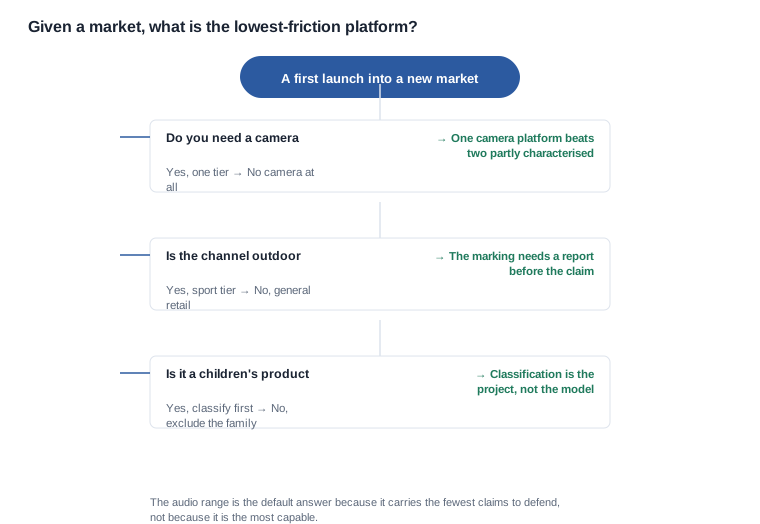
For a first United States launch the audio range is again the lowest-friction selection, for the same reason it is in the European Union: fewer claims to defend, and no camera to characterise. The camera platform in the United States is a larger undertaking than in Europe because the characterisation work sits closer to the claims a listing will make, which is why our position is to characterise one camera platform fully rather than two partly.
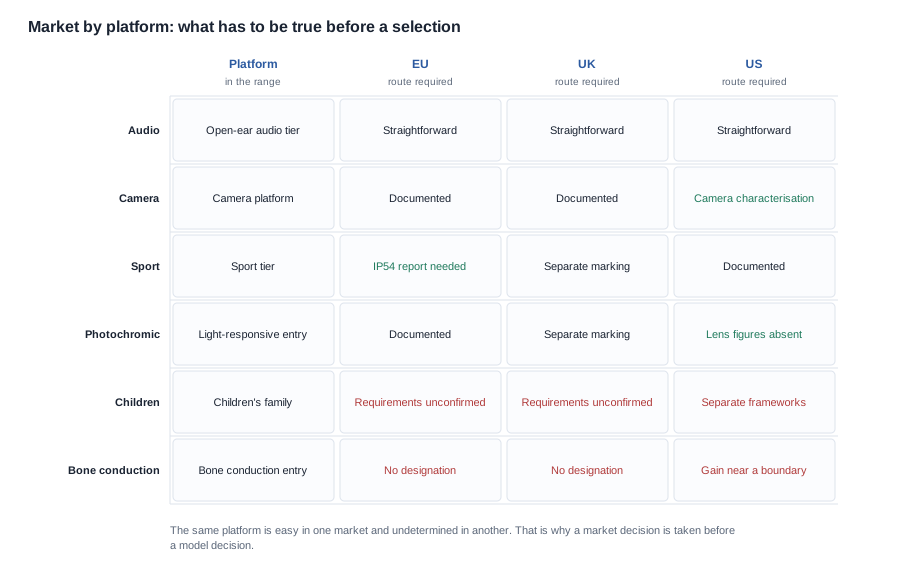
The matrix above is the practical version of the whole of this article. The same platform is straightforward in one market and undetermined in another, which is the reason a market decision has to be taken before a model decision. A buyer who reads only one row of that table will select correctly for one destination and discover the rest at documentation stage.

The markets where our answer is not yet available
Two corners of the range should not be selected on the strength of this article, because the question has not been answered.
The children's family. Children's products carry additional requirements in most destination markets — EN 71 in Europe, CPSC and ASTM F963 in the United States — and our documentation records no certification information for this family at all, with the applicable requirements recorded as needing confirmation rather than as not applying. That distinction matters: "not applicable" would be a conclusion, whereas "needs confirmation" is an open question. The models publish a feature set and a roughly twenty-hour duty-cycle runtime, and neither of those makes them sellable into a market whose requirements have not been established. Resolve the classification first; the model choice is the easy part afterwards.
The bone-conducted platform. It publishes a 35 dB amplification gain, which places it near a regulatory boundary, and it has no model number, no certification status and no disclosed customisation capability. A buyer selecting it for a market is not choosing a product; they are beginning a legal determination of what the product is. That is a legitimate project, and it should be scoped, staffed and scheduled as one rather than treated as a selection from a catalogue.
The photochromic platform sits between the two. It has a published specification and a real customisation route, but no model number and no lens performance figures, so a selection decision there needs a technical test as well as a conformity route. A buyer who selects it should expect to run its own characterisation, and should decide whether that is acceptable before placing the order rather than after the sample arrives.
There is a general reason these three corners are described rather than selected, and it is worth stating plainly so that it is not read as evasiveness. In each case the missing item is not a specification detail that a buyer could reasonably supply; it is an identifier or a determination that the supplier is the party best placed to make. A platform with no model number cannot be named on a declaration of conformity. A family whose requirements are recorded as needing confirmation cannot be declared to meet them. A platform whose gain places it near a regulatory boundary has not been classified, and classification is a legal determination rather than a product attribute.
The distinction for a buyer is between a gap you can close and a gap that has to be closed by somebody else. Missing lens performance figures are a gap the buyer can close by testing, at a cost the buyer controls. A missing classification is a gap the supplier must close, on a timeline the buyer does not control. Sorting the gaps into those two categories before the purchase order is the difference between a planned cost and an open risk.
There is also a sequencing consequence worth noting. In each of these three cases the model choice is downstream of the classification rather than upstream of it, which means the commercially attractive step — picking the model — cannot be taken first. Buyers who understand that early tend to scope these as a short investigation with its own budget. Buyers who do not tend to discover the dependency when the sample has already been approved.
A general caution about the whole method: a market-access framework is not a single document, and any supplier that describes one route as a single certificate is either simplifying or is describing a document that will not cover the obligation you are being sold against. Where a claim is company-level rather than model-level, that is a legitimate position to take, provided it is stated as such and the question of who completes the file for a given destination is answered in writing.
There is a fourth caution that belongs with the other three, and it is about sequence rather than about documents. Market-access work tends to be commissioned late, because it becomes urgent only when a launch date is fixed, and by that point the packaging artwork has usually already gone to print. In this category the artwork cycle is external and does not compress, so a market decision taken after the print run is a market decision that waits for the next print run. The remedy is unglamorous — establish the destination and the language set before the artwork is commissioned — and it is one of the few places where doing the ordinary thing early removes a month from the critical path.
The same sequence logic applies to the responsible party. Where a destination requires a named economic operator, arranging one is an administrative task that can take weeks of correspondence, and it is far easier to do while the route is still open than to retrofit onto a product that has already been declared by somebody else.

What to ask before a platform is shortlisted
The questions that actually decide a selection are unglamorous, and they are worth asking in writing because the answers become the specification.
- Which obligation attaches to us rather than to the hardware, and who signs the declaration of conformity for our exact model code? A declaration signed by an importer and a declaration signed by the manufacturer are different commercial positions.
- Which documents already exist for this model, and which are at company level only? Our documentation claims CE, FCC and RoHS at company level and does not publish model-level certificate numbers, issuing bodies or validity periods, so a complete file for a given destination has to be assembled partly outside our documentation.
- Does any existing report name our exact model, or does it cover a family or an electrical design? This is the single most efficient question in the category, because most documents here are issued per family rather than per marketing name.
- What will the labelling require, in which languages, and has the artwork been commissioned? A market-access file is not a packaging file, and the packaging cycle is usually the one that misses a launch date.
- Which claims will the listing make, and is each of them supported by a document we hold? Claims are the variable that multiplies across markets, because a claim that is defensible in one market may not be in another.
- What is excluded from this route, and what would we have to do to include it? The answer identifies whether a second platform is required later.
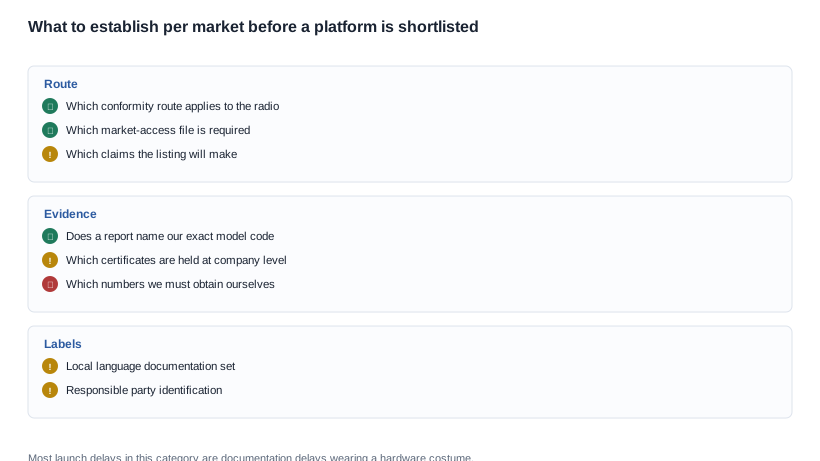
The sixth of those questions deserves the most attention, because it is the one that prevents a programme from discovering in month four that the platform it selected cannot carry the feature the second market requires. Where the answer is that a second platform would be needed, that is a planning input rather than a failure — provided it arrives now rather than later.
There is a seventh question that belongs in the same list and that almost nobody asks, which is what the supplier would need in order to complete the file on our behalf rather than handing us a company-level claim. The answer determines whether the buyer is assembling a file or buying one, and those are very different activities with very different costs. A supplier who can produce model-level documents for a named model code has told you something useful about the programme; a supplier who can only state that the company holds certain approvals has told you that the file is ours to build.
It is worth putting the destination list in priority order before the quotation, because the order determines what gets done first. Most buyers discover that their own list has no order in it, and a supplier who is left to sequence three markets will sequence them by whatever is easiest rather than by whatever the launch plan requires. Naming a first destination and a second destination, with a date for each, converts an open-ended compliance scope into a plan with a beginning.
The final discipline on selection is to write down what has been excluded and why. Excluded platforms are the ones a programme is most likely to reconsider under commercial pressure in month four, and having the reason recorded at the time — an unresolved classification, an absent test report, a missing model designation — is what stops that reconsideration from becoming an argument about what was agreed.
Being clear about the markets we cannot answer for
We will tell a buyer which route is straightforward and which is undetermined, and that we would rather decline a platform for a market than sell it into one we have not resolved. Two of the corners above are the practical expression of that, and the published gaps behind them are the reason: the children's family has no certification information recorded at all, and the bone-conducted platform has no designation, no certification status and no disclosed customisation route.
It follows that we will not supply a market-access statement we cannot evidence. Where our documentation holds a claim at company level only, we say so and we say what a buyer would have to complete separately, because a buyer who plans on the assumption that our file is theirs will discover the difference at a point where it is expensive to recover.
The whole of this article reduces to one instruction: select the market, establish the route, and then pick the platform that serves it with the fewest claims to defend. For most brands that means the audio range plus one camera platform, because the audio tier groups into a small number of configurations, so a distributor can mix models without the configurations multiplying, and one camera platform changes the documentation, the retail proposition and the support script in a way that is worth doing properly rather than doing three times thinly. The sport range belongs where the channel is outdoor and the IP54 marking can be backed by a test report, and that report is the item to chase.
Tell us the destination markets, the channel, the volume and the categories you need, and we will come back with what is available in each and what we can close for you directly. The selection logic is on our select by market page, and the platform structure behind it is set out in which model to pick.
Related reading
- How the route is normally scoped — certification checklist
- How the range is grouped by platform — which model to pick
- Where the claims boundary sits — medical boundary
Tell us the destination markets, the channel, the volume and the categories, and we will come back with what is available.


