

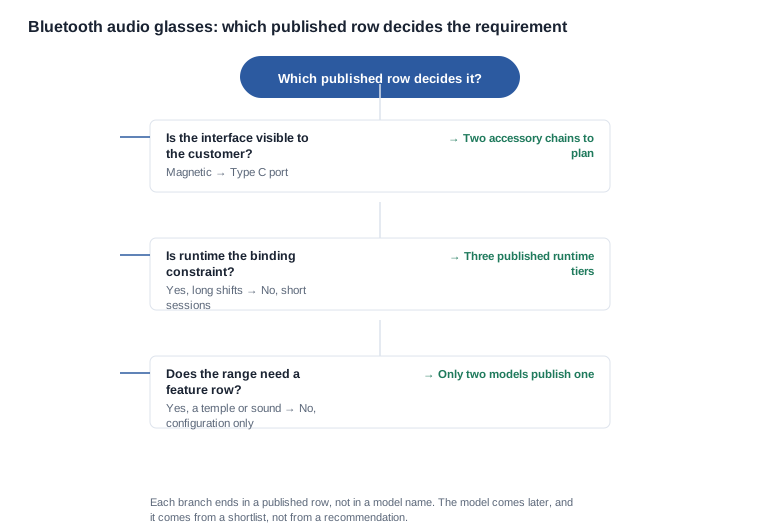
The audio range has eight models, and the first thing a buyer should know is that six of them publish no distinguishing feature at all. The D11 and the K02, the LC-105-1 and the D12, and the LC-105-2 and the K01 are, on paper, three pairs of the same idea with different cell configurations and charging interfaces. The G07 and the YK12 each carry one thing the others do not. That is the structure of the range, and a decision made against it is much faster than a comparison of eight spec sheets.
Bluetooth audio glasses which model to pick: the range is three platforms, not eight products
The decision in front of you is usually a range decision
Two different questions arrive under the same heading, and they have different answers.
A buyer placing a single order needs to know which model designation goes on the purchase order, and the answer is decided by a small number of constraints that are already published. A buyer building a range needs to know how many distinct products this catalogue can support, and that question has a much harder answer than the first one, because the answer is set by how many of the eight models publish something that can be listed.
The range question is the one that catches people out. A range of eight models is, on the published evidence, a range of three configurations and two feature rows. A plan built on eight differentiated listings will fail at the artwork stage, when somebody has to write the sentence that distinguishes the third 55mAh*2 model from the fourth.
What we will not do in this article
We will not tell you which model to buy, and that is a deliberate position rather than a cautious one. A recommendation made from a published row would be a recommendation with no evidence behind it, and the published rows in this family do not cover the questions that actually decide a purchase: acoustic performance, frame weight, ingress, packaging, certification coverage, lead time, and price.
What we can do is give you the structure of the range, the published row that settles each requirement, the questions that close the gaps, and the order to work them in. The open-ear audio notes cover what the form factor gives up, and the physical-side analysis of this family covers the variables that decide whether an open-ear frame is used at all.
The range as it actually publishes
The eight models sit on three cell configurations and two charging interfaces, and those two groupings are the whole architecture.
The 90mAh*2 platform carries the K01 and the K02. Both publish Bluetooth V5.3, magnetic charging, a charge time of two hours or less, and a rated runtime of approximately eight hours. It is the only platform in the family on V5.3.
The 100mAh platform carries the D11 and the D12. Both publish Bluetooth V5.4, a single cell, Type-C charging, a charge time of two hours or less, and a rated runtime of approximately seven hours. It is the only platform with a single cell.
The 55mAh*2 platform carries the YK12 and the LC-105-2, and the G07 and the LC-105-1. All publish Bluetooth V5.4, magnetic charging and a charge time of two hours or less. The published runtimes split inside the platform: approximately eight hours on the LC-105 pair, approximately six hours on the G07 and the YK12.
The charging interface splits the range independently of the platform: six models magnetic, two models Type-C. The two properties cross, which is why the range has eight models rather than six.
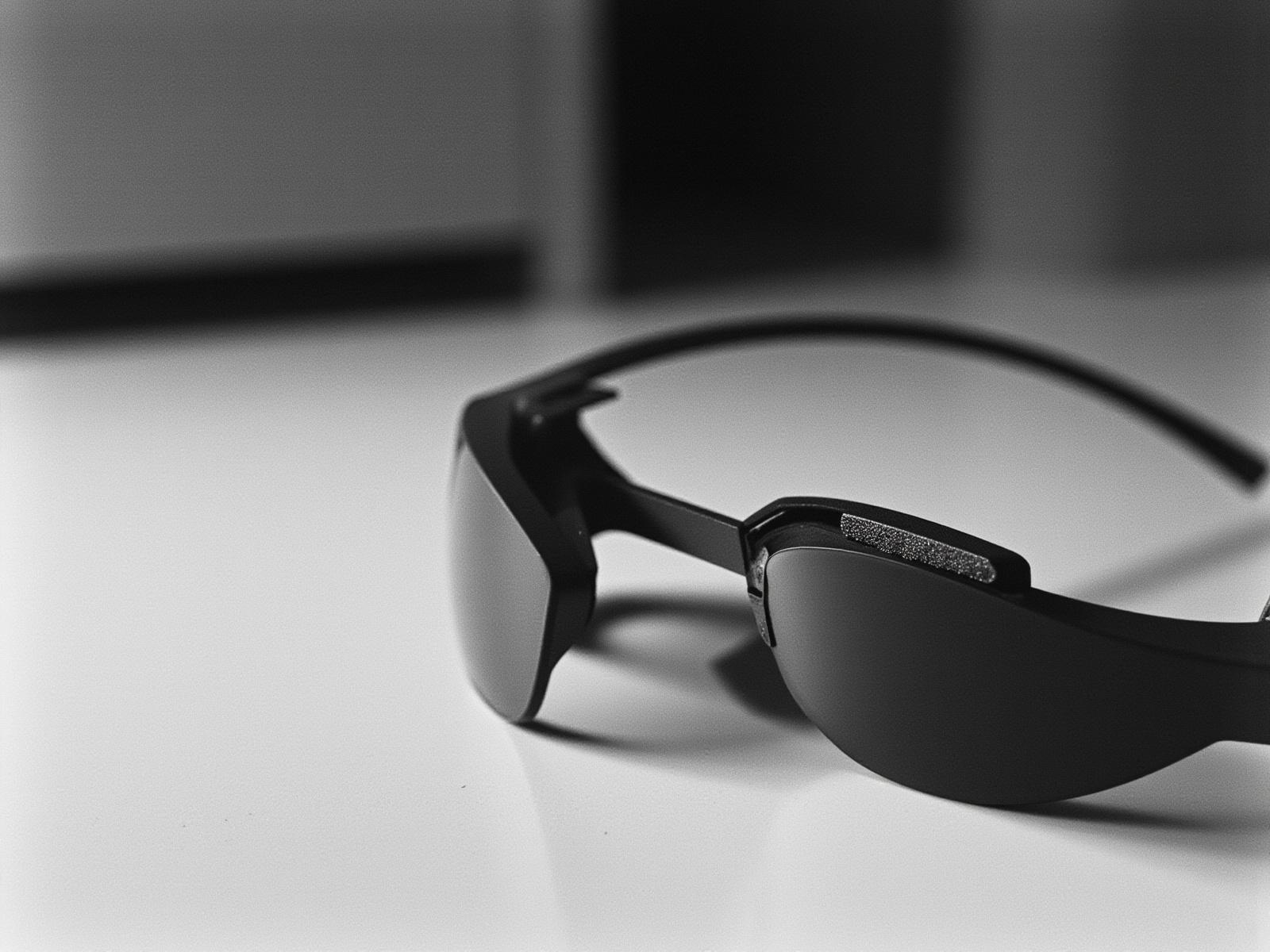
The requirement in front of you, and the published row that decides it
The five constraints that actually decide a selection
Only five constraints in this family can be settled from published rows, and they are the same five for every buyer.
The charging interface is a customer-facing decision — a visible dock or a visible port — and it rules out half the range before anything else matters. It is published on all eight.
The runtime tier is a second constraint, with three published values: approximately eight hours, approximately seven hours and approximately six hours. It is published on all eight.
The cell configuration matters to a buyer who cares about balance, about the number of cells in a battery file, or about the single-temple mass distribution of the 100mAh platform. It is published on all eight.
A published structural feature exists on exactly two models: the G07 publishes an ultra-slim detachable temple, and the YK12 publishes a surround sound claim together with a slim temple. It is published on two.
The radio generation is published on all eight, and it is the weakest of the five, because V5.4 is not a differentiator between the six models that carry it. It only separates the 90mAh*2 platform from the rest.
Everything else is a gap, and a gap is an instruction
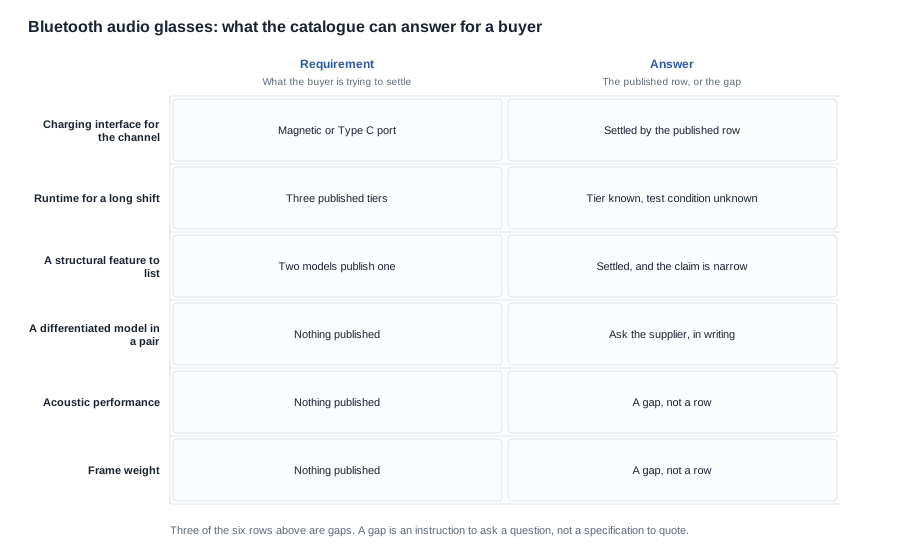
The matrix above is the honest summary of what a buyer can and cannot settle from our documentation. Three of the six requirement types are gaps: acoustic performance, frame weight, and a differentiated model within a pair. A gap is not a row to be quoted and it is not a weakness to be hidden — it is an instruction to ask a specific question of the supplier, and it is the reason the questions in the fourth section of this article exist.
The cost of not knowing which rows are gaps is high in one direction and zero in the other. A buyer who assumes a gap is closed will build a listing on a number that turns out not to exist, and that is a claim problem rather than a specification problem.
The order to work the constraints in
One: the charging interface. It is the constraint with the widest reach and the one that determines the accessory chain, the packaging and the spare-parts plan.
Two: the runtime tier. If the deployment is a full shift, the six-hour models are the ones that force a charging routine into the middle of it, and the eight-hour and seven-hour models do not. If the deployment is a short session, the constraint does not bind and you should not let it narrow the range.
Three: the cell configuration. This is where the balance and the battery-file questions live, and it is the point at which a 55mAh*2 model and a 100mAh model become a genuinely different decision rather than two rows in a spreadsheet.
Four: the feature row. If the range needs something to list, the G07 and the YK12 are the only two models that publish something. If it does not, the range is a configuration range and should be planned as one.
Five: everything else. And at this point, the residual is the gap list, which is where the supplier questions go.
The three configurations and the six models that publish no distinction
The 90mAh*2 pair: the K01 and the K02
Two models, identical published rows, and no published feature on either of them. The only thing that distinguishes them in the catalogue is their designation.
That is not a criticism of the product; it is a description of what is documented. What it means practically is that a buyer who plans to list both will have to supply the difference themselves, and the most likely source of that difference is a factory capability rather than a published specification: an assembly option, a control method, a colour treatment, a packaging format. None of those is documented, and all of them can be documented if the buyer asks.
The question to ask is the identity question: what separates the K01 from the K02, in writing, in one sentence. If the answer is a feature, it goes in the listing. If the answer is "the designation", then the range has one product in it, and that is a decision to make deliberately.
The 100mAh single-cell pair: the D11 and the D12
Also two models, also identical published rows, also no published feature. This pair is the only one in the family on a single cell, and it is the only one on Type-C charging, and the two facts together make it a different product line rather than a different model.
A single cell in one temple changes the balance characteristics, and Type-C removes the dock from the accessory chain, which changes the parcel. Both of those are commercial consequences of a published row, and both are worth having. The distinction between the D11 and the D12 is not documented, and the question to ask is the same identity question.
The 55mAh*2 group: four models, two identities, two feature rows
This platform is where the range's real choice lives, and it is also where the documentation is least able to help.
The LC-105-1 and the LC-105-2 publish identical rows and no distinguishing feature. The G07 and the YK12 publish identical electrical rows and each carries a feature row.
So the platform resolves into three product identities rather than four: the LC-105 pair, the G07 and the YK12. That is a genuinely usable range structure, because each of the three can be listed against a published fact — the LC-105 pair on runtime, the G07 on the detachable temple, the YK12 on the sound and temple rows. The question to ask is again the identity question, and this time it carries more weight, because the LC-105 pair is the part of the group that has no published differentiator at all.

The two feature rows, and what each one commits you to
The G07 detachable temple
An ultra-slim detachable temple is a published row and it is the most commercially interesting row in the family, because a detachable part is simultaneously a construction feature, a sizing story and a service commitment.
What it commits you to. If the temple is user-replaceable, the G07 can be listed as an adjustable and serviceable product, and the replacement path is part of the product. If it is factory-only, then a broken temple is a channel cost, a return, or a write-off, and the listing has to say so.
The adjustment range question. A detachable temple implies more than one size or more than one position, and the adjustment range is not published. A range that a buyer cannot quote is a range that a customer will discover is smaller than expected, which is a return.
The interchange question. Whether the detachable temple on the G07 is interchangeable with the temple on any other model in the family, and whether a replacement can be ordered separately, are both unpublished and both decide whether the feature is a service asset.
The who needs the G07 analysis covers the model where the weight and temple questions tend to decide the order.
The YK12 sound and slim temple
The YK12 publishes a surround sound claim together with a slim temple, and the two rows carry different risks.
A sound claim is a listening claim, and it is narrow. A listening feature describes how the product sounds to the person using it. It is not a transmission claim, it is not a microphone specification, and it says nothing about call quality. The microphone testing notes set out why the listening and transmission arguments have to be kept apart, and keeping them apart in the copy is the cheapest protection there is.
The conditions question. No acoustic figure is published for this model — no driver size, no frequency response, no leakage value — so the sound row has no number attached to it. The conditions that would make it defensible, a source level, a distance, a volume setting, are all things a buyer can establish on a sample, and the YK12 placed against the published rows covers what that looks like.
A slim temple is a weight and balance question, and it intersects with the fact that the YK12 publishes the shorter runtime tier in the family. Two published rows in the same model pointing in opposite directions is a normal situation and a useful one: it tells the buyer exactly which trade-off the model embodies, and it is the kind of trade-off a range plan should be built on rather than around.

How to build a range from this catalogue, and the questions that decide it

The five questions to ask, in one message
What separates each pair? One question covers the K01 and the D12, and the D11 and the K02, and the LC-105-1 and the LC-105-2: what does the designation change, in one sentence, in writing.
What is the test condition behind every published runtime? The models on the 55mAh*2 platform publish both six-hour and eight-hour figures, and no condition is published for either. If two numbers came from different rigs they do not belong on the same comparison chart, and a chart that mixes them is a chart that a customer can dismantle with a search engine. The battery specification guidance covers the questions to ask.
Is the G07 temple user-replaceable, and what is the adjustment range?
What conditions sit behind the YK12 sound claim?
What is the colour, packaging and accessory scope for each model you intend to carry? The range is small enough to specify in a single document, and a buyer who asks in three rounds gets three partial answers.
The failure patterns this structure produces
Eight models were planned because eight models exist. The symptom is that four SKUs reach the artwork stage with nothing to say, and the trade-off between them is settled by whoever argues hardest in the meeting. The root cause is that the range was planned from the model list rather than from the configuration and feature structure. The prevention is to plan three configurations and at most two feature positions, and to check the count before the listing work starts.
The LC-105 pair was listed as two differentiated products. The symptom is a customer question about the difference that the listing cannot answer. The root cause is that the identity question was never asked. The prevention is to ask it in writing before the listing exists.
A runtime chart mixed test methods. The symptom is a customer comparing two figures that were not measured the same way, and the range losing credibility for it. The root cause is that the figures were published without conditions. The prevention is to chart only what is comparable.
A listening feature was sold as a transmission feature. The symptom is a call-quality claim that no published row supports. The root cause is that a sound claim was read as a microphone row. The prevention is to keep the listening and the transmission arguments separate in the copy and in the RFQ.
The detachable temple was sold as a sizing feature and the service path was never established. The symptom is a broken temple that cannot be replaced and a channel that absorbs the cost. The root cause is that user-replaceable versus factory-only was never established. The prevention is to ask the question at the RFQ stage.
The price tier was decided first. The symptom is a range that ends up with several models at the same price and no differentiation. The root cause is that the configuration and feature decisions were deferred. The prevention is to work the five constraints in order and to treat the price tier as the output rather than the input.
Commercial terms, and what the range structure is worth
The number of accessory chains is the real commercial cost of a range. Magnetic and Type-C are not cosmetic differences: they are two accessory chains, two packaging specifications and two spare-parts plans, and a range carrying both carries both costs.
The negotiable items are the unit price and volume tiers per model, the sample order cost, the accessory set and its own minimum quantities, the packaging specification, delivery splitting, payment nodes against inspection, the warranty period with a stated response, and the terms of a pilot order with a defined exit.
The items that do not move are the certification cost and time, which follow the process and the testing body, and tooling, which is usually amortised across the first order. The useful question is which one you are being quoted, because the two are frequently bundled into one line that hides which is which.
What to put in the purchase order: the configuration and cell for the model ordered; the charging interface and the accessory set; the rated figure with its condition; the temple configuration and whether it is user-replaceable; the warranty period with a stated response; and the accessory minimum quantities.
What to leave out: any leakage figure, frequency response, driver size or microphone count. None is published, and each one in a listing becomes a claim the brand has to defend.
A hypothetical range plan, and where we will not give you a recommendation
A hypothetical plan, worked through
This is a hypothetical case rather than a real engagement, and it exists to make the order of decisions visible rather than to report a result.
Assume a brand that sells into two channels: one that expects a dock and a long session, and one that expects a bare retail unit and a short session. The brand currently plans to carry four models.
The first step is the interface split. The two channels need different accessory chains, and the catalogue offers both: six magnetically charging models and two Type-C models. The interface constraint is settled from published rows, and it settles the accessory and packaging work before any product is chosen.
The second step is the runtime constraint, applied per channel. The long-session channel takes the eight-hour and seven-hour tiers. The short-session channel is not constrained by runtime, which means the six-hour models are available to it at no functional cost, and the detachable temple feature becomes usable there.
The third step is the feature constraint. The long-session channel has no published feature to use, so its range is a configuration range. The short-session channel can use the G07 or the YK12 as a listed product with a published differentiator.
The fourth step is the SKU count. The plan that emerges is not four models. It is two configurations per channel, and the point of the exercise is that the buyer arrived at two because the published rows allowed two, and not because two is a nice number.
The fifth step is the question that is still open. The identity question for the three pairs is still unanswered, and until it is answered the long-session channel's range is three possible products and one unknown. That is the position the buyer writes into the RFQ, and it is a better position than an assumption.
What we publish, and where our boundary is
The audio range is an honest range that is easy to buy from once you stop reading it as eight products and start reading it as three configurations with two feature rows scattered across them. We would rather tell you that six models publish nothing distinctive than dress them up with adjectives to make the range look richer.
We will also not quote a price, a minimum order quantity or a lead time in an article, and we will not recommend a model for a scenario. The published rows are what we can put on the table, and the recommendation belongs to the buyer because it depends on the channel, the market and the margin. What we will do is tell you exactly which rows differ between which models, and which questions we can close for you on request.
If you tell us the channel, the volume and the target market, we will come back with what is available and what is not. The family is on our Bluetooth audio glasses range page.
What to send before the next RFQ
Send the channel, the volume, the target market and the two or three models you have in mind, in one message. We will come back with the published rows for each of them, the identity question for the pair they belong to, and the list of gaps that remain open in our documentation.
Related reading
- The physical side of choosing an open-ear frame — the physical-side analysis
- One model placed against the published rows — the YK12 against the range
- What an open-ear frame actually gives up — open-ear audio
Tell us the channel, the volume and the target market, and we will come back with what is available and what is not.


