

Odm development team involvement fails in a predictable way: nobody in the room owns the decision that was actually blocking the programme. The factory assumes the brand will specify it, the brand assumes the factory handled it last time with somebody else, and the item sits open until the schedule slips and somebody senior reads a status report. The fix is not more meetings. It is a written split of four responsibilities, a named owner for each decision, and a rule about which of them must exist in writing before tooling starts.
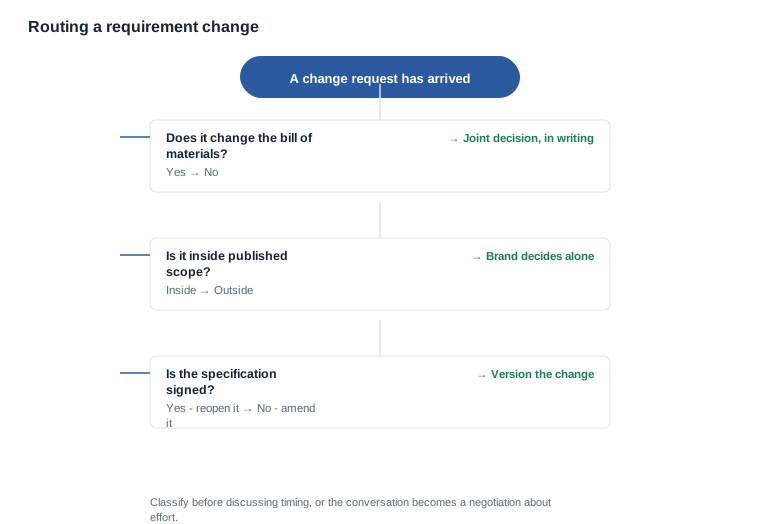
ODM development team involvement: four responsibilities that cannot be shared
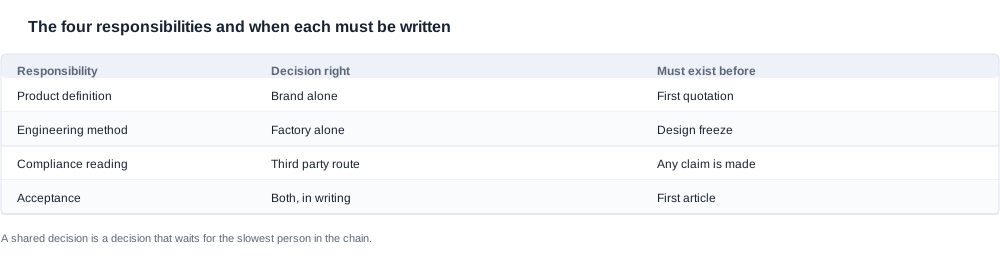
Each of the four below has to sit with one party. They fail when they are shared, because a shared decision is a decision that waits for the slowest person in the chain rather than for the person best placed to make it.
Product definition belongs to the brand. The decision that the product records video rather than stills, or runs for six hours rather than four, is a market decision about your customer and not an engineering preference. A factory can tell you exactly what a given configuration produces and what it will do to the schedule; it cannot tell you what your buyers will pay for, which is a different question with a different evidence base. Write this down as a signed product requirement before anyone opens a mechanical file, and include what the product deliberately will not do, because the exclusions are where the next argument comes from.
Engineering implementation belongs to the factory. Tooling, circuit design, thermal work, firmware integration and the production test method are the manufacturer's job in an ODM relationship, and a buyer who second-guesses them inside the build adds latency without adding knowledge. The published customisation scope for this range covers logo, colour, packaging, temple shape, system and UI, Bluetooth name and firmware. That list is not a marketing statement, it is the boundary of what can be changed without becoming a different product, and it is the line against which every requirement should be checked before it enters the programme.
Compliance interpretation needs a third voice. Whether a claimed feature is permitted in your destination market is a legal question about intended use, labelling and the market's own rules — not an engineering judgement and not a marketing decision. A factory can tell you what it has declared and what evidence it holds. For this range, certificate numbers, issuing bodies and validity dates are Not published, and the applicable regulatory pathway differs by market, so a buyer who needs a specific answer for a specific destination needs a route designed for that destination rather than the general position.
Acceptance belongs jointly, and in writing. The moment a buyer accepts a first article, the specification becomes binding in practice whether or not it was ever signed. Acceptance criteria that live in somebody's memory are the most expensive item in the entire process, because they are the point at which an unresolved disagreement turns into an inventory problem.
Two failure patterns run through all four. The first is the missing owner, where a decision has a committee attached to it and therefore has no deadline. The second is the confident delegate, where somebody senior has been given a decision because they are available rather than because they are qualified, and then makes a call outside their competence that nobody revisits because reversing a senior decision is socially expensive. Both patterns are invisible from inside the programme and obvious from outside it, which is why the written split matters more than any individual competence in the room.
There is a practical test for whether the split is real. Take any item currently open in the programme and ask who would be embarrassed to be asked, this week, for the decision on it. If the answer is a person rather than a group, the structure is working. If the answer is a meeting, the item is unowned and the programme is relying on somebody noticing it, which is the condition this whole arrangement exists to prevent.
The test is worth repeating at two further moments, because ownership decays in a predictable order. It decays first at the point where the programme stops being interesting, which is usually somewhere in the middle of the build, and the first items to lose an owner are the ones nobody is actively asking about. It decays second at the point where the team turns over, when the person carrying an item in their head leaves and the item goes with them rather than with the log. A structure that survives both moments is one where the answers are written somewhere other than in people, and that is the whole argument for spending an afternoon on it at the start.

Where the change boundary actually sits
The useful test is short: if the change is visible on a shelf it is cheap, if it is visible only after the electronics are designed it is expensive, and if it changes what the electronics can do then it is a new product. That test is rough, but it correctly predicts most of the commercial weight of a change, and it gives both sides the same vocabulary for a conversation that otherwise becomes an argument about effort.
| Change | Where it lands | Rough commercial weight |
|---|---|---|
| Logo and packaging | Printing and tooling artwork | Low |
| Colour and temple shape | Surface finish, structural tooling | Moderate |
| Bluetooth device name | Firmware configuration | Low |
| UI and system appearance | Software | Moderate, ongoing upkeep |
| Battery capacity or sensor class | Bill of materials, re-layout | High |
| Adding or removing a function | New platform | Highest, effectively a new SKU |
The row that catches buyers out is the last one. Removing a function from an existing platform is not a simplification of the current product; it is a different board, a different tool set and a different approval path, and it is frequently assumed to be free because nothing is being added. Ask early, and ask specifically what the shortened specification costs in engineering rather than in materials.
How to use the table in a negotiation is straightforward. Classify the request, quote the row, and then ask the question that the row implies rather than arguing about the number. For a cosmetic request the implied question is whether the artwork deadline still works. For a structural request it is whether a second tool is being opened or an existing one modified. For a request that touches the electronics it is whether the current platform still makes sense at all, which is occasionally the most valuable conversation in the programme, because a brand that has drifted towards a platform it does not need is better served by a smaller product than a more complicated one.
The middle rows have a subtlety worth naming too. Anything touching the user interface carries an ongoing upkeep rather than a one-off cost: the work is delivered once and then has to survive every subsequent software release. A buyer who negotiates a custom interface should establish at the same time who owns it afterwards, how changes are requested and what a change costs, because a custom interface with no upkeep route is a liability that arrives in the second year rather than an asset.
There is a second axis the table does not show, which is how visible the change is to the person eventually holding the unit. A change that alters the bill of materials is usually invisible from the outside and costs a great deal; a change that alters the outside is highly visible and frequently costs almost nothing. Buyers consistently weight these the wrong way round, because visible changes attract attention during the review while invisible ones are accepted without discussion — and the invisible ones are the expensive ones. The practical consequence is that a review meeting should spend its time on the rows nobody can see, which is the opposite of where it usually goes.
The test has limits, and it is worth knowing them before relying on it. It predicts relative weight rather than a cost, so two changes classified as heavy may differ by a factor of ten. And it says nothing about how long a change takes, which is governed more by where in the programme it arrives than by what it contains. Used properly it is a way of sorting the agenda — cheap, moderate, structural — so that the meeting spends its limited time on the decisions that are still open, rather than on confirming changes everyone has already accepted informally.
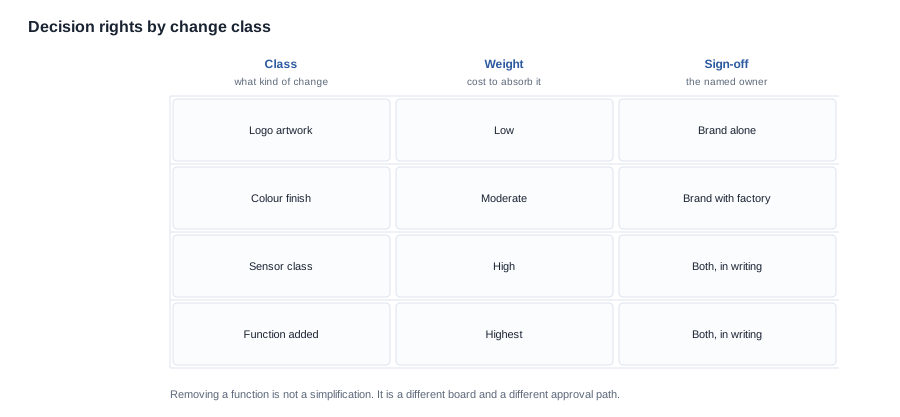

Decision rights: who may say no, and who absorbs the re-work
Two questions separate a workable ODM relationship from a stalled one, and both are about authority rather than about opinion.
Who may say no to a requirement change without escalation? If every change requires a founder-level conversation, the development timeline will be governed by calendar availability rather than by engineering, and no amount of planning will fix that. The answer should be a named role with a stated limit, and the limit matters more than the name. A person who may say no to anything is as much of a bottleneck as one who may say yes to anything.
Who owns the list when a requirement changes mid-development — the party who requested it, or the party who absorbs the re-work? This one is worth settling in writing because the default answer, when nobody states one, is that the factory absorbs the cost. That default is precisely why re-work quietly becomes the price of a change: each individual change appears trivial, nobody is tracking the total, and by the time the total is visible it is embedded in a schedule that has already been committed to somebody downstream.
There is a third question that experienced buyers add, and it is the one that prevents the most argument later: what evidence must be re-established when a change lands after a gate has been passed? A change to a cosmetic item invalidates a packaging file. A change to a component inside an assessed configuration invalidates part of the assessment position and possibly part of the technical file. Writing that mapping down at the start of the programme converts a recurring argument into a single reference, and it is also the single most useful artefact to hand to a new person joining the team three months in.
The mapping has a second use that teams rarely notice. Because it maps changes onto gates, it also tells you where the gates are — and a programme with no clearly stated gates is one where every change is technically post-gate and therefore always expensive. Stating four gates explicitly, with the evidence each one produces, gives the programme a vocabulary for a conversation that otherwise defaults to whether the change is "significant". Significance is a judgement; a gate is a fact, and facts are easier to agree on.


How a change request should travel, and what to ask before you commit
The mechanics of a change are worth specifying, because an unspecified change process is where re-work hides. Seven steps describe one that works, and each of them can be checked on a given day without a meeting.
- Raised by the requester with a reason attached. A change requested without a reason cannot be weighed, and the reason is often the only thing that determines whether it is cheap or expensive.
- Classified against the published customisation scope. Inside scope, or outside it. This is a definitional question, not a negotiation, and it should be settled before anyone discusses timing.
- Weighed by commercial impact, not by effort. The question is what the change does to the landed cost and the schedule, not how hard it appears.
- Sent to the named decision owner, not to a channel. Routing a change to a shared inbox is how decisions disappear.
- Answered with a date and a written reason. No answer is a decision to keep the current specification, and it should say so.
- Logged with the cost of the change attached. Individually small changes accumulate into the largest unmanaged number in most programmes.
- Reflected in the specification version. A change that lives in an email is not a change to the specification.
What happens without this process is predictable rather than catastrophic, which is why it survives so long. Early changes get absorbed, because they are individually cheap and nobody is counting. The counter only becomes visible at the end, when the schedule has slipped by an amount that nobody can attribute to any single decision. At that point the usual response is to accept the new date rather than to investigate, since investigating would mean admitting the number was never controlled. The cheapest intervention available anywhere in an engagement is a running total of what changes have cost, maintained from the first change onward, because it turns an argument about blame into a number both sides already share.
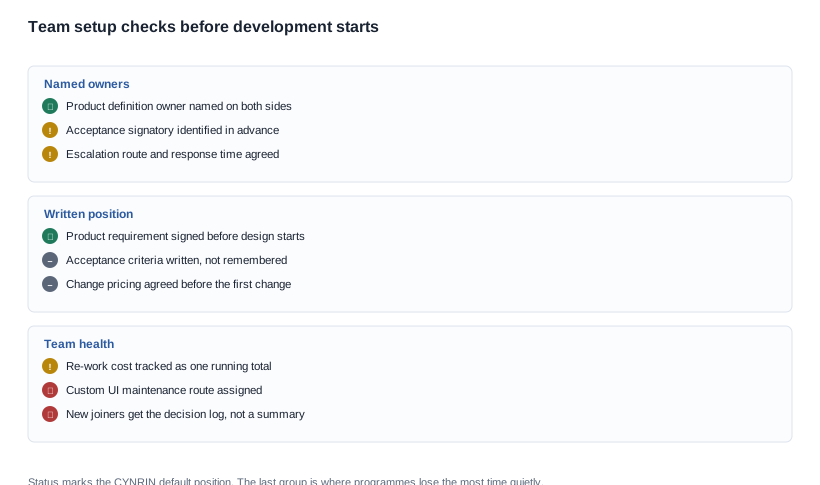
Four questions are worth asking any supplier before you commit to a programme, and they concern people rather than machines. Who is the named owner of product definition on your side, and is that person reachable? Who signs acceptance, and against what written criteria? What is the escalation route when a decision is blocked, and how long does it take? And when a change is requested mid-build, what is your process for pricing it before it is accepted? The fourth is the one most often left unanswered, and it is the one that determines whether the first change costs nothing and the twentieth costs a month.
A fifth question is worth asking of your own organisation rather than of the supplier, because it is the one that most often turns out to be the real constraint. Who inside your business is allowed to say that a requirement is not needed? Most teams can name a person who can add things and no equivalent person who can remove them, which produces a specification that grows monotonically through development and a schedule that inherits every addition nobody had the authority to decline. In an engagement where the manufacturing side is doing the engineering, that asymmetry has nowhere to resolve itself, and it is resolved instead by the factory quietly absorbing scope into a fixed tooling budget.
What we publish as customisation scope, and where our own limits are
Our published customisation scope is the boundary we will work inside, and we would rather hold that line clearly than widen it mid-programme and deliver something nobody specified. Logo, colour, packaging, temple shape, system and UI, Bluetooth name and firmware are the published customisation items for this range. Anything that alters the bill of materials is a different conversation with a different cost, and saying so early is more useful to a buyer than discovering it at week eight.
We do not publish minimum order quantities, unit prices or development fees as fixed numbers. All three depend on configuration and are confirmed per enquiry, and a fixed figure quoted before the product definition exists would be a guess dressed as a quotation — which is a particular kind of unhelpful, because it moves the argument from engineering onto arithmetic where neither party has information.
What we will do is tell you early, before the programme is committed, which of your requirements sit inside the published customisation scope and which require a different product base. That single piece of information is usually the most valuable output of an early conversation in this category, because it determines whether the programme is an ODM project or a white-label swap, and the two have different timelines, different costs and different risk profiles.
It is worth being explicit about why we hold the scope line rather than widening it when a request sits outside it. Widening the scope mid-programme does not make the request cheap; it makes the programme less predictable for both sides, because every widened boundary becomes a precedent for the next request and eventually the specification stops describing any particular product at all. Holding the line costs a conversation now and saves an argument later, and it also keeps the published scope meaningful — a scope that is quietly widened whenever somebody asks is not a scope at all, it is a starting position.
The same reasoning applies to the numbers we do not publish. A minimum order quantity, a unit price or a development fee quoted before the product definition exists cannot be more than an estimate, and publishing an estimate as a figure transfers the cost of our uncertainty onto the buyer's business case. Confirming them per enquiry costs both sides a little more time and produces a figure that means what it says.
For the sequence a development programme follows, odm development sets out the stages and the hand-off points. If your requirement turns out to be closer to a white-label swap than a development, standard OEM is the cheaper route and you should compare the two before committing rather than after.
One last practical point about team shape. In most engagements the buyer's side is represented by one person, and that person is usually not the person who will use the product or sell it. Their instincts are therefore a reasonable proxy for the organisation's but a poor proxy for the market's, and the gap shows up as a specification that is internally coherent and externally unremarkable. Adding one colleague who represents the intended use — briefly, and early — costs a day and reliably removes a class of late change that would otherwise be discovered during a review meeting with no time left to act on it.
Related reading
- ODM and OEM compared — which model fits which project
- Engineering customisation scope — what changes at what commercial weight
- Certification checklist before development starts — the compliance workstream
- The eight items a prototype has to settle
Tell us your product definition and the requirements you believe are non-negotiable, and we will tell you which sit inside our published customisation scope and which need a different base.


