

The reason an odm development prototype phase carries more risk than the equivalent stage in an OEM programme comes down to a single word: ownership. In a standard OEM engagement the design already exists and the factory already knows how to build it, so a prototype confirms what is known. In an ODM the design belongs to the buyer and the prototype is the first point at which that design meets the factory's existing platform, tooling, process and test capability. Almost everything that goes wrong at this stage goes wrong because the two were assumed to be compatible and they were not. This article sets out what the phase has to settle, how to tell early whether it is settling them, and what to ask while it is happening rather than after.

ODM development prototype phase: the eight items it has to settle
A prototype is not a demonstration. It is an instrument, and like any instrument it has a defined list of things it is able to measure. Anything outside that list stays unresolved no matter how many units are built. The eight below are the ones that decide whether the programme proceeds, and each one has a specific question and a specific piece of evidence that closes it.
1. Sizing and assembly clearance. Whether the electronics occupy the housing as it was drawn. This sounds trivial and it is the most common failure, because a design drawn in a CAD tool does not account for the tolerance stack, the fixings, the wiring route or the assembly sequence. The difference between the drawing and the physical part is normally discovered by a tool being cut, which is the most expensive place to discover it.
2. Heat. Whether the assembly runs at a temperature the frame can carry. The housing is the thermal path towards the skin, so the design has to show where the heat goes. The question worth asking is the surface temperature at the skin contact point under a full workload, not at rest. A rest measurement is comfortable, easy to produce and useless for the decision.
3. The antenna. Whether the radio behaves in this frame. The housing is part of the antenna environment, and a design never assessed in its final housing carries an open radio question. Ask whether an assessment is needed before the tool is cut, because after it is cut the answer is expensive in a way that has nothing to do with the money.
4. Buttons, ports and seals. Whether they seal and whether they behave. A button in a sealed housing is a moving part passing through a hole, and that is a design question rather than a manufacturing one. The feel of a button is set by the gap, the travel and the dome force, all of which are fixed in the tooling, so a subjective decision made verbally at the prototype review becomes a permanent one when the tool closes.
5. Manufacturability. Whether the line can build the part to the drawing at a repeatable rate. This is the point at which a drawing is found to be unbuildable as written, and it is considerably cheaper here than after the first production run has been planned around.
6. Tooling. Whether a new mould is needed or an existing tool can be modified. A modified tool is faster and cheaper and it carries the history of whatever it made before, which is worth asking about in a due diligence review rather than discovering through the first trial shot.
7. The compliance configuration. Whether the prototype is the configuration that will be assessed. A model code should be fixed at this point, because assessment applies to a configuration and a change afterwards means re-assessment. In this category the catalogue text names no CE, FCC or RoHS and carries no compliance line against any model, so a late configuration change cannot undermine published wording — it changes what the buyer has to obtain in writing.
8. Cost. What the unit cost looks like at volume. A prototype is the first point at which a real number can be produced rather than an estimate, and in many programmes that number is worth more than the prototype itself, because it is what the rest of the business case is built on.
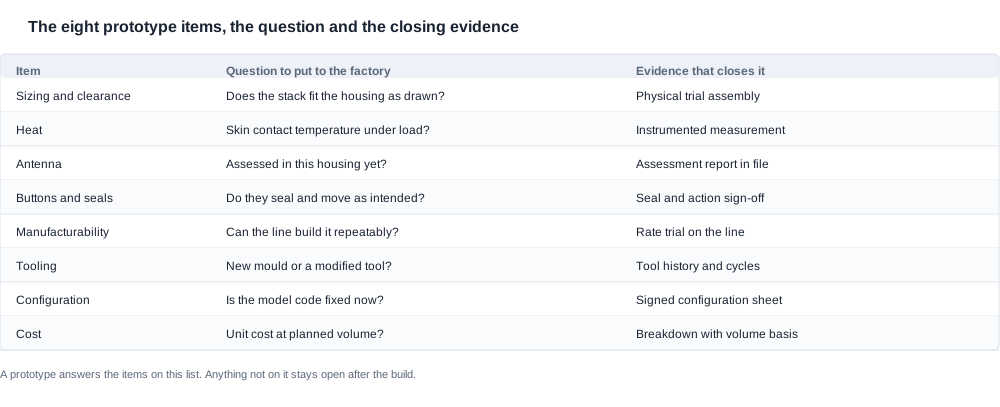
The eight are not eight tasks to be worked through in order, because they have very different costs of late discovery. Three of them — sizing and clearance, heat and the antenna — can only be answered with a physical part, so they are schedule-critical and must be answered before the tool is committed. Three more — manufacturability, the substitution rule and the configuration — are answerable as analysis before anything is cut, and answering them early is free. The remaining two, cost and acceptance, are conclusions rather than questions, and they are only meaningful once the other six have produced something to cost and something to accept. Sequencing the eight this way rather than by their numbering is the difference between a prototype phase that informs the programme and one that confirms it.

Why the ODM prototype phase fails more often than the OEM equivalent
Four structural differences account for most of it, and each has a practical countermeasure that can be written into the programme rather than discovered afterwards.
The design has never been built by anyone. In an OEM engagement the design has a production history, however old. In an ODM the buyer's design is being met by a factory that is applying its own engineering judgement to it. That judgement is usually good and sometimes different from what was intended, and the difference only becomes visible when something physical has to happen.
The platform underneath is a compromise. An ODM prototype is usually built on an existing platform, because starting from nothing costs more and takes longer. A platform brings a validated radio, a validated battery system, a validated assembly method and a validated test method — and it brings assumptions about use, duty cycle, thermal load and user context that were made for a different product. The prototype's job is to find out which of those assumptions the new design violates.
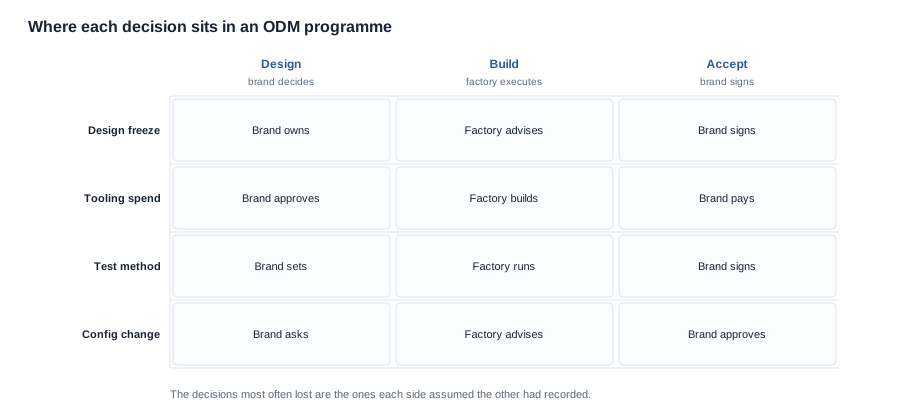
Two organisations hold the decision log. In an OEM the factory usually holds it. In an ODM the design decisions are the buyer's, the build decisions are the factory's, and the decisions that get lost are precisely the ones each side assumed the other had recorded. A shared log with a version number and a named owner costs nothing and prevents the most common source of week-long arguments.
Nobody has written down what the prototype is not proving. Prototypes attract optimism. A programme that lists the questions the prototype will not answer — process capability at volume, longevity, the documentation position, the commercial proposition — is far more robust than one that treats a successful build as a milestone in itself.
Two further structural differences are worth naming because they are less visible and equally expensive. The first is that the buyer's specification may arrive in a form the factory cannot act on: a visual reference, a competitor's published figures, or a requirements document written before anyone established whether those requirements are physically achievable together. A good factory does not quietly reinterpret such a document. It builds what is written and reports the gap, which can produce an expensive and slightly awkward conversation. The second is that there is no cost history to sanity-check against. In a repeat programme, the previous unit cost is a baseline. In a first ODM programme the only baseline is a quotation, so the first real cost conversation is also the first time anyone tests whether the quotation was a number or a position — which is one more reason to ask for the breakdown rather than the total.
Four failure patterns that recur at this phase
The tool is cut before the design is settled. The temptation is real, because cutting a tool creates commitment and commitment feels like progress. The countermeasure is a design freeze, and a freeze should be a document with a version number and a signature rather than a decision reached in a meeting. If the freeze is a meeting, it will be reopened in the next meeting where somebody needs it reopened.
The first tool needs several iterations. A first tool on a new shape is rarely right first time. The cost of an iteration is tool time plus material plus the schedule disruption, and the schedule disruption is usually the larger of the three. A factory quoting a single tool cycle for a new shape is quoting something that is usually wrong, and the honest answer is an expected range with the trigger for each additional cycle.
The compliance configuration drifts after the tool. The classic cause is a component that becomes unavailable and gets substituted. It is a small change with a large consequence, because it moves the tested configuration away from the shipped one. This is what a change-control rule exists for, and the rule that matters is the one that says what evidence a substitution invalidates.
The cost number arrives without a breakdown. A unit cost quoted at the prototype stage is usually a single figure covering everything, and it cannot be negotiated because there is nothing inside it to negotiate. Ask for the breakdown — tooling amortisation, component cost, assembly, test, packaging, firmware, overheads — and the conversation changes from a number dispute to a structure discussion. Where the volume assumption behind the figure is not stated, the figure is not a quotation and should not be placed in a business case.
Each of the four has a countermeasure that costs almost nothing if adopted early and a great deal if adopted late, which is why they are worth handling as programme rules rather than as lessons.
For the tool cut before the freeze, the countermeasure is a signature. A design freeze document with a version number, a date and a named approver costs one meeting and it converts an argument about intent into a check about a version. For the tool iterations, the countermeasure is a written expectation: an expected cycle range, the specific trigger for each additional cycle, and who decides. A supplier that quotes a range with triggers is modelling the work; a supplier that quotes a single cycle is protecting a date. For configuration drift, the countermeasure is a substitution rule that names the evidence a change invalidates — the assessment, the technical file, the test results, the warranty position — rather than a rule that merely requires notification. Notification without consequences is how the gap reopens later. For the cost figure, the countermeasure is structure: a breakdown, a stated volume basis and a sensitivity at half that volume. A supplier who provides all three has priced the programme; a supplier who provides one has quoted a line.

Working through the eight items with a supplier
The most useful thing a buyer can do at this stage is ask the eight items as questions with a written answer attached, rather than as a design review with a verbal outcome. Fourteen questions worth putting, in the order they usually become relevant:
- What has this prototype been built to prove, and what is it explicitly not proving?
- Which design decisions are still open, and which are frozen under a version number?
- Where does the tolerance stack live, and has the assembly clearance been checked physically or only on the drawing?
- What is the surface temperature at the skin contact point under a full workload, and how was it measured?
- Has the radio been assessed in this housing, or is an assessment still outstanding?
- What is the ingress evidence for this configuration, and is it carried over or generated fresh?
- How many tool cycles are expected, and what specifically triggers another one?
- Is the model code fixed at this point, and is the prototype the configuration that will be assessed?
- Which components are single-sourced, and what is the substitution rule if one becomes unavailable?
- What is the unit cost at the planned volume, and what is the breakdown behind that figure?
- What volume assumption is the cost figure based on, and what happens to it at half that volume?
- What is the decision log, who maintains it, and how do I see it?
- Which of the eight items can you evidence today, and which require a build?
- Which of the eight items do you expect to decide the schedule?
The last two are the ones that distinguish a supplier running a process from a supplier describing one. The first tells you where the programme's real risk sits before money is committed; the second tells you whether the supplier has modelled the programme or is reacting to it.
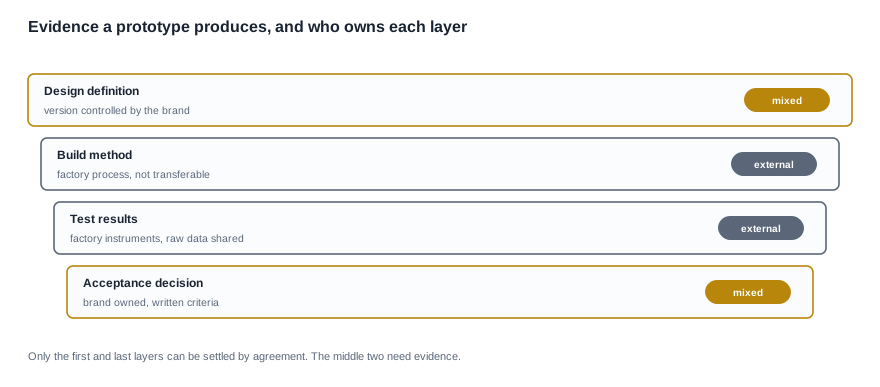
The answers themselves carry information, and it is worth reading them for structure rather than for content. A strong answer to the tolerance question names the stack, the position where it was checked and what was measured. A weak answer says the assembly was fine. A strong answer to the tool-cycle question gives a range with triggers attached; a weak answer gives a single number. A strong answer to the configuration question names the model code and the assessment route; a weak answer says certification is being handled. Where an answer is genuinely unknown, the useful response is a stated method for closing it rather than an estimate, and an estimate offered in place of a method is the clearest signal in the whole exchange that the programme is being managed by optimism.
Used across several suppliers, these fourteen questions form the criteria for a shortlist rather than a comparison of adjectives. The trade-off to keep in view is speed against evidence: a factory that answers nothing quickly will lose a programme that needed speed, and a factory that answers everything quickly without naming a method will lose one that needed evidence. Signs that a supplier is describing rather than doing show up in the same three places every time — no method named, no trigger attached to a date, and no consequence stated for a failed criterion — so those three are worth carrying from one conversation to the next as red flags rather than rediscovering each time.
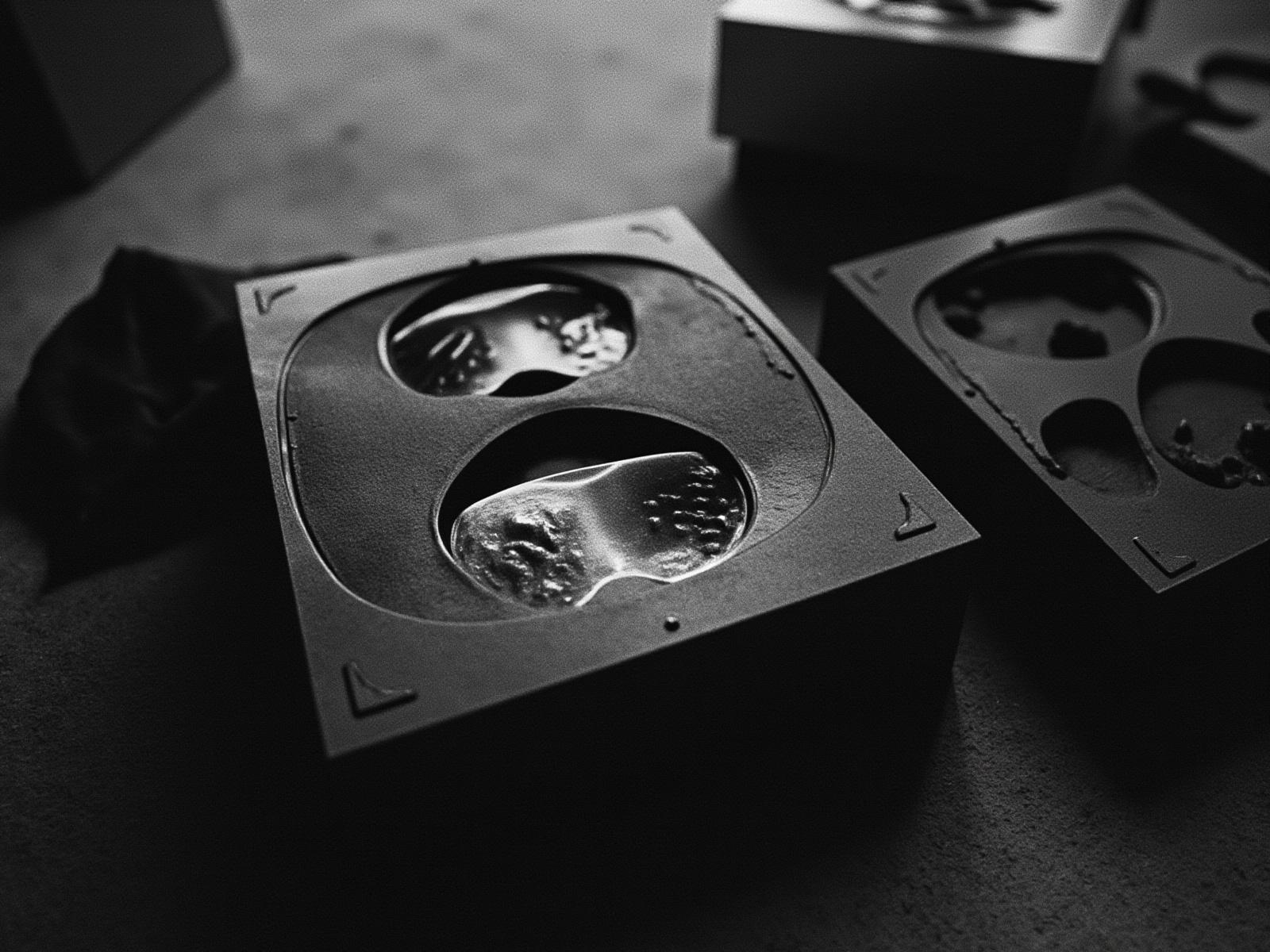
Auditing a prototype claim during a supplier audit
When you are assessing a factory rather than commissioning from one, the prototype claim itself needs checking. A factory's previous prototypes are the best available evidence of how it will run yours, and they are cheap to inspect compared with anything else in the audit.
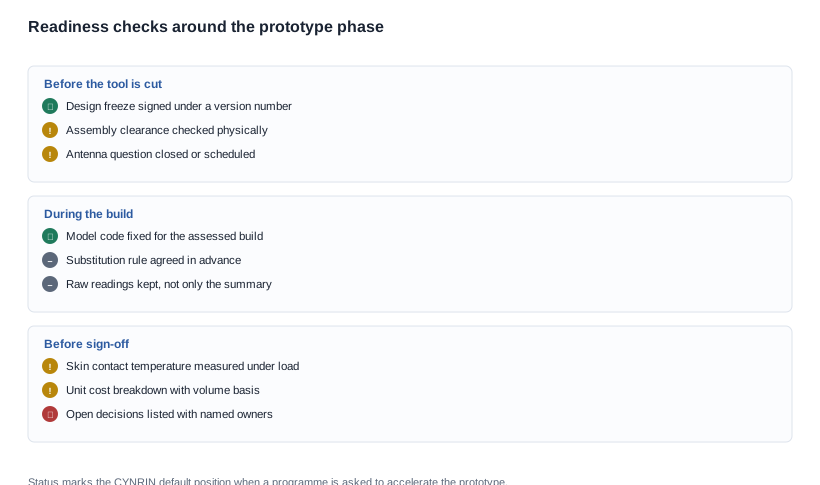
Five artefacts are worth asking to see, in this order. The prototype build record, which shows whether the units were built on production tooling or on a separate sample tool, because the second is much weaker evidence than the first. The raw measurement data from at least one criterion, which reveals whether the factory measures and records or produces conclusions. The tooling ownership terms, because a tool paid for by one customer and left on the factory floor is a negotiating position as much as an asset. The change log for any configuration that has shipped, which shows whether the factory has ever substituted a component after assessment and how it handled it. The closure record for whatever went wrong on the last programme, which is more informative than any list of capabilities because it shows what happens when something fails.
Four findings are worth treating as serious. A factory that cannot produce a prototype build record for its own past work is telling you its prototypes are not systematically recorded. A factory whose measurement data is a single summary figure per test is not going to produce per-unit readings for your pilot on request. A factory whose tools are owned by customers who have left is holding tooling it does not have a contractual basis to reuse. And a factory with no closed failure record is a factory that has either never had a serious failure or has not written any of them down; the first is unlikely, so the second is the more useful working assumption.
What we can evidence today, and what we publish
Our own limits are worth stating plainly, because they are the same limits every buyer in this category should test for. Our catalogue publishes the product data the design is built from: the colour options, the battery capacities, the charging interfaces, the camera tiers, the case capacities, the rated runtimes, the structural features and the charge times. We publish a frame weight for one model — 158 g for the MT6 — and Not published for the rest. The sensor model, the field of view, the video specification, the microphone figures, the lens performance, the ingress report numbers and the seal material are Not published.
What we do not publish is our prototype lead times, our development costs, our tooling costs, our minimum order quantities or our production capacity. Those remain open internally, and a buyer who is offered them by anyone should treat the offer itself as information.
What we will do is work through the eight items above with you against a specific design, and tell you which of them we can answer today, which require a build, and which are the ones most likely to be the reason the programme slips. The prototype phase is a test rather than a presentation, and a programme arriving at a prototype with an open design has not finished the requirements phase — it has started it twice.
It is worth being concrete about what a written answer to each of the eight looks like, because the difference between a usable answer and an unusable one is usually a detail rather than a disagreement. For sizing and clearance, a usable answer names the tolerance stack, the check method and the measured value at the tightest point. For heat, it names the measurement point, the workload and the instrument. For the antenna, it either attaches the assessment for this housing or gives a date and a route for one. For buttons and seals, it states the action force and the seal condition the design is validated to. For manufacturability, it gives the cycle time the line demonstrated and the defect rate on the trial. For tooling, it states whether the tool is new or modified, what it previously made if modified, and how many cycles to a stable part. For the configuration, it gives the model code and confirms that the assessed build and the prototype build are the same. For cost, it gives the breakdown, the volume basis and the sensitivity at half that volume. A supplier who can produce all eight of those in writing before the first shot is describing a programme rather than selling a prototype, and that distinction is the single most useful thing to establish at this stage.
Related reading
- ODM development
- The stages of a development programme
- Pilot runs and how to specify one
- Can I start with a small test order
Send the design and the open questions, and we will tell you which of the eight items will decide the schedule.


