

The most expensive number a buyer ever sees in this category is usually the smallest number on the page. A quotation arrives carrying one headline figure per unit price, and the figure is usually the last thing decided rather than the first, because it is the output of a stack of decisions that were made earlier: which controller, which camera module, which cell, which case, which packaging, which quantity, which incoterm and which destination. Strip those out and the headline number describes almost nothing.
What a buyer actually wants from a pricing page is the structure — which levers exist, which of them are inside the unit price, which sit outside it, which of them are fixed and which scale, and which ones can be negotiated at all. That structure is what allows two quotations to be compared, and it is what lets a buyer know whether a lower number is actually cheaper or just quoted on a narrower scope.
This site publishes no unit price, no tooling figure and no non-recurring cost, and that is a deliberate position rather than an omission. A price without a configuration and a volume is not a price; it is a hint. What we publish instead is the set of published configuration facts a quotation should be built against, so that when you ask us for a number you get one that can be honoured in a written quotation.
There is a second reason the structure matters more than the number, and it is a commercial one. A buyer who negotiates on a headline figure is negotiating on the most visible part of a cost stack that they cannot see. A buyer who negotiates on the driver — the cell, the module, the case, the packaging run, the break point — is negotiating on something they can actually move, and the conversation tends to end faster because the supplier has something concrete to respond to. That is the difference between a price negotiation that stalls for a month and one that resolves in a week.
OEM ready platforms: what moves the unit price and what sits outside it
The cleanest way to draw the line is to ask one question about each cost: does it change when the order changes?
Inside the unit price, and therefore responsive to configuration and quantity, sit the electronic components, the mechanical parts, the assembly labour, the test and the packaging material. Outside it sit the costs that do not scale with the second order: the mould tooling for the frame and for the case, the first-article inspection and approval, the packaging artwork and print setup, the certification and testing work, and the documentation package.
That distinction is not academic. It decides how the two orders compare. A tooling cost of any size hurts a 500-unit order and barely registers on a 5,000-unit order, so the same pair of suppliers can rank differently at two volumes. A unit-price comparison between two suppliers tells you nothing about which one is cheaper for the volume you actually intend to buy, unless the one-time costs have been separated out and applied to your volume.
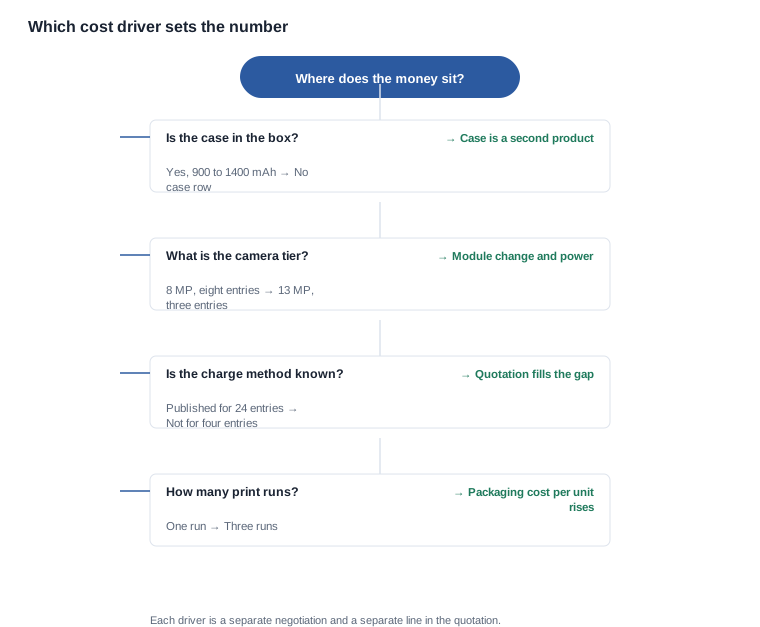
There is a third group that is neither inside nor outside, and it is the one that catches buyers out: the costs that are per-unit but not per-article. The charging case is the clearest example. A case is a second product in the box with its own cell, its own circuit board, its own contacts and its own mould, so a configuration with a 1400 mAh case carries a second lithium cell into the shipment. That second cell is not a unit cost in the usual sense, but it is a transport cost and a freight cost, and it is frequently omitted from the comparison. The catalogue publishes case capacities for five entries — the CY05 and the CY03, and the L1 Pro — each at 1400 mAh, the L2 Utral at either 900 mAh or 1400 mAh, and the MT6 in a 1200 mAh foldable form — and the choice between the two published L2 Utral capacities is a freight decision as much as a customer-facing one.
The same logic applies to weight. The MT6 is the only entry in the range that publishes a weight: 158 g for the glasses alone, explicitly excluding its 1200 mAh foldable case. That exclusion is a warning label rather than a convenience. A logistics model built on 158 g will understate the shipped weight of that configuration by the entire case.

OEM ready platforms: the six cost drivers behind a quotation
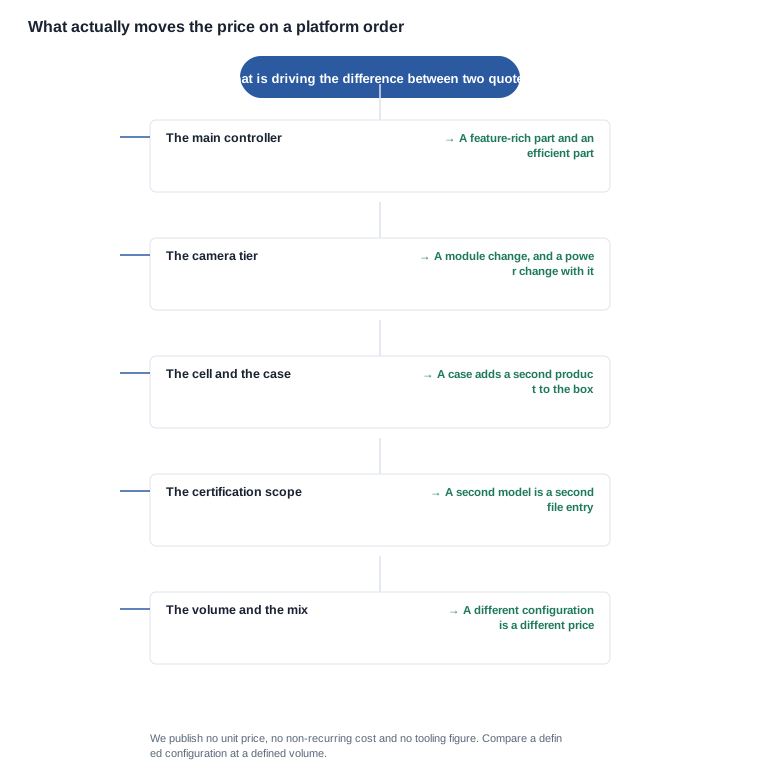
The controller and the wireless solution. In a product of this size, the system on chip and the Bluetooth part are the largest single line in the bill of materials. The economical audio platforms carry the Bluetooth radio and the audio codec on one chip; the richer platforms add a second die or a higher-tier part. The spread between an efficient part and a feature-rich part is normally wider than the spread between any two other rows in the bill, which is why this is the first cost conversation and the last one a buyer should leave to the supplier. It is also the driver behind a difference the buyer can see: the range publishes a Bluetooth version for 14 of 28 entries, and that spread is a direct consequence of which wireless solution each entry carries.
The camera tier. The step from 8 MP to 13 MP is a module change, and it is a price change and a power change in the same decision. The catalogue divides the camera group cleanly: eight entries at 8 MP, and three at 13 MP — the L2 Utral, the L1 Pro and the S7. The cell follows the tier as well, with camera batteries published in a band from 220 mAh to 290 mAh and a rated runtime of about five to eight hours across the group. No test condition is published for any of those runtime figures, so the runtime belongs to a configuration and cannot be carried into a retail claim as though it were measured.
The cell and the case. The cell is a line item and the case is a second product. Five entries publish a case capacity, two publish the existence of a case without its capacity, and the V03 and the S7, and the V06 carry no case row while the V03 Pro explicitly has none. On the charging side, the method is published for 24 of 28 entries — magnetic on 17, Type-C on 7 — and is not published for the CY05 and the MT6, and the L1 Pro and the CY03. A configuration with an unpublished charging method is a configuration whose part cost cannot be reasoned about from the catalogue at all.
The charging behaviour. Charge time is published for 26 entries, all of them at two hours or less, with only the D17 and the ZH12 publishing approximately one hour. Two hours or less is a ceiling rather than a typical figure, and a buyer who assumes the ceiling is the norm will mis-predict the customer experience. A faster charge usually costs money in the cell, the charger and the thermal design, so this is a genuine specification trade-off rather than a free improvement.
The certification scope. Every configuration that leaves a factory for a saleable market carries a file of work behind it, and the work has a cost. The catalogue itself carries no per-model certification row, so the scope is established in the quotation and not on a page. The export certification page on this site is a picture page showing ten patent certificates — eight design patents and two utility models — which evidence design work rather than market conformity for any given configuration.
The volume and the mix. Quantity breaks apply to the order, and per-colour or per-configuration floors apply inside it. A quotation that shows no breaks has been assembled rather than priced, because a supplier who will not show the break points is asking the buyer to guess the business model at scale.
OEM ready platforms: how to compare two quotations line by line
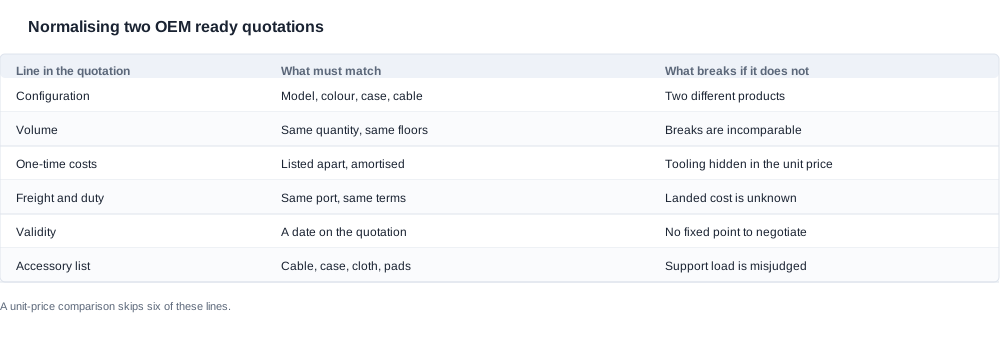
A comparison works only when both sides are describing the same object. Four things have to be normalised before any number is worth reading.
- The configuration. Same model, same colour, same case or no case, same accessory list, same packaging. The catalogue shows how wide this gap is in practice: the V03 Pro publishes three colour options and the V06 publishes four, and colour is a different production line, not a different label.
- The volume. Both quotations at the same quantity, including the per-configuration floor if one is lower than the order.
- The one-time costs, shown separately. Tooling, first-article approval, packaging setup, certification and documentation listed as their own lines with their own amortisation over the quantity you intend to buy.
- The freight and the duty, to the same destination and the same incoterm. This is where a low unit price frequently turns out not to be one. The weight, the carton volume and the battery configuration all feed the landed cost, and the transport rules that apply to a lithium product limit what can move by air and at what price.
Once those four are aligned, the comparison becomes readable and the negotiation has a fixed point. The lower landed cost wins, and the reasons are visible: cheaper cell, cheaper case, cheaper packaging, smaller carton, better break. That last point deserves emphasis — a quote with a higher unit price and a better break can win on a larger order, and a buyer who compares only the headline figure will systematically pick the wrong supplier for their actual volume.
Two further disciplines are worth adopting early. First, ask each supplier for the quotation in the same written structure, so the comparison is mechanical rather than interpretive. Second, treat the validity date as part of the quotation. A number without a validity period is an opening position in the negotiation rather than a price, and both sides should be able to see that.
A worked comparison shows how the method changes the answer. Suppose two suppliers quote the same camera entry, with a 1400 mAh case, at 1,000 units, to the same destination, and the first quotes a lower unit price but a larger minimum order quantity per configuration. On a headline comparison the first supplier wins. Once the per-configuration floor is applied, the second supplier may be the only one able to take the order at all, and the first becomes a supplier of a larger order at a lower effective rate — a different commercial proposition entirely. Now suppose both can supply the volume, and the first quotes a printed colour retail box while the second quotes a plain white box. The unit prices may be identical, but the first carries a moulded insert and a print run, the second does not, and the landed costs separate as soon as freight is calculated to the same destination.
The pattern holds across the range because the catalogue publishes the rows that drive it. A configuration with a case carries a second cell into the consignment and a different freight weight. A configuration at 13 MP on a 290 mAh cell behaves differently at the end of a shift from one at 8 MP on a 220 mAh cell. A configuration charged magnetically is not charged the same way as one charged over Type-C. These are the published facts that let a buyer predict the shape of a quotation before it arrives.

OEM ready platforms: the questions that make a quotation negotiable
Negotiation over price is easier to run when the buyer arrives with structured criteria rather than a target number, because a supplier can respond to a question and cannot respond to an assertion. Six questions do most of the work.
- What is the unit price at our volume, and what are the volume breaks? This exposes the curve rather than a single point.
- Which component is doing the work in the number? A supplier who answers this question honestly is telling you where the negotiation lever is. If the answer is the camera module, the lever is the tier; if it is the controller, the lever is the wireless solution; if it is the case, the lever is the accessory decision.
- What is the one-time cost list, itemised, and how is it amortised? Amortisation is a negotiating position, not a fact, and it should be treated as one.
- What is the minimum order quantity per colour and per configuration, and what is the rule if a forecast is missed? Forecast flexibility is often worth more than a small unit-price movement, particularly for a channel buyer with a seasonal business.
- What is the packaging cost at our print run length, and what happens at the second and third run? A brand ordering in three waves may trigger three print runs, and the second and third commonly cost more per unit than the first. That is a real number in a real negotiation, and it is one of the few places where a buyer's own behaviour changes the price.
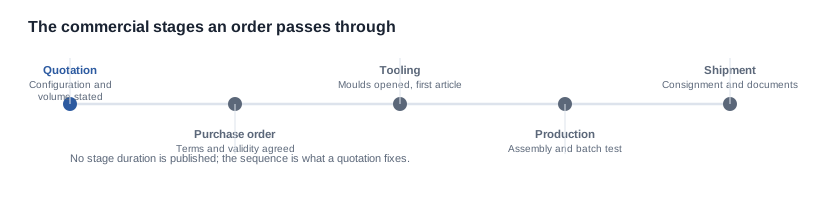
- What is the lead time for this configuration, and does the tooling have to be completed before it starts? A long lead time has a carrying cost of its own, and it is a cost a buyer can negotiate even when the unit price cannot move.
Each of these is answerable in writing by a supplier that is pricing the order rather than advertising a range. A supplier that answers only the first question has given a number, not a quotation.


OEM ready platforms: what a buyer can actually negotiate
Not everything in a quotation moves, and a buyer who treats every line as negotiable loses credibility faster than one who negotiates well. Splitting the quotation into three classes is the most useful preparation a buyer can do before the meeting.
The lines that move with quantity. These are the volume breaks, and they move a lot — enough that a forecast disagreement between buyer and supplier can be worth more than a unit-price argument. Two things make them negotiable in practice: the forecast itself, and the question of whether the floor applies per configuration or per order. A buyer who can credibly forecast in waves, or who can accept a mixed wave, is negotiating with a tool the supplier values.
The lines that move with specification. These are the configuration choices, and this is where the catalogue helps most. The case question is worth an explicit conversation because case capacity is published for five entries and the choice is visible in the specification: 900 mAh or 1400 mAh on one entry, 1200 mAh foldable on another, 1400 mAh on three more. The camera tier is worth the same treatment, because 8 MP and 13 MP are two genuinely different products rather than two marketing descriptions. The packaging level is worth it because the catalogue publishes how few colour options exist — the V03 Pro with three and the V06 with four — so a buyer who knows the colour plan can ask for a single production line across a larger volume.
The lines that do not move at all. These are the parts that are already at a competitive cost, and they are usually the electronics. The controller and the wireless solution, the camera module at a chosen tier, and the cell are set by what the product is. A buyer who argues hard on those lines is usually arguing for a specification change dressed up as a discount, and the risk is that the change lands in the sample and not in the paperwork.
The discipline that follows from this classification is simple: negotiate the specification and the schedule, accept the electronics, and use the specification conversation to improve the product rather than to win a percentage. There is a trade-off to be aware of in every one of these negotiations. Cutting the case to save money moves the customer experience; taking the shorter lead time can move the unit price; adding a third colour spreads the volume and the tooling across fewer units. The buyer who names the trade-off out loud gets a better answer than the buyer who simply asks for less money, because the supplier can respond to a decision rather than to a demand.
Before any of this, the due diligence question has to be answered: is the supplier pricing the configuration you intend to buy, or pricing a catalogue entry and hoping you will not notice the difference? The way to find out is to ask for the specification behind the number. A supplier who can name the cell, the module, the case, the accessory list and the packaging level inside a quotation is pricing a product. One who cannot is pricing a range.
There is a fourth class that buyers often forget to classify, which is the specification that is not yet chosen. The catalogue publishes colours on only two camera entries and publishes a case capacity on only five, and it publishes an IP54 marking on only two. That means most configurations still contain a decision that has not been made, and each of those decisions lands in the quotation when it is made. A buyer who decides the colour plan, the case level and the packaging tier before asking for a price has removed three variables from the negotiation. A buyer who leaves them open has left three levers on the table for the supplier, and the number that comes back will carry all three.
OEM ready platforms: why this site publishes structure and not a price
Because the price depends on things that are decided after the product exists. Two identical products, ordered in different quantities, with different packaging and shipped to different destinations, are two different commercial transactions, and the number that matters is the landed cost of the transaction rather than the unit price of the product. Publishing a single figure invites a comparison that cannot be won.
What we do publish is the configuration set that a quotation is built from: the charge times, the rated runtimes, the case capacities, the charging methods, the resolution tiers and the cell capacities, the colours, the IP markings and the one published weight. Those are the facts that let a buyer predict which driver is moving the number in a quotation they have not yet received, which is exactly what a negotiation needs.
The same reason explains the rest of what is absent. Minimum order quantities, lead times, payment terms, warranty durations, shipping costs, carton and pallet counts and production capacity are all properties of a live programme rather than of a product, and a figure for them on a static page would be a figure nobody could hold us to. A buyer who needs them should ask for them in the quotation, where they carry a validity date and a signature.
So send us a configuration and a volume, and we will quote against them, show which driver is setting the number and state the one-time costs as separate lines. The range itself is on the OEM ready products page, the cost structure in more detail is in procurement pricing, the volume mechanics and the per-configuration floors are in smart glasses MOQ, and the packaging line — which is more often the difference between two quotations than the electronics — is in standard OEM packaging options.
Related reading
- How the cost is built — procurement pricing
- The volume mechanics — smart glasses MOQ
- The packaging line — standard OEM packaging options
- The platform range — OEM ready products
Send a configuration and a volume, and we will show which driver is setting the number and what the one-time costs are.


