

Standard oem packaging options are decided at a point in the programme when almost nothing else is decided, and that timing is the reason packaging conversations go wrong. The carton is designed after the product, the artwork is approved after the carton, and the print run is placed after the artwork — so by the time a buyer is looking at a proof, the decisions that determined the cost of everything have already been made somewhere else, in a meeting the buyer was not in. The result is a proof that looks final and a bill that is not.
This page is for the buyer who wants to hold that timing. It sets out the decisions that have to be taken before any artwork is drawn, walks through the artefacts a carton actually moves — both the physical ones and the documentary ones, because the documentary half is where most of the risk sits — asks which of those choices survive a second order, and turns a packaging request into a brief that a supplier can price and a factory can build to.
It does not list packaging options for you. Our catalogue publishes no packaging row for any of its twenty-eight entries, so there is no published list to copy, and any list of options presented as ours would be borrowed from somewhere else.
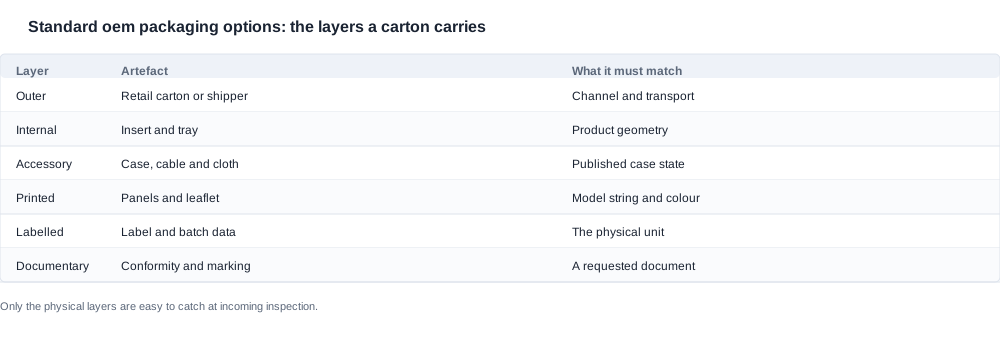
The table is organised as layers rather than as options, because a carton is not a list of options — it is a stack, and each layer has a different dependency on what the product itself is. The physical layers are decided by the product and the case. The documentary layers are decided by the market and the compliance scope. The outer layers are decided by the transport method and the print run.
Packaging decisions a buyer makes before artwork
Seven decisions come before a single piece of artwork is drawn, and each one is cheaper to change at this point than at any point afterwards. The criteria for taking them are not a matter of taste, and the questions to ask about each one are specific.
The first is the outer carton format. Whether the product ships in a printed retail carton, a plain brown shipper with a printed sleeve, or a presentation box, changes the material, the print run and the shelf position at the same time. This decision belongs to the channel, not to the factory, and it is frequently made by somebody who assumes it is a factory question.
The second is the internal arrangement. A moulded or folded insert, a paper tray, a foam block, or nothing at all with the product held by the carton walls. The insert is the only part of the packaging that has to know the shape of the product, so it is the part that changes when the product changes, and the part that a second order can invalidate if the product moves. In this range that risk is concentrated: three entries publish a removable part, the V06 and the S7 publish a removable inner frame and the G07 publishes a detachable temple, and a detachable component is a component that can arrive in the carton or travel separately.
The third is the accessory set. What ships in the box — a charging cable, a case, a lens cloth, a printed card — decides the width of the carton, the shape of the insert and the printed claim on the panel that says what is included. The charging case is the accessory that most often decides the packaging, because it is a moulded object with a footprint of its own. The charging case is described three different ways across the eleven camera models. Five entries give a capacity, two show a case with nothing measured against it, and the remaining four — the S7, the V03 and the V06, and the V03 Pro — give no case line at all.
The fourth is the accessory documentation. Every market has its own requirements for what accompanies the unit, and those requirements differ from the artwork rather than matching it. They are not decorations added to a finished design; they are inputs to it.
The fifth is the language and market set. A carton for more than one market is not one carton with two languages on it, because the regulatory text is positioned and sized differently, the model string may not be the same, and the back panel runs out of room before the language set is complete. Languages are usually added later as a variant of an existing carton, which is why they are usually priced as an additional print run.
The sixth is the print treatment. The stock, the number of colours, the varnish and any special process. Every one of those is a decision that belongs to the print run, and therefore to the quantity that run covers.
The seventh is the shipping layer: the master carton, the carton marks, the pallet configuration and the way the units are counted in and out. This one is usually inherited rather than chosen, and it is worth reviewing anyway because it constrains the outer carton dimensions more often than anyone expects.
Taken together, these seven decisions are what the word packaging actually contains. A buyer who treats packaging as "the box" has made one decision and inherited six.

The sequence is the practical content of this section. The product and its case set the internal arrangement; the internal arrangement sets the outer carton; the channel and the market set the documentary layers; the print run sets the artwork; the artwork is the last thing that can change, which is exactly why it is where buyers tend to concentrate their attention.

The physical and documentary artefacts a carton moves
A finished carton moves two quite different kinds of artefact, and the distinction matters because only one of them is visible to the customer and only one of them is easy to correct.
The physical artefacts are the carton, the insert, the printed leaflet, the label stock, the cable, the case, the cloth and any other item in the box. Their requirements are dominated by the product: they have to fit it, protect it, and be assembled around it. A physical artefact is easy to check — it is either there or it is not, and it either fits or it does not.
The documentary artefacts are the printed panel content, the model string, the colour designation, the batch and serial information, the conformity statement, the market labelling, the instructions, the after-sales contact, the warning text and the leaflet. Their requirements are dominated by evidence and by the destination. A documentary artefact is harder to check because a claim on a panel looks exactly as complete whether or not anything supports it.
That asymmetry is the real risk in packaging work. The physical errors are visible at incoming inspection; the documentary errors are visible to a regulator, a customer or a court, and they are visible long after the carton has been printed.
The published rows a carton has to match are few, and that is worth stating so a buyer knows exactly where the traps are. A buyer who wants to compare two packaging proposals should work from this list rather than from the artwork, because this is where the two proposals actually differ. The model string on the panel has to be the string that the compliance documentation is issued against, and that documentation has to be requested for the exact model designation, because no model in our range carries a certification line at all; the catalogue text names none of CE, FCC or RoHS. What the export certification page carries is company artwork that is not a per-model record: ten patent certificates, and a patent certificate is not a conformity document for a model and cannot be presented as one.
The colour designation on the carton has to match one of the published colour names for that model, and only two models publish any: the V03 Pro publishes orange, off-white and black, and the V06 publishes orange, white ice blue, black and black ice blue. A carton that prints a fifth colour for either of them is printing a claim our record does not support.
The contents statement has to match the case position, and here the three published states matter directly. A panel that says what is in the box is making a factual assertion about a case that, for four camera entries, our catalogue does not describe at all. Those four have to be settled before the panel is written, not after the print run is placed.
The ingress claim has to match the marking and its evidence. Two entries carry an IP54 marking — the V06 and the S7 — and the marking is an annotation only: no third-party report number is published against it, so it cannot be restated externally without one. A carton that repeats it turns an internal catalogue note into an external claim, which is a different thing with a different consequence.
The battery and runtime figures, where a carton or leaflet prints them, have to match the published row exactly, including the way the catalogue expresses a ceiling. A charge time of two hours or less is a ceiling and it is not the same statement as under two hours, and a run time published as a range of five to eight hours should not be printed as a single number. These are small print decisions with a disproportionate effect on how a carton reads.
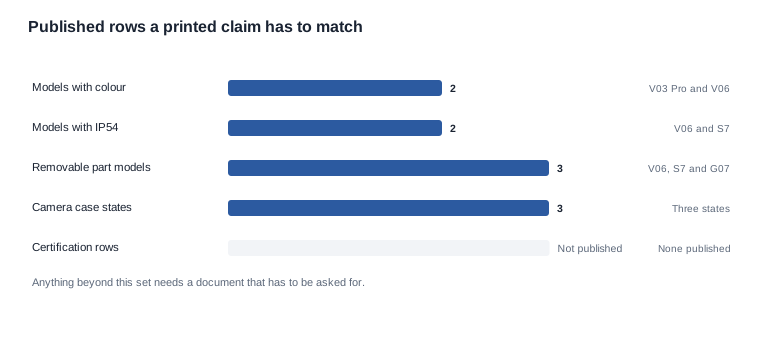
The chart is a reminder of how thin the matching set is. There are two models with published colour names, two with an ingress marking, three with a removable part, three published states of the charging case across the camera models, and no certification line for any model at all. Everything a carton asserts beyond those has to be sourced from a document that has to be requested, which is why the documentary layer is the layer with the longest lead time and the shortest tolerance for error.
Which packaging choices survive a re-order
A first order is a test of the packaging. A second order is a test of the packaging decisions, and the two are very different tests. Some choices survive the move from one wave to the next without any further work. Some create a fresh obligation each time. A few quietly invalidate the arrangement that was built for the first wave.
The choices that survive are the structural ones, provided the product does not change. The outer carton format, the insert type, the master carton and the pallet arrangement are fixed at the first run and simply repeat. If the product's geometry is unchanged, they can be re-ordered from the same specification.
The choices that create a fresh obligation are the print-dependent ones. A change to the artwork — a new colourway graphic, a revised panel layout, a different market variant, a new language set — either falls inside an existing print run or starts a new one. The first is free and the second is not, and the difference between them is a decision the buyer makes by ordering in time or not.
The choices that invalidate the arrangement are the ones that tie the packaging to the product. An insert designed around a product that has since gained or lost a component has to be re-made. An accessory list that has changed since the carton was printed leaves the printed contents statement wrong. A carton whose panel names a case position that the catalogue does not describe for that model will need correcting the moment the case question is closed. And a packaging specification written against a configuration that has itself moved — a different charging method, a different removable part, a different market — is a specification for a product that no longer exists.
The test to apply before you order is narrow and practical: does this choice bind the packaging to a batch, to a tool, to a market, or to nothing at all. If it binds to a batch, the re-order carries a print run. If it binds to a tool, a change in geometry invalidates it. If it binds to a market, a change of destination invalidates the documentary layer. If it binds to nothing, it repeats freely and can be treated as a settled question rather than an open one.
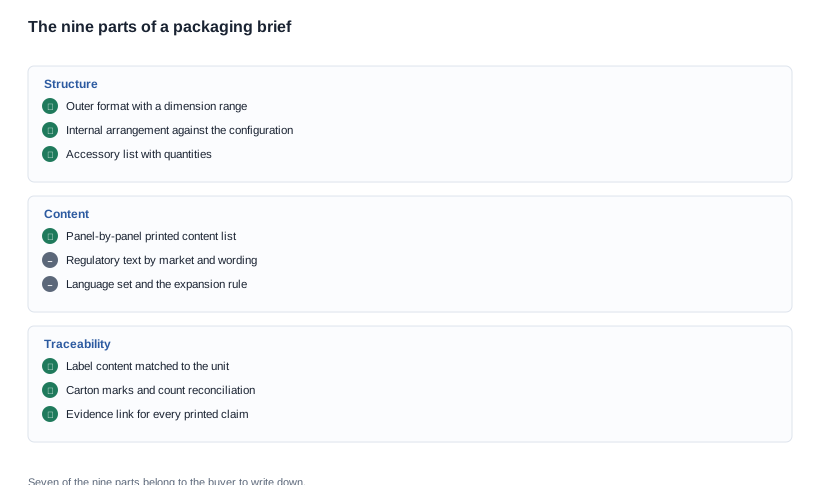
That checklist is arranged around the three questions a buyer should carry into a second wave. Which decisions repeat as they are, which decisions need a new print run, and which decisions have to be re-verified because the product or the destination moved underneath them. The third group is the one that gets missed, because it is invisible until the second wave has already been scheduled.

Turning a packaging request into a written brief
A packaging brief that is not written produces artwork that has to be redone, and the redoing is always more expensive than the writing. A shortlist should therefore be compared on the brief rather than on the proof. The brief below has nine parts, and each of them exists because its absence has cost somebody a print run.
The outer format is first: retail carton, shipper with sleeve or presentation box, with the dimensions stated as a range rather than a target and the tolerance left open for the factory to propose.
Second, the internal arrangement: insert type, and the list of items the insert has to hold. This is where the product specification and the packaging specification meet, and it should be written against the configuration rather than against the product family.
Third, the accessory list, with quantities, and the case position if a case is in scope. If the case position is one of the four camera entries where our catalogue prints no case line, the brief should say that the case is to be confirmed rather than assume either way.
Fourth, the printed content list, panel by panel. Which panels carry brand artwork, which carry specifications, which carry the contents statement, which carry the regulatory text. A panel inventory prevents the single most common failure, which is artwork being approved before the specification panel has been written.
Fifth, the regulatory text, by market and by the exact wording to be used, not by reference to a general obligation. This is the part of a carton that a factory cannot improvise.
Sixth, the language set, and the instruction for what happens to the panel layout when it expands.
Seventh, the label content and placement: the model string, the colour designation, the batch and serial information, and the market label. Each of these has to agree with the physical unit, not with a plan for it.
Eighth, the carton marks and the shipping layer, and the requirement for how the carton count reconciles with the unit count.
Ninth, and most often omitted, the evidence link: for every printed claim, the document or the published row that supports it. A claim without an evidence link is a claim that has to be taken on trust, and the buyer who has written the link down has converted a risk into a task.
Two of those nine are decisions the supplier makes and the buyer should ask to receive in writing rather than fill in: the proposed outer dimensions with their tolerance, and the print specification. The remaining seven are the buyer's, and a buyer who delegates them will inherit them.
Where CYNRIN stands on standard oem packaging scope
On packaging scope, our position is that the carton is a documentary artefact first and a physical object second, and that we will not supply artwork for a claim our published record cannot support. Where a panel repeats a published row — a model string, one of the two published colour lists, a charge time of two hours or less, a runtime published as a range, an accessory that is actually in the box — we will confirm it against that row. Where a panel would assert something we do not publish, including any certification status, we will say which document has to be obtained and against which model designation before the assertion can be printed.
We also publish no packaging row, no print minimum, no artwork fee, no packaging minimum order quantity and no lead time for any printed item, and this article contains none of those figures. Those are commercial terms belonging to a quotation against a configuration, and they are treated the same way everywhere in our material: named as an item to be quoted rather than stated as a number in advance.
Two further limits belong with that position. Our catalogue contains no certification line for any model, and its export certification page is a company-level image set of ten patent certificates rather than a per-model conformity record. And the ingress marking on the V06 and the S7 carries no third-party report number, so it cannot be printed as an external claim without a report behind it. Neither of those limits is a position on what is possible; they are statements about what our published record can currently evidence.
For a buyer, the method is straightforward. Decide the carton before the artwork, write the nine-part brief, and attach an evidence link to every printed claim. A programme that does that will not avoid a re-print, but it will know before the print run which claims are supported and which are waiting on a document — and it will not discover the difference from a carton in a warehouse.
Related reading
- the threshold questions a volume order has to answer
- the published physical rows and the material claims they cannot settle
- a signed reference unit and what it settles
- the acceptance step that catches a printed error late
- the tool line, its owner and the geometry a carton must fit
Packaging decisions are made once and repeated for years — the ones that survive a re-order are the ones written down before the artwork, and the ones that do not are the ones nobody recorded.


