
A sample order gets treated as a trivial transaction, and it is not. A smart glasses sample is a lithium battery consignment carrying an electrical product, travelling to a recipient who may be in another country, and it is very often the first shipment that has ever moved between the two companies involved. The freight arrangement, the paperwork and the customs treatment set precedents that the commercial order inherits without discussion. Ten minutes of attention at the sample stage is considerably cheaper than a dispute at the first production shipment, and in some cases cheaper than the shipment itself.
The reason the shipping deserves more thought than it usually gets is specific to this product. Two features of the catalogue turn an ordinary small parcel into a regulated consignment: every product in the range contains a lithium cell, and several configurations contain a second one. The S7 and the V03 Pro, and the V06 and the V03 carry no case row at all, and the configurations that do carry a case publish capacities of 900, 1200 or 1400 mAh, which is the figure the transport file needs. A case is a second cell in the box, and a second cell is a second item in the declaration.
We publish no sample shipping policy, no freight arrangement and no sample lead time, because each of those is a commercial term settled per request against a named destination. What we publish is the product data a shipment is built around — the model code list, the specification for each configuration, and the case, cable and packaging contents — and the practice that lets a buyer ask the right questions before the unit is packed.
There is a decision embedded in every shipment, and it is worth naming it early: whether this consignment is a delivery or a rehearsal. A delivery gets the unit to a person. A rehearsal proves that the chain works so that a larger consignment will not fail. The two use the same box and the same paperwork, they cost almost the same, and they are bought for different reasons. Buyers who decide which one they are doing before the unit is packed get a shipment that is aimed; buyers who decide afterwards usually get a shipment that merely works, and then wonder why the first production order did not.
Requesting smart glasses samples: a sample is still a dangerous goods consignment
This is the point that surprises people, and it is worth stating without softening it. A pair of glasses with a cell inside is subject to the transport rules for a lithium battery product whether the consignment contains one unit or ten thousand. The test summary, the classification, the packing, the marking and the documentation all apply to a single sample exactly as they apply to a production shipment. There is no small-parcel exemption that a smart glasses product can use, because the exemption, where it exists, does not cover a lithium cell inside the product.
The practical consequence is that a sample shipment cannot be arranged in a hurry on the assumption that it is an ordinary parcel. It needs the same documentation as a commercial consignment, and a forwarder needs the same working time to check it. A buyer who expects a unit within a few days of sending the request will usually be waiting on paperwork rather than on a vehicle, and the honest thing is to establish that expectation before the request is sent rather than after.
The second point concerns the cell count, and it is where the catalogue's configuration rows turn into a shipping question. A configuration with a charging case carries two lithium cells, and the second one is a separate line in the declaration with its own paperwork. The configurations with the largest published case capacities — the 1400 mAh cases on the CY03 and the L1 Pro, and the CY05, the 900 or 1400 mAh options on the L2 Utral, and the 1200 mAh foldable case on the MT6 — are the ones where this matters most, and the MT6 is also the only entry in the range that publishes a weight at all: 158 g for the glasses themselves, explicitly excluding the case. A freight calculation built on that number is missing the whole of the second cell and the case around it.
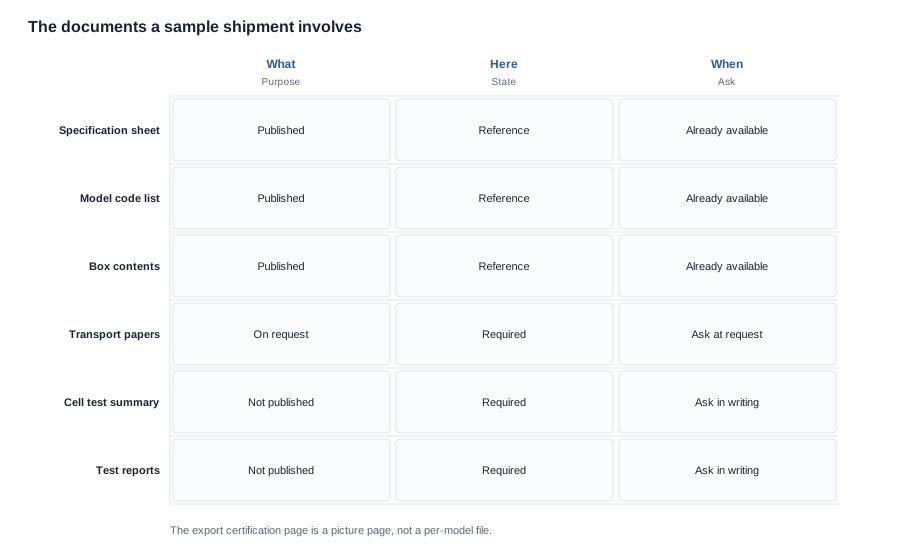
There is a third point about what is published and what is not. The catalogue carries no per-model certification row, and the export certification page is a picture page holding ten patent certificates — eight design patents and two utility models — with no published UN38.3 test summary. So the transport documents that govern a lithium consignment are not on this site; they are documents that belong to a specific configuration and are supplied on request. That is not a failure of the catalogue. It is the correct boundary for a document that is tied to a cell and a model rather than to a brand.
The due diligence question here is a narrow one, and it is worth asking before the consignment rather than after the hold: has this forwarder handled a lithium consignment before, and did the classification come back as it was declared. The forwarder will answer, and the answer tells you whether the documentation will be checked properly or merely passed through. A buyer who has a shortlist of two or three candidate suppliers is usually better served by making this question part of the selection criteria, because a supplier with a competent forwarder removes an entire category of delay from every consignment that follows, not just from the sample.
Requesting smart glasses samples: the commercial arrangements worth agreeing
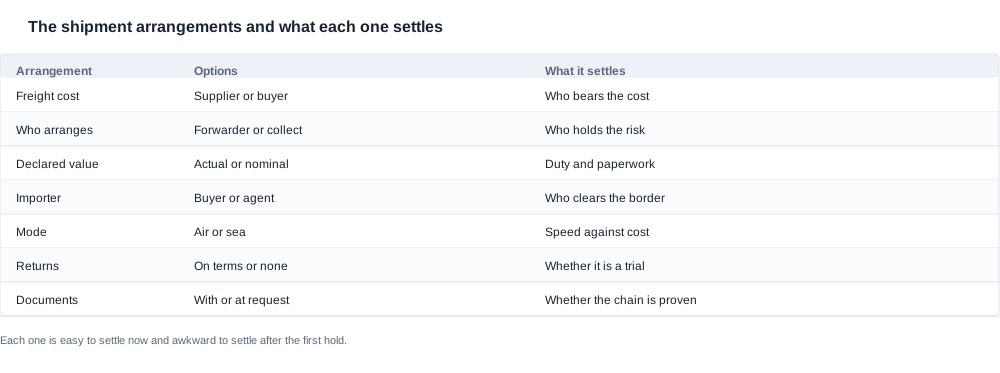
Six arrangements decide how a sample shipment works. None of them is complicated, all of them are worth settling in writing, and each of them sets a precedent that the commercial order will follow by default if it is not addressed.
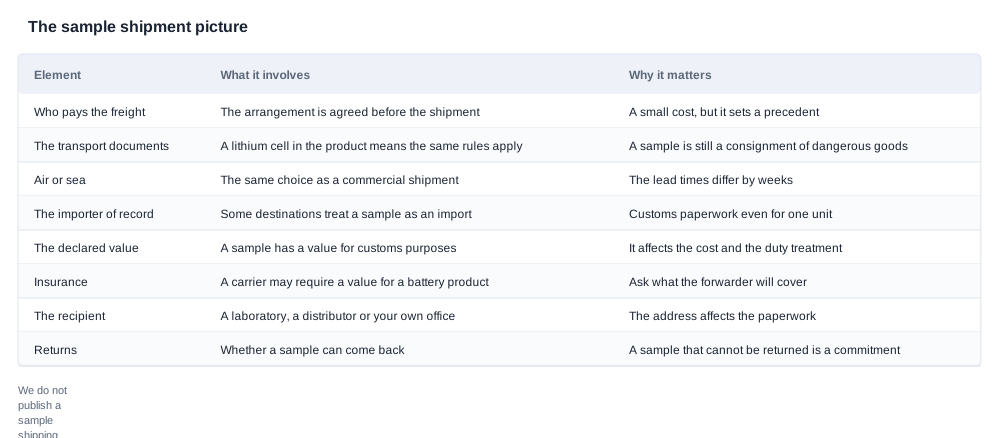
Who pays the freight. The amount is small; the point is not the amount but the precedent. The same question arrives again with the first real order, with the warranty replacements and with any re-shipment after a quality issue. A sample arrangement that quietly settled who bears the freight has quietly settled the replacement arrangement too, usually in a way neither side intended.
Who arranges it. Three common arrangements: the supplier ships through its own forwarder, the buyer ships through its own, or the buyer collects. Each has a different cost and a different level of control, and the third has one advantage that is easy to overlook — a collected unit can be inspected before it has travelled, which matters when the question behind the sample is about packaging or about damage in transit.
The declared value. A sample has a value for customs purposes even when it is free to the buyer, and the declared value affects the cost and sometimes the duty treatment. A nominal declaration on a battery product tends to be challenged, and an inflated one is a risk that sits on the record afterwards. The middle course is the actual value of the unit, which is small and easy to state.
The importer of record. For a consignment into most destinations, a single sample is still an import, and the paperwork has to exist before the unit arrives rather than after it has been held. The importer of record for the sample should be the same entity as for the commercial order. If it is not — because a third party is receiving the unit, or because a laboratory is testing it — that needs to be stated deliberately, with the consequences understood.
The incoterm or its equivalent. Whether the supplier delivers to the buyer’s door or hands the consignment to the buyer’s forwarder changes who carries the risk in transit, who pays the duty and who produces the paperwork. Agreeing it for the sample means the commercial order inherits an arrangement that has already worked once.
The return arrangement. Whether a sample can come back, on what terms, in what condition, and to whom. A sample that cannot come back is a commitment rather than a trial, and for a customised unit that is worth thinking about twice before it is ordered.
The pattern across all six is the same. Each one is easy to settle now and awkward to settle later, and the sample stage is the cheapest place in the entire programme to settle any of them.
Which one to fix first is a judgement call, and the criterion is simple: start with the arrangement that can stop the consignment moving at all. The importer of record and the declared value are the two that can hold a unit at a border, so they come before the freight cost and the return terms, which are inconvenient but never fatal. The trade-off in each negotiation is also worth naming. A buyer who negotiates the freight cost alone is optimising the smallest line; a buyer who negotiates the cost against the importer and the documentation is negotiating the terms that determine whether the shipment happens on the day it was meant to.
One arrangement deserves special attention because it is usually left implicit: the third-party recipient. A unit sent to a laboratory, a distributor or a colleague is an import into a different name, and the receiving entity may need to be able to act as importer of record for it. Where the sample goes to a third party, that has to be established before the unit is packed, and it is one of the few sample arrangements that is genuinely difficult to fix after the fact.

Requesting smart glasses samples: air or sea, and the practical difference
The mode choice for a sample is not the same calculation as for a commercial consignment, because the constraint is different. A production shipment is usually measured against a cost per unit and a delivery window; a sample is measured against a decision that somebody is waiting for. Air is faster and more expensive, and the restrictions that apply to lithium ion batteries shipped by air — including the state of charge rule — apply to the sample exactly as they apply to the production consignment. Sea is slower and cheaper, with no equivalent state of charge restriction, and for a single unit the cost difference is often trivial while the time difference is not.
That arithmetic usually makes air the sensible default for a sample, even though the handling is more involved. The exception is a sample whose configuration is not yet available and whose arrival is not on the critical path, where a slower mode is simply better. What is not sensible is leaving the decision open, because the choice determines the documentation set and the lead time needed to prepare it.
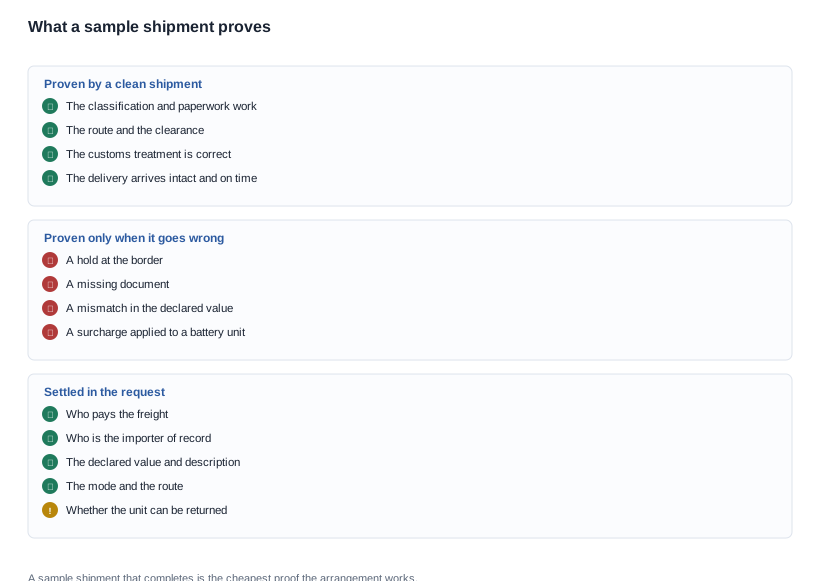
The more valuable point is about consistency between the sample and the order. Using the same mode, the same forwarder and the same customs treatment for the sample and for the first commercial consignment means the documentation is already proven. A sample that arrived smoothly has tested the entire chain: the classification, the paperwork, the route, the clearance and the delivery. A sample that arrived after three emails and a hold at the airport has not tested anything except the supplier’s willingness to be helpful, and it has proved that the same problem will recur on a consignment ten thousand times larger.
The criteria for choosing the mode are therefore two rather than one, and they can conflict. The first is the programme constraint: does a decision wait on this unit. The second is the rehearsal constraint: will the same mode, the same route and the same carrier carry the production consignment. When the two conflict — a slow sample by sea but a production order that must move by air — the right answer is still air, because the sample is more valuable as a rehearsal of the production route than as a fast delivery, and because a unit that took four weeks to arrive is a unit nobody is still waiting for by the time it does. The trade-off is that a sea sample proves the paperwork without proving the route, and that gap has to be closed another way.


Requesting smart glasses samples: what to put in the shipment request
The request has to carry the shipment arrangements as well as the product details, because they are settled together and the unit is packed once. Eight things belong in it.
- The models and configurations, each with the reason it is being requested, so that the preparation is aimed at the right specification.
- The test script with its pass conditions, which is the part that makes the freight worthwhile rather than merely spent.
- The delivery address, stated in full, and whether a third party — a laboratory, a distributor, a colleague — is the actual recipient.
- The incoterm or equivalent arrangement, and who the importer of record is for this consignment.
- Who pays the freight and who arranges the shipment, including whether the unit is collected.
- The delivery window the sample is needed in, and whether it is tied to a launch date or to a review meeting.
- The documentation wanted with the consignment, which usually means the specification sheet, the model code list and any transport document the supplier holds for that configuration.
- The return arrangement, with the condition the unit has to be in to be accepted back.
The protocol the sample is judged under is set out on the sample policy and cost page, and the full request goes through the quote request page. The model and configuration data that the shipment paperwork refers to is on the OEM ready products page.
The order of the list is not arbitrary. The first two items determine whether the unit is worth anything when it arrives, and the remainder determine whether it arrives at all, on the day it was needed, with paperwork that will not stop at the border. A request that leads with the shipment details and leaves the purpose vague tends to produce a well-delivered unit that answers nothing; a request that leads with the purpose and leaves the shipment vague tends to produce a well-aimed unit that arrives three weeks later than the programme assumed.
Where the shortlist has more than one candidate, one further item earns its place: state in the request whether the units are travelling together or separately, and whether they may share a consignment. A single consignment carrying two candidate units is cheaper, faster and simpler to clear than two separate ones, and it also makes the side-by-side comparison easier on arrival because both units have been through the same journey and the same handling rather than two different ones. That is a small point, but it is the kind of detail that decides whether the comparison you planned is the comparison you actually get.
Requesting smart glasses samples: the question to ask about every shipment
Ask what the sample shipment is going to prove about the commercial one. That single question changes the value of the freight charge, because it determines whether the shipment is a delivery or a rehearsal.
If the answer is that it proves the product works, the shipping is a side issue, and a plain, fast, documented consignment is sufficient. If the answer is that it proves that the documentation, the route and the customs treatment work, then the sample has a second job, and that job is worth paying for explicitly — because it is the job that has to be done again before the first production shipment if it was not done during the sample.
The due diligence test for a shipment arrangement is the same one that applies to any other claim: is it described, or is it demonstrated. A forwarder that has never handled a lithium sample can quote a smooth shipment and still hold the unit at the border, because the classification was wrong or a document was missing. A sample shipment that completes without an incident is the only real evidence that the arrangement works, and it is the cheapest evidence available, because the alternative is discovering the problem with a full consignment in it.
When a shipment does fail, the negotiation about what happens next is worth handling in a particular order, because the order preserves the value of the rehearsal. First, get the unit released and delivered rather than returned to the sender — a unit that never arrives has proved nothing, and the documentation problems it revealed can be raised in parallel. Second, record precisely what went wrong: the missing document, the classification query, the customs query, the surcharge. That record is the due diligence output of the sample, and it is worthless if it stays inside a conversation. Third, require the arrangement to be corrected and the corrected arrangement to be used for the next consignment, whether that is the second sample or the first production order.
The alternative is to treat a failed shipment as an inconvenience, absorb it and move on. That is a reasonable choice when the sample was only ever a delivery. It is an expensive one when the shipment was a rehearsal, because the same failure then repeats on the consignment that matters, and the second occurrence is paid for at volume.
There is a closing point specific to this category, and it is the reason the transport rules are worth reading before the first sample rather than after the first hold. The documents that govern a lithium consignment depend on the cell and on the configuration, and the configuration is the buyer’s choice. A buyer who changes the configuration — swapping a case for no case, or choosing a different colour that carries a different accessory set — changes the consignment, and therefore the documentation, and therefore the arrangement. The shipping is part of the specification, not a detail that sits outside it.
Which is also why the shortlist is worth settling before the shipment rather than after it. The configurations differ in ways that reach well past the unit itself: the case presence and its published capacity, the accessory set, the packaging level and the declared value all follow from the choice of model. Two candidates that differ on those points do not just need two units; they need two different consignments, two sets of documents and two declarations, and a programme that has planned for one consignment will discover the second one on the day it ships. Sending one request that covers both candidates, with the differences stated, is the difference between one rehearsal of the chain and two halves of a rehearsal.
Related reading
- The documents a battery shipment needs — battery transport
- The sample request itself — request a quotation
- The protocol the sample is judged under — sample policy and cost
- The model and configuration data — OEM ready products
Tell us the models, the destination and the delivery window, and we will confirm the documentation and the arrangement for the shipment.


