
A consumer electronics brand arriving at smart glasses usually has strong category knowledge and a weak category specification. They know what a good speaker, a good sensor or a good battery looks like, and they arrive expecting the same clarity here. They do not get it, and the reason is structural rather than a matter of supplier quality: smart glasses merges a wearable form factor with an audio and an imaging product, and the documentation conventions of all three are looser than any of them separately.
This article is the orientation piece for that situation. It sets out what the published material in this category can and cannot tell you, which published rows actually move a decision, which two rows matter more than any of the technical ones if you are building a retail proposition rather than a project, and what a brand should ask a supplier for that most brands do not ask for at all.
The practical output of reading it should be a shortlist of two or three models and a list of five specific documents to request. Not a decision. A shortlist, and the questions that turn it into one.
Smart glasses for consumer electronics brands: the overview
There are four things a brand is buying when it buys smart glasses from a manufacturer, and they are worth separating because they are usually bundled into one conversation and then traded off against each other without anyone noticing.
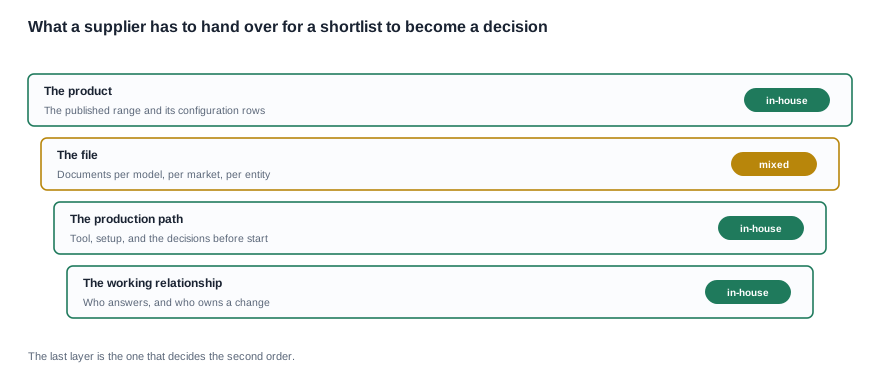
The first is a product. That part is the least difficult and the most published: a range of twenty-eight catalogue entries across camera, audio, sport, kids, photochromic, bone conduction and AR, with configuration rows on the model pages.
The second is a file. The documents that let the goods be imported, sold and supported in a given market. This is the part that is least published and most contested, because a document is only meaningful when it names a specific model under a specific entity at a specific date.
The third is a production path. The question of how your configuration is actually built — what tool it uses, what it shares with the rest of the range, how long it takes and what has to be decided before it can start.
The fourth is a working relationship. Who answers the question when something is unclear, who owns the decision when a specification changes, and whether the person who quoted you is the person who can resolve the problem in month seven.
Most first conversations in this category are conducted entirely at the level of the first of those, and the other three get discovered later. That is the pattern this article is trying to break, because each of the three has a specific set of questions and a specific set of answers, and each of them can be settled before a purchase order rather than after one.
It is worth being clear about why the second of the four — the file — is so often the surprise. A brand that has bought consumer electronics for a decade expects a supplier to hold compliance for the product as a matter of course, because for most of the categories it buys that is true and invisible. Here it is neither invisible nor automatic. There is no per-model certification row to consult, the export-certification page is a picture page of patents, and the coverage of any document depends on which legal entity holds it and which configuration it was produced for. That is not a criticism of suppliers in this category; it is a description of a category where the wearable, the radio and the optical element all meet, and where the evidence for each is produced at a different moment by a different party.
The fourth of the four — the working relationship — is the one that a first order cannot reveal and that a second order exposes completely, which is why this article spends less time on it than the other three. It is enough to say here that the question worth asking early is not "who is your account manager" but "who resolves a specification question, how long does it take them to answer, and what do you need from us to answer it."
It is also worth saying plainly that this is a category where a shortlist is the correct first output rather than a specification. The published rows are precise enough to eliminate most of the range — a brand that needs an ingress marking, a published weight, a Bluetooth version, or a case capacity can already tell which models qualify and which do not — and they are not precise enough to choose between the survivors. Choosing between them requires the five documents in the last section, and until those arrive any selection is a judgement about proposition rather than about specification.

Smart glasses category shape: why a consumer electronics playbook does not transfer
Four structural differences account for most of the friction, and it is worth naming them precisely because each one is a place where a well-run buying process will read a published figure incorrectly.
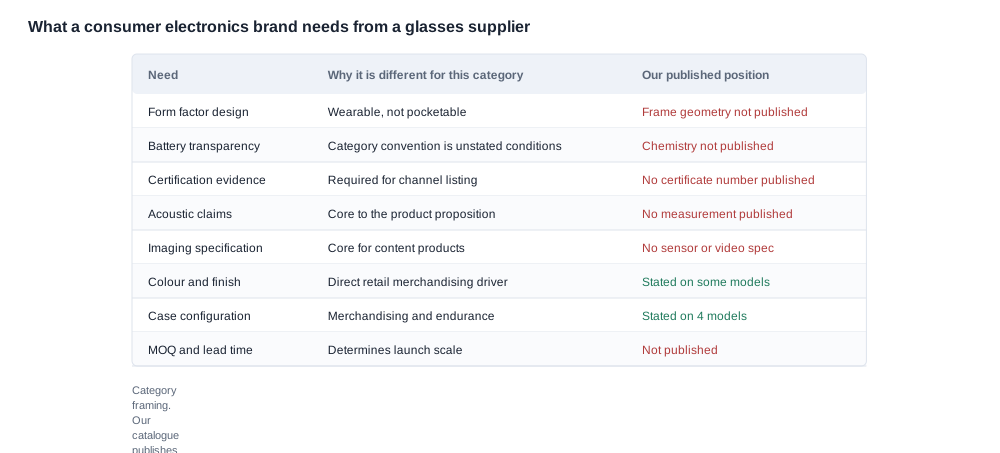
The form factor is the hard part, not the electronics. Across our twenty-eight entries we publish exactly one frame weight — the MT6 at 158 g, for the glasses alone and explicitly excluding its 1200 mAh foldable case. No frame dimensions, no temple lengths, no material composition are published anywhere in the range. For a brand used to specifying a device by its bill of materials, this is the missing document rather than a gap in the information, and the practical consequence is that a glasses programme needs a fit and materials conversation that a speaker programme does not.
The battery convention is different from what electronics buyers are used to. We publish capacity, rated runtime and charge time, and no test condition behind any runtime figure. Our own camera tier demonstrates why the missing condition matters: batteries across the 220–290 mAh band carry a rated runtime of roughly five to eight hours, and without a stated duty cycle those numbers cannot be compared with anything, including with another manufacturer's. A buyer who has learned to read capacity as a proxy for endurance will get this category backwards, and will over-read a small cell and under-read a large one.
The certification evidence is thinner than expected. Our published catalogue carries no per-model certification row for any entry. The export-certification page we publish is a picture page showing ten patent certificates — eight design patents and two utility models — and nothing maps a model to an authorisation number, an issuing body or a validity period. If your channel process expects to verify a reference in a registry, that step has nothing to verify against until the supplier provides the document, which is a normal outcome and not a warning sign in itself.
The performance claims you would specify are unpublished. No acoustic measurements, no sensor model, no video specification and no field of view appear anywhere across the range, and no capacitive-touch row and no translation row exist for any model. Those are the rows a consumer electronics specification review is built on, and their absence is the single biggest reason a familiar supplier process does not transfer to this category.
There is a fifth difference that sits underneath the other four, and it is the one that catches out buyers with the strongest category knowledge. The deciding variable in this category is fit, not specification. A shopper or a buyer does not choose between two megapixel counts; they choose between a pair of glasses that works for their face and a proposition they want, at a price they will pay. That has a direct consequence for how a range should be evaluated: a specification-led shortlist will tend to produce more candidates than a proposition-led one, and the extra candidates will not be resolved by more specification, because the thing that is actually deciding has been the whole time the thing you cannot read on a datasheet.
The practical response is to run two filters in parallel — one on the published rows, and one on the proposition — and only compare the models that survive both. A model that is technically perfect for the requirement and wrong for the customer is not a candidate, and in this category it is a remarkably common outcome, because the published range contains several models that are close to each other on specification and far apart on proposition.

Smart glasses published rows: enough to narrow, not enough to pick
What we publish is worth stating precisely, because a brand that knows the shape of the published material can use it as a filter instead of waiting for a supplier to tell it what exists.
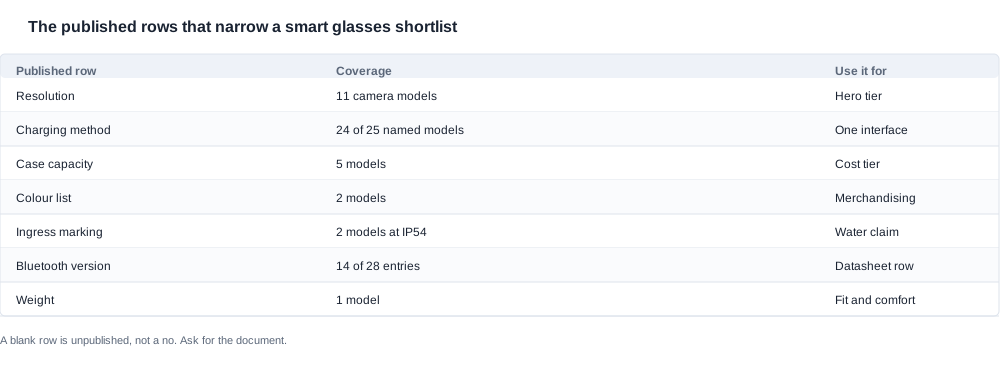
Twenty-eight catalogue entries across seven categories. On the camera tier, resolution in two classes — 8 MP on eight models and 13 MP on the L1 Pro and the L2 Utral, and the S7 — with camera batteries across the 220–290 mAh band, a rated runtime of roughly five to eight hours, and a case capacity published for five models. On charging, magnetic on seventeen models and Type-C on seven, with MT6 and the CY03, and CY05 and L1 Pro not published at all. On charge time, "2 hours or less" for twenty-six entries, with the D17 and the ZH12 publishing approximately one hour. An ingress marking on exactly two models, the V06 and the S7 at IP54. A weight on exactly one. A Bluetooth version on fourteen of the twenty-eight entries. A colour list on exactly two, the V03 Pro with three and the V06 with four. Surround audio published for the D11, with the D17 publishing "Surround Sound" and the ZH12 publishing 立体环绕音.
That is enough to eliminate most of the range and to shortlist two or three candidates. It is not enough to pick one, and any supplier who tells you otherwise is selling rather than specifying.
The filter is best applied as a set of written criteria rather than as a general impression. Write down what the programme genuinely requires from the published rows — an ingress marking, a published weight, a Bluetooth version on the datasheet, a case capacity, a colour list — and run each candidate against it. In our published range those criteria are quite restrictive, and that is the point: a narrow filter applied early is what saves the weeks at the end when a requirement turns out to be unavailable on the model you had chosen.
A useful trick with the published rows is to write the filter as a sentence rather than as a table, because a sentence forces you to say what the requirement is for. "We need a Bluetooth version on the datasheet" is a different requirement from "we need a Bluetooth version on the datasheet because the retailer's product template requires one", and the second one may be satisfiable by asking the supplier rather than by filtering the range. Several of the published gaps are documentation gaps rather than product gaps, and a filter that cannot distinguish between the two will eliminate a model for a reason that was never real.
Two warnings about using published rows as a filter. First, a blank is not a "no" — it is an unpublished figure, and the distinction matters enormously when you are deciding whether to drop a model or ask for the document. Second, the published row is the row for the configuration as published, so a customisation that changes the configuration may change the row, which is the reason to ask for the row rather than copy it.
A third warning is about how the rows relate to one another, and it is the one that catches out buyers who read the catalogue as a specification sheet. The rows are not independent. The camera tier is where the case capacity, the colour list, the ingress marking and the weight figure all appear, which means the camera tier is simultaneously the best-documented part of the range and the part with the most rows that a buyer might mistake for product differentiators. Camera resolution in particular divides the tier into two classes across eleven models, and treating it as a tier axis produces a portfolio that is much more granular than the customer decision it is meant to serve.
Smart glasses merchandising assets: the two rows a retail buyer uses
If you are building a retail proposition rather than a project, two published rows tend to matter more than the technical ones, and both are merchandising assets rather than performance claims.
The charging case. CY05 and L1 Pro, and CY03 carry a 1400 mAh case; L2 Utral also offers a 900 mAh option; MT6 carries a 1200 mAh foldable case. A case supports a "try it, then carry it daily" story, raises achievable basket value, and changes packaging, shipping weight and landed cost all at once. It is also the cleanest tier differentiator in this category, because it is a physical object the shopper can see and hold, and because the published figures let a brand build a genuine ladder from a 900 mAh case to a 1400 mAh case rather than a cosmetic one.
Colour breadth. The V03 Pro lists three colours and the V06 lists four. Colourway depth is a direct merchandising decision for a consumer electronics brand, and it is one of the few rows we can support directly from published data. It is worth noting how narrow that support is: two models out of twenty-eight publish colours at all, and the rest have to be asked for. A brand planning a colour-led launch is therefore planning a material batch, not selecting from a catalogue, and should treat the sourcing question as part of the launch plan.
There is a third merchandising asset that is worth a mention even though it is a feature rather than a published row: the sport tier's charge time. With the D17 and the ZH12 publishing approximately one hour against a ceiling of two hours or less everywhere else, a brand can make a defensible on-the-go claim for two models and no others. It is a small row that carries a real amount of copy, and it is exactly the kind of thing an over-used differentiator — camera resolution — crowds out if the range plan is built from the specification rather than from the proposition.
There is a merchandising consequence to the case that is easy to miss, and it is worth putting in front of a channel team before the range is fixed rather than after. A case is not only a proposition; it is also a packing and logistics decision. It changes the carton dimensions, the shipped weight, the volumetric freight cost, the shelf footprint, and the retailer's expectations about returns, because a returned product with a missing case is a different commercial event from a returned product without one. A brand that treats the case as a free upgrade in the unboxing is planning for one thing and will be surprised by another. And a brand that wants a case on every SKU in the range has to check the published rows first, because the case exists on some models, exists without a published capacity on two others, and is explicitly absent on several more.
The same caution applies to colour. Four colourways on a hero model is a merchandising asset; four colourways across a range is a material commitment across four batches, and the four have to be reordered separately. That is a purchasing decision with a schedule attached, not a design decision with a mood board attached.
Smart glasses supplier verification: what to ask for before you shortlist
Five requests will turn a shortlist into a decision, and every one of them asks for a document rather than for an opinion. They are the same requests regardless of which models you are looking at, and they are the requests most brands skip because each of them seems minor on its own.
- The sensor part number on any camera platform. One answer resolves pixel size, design era and plausible low-light behaviour, and it is the cheapest of the five.
- The acoustic leakage figure on any audio platform. Without it, sound quality claims are not comparable to anything, including to a competitor's.
- The frame weight and temple length for the specific configuration you would order. Weight depends on the battery and electronics configuration, so a single published figure is not enough for a build that is not the published one.
- The cell chemistry and cycle life. This is the component most likely to define the product's life, and it is the input a warranty position has to rest on.
- The test basis behind any published marking. For the two models that carry an ingress marking, this is the row we cannot currently supply from published material, and the gap is worth naming rather than glossing.
A sixth request, for brands that have not done this before: the model list behind each document in the set. Not the document itself — the list of models it covers. The list is the part that tells you whether a document applies to your SKU, whether it can be inherited, and what happens if you add a model later. Reading the lists is the difference between due diligence and collecting PDFs.
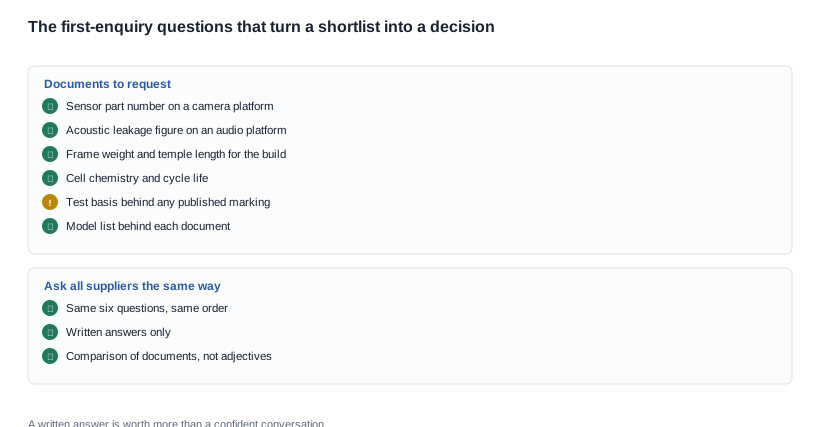
A useful way to run this is to ask all shortlisted suppliers the same six questions in the same order and require the answers in writing. Then the comparison becomes a comparison of what each supplier can produce, rather than a comparison of how each supplier describes itself — which is the only comparison that survives contact with a purchase order. The supplier verification article covers the same ground at a factory level for brands that want to go further than a document set.
Two things to do with the answers. The first is to sort them by whether they close a question or merely restate a specification. "The sensor is a 1/2.8 inch sensor with a fixed focus and no stabilisation" closes a question; "the camera is 13 MP" restates a published row and closes nothing. The second is to write down which answers you did not get, because an unanswered request is a fact about the supplier's document position that will not improve on its own, and it tells you which part of your programme is going to need a decision rather than a document.

A closing note on the order of the work. In most consumer electronics categories the specification review comes first and the elimination happens afterwards, on price and lead time. Here the elimination is cheaper and better done first, because the published rows remove most of the range before anyone spends time on a document set, and because a document set for a model you would not have chosen is pure cost. Write the criteria, filter the range, request the documents for the two or three survivors, and then compare on what each supplier can actually produce. That is the sequence that keeps this category from being run like a speaker programme, which is the mistake it is most often run as.
The positioning for this category is under consumer electronics brands. The model-level detail for the camera platforms is on the ai camera glasses range page, and for the audio class on the bluetooth audio glasses range page. The ergonomics and materials position, including what we publish and what we do not, is on the frame materials and ergonomics page.
Related reading
- Narrowing the range from published rows — smart glasses model comparison
- What our documentation omits — smart glasses frame materials
- Verifying what a supplier gives you — supplier verification
Tell us the application and the price band, and we will narrow the range from published rows.


