

The difference between a smart glasses factory audit and a verification framework
An audit tells you about a day. A verification framework tells you about a relationship. The difference is entirely in what you are checking: the factory's story, or the factory's records. A day can be a good day, and a factory can present well on a day without any of the controls behind that presentation existing. Records are different, because a record is the residue of a control that ran, and the record either resolves to a unit or it does not.
This matters commercially because the two instruments answer different questions and the buyer usually needs both, in the wrong order far more often than not. An audit is the right instrument when you have no order and no units, and it tells you whether the process can hold a specification. A verification framework is the right instrument when you have a relationship, and it tells you whether the process is still holding that specification three, six or twelve months later. Most of the damage in this category comes from running the first one and believing you have run the second.
The framework below is arranged so that each layer is checkable without trusting the one above it. That is the design principle, and it is what makes the difference between a verification exercise and a series of increasingly friendly conversations. A layer that depends on the credibility of a previous layer is not a layer; it is an opinion with a heading.
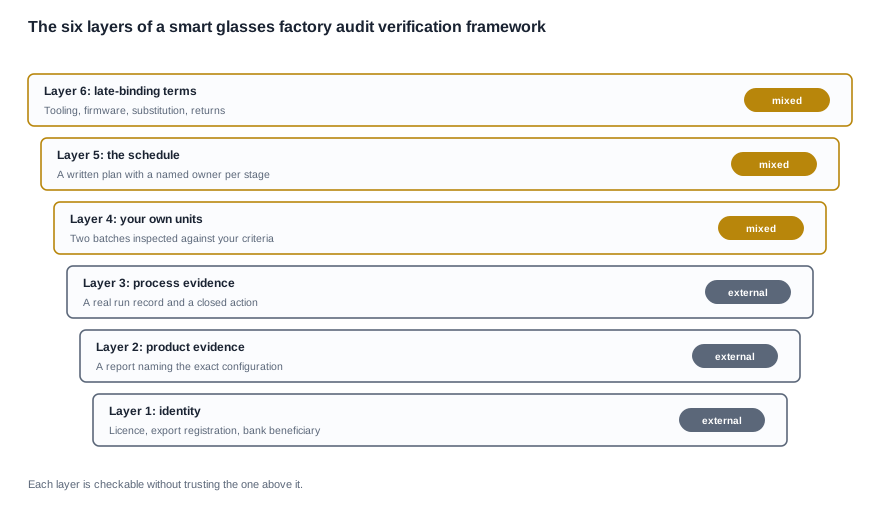

Layers one to three: identity, product evidence and process evidence
Layer one, identity. The contracting entity's business licence, checked against the bank account beneficiary character by character, because a bank account is the one document in a supplier file that is almost never wrong by accident. Export registration where the entity is not in the same country as the goods, and the economic operator registration number where the destination market requires one. This layer is binary. Either the names match or they do not, and a mismatch here ends the evaluation immediately rather than qualifying it, because a payment relationship that runs through a different entity from the one that builds the product is a payment relationship you will want to revisit at the worst possible moment.
Layer two, product evidence at model level. The test report for the exact model designation you intend to buy, with the standard referenced, the laboratory named and the sample batch identified. In the European Union, radio equipment sits under the Radio Equipment Directive, Directive 2014/53/EU, and traceability sits under the General Product Safety Regulation, Regulation (EU) 2023/988, applicable since 13 December 2024. A category-level claim is not evidence, and a report naming a different suffix is not evidence about your configuration. In this range the trap is specific: a 13 MP tier appears on more than one model with different cell sizes and different case options, and a 900 mAh case option sits alongside a 1400 mAh one on the same model, so a file that covers the model may not cover the build.
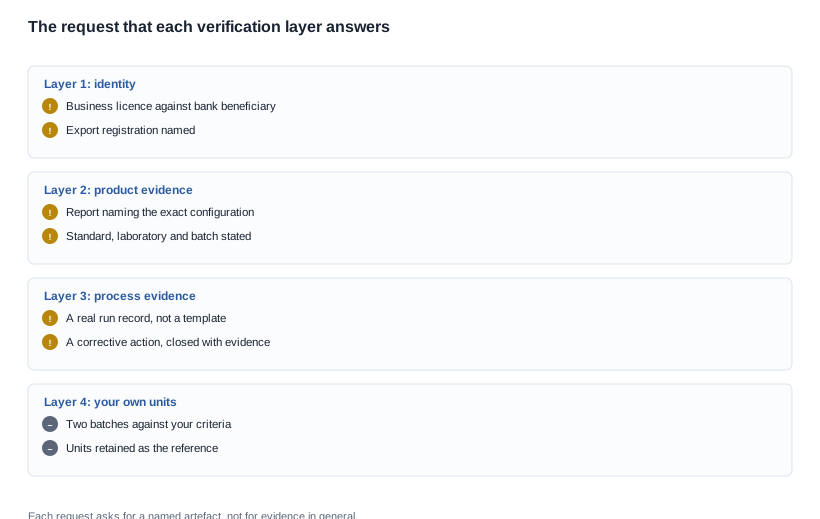
Layer three, process evidence. A filled inspection checklist from a real run rather than a template with the same headings. A batch traceability example showing how a finished unit is traced back to a component lot. A corrective action record from a past defect, with the date it was raised and the evidence it was closed. The pairing of the last two matters more than either of them alone, because a supplier with detailed inspection records and no corrective actions has a process that has never encountered a defect — which usually means the process has never been tested, not that the factory is unusually consistent.
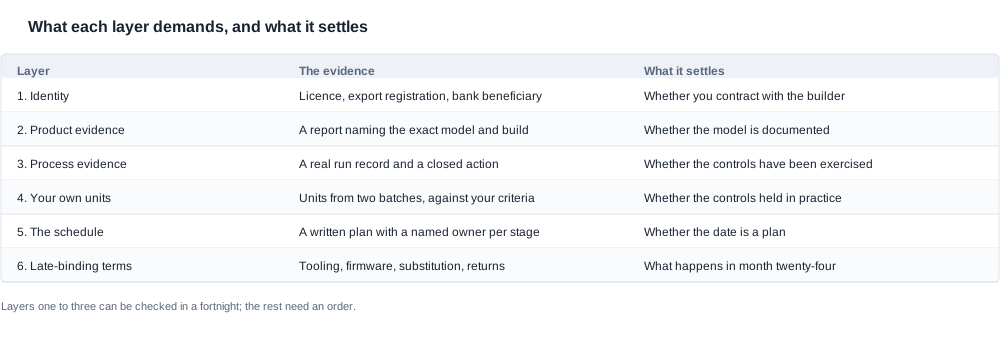
| Layer | The evidence it demands | What it settles | What it cannot settle |
|---|---|---|---|
| 1. Identity | Licence, export registration, bank beneficiary | Whether you are contracting with the entity that builds | Whether the entity is competent |
| 2. Product evidence | A report naming the exact model and configuration | Whether the model is documented for the destination market | Whether the factory builds it consistently |
| 3. Process evidence | A real run record, a trace example, a closed action | Whether the controls exist and have been exercised | Whether they will hold on your order |
| 4. Your own units | Units pulled from at least two of your batches | Whether the controls held in practice | Anything about the period before your first order |
| 5. The schedule | A written schedule with a named owner per stage | Whether the date is a plan or an aspiration | Whether the plan survives a component shortage |
| 6. Late-binding terms | Tooling, firmware, substitution, returns rules | What happens in month twenty-four | Anything that needs a live order to test |
The language of a verification request
The evidence you get back is shaped by the way you ask, and a verification framework is only as good as the requests it produces. Three habits separate a request that can be answered from one that generates a paragraph.
The first is to ask for a named artefact rather than for evidence. "Please send your certification documentation" invites a folder. "Please send the test report that names the model designation in the order, with the standard referenced, the laboratory named and the sample batch identified" invites one document. The second is to ask for the scope as well as the document, because a report without a stated scope has an undefined boundary and cannot be compared with a report that has one. The third is to ask who holds the file rather than whether the file exists, because the answer to the second question is almost always yes.
There is a fourth habit that matters more than it appears: asking the same question of every supplier in the same words. Verification is a comparison, and a comparison built on differently worded questions produces differences that are artefacts of the wording. When one supplier answers in two days and another in six, the difference is informative. When one supplier answers "yes" and another answers "we follow the standard practice", the difference may be nothing more than the fact that the second supplier read the question as asking about their approach. Write the request once, send it unchanged, and record who answered it.
The final habit is to log the response as it arrives rather than at the end. A verification file that is assembled at the end of the process from memory and email is a summary, and summaries lose exactly the detail — the date, the attachment, the person, the hesitation — that makes the difference between a document and a description.
Timing is the remaining variable, and it changes what a response means. A request issued while the factory is between programmes gets a considered answer, because nobody is competing for the same person's attention. The same request issued four days before a shipment gets a fast answer assembled from whatever is on the desk, which is often a company-level document rather than the model-level one. Neither behaviour is dishonest and both are entirely predictable, so the useful conclusion is that the timing of a request is part of the request. If a document is needed for a decision with a deadline, ask for it early rather than asking for it faster, because the two produce very different answers.
There is one more timing point that is specific to this category and that buyers tend to discover late. The point at which a document is most useful is before the configuration is frozen, and the point at which it is most expensive is after the purchase order is issued, because a configuration change after the order reopens the file. A request sent during the specification stage costs an afternoon; the same request sent after the artwork is approved costs a re-approval cycle on both sides, and the re-approval cycle is where schedules in this category actually slip.
Layers four to six: your own units, the schedule, and the terms that only matter later
Layer four, your own units. This is the layer that only exists after the first order, and it is the one that catches everything above. Pull finished units from your own production, from at least two batches if two exist, and inspect them against the acceptance criteria you defined before the order rather than against criteria written after the units arrive. A factory that has only ever run one batch for you is telling you something important about whether you have a manufacturing relationship or a prototype relationship that happens to have a purchase order attached.
Layer five, the schedule, tested against a constraint. Which stage is binding, what is booked ahead of your order, what happens if a stage slips, and who owns the recovery. This is a records question as much as a claims question: a supplier that produces a written schedule with a named owner for each stage has a process, and one that produces a date has a hope. The test is to ask for the schedule rather than the delivery date, because a date is an output and a schedule is a system.
Layer six, the terms that only matter later. Tooling ownership, firmware update commitment, component substitution rules, and how data is handled on return. These are cheap to ask in month zero and expensive in month twenty-four, because the leverage is gone. The reason they are listed last is not that they are unimportant; it is that they are the terms a supplier is most likely to agree to at the start, when the order is what it wants, and most likely to decline later, when it is not.

Turning layer four into an acceptance rule before you have layer four
Layer four needs your own units, which is why it arrives late, and that is a structural problem rather than a character flaw in the buying process. There is a way to make it arrive early, and it is the single most useful thing a buyer in this category can do in the first week of a programme: write the layer four criteria into the purchase order as the acceptance rule for incoming goods.
An acceptance rule is not a specification. It is a statement of what will be checked on arrival, by whom, against what written list, with what record kept. If the rule says that every incoming lot is checked against the configuration string, the case option, the camera tier and the interface, and that the check is recorded against the lot reference, then every delivery from the first one produces layer four evidence automatically. A year later, when a question arises about a unit from month four, the answer exists in the goods-in record rather than in a recollection.
The criteria that make the most sense in this role are the ones that a configuration error would break, because configuration errors are the failure mode that returns are made of. In this range that means the camera tier, the cell capacity, the charging interface, whether a charging case is present and what it holds, and the colour. Those five are checkable in minutes against a written list, and they are the five that a packing list mistake, a label mistake or a substitution mistake would change.
The cost of the rule is a small amount of goods-in time. The return is that the cheapest, most common and most expensive failure in this category becomes visible at goods-in rather than at the customer's door, and that the layer four evidence your framework needs starts accumulating from the first shipment rather than from the year after.

Why verification stops at layer three, and what that does to the risk you carry
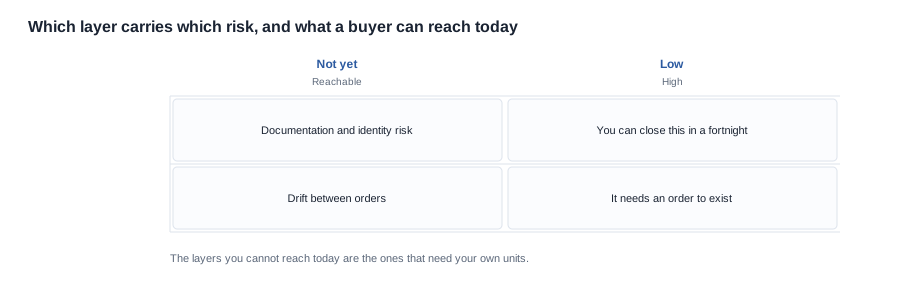
Layers one to three can be requested and checked inside a fortnight. The three that follow cannot, because layers four to six require an order and a relationship to exist. That asymmetry is the reason most buyers' verification stops where it does — not because they have judged the residual risk acceptable, but because the layers that would settle it are not yet available. The failure is not dishonesty; it is a structural gap in what a first evaluation can reach.
The practical consequence is that the layers a buyer can check cheaply are the ones about the supplier's history, and the layers about your own orders are the ones about drift. A supplier can be entirely legitimate on the first set and still fail on the second, and that is the ordinary case rather than the exceptional one. The interesting question is therefore not whether a supplier passes verification today, but which layer the buyer intends to have evidence from when the relationship is under pressure, and whether anything has been put in place now to collect that evidence then.
It is worth saying what that residual risk actually consists of, because buyers often describe it more dramatically than the evidence supports. It is not a risk of deliberate misrepresentation, which is what a first evaluation is designed to detect and does detect. It is a risk of ordinary drift: a component substituted because the original went on allocation, a firmware branch changed for a customer with a larger order, a worker moved from the test bench to the line, a packing list updated for a configuration the buyer was never told about. None of those is a lie, all of them change the product, and not one of them is visible in a document set. They are visible in a sample, in an acceptance rule, and in a schedule with an owner, which is precisely why the framework puts those layers last and insists they are collected continuously rather than once.
This is also the reason a verification framework is worth more than an audit in a long relationship, even though it costs less at the start. An audit is a price on a day. A verification framework is a mechanism that keeps producing evidence, and the evidence is what lets a buyer act early instead of acting after a channel has already been affected.
There are two ways to close the gap partially, and neither of them is a visit. The first is the acceptance rule described above, so that from day one every received unit generates the evidence that layer four needs. The second is to ask for the corrective action records from layers three and six at the point where the relationship is weakest, which is the first significant dispute, because that is when a supplier's willingness to show you its closed actions is at its least convenient and therefore most informative.
There is a third option that is more uncomfortable and sometimes more useful: name the layers you cannot reach in the contract, and state what will happen if they fail. A clause that says the buyer may withhold a milestone payment against a documented corrective action, or may require a re-inspection at the supplier's cost, converts an unreachable verification layer into a lever. The lever is worth less than evidence, and it is worth considerably more than silence, because the counterparty has to price the possibility rather than assume the buyer never looks.
What a smart glasses factory audit verification asks of us, and where we draw the line
We will complete layers one to five for our own arrangements, and we will do it in writing, without a visit. What we will not do is present undocumented capacity figures or quality rates to move an evaluation along. The catalogue's front matter carries company-level statements about the production base and the size of the engineering team; those are company-level facts and they are not line-level facts, and the daily output, the line count, the defect rate and the lead time are not published at all. An audit is precisely the situation in which a convenient estimate does the most harm, because an estimate in a file is indistinguishable from a measurement once it has been forwarded twice.
We publish what our documentation states — the camera tier, the cell capacity, the charge time, the rated use, the charging interface, the charging case capacity, the colour availability and the single frame weight we hold — and we mark the rows that are open as open. We will not fill an open row with a typical figure taken from a supplier's general data, because a buyer who builds a commercial commitment on an estimated number discovers the error in the field rather than in the quotation, and the correction always costs more than the question would have.
For the on-site half of the framework, the factory audit section sets out what a visit here covers. For the document half, the documents to request article is the field-level version of layers one to three, the advanced audit guide covers layer four in detail, and the audit negotiation article covers how to get access to the evidence in the first place, which is the step that fails most often.
It is worth being precise about one thing that buyers in this category sometimes expect us to do and we will not. We will not score a supplier for you, and we will not produce a pass or fail verdict on another factory. The framework is a structure for a buyer's own evidence, and the judgement in it belongs to whoever carries the commercial consequence of it. A verdict produced by somebody else is worth very little, because the buyer still has to decide what to do with it — and the decision, not the score, is where the money is.
What we will do is make the framework usable against our own operation, which is a lower and more honest claim. Send us the model, the configuration, the destination market and the annual volume, and we will tell you which layers we can evidence for you in writing, which ones require a paid sample, and which ones will only exist once there is an order against which to inspect.
Related reading
- The documents to request, layer by layer — documents to request
- Inspecting your own production units — advanced audit guide
- Getting access to the evidence — audit negotiation
- What a visit here covers — factory audit
Send us the model, the configuration, the destination market and the annual volume, and we will tell you which layers of the framework we can evidence for you in writing, and which ones you will have to build into the order to get at all.


