
A product portfolio for a consumer electronics brand in this category is not a range of models. It is a small number of propositions, each with one or two products behind it, and the discipline is in what gets left out.
The reason that discipline is needed is that the option space in this category is wide enough to make a large portfolio look reasonable. Our published range contains twenty-eight entries across seven categories: eleven camera models in two resolution classes with cells across the 220–290 mAh band, eight audio models, three sport models, three children's models, and three entries without a model name covering photochromic, electrochromic and bone conduction. Case capacities are published for five models. An ingress marking appears on two. A weight appears on one. Bluetooth version is published for fourteen of the twenty-eight entries, and the published colour lists cover two models — three for the V03 Pro and four for the V06.
Every one of those could be a SKU. Most of them should not be.
The asymmetry between those two sentences is the whole difficulty. In most consumer electronics categories the option space and the portfolio are close to the same size, so a brand can start from the options and trim lightly. Here they are an order of magnitude apart, and the trimming is the work. A portfolio of three propositions drawn from a published range of twenty-eight entries means rejecting twenty-five candidates, and a process that rejects candidates explicitly is a different process from one that selects them by preference.
That is also why this category punishes a brand that arrives with a portfolio already decided. A portfolio built on an existing brand architecture — a good, better and best ladder imported from another category — will not survive contact with the published range, because the range does not offer three equally spaced products in the way a portable speaker range does. It offers several strong configurations and a wide selection of variations, and the variations are what get mistaken for a ladder.
So a smart glasses product portfolio for a consumer electronics brand is a question about how to select from a wide published option space and end up with something a channel will actually stock, a factory will actually build and a customer will actually choose between. The selection criteria are narrow, and the exclusions do most of the work.
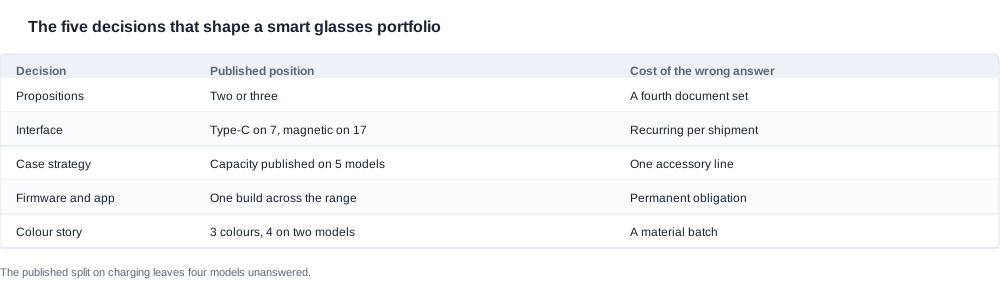
Smart glasses product portfolio: the five decisions that shape it
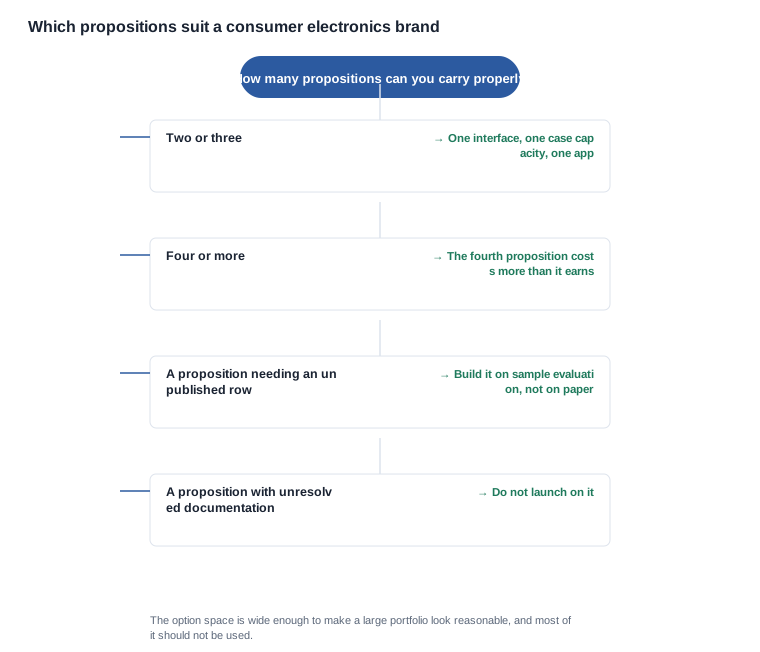
1. How many propositions? Two or three. The deciding variables in this category are fit, use case and price band, and three propositions covers them. A fourth proposition is a fourth set of documentation, a fourth packaging line, a fourth accessory set and a fourth set of claims to defend — and it arrives with a fourth production path attached, which is the part that costs the most and is the part that is hardest to reverse.
2. What is the interface across the range? One interface is worth a great deal to a distributor, a retailer and an institution. The published split is Type-C on seven models and magnetic on seventeen, with the charging method not published for the CY05 and the CY03, and the L1 Pro and the MT6. Choosing across the split is a decision with a recurring cost: it is a cable decision for the customer, a stocking decision for the retailer and a logistics decision for the distributor, and it is paid on every shipment rather than once.
3. What is the case strategy? One case capacity across the range means one accessory SKU, one packaging line and one customer routine. The published case positions are 1400 mAh on the CY03 and L1 Pro, and CY05, 900 or 1400 mAh on the L2 Utral, and a 1200 mAh foldable on the MT6. A case per model multiplies quickly, and the models where the case exists but no capacity is published — the KY06 and the MT5 — are exactly the ones that turn an accessory decision into a question.
4. What is the firmware and app position? One app and one firmware across the range means one maintenance obligation and one set of claims. The published customisation list includes system and interface work, Bluetooth device naming and firmware customisation, and a branded app is a permanent relationship rather than a deliverable. This is the decision that most often gets deferred and then becomes permanent by accident.
5. What is the colour story? The published colour options are three for the V03 Pro and four for the V06, and no list for the rest of the range. A colour story needs a material batch, and a material batch needs a reason, a quantity and a lead time — none of which are published, so a colour-led portfolio proposition is a sourcing conversation before it is a design one.
The order in which these five decisions are taken also matters, and the order is not the order above. The interface and the case strategy come before the propositions in practice, because they constrain which models can sit in the range together. A proposition that needs a model with a magnetic charging method and another that needs a Type-C model cannot share a cable decision, so the interface choice is effectively a statement about which propositions are still available. Working backwards from the interface is a more reliable way to narrow the published range than working forwards from the proposition list.
There is a second ordering point, which is that the firmware and app decision is the one that must be taken even when the answer is "nothing". A brand that launches without deciding will have one anyway, because the factory's default firmware and any stock app become the de facto position, and the de facto position is much harder to change later than a decision taken before the first order. The default is always a position, and it is always a position somebody chose without knowing it was being chosen.
Smart glasses propositions: what the published range can carry
Five propositions fit the published range, and it is worth being precise about what each one rests on, because the ones that rest on unpublished rows need a different kind of evidence than the ones that do not.
1. Everyday audio and calls. The audio tier's eight models are the entry point for most brands, because this is the lightest proposition to carry and the least claim-heavy. It is also the tier where the published configuration is most complete for the radio, since Bluetooth version is published across much of the audio range. The G07 carries a detachable temple, which makes a retail fit proposition possible without a new tool. Note what this tier does not give you: there is no capacitive-touch row for any model in the range, so no audio model may be described as having capacitive touch, and no acoustic measurement is published for any of the eight. If the proposition depends on sound quality, it has to be built on samples.
2. First-person content. The camera tier's eleven models, in two resolution classes — 8 MP on eight models and 13 MP on the S7 and the L2 Utral, and the L1 Pro — with camera batteries across the 220–290 mAh band and a rated runtime of roughly five to eight hours. The case positions are what make a shooting day work: a 1400 mAh case on L1 Pro and CY05, and the CY03, a 900 or 1400 mAh option on the L2 Utral, a 1200 mAh foldable on the MT6, and no case row at all for the S7 and the V03, and the V06 and the V03 Pro, and the box contents for those four have to be confirmed before the proposition is written. The published caveat is that the sensor model, the field of view and the video specification are not published, and the runtime figure carries no published test condition — so this proposition has to be built on sample evaluation rather than on specification.
3. Sport and outdoor. The sport tier has three models: YKC02, D17 and ZH12. YKC02 is a sport model with two 70 mAh cells. The D17 and the ZH12 are the only two models in the entire catalogue publishing a charge time of about one hour, against a ceiling of two hours or less across the other 26; the D17 publishes "Surround Sound" and the ZH12 publishes 立体环绕音. One point of care here, because it is easy to get wrong: the two models that carry the IP54 marking, the V06 and the S7, are named for sport but belong to the camera tier. The sport tier itself carries no published ingress marking.
4. Children's and education. The three children's models, the A05, A06 and A07. This is the proposition with the largest compliance burden, because children's products sit in their own standards regime in both the European Union and the United States, and because our catalogue publishes no per-model certification row for any entry — including these three. Bluetooth version is published for neither the A05 nor the A06.
5. Specialist propositions. The photochromic entry, the electrochromic entry and the bone conduction entry. The first of these has a model behind it: the V03 Pro is the only camera model in the range with photochromic lenses, and it publishes three colour options alongside them. The electrochromic entry and the bone conduction entry carry no model name at all, and the bone conduction entry publishes no Bluetooth version. Both are thin as propositions, and both carry the category's most specific compliance questions.
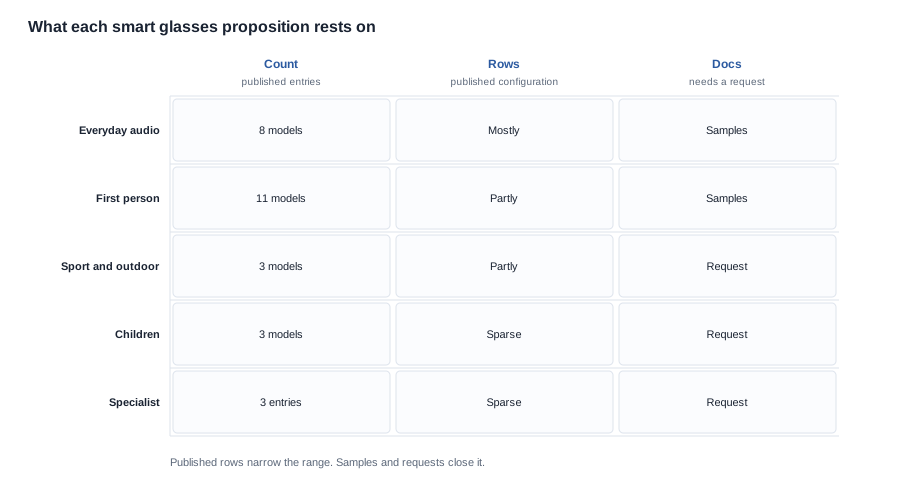
Two observations about this table that are easy to miss. The first is that the strongest published evidence belongs to the middle of the range, not to its edges. The camera tier carries the most published configuration rows and the most case options, and the audio tier carries the most complete radio position — while the children's tier and the specialist entries publish the least and carry the most specific compliance questions. A portfolio that reaches for the edge models for differentiation is reaching for the models with the least published support, which is the opposite of what a differentiation strategy normally assumes.
The second observation is about how a portfolio can be built from the same tier. Two propositions can share a tier and differ by something the customer perceives — a case, a fit, a use case — rather than by a specification. That is cheaper, because it usually reuses a tool, and it is more honest, because the difference is one the customer can see. It is also the reason a range built this way is easier to reorder and easier to support.

Smart glasses portfolio questions: what to settle before you commit
- Which three propositions, and which published models sit behind each? Write the mapping down, because a proposition without a named model behind it is a marketing idea rather than a plan, and the gap between the two is where the launch-week surprises live.
- Does the range use one interface and one case capacity? If not, the cost of the exception is paid on every shipment, and it is better to price that exception deliberately than to discover it in the freight quote.
- What is the documentation position for each configuration, per market? Our published position is that the catalogue carries no per-model certification row for any of the twenty-eight entries, and the export-certification page shows ten patent certificate images — eight design patents and two utility models — rather than a conformity table. Certification status for a specific model is a question for the supplier, and a portfolio question has to be asked per configuration rather than per proposition.
- What is the app and firmware position, and who maintains it? If the answer is a branded app, the maintenance obligation is permanent and should be costed as such.
- Which propositions are you prepared to defend a claim on, and which will you describe with published rows only? This is the question that separates a portfolio from a wish list, and it is worth answering before the copy is written rather than after it is published.
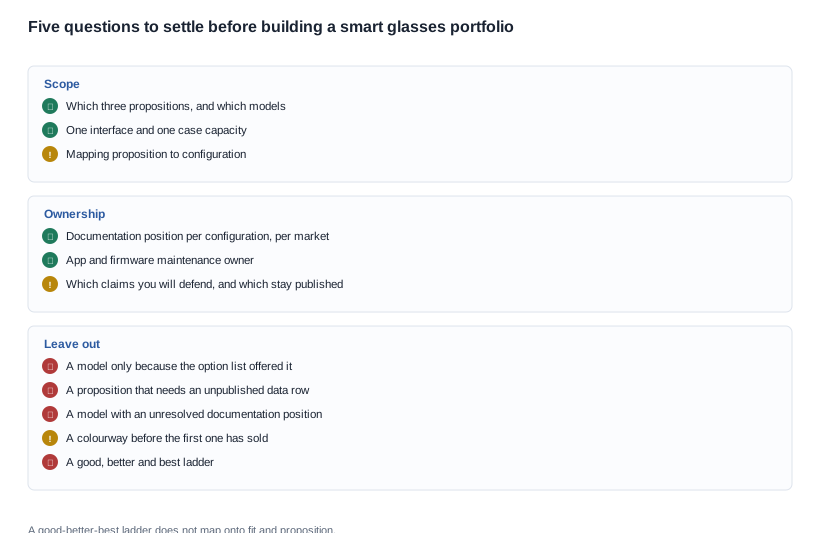
The third question is the one with the longest tail, and it is worth being more specific about it than the wording allows. Because no per-model certification row is published, the coverage of any document is per configuration, and the configuration is what a portfolio decision actually creates. Two propositions that differ only in a colour may share a document set; two that differ in a case, a cell or a charging interface may not. The due diligence step that matters is therefore to map each proposition to its configuration before mapping configurations to models, because the mapping is what tells you whether the portfolio is one document set or three.
A second piece of due diligence worth doing at this stage is comparative rather than internal. Take the two or three models that would sit behind each proposition and ask, for each one, which published row you would put on the product page. If you can find at least one published row per model that a customer would care about, the model is defensible in a listing. If the only rows available are battery capacity and charge time, the product page will be a list of numbers nobody asked for, and you should expect to write the listing around the proposition instead of around the specification — which is a different and more expensive exercise.
It is worth saying that a portfolio decision made on published rows alone is a strong outcome. Most brands in this category would be relieved to get to three models with a named configuration each and a short list of things to ask for. The expectation that the portfolio will emerge fully specified from the first conversation is the main reason first conversations in this category go badly.

Smart glasses portfolio discipline: the things to leave out
1. A model that exists because the option space offered it. The published option list is not a portfolio plan. It is an inventory of what exists, and the reason to read it is to find homes for requirements you already have — not to generate requirements.
2. A proposition that needs a data row the category does not publish. A product whose value depends on the field of view, or on the acoustic performance, or on frame weight, is a product whose evaluation has to be built on samples and on documents you request. That is a legitimate proposition, but it is a different kind of programme, with a different budget and a different schedule, and it should be labelled as one.
3. A model whose documentation position is unresolved at launch. A held shipment costs more than a delayed launch, and a delayed launch costs less than a product that arrives without the paperwork to sell it.
4. A second colourway that needs a new tool before the first one has sold. Colour breadth on a hero model is a merchandising asset; colour breadth across a range is a material commitment across several batches, and it is the classic way a small portfolio becomes an expensive one.
5. A model chosen for parity with a competitor's line. A competitor's portfolio structure is not evidence about your market. In this category, the deciding variable is fit and proposition, and a competitor's range may be organised around a proposition that does not exist in yours.
There is a sixth exclusion that is specific to brands with genuine consumer electronics capability, and it is the one they are least likely to expect: do not plan a good-better-best ladder. That structure works in categories where the comparison is legible from the back of the box. Here it is not, because the customer is trying on a thing, and the comparison they make is between fit and proposition rather than between specification sheets. A ladder that does not map onto the actual decision produces three SKUs where the customer wanted two, and it produces them with three documentation sets and three packaging runs.
A seventh exclusion is worth naming for the same reason. Do not plan a proposition around a feature the catalogue does not publish. This is a specific temptation in this category, because the published range contains rows that sound like features and are not: there is no capacitive-touch row for any model in the range, no translation row for any model, and no published frame weight except for the MT6. A proposition built on touch control or on multilingual packaging is a proposition built on a product that does not yet exist in the published range, and it should be scoped as development rather than confirmed as configuration. Which model a brand would actually pick for that proposition, and whether any published model supports it, is a question to answer before the proposition is written rather than after.

Smart glasses portfolio commercials: how a proposition becomes an order
A portfolio decision is also a commercial one, and the two are easier to keep separate when the commercial question is stated properly. The range can be proposed from published rows. What it costs, what its minimum order quantity is and how long it takes are questions that only have answers once a volume is assigned to each proposition — and a volume assigned to a proposition is a forecast, not a specification. We do not print those figures, and we do not quote them against a model on its own.
The negotiation that follows a portfolio proposal is therefore about allocation rather than about list price. Which proposition carries the minimum, which one carries the first tooling, and which one carries the risk if the forecast is wrong. A portfolio where the three propositions are deliberately unbalanced is often cheaper and more robust than one where they are balanced, because the volume lands somewhere and the range is built to handle that landing rather than to average over three guesses.
There is a trade-off to negotiate explicitly here, and it is the one that most often gets left implicit. A balanced portfolio spreads the forecast risk and spreads the shelf space; an unbalanced one concentrates both, and in exchange it lets the brand commit tooling and documentation to a single proposition and treat the others as extensions. Which side of that trade-off to take depends on how confident the brand is in the demand for each proposition, which is a commercial judgement and not a technical one — and it is better made explicitly, with the risk written into the plan, than discovered through a slow-moving first quarter.
Four things worth settling at that stage, because they are cheap to settle and expensive to revisit:
- The minimum order quantity per proposition and per configuration, and which proposition carries the floor if the volume arrives unevenly.
- The lead time per proposition, recognising that propositions sharing a tool share a tool lead time and that two propositions on two tools do not overlap by default.
- The sample and golden sample position per proposition, since a golden sample is signed per configuration and a three-proposition launch needs three of them.
- The payment structure and the balance trigger, together with the point at which title and risk pass, so the working capital consequence of an unbalanced forecast can be modelled rather than assumed.
One last commercial point about portfolio structure that a channel partner will care about more than the factory will. A portfolio with three propositions that share one interface, one case strategy and one firmware position is a portfolio that can be reordered easily, restocked as a set and supported with one training story. A portfolio with three propositions that each carry their own accessory, their own interface and their own firmware is three products that happen to share a brand, and the distributor will price it that way. The platform route is summarised on the OEM ready platforms page, the audio tier is on the Bluetooth audio glasses page, and the SKU-level consequences of a portfolio are worked through in multi-SKU planning.
If you send your propositions and the volume behind each, we will map them onto the published range and tell you what is left to establish.
Related reading
- Smart Glasses for consumer electronics brands
- Multi-SKU planning
- OEM ready platforms
- Bluetooth audio glasses range
Send your propositions and the volume behind each, and we will map them onto the published range.


