

Multi-SKU planning is where a consumer electronics brand's existing capability turns out to be a liability, because this category does not reward the discipline the capability was built for.
The discipline assumes that a variant is a small deviation from a base product, that variants share tooling, and that the number of variants is a function of how much the market wants to choose from. In smart glasses, all three assumptions fail. A variant is often a different mould. The published configuration space in our range is wide enough that each option is effectively a separate production path rather than a menu entry. And the market rarely wants to choose from more than two or three, because the deciding variables — fit, proposition and price band — are not the same variables as the ones the option list is made of.
That last point is the one worth starting from, because it inverts the usual planning direction. A consumer electronics brand planning a range normally starts from a component list and works out how many meaningful combinations it can build. A brand planning a smart glasses range has to start from the customer, work out which two or three propositions that customer will actually choose between, and then ask whether the published configuration space already contains homes for those propositions. The range comes last, and it comes out smaller than the option list suggests.
Our published range shows the space a multi-SKU plan would have to navigate. Camera models in two resolution classes, with cells across the 220–290 mAh band and case capacities published for five of the eleven. Audio and sport models with their own cells and their own feature lines. Charging split between magnetic on seventeen models and Type-C on seven, with the CY03 and CY05, and L1 Pro and MT6 not published. Published colour options for two models only — three for the V03 Pro and four for the V06 — and no list for the rest of the range. Bluetooth version published for fourteen of the twenty-eight entries and not published for the eleven camera models, the A05, the A06 and the bone conduction entry.
So a smart glasses multi-SKU plan is a question about how many SKUs the category can carry and what each one opens up, and the answer is decided by the production paths rather than by the marketing ambition.
One more thing is worth putting up front, because it changes who should be in the room when the plan is built. A range plan in this category is not a marketing artefact that production then prices. It is a set of production paths that marketing then merchandises, and the cheapest version of the exercise is to let the two functions argue it out at the start rather than to discover the disagreement at the quotation stage, when the options are no longer open. The brands that plan this category well tend to have a product manager and a procurement lead sitting on the same document, which is not how ranges are usually planned in consumer electronics.
Smart glasses multi-SKU planning: what makes a SKU cheap in this category
Start with the cheap end, because the cheap end is where a range plan should be built, and because the expensive end is usually reached by accident rather than by decision.
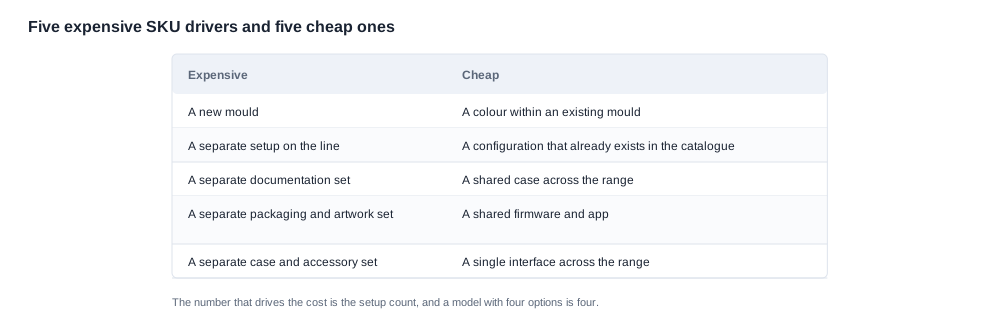
A colour within an existing mould. The published colour options are the model for this. The V03 Pro publishes three colours and the V06 publishes four, and in both cases the tool is shared — the colour is a surface and material variation on a geometry that already exists. That is why a colour variant is cheap: it adds no tool, no line setup and no new document, only a material batch to buy and a packaging artwork variation.
A configuration that already exists in the catalogue. The published option list is long enough that many requirement sets already have a home. An existing configuration needs no new tool, no new setup and no new documentation, because the documentation, the packing list and the build instructions already refer to it. This is the single biggest lever in a range plan: the number of SKUs you can assemble from published options without opening anything new.
A shared case across the range. One case capacity across several models means one accessory SKU and one packaging line instead of several. Our range publishes a case capacity for exactly five models — L1 Pro and CY05, and CY03 — each at 1400 mAh, L2 Utral at 900 or 1400 mAh, and the MT6 as a 1200 mAh foldable — which is a small enough published set that a brand can plan a shared case deliberately rather than hope for one.
A shared firmware and app across the range. One maintenance obligation instead of several. This is worth more than it sounds, because firmware is the thing that keeps costing after the shipment is paid for, and the moment a brand commits to a branded app or a per-market firmware build, that becomes a permanent relationship rather than a deliverable.
A single interface across the range. One charging interface means one cable type in the customer's hand and one in the retailer's stock. Magnetic charging is published on seventeen models and Type-C on seven, so a range built on one interface is possible across most of the published catalogue — but the four camera models with no published charging method are exactly the ones a range plan has to ask about.
The common thread through all five is that they are decisions about production paths rather than about features. A cheap SKU is one that reuses a tool, a setup, a document, an accessory and an interface. That is a different question from the one a product team naturally asks, which is what else could this SKU have.
There is a commercial term worth attaching to this, and it is the reason range plans in this category are usually made by a narrow team rather than a broad one. The cost of a SKU is not paid once; it is paid on every order that includes it, and it is paid whether or not the SKU sells well. A range that opens five production paths has committed the brand to a factory schedule that assumes all five, which is a fixed obligation in a market where the demand for two of them may not exist. The cheap SKU is not merely cheaper; it is cheaper per order and it does not create a standing obligation.
That makes it a negotiation variable rather than a design variable, and the trade-off is worth putting on the table early. A broader range gives the brand more merchandising options in a channel that rewards choice and it spreads the risk of one proposition failing. A narrower range gives a better unit price on the SKUs that do sell, because the setups and the documentation are shared, and it keeps the factory schedule predictable enough to promise a delivery date. Most brands that get this category right run a narrow core range with one or two deliberately separate products beside it, and they negotiate the commercial terms on the core range while treating the outliers as individual decisions.

Smart glasses SKU cost drivers: what opens a new production path
The mirror image is the list of things that turn a variant into a development item, and in this category the list is short enough to memorise.
A new mould. The frame or temple geometry decides whether an existing tool can be used. Our published colour options sit within existing moulds, which is why they are cheap, and temple shape customisation sits at the other end of the scale. A new temple profile is a new tool, a new first article approval and a schedule attached to it, and it should appear in a range plan as a capital decision rather than as a design preference.
A separate setup on the line. Configuration is the unit of setup, not model. A model with a magnetic and a Type-C option is two setups, and a model with two cell options and two case options is four. This is the driver most often under-counted in consumer electronics habits, because in those categories a variant usually shares an assembly with the base product and differs only in a part fitted at the end. In glasses, the temple carries the cell, the protection circuit and the board on the camera tier, so the configuration differences propagate into the assembly itself.
A separate documentation set. The model list on each document has to name the variant. Because our published position is that there is no per-model certification row anywhere in the catalogue, the coverage question is per variant by definition, and a variant that nobody has documented is a variant that cannot ship to a market that requires documents. Plan the documentation set per variant from the start, because the model list is the thing that is usually missed.
A separate packaging and artwork set, with print minimums and per-language artwork recurring per variant. Artwork that repeats per language and per market is a cost that scales with the range rather than with the volume, which is exactly the wrong direction for a brand trying to make a small range deep.
A separate case and accessory set, because the case options in our range are moulded components with their own colours and their own SKUs. Three entries also carry a detachable component — an inner frame on the V06, an inner frame on the S7 and a temple on the G07 — which means a detachable part is its own inventory line with its own replacement demand and its own packaging.
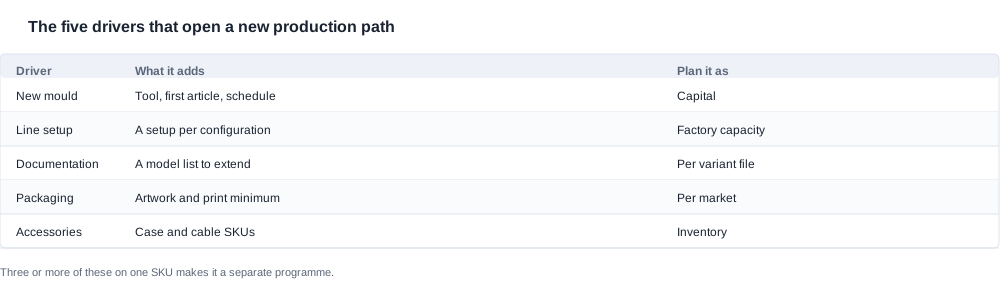
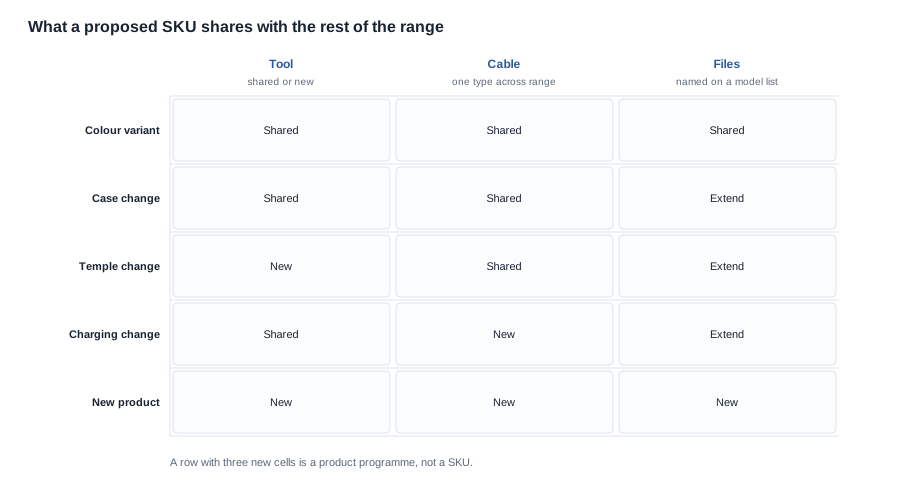
A useful discipline is to classify every proposed SKU against these five drivers before it enters the plan, because the classification determines everything that follows. A SKU that opens none of them is a variant. A SKU that opens one of them is a variant with a cost. A SKU that opens three or more of them is a separate product programme and should be planned, staffed and budgeted as one.
The classification also tells you which SKU to argue about first, because the drivers are not equally painful. A new tool is visible and budgeted, so a brand can decide it deliberately. A documentation extension is invisible until the file is requested, so it is the driver most often discovered late. A separate setup is invisible in a spreadsheet and visible only in a lead time. The accessory set is invisible until the packaging is designed, by which point the case tooling is already committed.
One driver deserves a specific caution. The charging interface looks like a small difference — a different connector in a different place on the temple — and in most consumer electronics it is. Here the interface sits in a temple that also carries the cell, the protection circuit and the electronics, so it is a structural question rather than a plug question. If your range is built on one interface across the models, check the four camera models where no charging method is published — the CY03 and L1 Pro, and CY05 and MT6 — because those are the four where the answer cannot be read.

Smart glasses portfolio decisions: the five questions to run the plan through
- For each SKU, does it need a new tool? If the answer is yes, the SKU is a development item and should be planned as one, with its own approval, its own sample and its own budget line.
- For each SKU, how many production setups does it add? The count, not the unit quantity. This is the number that determines the shape of the order rather than its size.
- For each SKU, is the documentation covered by an existing model list, or does it need extending — and by whom?
- For each SKU, what does it add to the packaging, the case and the accessory inventory?
- For each SKU, is there a customer who would choose it over the others? A SKU chosen by nobody is a setup cost with no revenue attached, and it is the single most expensive item in a range plan, because it costs on every single order.
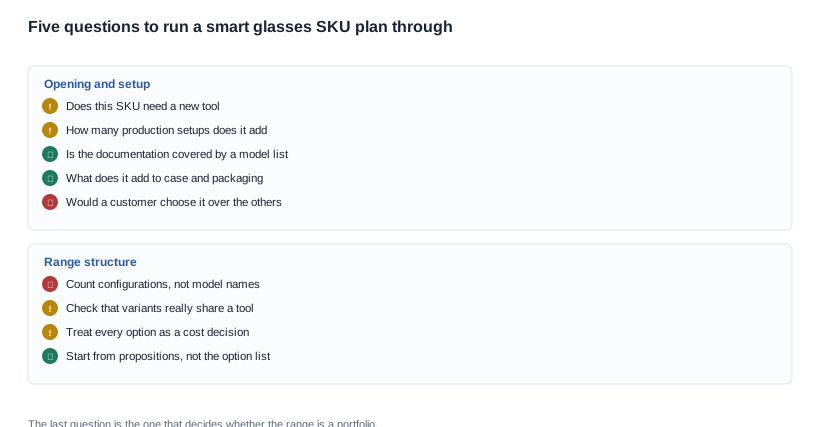
Question five is the one that most brands answer least rigorously, and it is the one that turns a range plan into a portfolio. The deciding variables in this category are narrower than a general consumer electronics range because the product is worn on the face and the fit is not universal. A shopper does not choose between three shades of the same proposition; they choose between a fit that works for them and a proposition they want, at a price they will pay. That produces two or three genuine choices in most cases, and it means a range of eight SKUs is usually four choices with four duplicates.
Question two has a second use that is easy to miss: it is the best available proxy for how a range will behave commercially. A range where each SKU adds one setup is a range that scales. A range where one SKU adds four setups is a range whose commercial performance is dominated by factory scheduling rather than by demand.
There is a third question that a good range plan answers before the list is circulated, and it is not on the list above because it is not about a SKU — it is about the range. Which of these SKUs will still exist in two years? In this category, a SKU that exists to cover a temporary merchandising gap has a short life, and the cost of retiring one is not zero: the documentation has to be withdrawn, the packaging artwork retired, the accessory inventory run down, and the channel told. Ranges built from propositions tend to age better than ranges built from promotions, and they are much easier to plan a second order against.

Smart glasses range planning: the mistakes that multiply SKUs
Counting models instead of configurations. The number that drives cost is the setup count, and a model with four options is four production paths, not one. This is the mistake that transfers most directly from other consumer electronics categories, and it is the one that turns a three-SKU range into a nine-SKU range in the factory without anybody deciding to add a SKU.
Assuming variants share tooling when a variant is a different frame or temple geometry. A range plan drawn on a spreadsheet will show a shared tool because the two SKUs share a product name. The tool is not shared, and the plan has under-counted the capital by an entire line.
Treating the option space as a menu rather than as a cost. Every published option is a cost decision, and most of them are not worth taking. The published option list is a description of what exists, not a recommendation of what to use. A brand that treats it as a menu will end up with a range that offers a choice on every dimension and resolves none of the customer's actual decision.
Under-counting the accessory SKUs. The case, the cable and the packaging are SKUs too, and they multiply faster than the models do, because they are also where the artwork and the print minimums live. A three-model range can easily carry six accessory SKUs.
Planning the range before the proposition. A range built from the option space rather than from customer segments produces a portfolio nobody chose from, and it is the most expensive of the five mistakes because it cannot be fixed by renegotiating; it can only be fixed by re-launching.
There is a sixth habit worth naming because it is specific to brands with genuine consumer electronics capability. Those brands are used to planning a range as a portfolio of good, better and best positions, and they carry that assumption into a category where the customer is not comparing specification sheets but trying on a thing. The ladder works in categories where the comparison is legible from the back of the box. Here it is not, which is why the fit and the proposition decide the range and the specification mostly follows.
The corollary is a rule that is worth stating explicitly, because it is the one most often broken in this category: do not add a SKU to close a competitive gap you have not verified exists. The published configuration space is generous enough that a range can be assembled to look complete against a competitor's line, and it will still be wrong, because the competitor's line may be organised around a proposition this category cannot easily serve. The verification is cheap — the question is what the competitor's SKU is for, not what it has — and the answer usually shows that two of your three SKUs are competing with one of theirs.
Smart glasses range scope: how many SKUs this category can carry
If you take the published configuration space at face value it looks like a range of twenty-eight. It is not, and the reason is that most of the published variation is not customer-facing variation at all. Resolution classes, cell capacities, runtime bands and charging interfaces are the things that make the catalogue usable and the specification legible. They are not the things a customer chooses between on a shelf.
Working from the proposition rather than the option space, most smart glasses ranges in practice carry two or three SKUs, and the pattern of those three is consistent: a hero model that carries the proposition, a variant that differs by fit or by use case rather than by feature, and a lower-cost entry that either drops a feature or accepts a smaller case. The published range supports exactly that shape. The camera tier separates into two resolution classes, with 13 MP on the L2 Utral and the S7, and the L1 Pro and 8 MP on the other eight, which is a hero tier. The sport tier's published charge time of about one hour on the D17 and the ZH12, against a ceiling of two hours or less across the rest of the range, is a use-case differentiator. The five published case capacities are a cost-tier differentiator.
Two consequences follow for a range plan.
The first is that the range should be assembled from published configurations wherever possible. Every SKU taken from the published set arrives with a specification, a documentation position and a build instruction already attached, and the brand's job reduces to proposition, branding and packaging. That is where the cost of a range plan is lowest and where the schedule is shortest.
The second is that the number of tools is the number that matters, and it should be small. A range that opens one new tool and assembles the rest from published configurations behaves like a normal consumer electronics range. A range that opens three new tools is a product programme wearing a range's clothing, with the approval structure, the capital exposure and the schedule risk that implies.
For a brand deciding where to start, the pragmatic shortlist is worth building from the published side rather than the marketing side: start from the models whose published configuration supports a proposition you already want to make, and check what the range costs to open. The models worth looking at first are the ones that publish the most — the camera tier with its resolution classes, case capacities, colour lists and ingress markings, and the audio tier for a shared interface across a broad range. The platform range is summarised on the OEM ready platforms page, and the full option picture is in the customisation options overview.

What we will do with a proposed list is straightforward. We will tell you which SKUs need new tools, which can be assembled from published options, how many production setups the list creates, and which of the five cost drivers each SKU opens. We will also tell you where a SKU looks like it is competing with another one. The list of commercial terms — unit price, production lead time, minimum order quantity — follows the SKU list rather than the model names, because all three are functions of how many tools your range opens and which documentation each proposition needs, and that is why we quote them once we have your list rather than against a model on its own.
There is a procurement view of the same list that is worth having in front of the negotiation, and it is the part that usually gets skipped. A range quotation is not three product prices. It is a forecast against a factory schedule, and the terms that matter are the ones that describe how the schedule behaves when demand is uneven — which is exactly what a new range always is.
Four questions belong in the range quotation for that reason.
- Which SKU carries the minimum? In a range, a floor can be set per model, per configuration or across the range as a whole, and the difference between those three is often the difference between a viable first order and an impossible one. The answer determines which SKU is the anchor, so ask which one the factory would build first if volume arrived unevenly.
- What is the lead time per SKU, and does it run in parallel or in sequence? A range where three SKUs share a tool does not have three lead times; it has one tool lead time and three assembly lead times. A range that needs two tools has two tool lead times and they do not overlap by default. This is the single most useful number in a range quotation and the one least often requested explicitly.
- What are the tolerance and sample conditions per SKU? A golden sample is signed per SKU, not per model, and a brand that has budgeted one golden sample for a three-SKU range will discover the gap at the approval stage, when the schedule is least forgiving. The sample plan and the tolerance on colour, finish and fit should be stated per SKU.
- What does the warranty and the certification scope cover across the range? A warranty period is a commercial term that follows the SKU list, and so does the documentation scope — and because there is no per-model certification row in our catalogue, that scope has to be written down per SKU rather than inferred from a family.
The commercial terms that follow — unit price, minimum order quantity, production lead time, payment structure, warranty, tooling and NRE — are quoted against the whole list, because quoting them per model would tell you nothing about the range. If a supplier quotes a range per model, the sensible follow-up question is which model carries the tool cost and which carry the setup, and that single question usually exposes whether the range has been analysed as a range.
The due diligence on a range is not a factory audit; it is a documentation review. Ask for the model list behind each document the range depends on, check that each SKU on your list appears on the relevant list, and check that the list also covers the markets you intend to ship into. It is unglamorous, it takes an afternoon, and it is the cheapest way to find out that a third of your range was never documented for the market that matters most.
Related reading
- Smart Glasses for consumer electronics brands
- Product portfolio for consumer electronics brands
- Customisation options overview
- OEM ready platforms
Send your proposed SKU list and the propositions behind it, and we will tell you which need new tools.


