

Exporting smart glasses looks like a logistics problem until the first shipment is held, and the reason it is not a logistics problem is that a battery-powered radio product crosses two separate regulatory systems at once — one for the radio and one for the battery — with different documents, checked by different parties, at different moments in the timeline. For a content business the stakes are sharper than for most categories, because the product is bought to be shipped and used, and a detained consignment stops a creator from working. The export of this category is therefore better treated as a compliance sequence with a freight plan attached than as a freight decision with a compliance footnote.
This article walks that sequence in the order it actually has to happen, states what our catalogue does and does not tell you about it, and closes with the rows buyers forget and the way we scope a readiness check.
Smart glasses export: the battery file comes before the booking
Every model in our range contains a lithium cell. The camera models carry cells from 220 mAh to 290 mAh, and the YKC02 carries a published 2 × 70 mAh configuration, which is smaller but is still a lithium cell and travels under the same rules. There is no version of this product that is exempt.
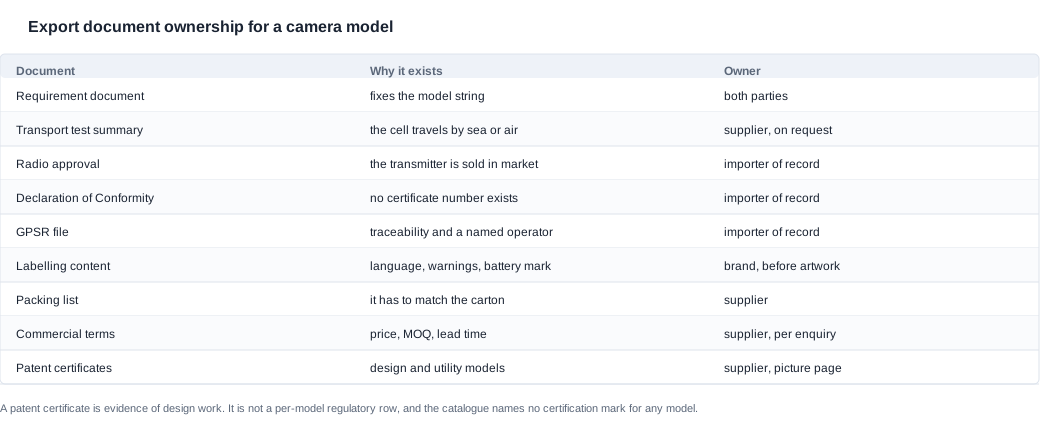
A lithium cell travelling by sea or by air needs a transport document that reports its test results, and carriers check for it as part of booking rather than as part of delivery. The practical consequence is one of sequence rather than of cost: the document has to exist before the booking, and the booking has to happen before the production completes, so the request has to be raised at evaluation stage rather than at shipping stage. A team that treats it as paperwork to be chased later discovers the dependency at the worst possible moment, because the options at that point are to air-freight at a premium or to lose a sailing cycle.
There are two failure modes worth separating. The first is a missing document, which stops the booking outright and is visible immediately. The second is a document that exists but does not match the goods in the carton — a cell capacity that has changed, a model string that differs from the one on the paperwork, a firmware-driven battery configuration that the shipping description does not reflect. The second is much more common and much more expensive, because it is discovered at the border rather than at the counter, and it is exactly the kind of discrepancy that a careful packing list prevents.
On this, our position is deliberately plain: we do not publish our transport documentation status, because it has not been given to us, and we will not imply a capability we cannot evidence. The battery transport documentation page sets out what the requirement involves and where the document sits in the shipment file. What we will do, at quotation stage, is tell you which cell configuration the model string carries, because that is the fact the transport file has to be written against.
The cell configuration is worth dwelling on for a moment, because it is the thing that quietly invalidates a transport file. A cell that is changed, a supplier that is changed, a firmware change that alters the battery's rated behaviour, or a configuration that moves to a different case — each of these can invalidate a test summary that was written against the earlier configuration, and the invalidation is invisible until the carrier or the customs authority checks. The practical control is unglamorous: the model string on the transport file, the model string on the packing list and the model string on the purchase order have to be the same string, and any change to the cell or the case has to trigger a review of the transport file rather than a note in the order history.
A second battery item in the same carton creates a second declaration rather than a second copy of the first. That applies to a configuration with a charging case, to a programme that ships spare cells as a service item, and to a distributor who stocks the case as a separate line. The question of whether the case may travel in the same carton as the device, or has to be declared separately, is one to settle at the configuration stage, because the answer changes the carton count and therefore the freight quote.
Why radio approval for smart glasses follows the destination
A product can need separate radio approvals in each destination it is sold into. The European Union, the United States and the United Kingdom each operate their own regime, and an approval in one does not carry across to another automatically. For a brand planning to list in more than one market, that fact determines how many configurations exist, because each market's requirement attaches to the model string that ships into it.
Two distinctions do a lot of work here, and both are commonly collapsed into the word "certified".
A Bluetooth qualification is not a regulatory approval. Qualification with the Bluetooth implementation body is a statement about the Bluetooth implementation itself. Regulatory approval of the radio is a statement about the transmitter in the jurisdiction where it is sold. A product can hold one and not the other, and a buyer who treats the first as evidence of the second will discover the problem at the point of listing rather than at the point of purchase.
A patent certificate is not a regulatory approval either. Our export-certification page is a picture page. It shows ten patent certificate images, eight design patents and two utility models. That is evidence of design and engineering work, and it is genuinely useful for a brand that cares about the industrial design of a product it is putting its name on. It is not, however, a per-model certification row, and it does not name a regulatory mark for any model.
That last point is worth stating precisely, because our catalogue body names no certification mark for any model at all. There is no per-model certification row in this range. A buyer who needs evidence that a specific model string may be sold in a specific market has to obtain that evidence, because it does not exist as a published row to point at.
There is a related detail that catches people. Our catalogue publishes a Bluetooth version for fourteen of the twenty-eight models it lists, and the eleven camera models are all in the group where it is not published. Radio approvals are written against transmitter parameters, and the parameters that would appear in such a document are therefore not available from the catalogue for the camera tier. That is not an obstacle to the approval; it is an obstacle to planning it from a catalogue page, which is why the radio question belongs in the requirement document rather than in the marketing brief.
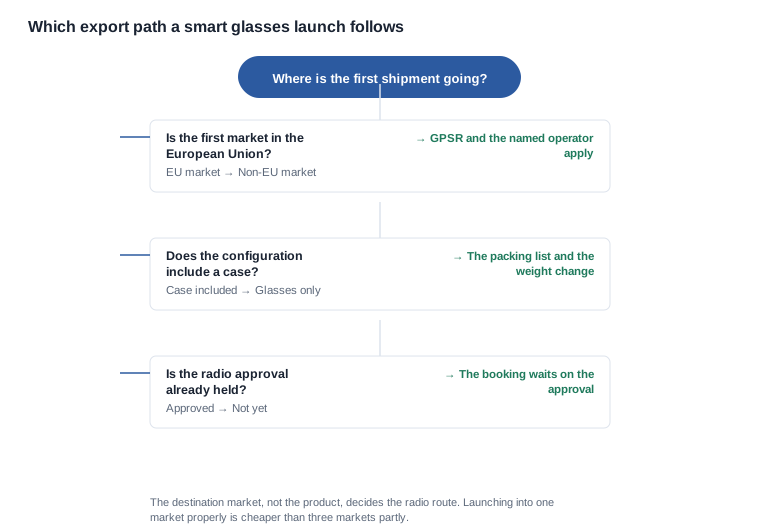
The decision diagram above is the version to take into a planning meeting, because it makes the sequence visible in three questions rather than in a list of documents. The first question fixes the market and therefore the regulatory route. The second fixes the configuration and therefore the packing and the weight. The third tells you whether the booking can proceed or has to wait on an approval that someone else holds.
One consequence deserves emphasis, because it changes how a range is built. If a radio approval attaches to the model string, then a range that looks like one product in three colours is potentially three regulatory files, and a range that looks like three products sharing one approval may be one product with three configurations. The catalogue cannot tell you which of those applies, because it carries no per-model certification row. What it can tell you is that the V03 Pro is the only camera model with a photochromic lens and three published colour options, that the V06 publishes four colours, and that every other model in the range publishes nothing about colour at all — which means the number of distinct configurations a buyer is really buying is a question to put in writing before the first purchase order, not after the first listing goes live.

What smart glasses labelling settles before the artwork freeze
For consumer products sold into the European Union, the general product safety regulation adds a set of obligations that sit alongside the radio approval: traceability of the product and of its economic operator, a named responsible party, safety information in the language of the destination market, and obligations that apply whether you sell through your own storefront or through a marketplace. The GPSR obligations page sets out the requirements in more detail.
Two points inside that set regularly surprise buyers.
The Declaration of Conformity is a separate document, and there is no certificate number to quote. No authority issues a CE certificate number for this product category, because the document that matters is the manufacturer's own declaration naming the model. A buyer asking a supplier for a "certificate number" is asking for something that does not exist in this form, which is a conversation that can be resolved quickly once both sides know it.
Labelling content is an artwork-freeze decision, not a finishing decision. Language, the identity of the manufacturer or the responsible economic operator, the warnings, the battery marking and the importer's details all have to be settled before the packaging artwork is frozen, because changing any of them afterwards means a reprint. Reprints of packaging artwork are one of the few genuinely expensive late changes in a consumer electronics programme, and they are entirely avoidable by deciding early.
The practical method is unglamorous and it works. Put the labelling content in the specification as a list, freeze it with the artwork, date both, and keep a copy of the approved artwork in the compliance file. When the first shipment arrives, the person on the receiving end compares the carton against the specification rather than against their memory.
Two further labelling rows come from the product rather than the regulation. The battery marking that identifies the cell, and the model designation on the carton, both have to match the goods and the paperwork inside. Our catalogue contains a naming item that is worth settling in writing before any artwork goes to a printer: the L2 Utral is listed under a name that reads as a typographical rendering of "Ultra", and the entry also carries an "Utral Pro Max" marking. A model designation that changes between the supplier's document and the buyer's carton creates real problems at customs, in a warranty claim, and in a marketplace listing.

The smart glasses shipping rows buyers forget at the border
The importer of record. Who is liable in the destination country is a decision, not a formality. It affects tax treatment, customs declarations, the response to a regulator's question, and the handling of a product that has to be recalled. Decide it before the first shipment, and write it into the purchase order and the packaging artwork at the same time.
Solid wood packaging. The treatment of wood packaging materials is checked by carriers and by customs, and it is a routine requirement that gets caught at the worst moment because nobody expected it. It is cheaper to confirm the packaging specification with the supplier than to discover it at a container terminal.
A customs description that matches the carton. The description on the declaration has to describe what is actually in the box, at a level of detail that a customs officer can act on. A model designation that differs between the listing and the goods creates a conversation at the border, and that conversation costs more than an accurate description would have.
Gross weight and the case. Only the MT6 publishes a weight, at 158 g for the glasses alone, explicitly excluding its 1200 mAh foldable case. Every other model in the range publishes no weight at all, and a configuration that includes a case changes the gross weight by an amount nobody has published. Freight is quoted on gross weight, and an estimate that is out by a margin turns a small programme into an expensive one.
Spare cells and the dangerous-goods question. A programme that ships spare cells, or a case that is sold as a separate line, is making a second transport declaration rather than the same one. Whether a case may travel with the device in the same carton, or has to travel separately, is a question to settle at the configuration stage rather than at packing.
The electronic record. Which system holds the declaration of conformity, the test reports and the model list, and who can produce them for a batch that shipped last year. This is the row that decides whether a recall is manageable or catastrophic, and it is the cheapest one to get right.
The packing list, line by line. A packing list is not a formality, it is the document that reconciles the carton, the purchase order and the customs declaration. It should carry the model string as it appears on the carton, the quantity, the accessories actually in the box rather than the accessories the product page describes, and the carton count and net and gross weight. The line most often wrong is the accessory line, because the cable set in the shipped carton and the cable set in the product photograph drift apart as the configuration changes, and the gap becomes a discrepancy at the border.
Which party carries which obligation under the delivery term. A DDP arrangement places more of the destination-country obligation with the seller; an FOB arrangement leaves more of it with the buyer. Either can work, and the choice is a commercial one rather than a legal one, but it has to be consistent with the way the importer of record, the tax registration and the market paperwork have actually been set up. Mixing the two is what produces a shipment that clears the port and then fails to clear the customs system a week later.
How we scope smart glasses export readiness for a buyer
Readiness is a document list, and the useful thing we can do is to tell you which parts of it we hold, which parts we produce on request, and which parts sit with you.

What the catalogue tells us. The model string, the cell configuration and capacity, the charging interface, the case configuration, the ingress marking where one is published, the colour and lens options, and the Bluetooth version where it is published. That is enough to write a requirement document and to start the conversations that have to start early.
What we produce on request. A written confirmation of the cell configuration for the exact model string, a technical data sheet for the shipped configuration, a packing list, a declaration that the goods match the sample that was approved, and the commercial terms — unit price, minimum order quantity, lead time, sample cost, warranty scope, tooling where the configuration needs it. All of the commercial terms are confirmed per enquiry, because each of them depends on quantity, configuration, documentation and the current schedule.
What sits with the importer of record. The radio approval for each destination, the Declaration of Conformity, the GPSR file, the local language labelling, and the registration of the responsible economic operator. We can supply the information that these documents need; the obligation itself is the party placing the goods on the market.
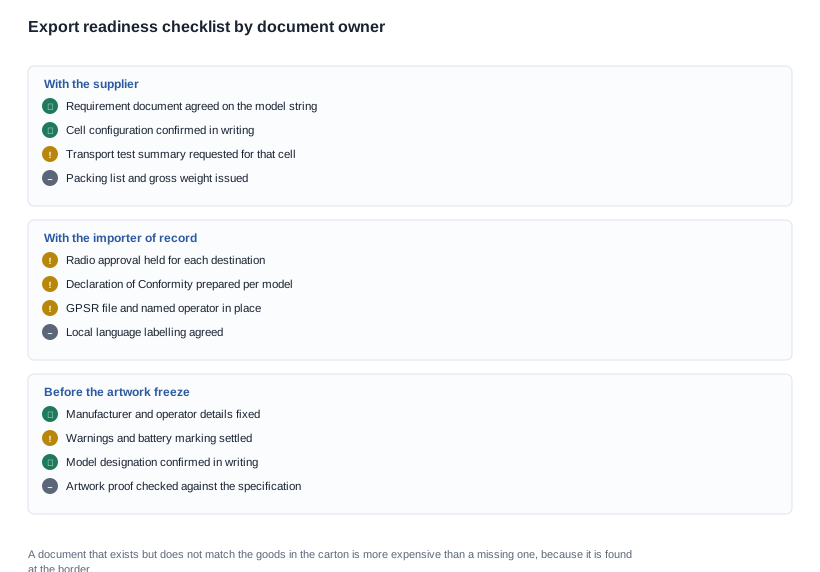
How we recommend sequencing it. The requirement document first, because everything downstream depends on the model string and the configuration being fixed. The transport document request second, because the booking depends on it. The radio and market paperwork third, because the market approval depends on the radio position and the labelling depends on the artwork. The purchase order last, once the acceptance criteria for the goods and the documents are written down and signed off.
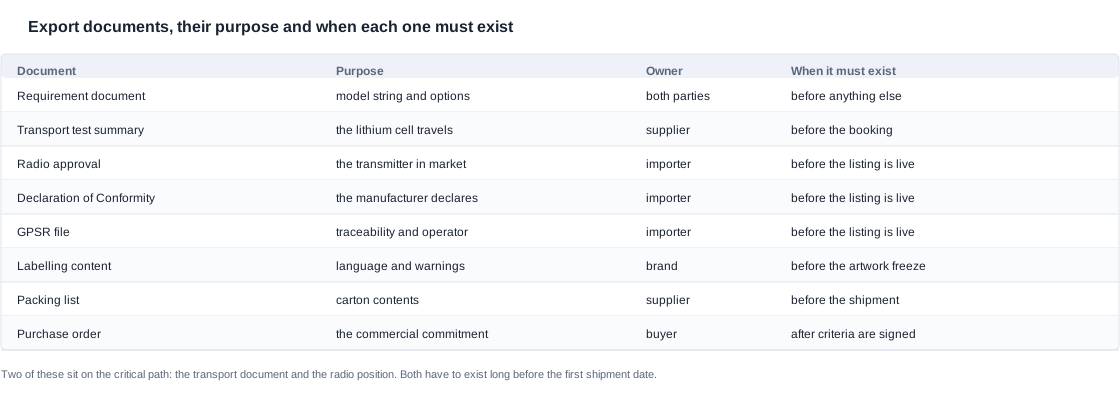
How a readiness check is assessed. Give the buyer a written list with four acceptance criteria: the document exists for the exact model string, it covers the exact destination markets, it matches the configuration on the packing list, and it is held in a place that will still exist when a batch from three years ago is recalled. Each of those is checkable, and each of them is the difference between an export programme that is a sequence and one that is a series of surprises.
There is a commercial point hiding inside the compliance sequence. Before you order, decide which markets you are actually launching into first, because the regulatory work follows the market and the market follows the decision. Launching into one market properly is nearly always cheaper than launching into three markets partially, and the first shipment is the one that sets the pattern for everything after it.
There is a cheaper way to find out whether the documentation is right than a production order. A sample shipment, or a small pilot consignment, exercises the same documentary path: the same transport document, the same packing list, the same declaration and the same customs description, without the volume behind it. We can arrange that as part of the sample request, and the sample cost, the sample lead time and the freight arrangement for it are confirmed per enquiry in the same way as any other commercial term. A pilot that fails on paperwork is a cheap lesson; the same failure on a production order is a delayed launch and a channel conversation you did not plan for.
One last row belongs in this section because it is often left to the last minute. A warranty claim on an exported product travels back through the same customs route as the original shipment, and a return of a lithium device is a regulated movement rather than an ordinary parcel. Whatever warranty period is agreed, the return route and the documentation that travels with it have to be workable, and that is a question to settle while the terms are being written rather than while a customer is waiting for a replacement.
The content creation solution page covers how a camera model sits inside a creator programme, and the two compliance pages above cover the battery and the market obligations in detail. Tell us your destination markets, your target launch window and whether the configuration includes a charging case, and we will map the sequence, name the documents, and mark the lines that belong to your importer of record.
Related reading
Tell us the destination markets and the launch window, and we will map the sequence and the document list.


